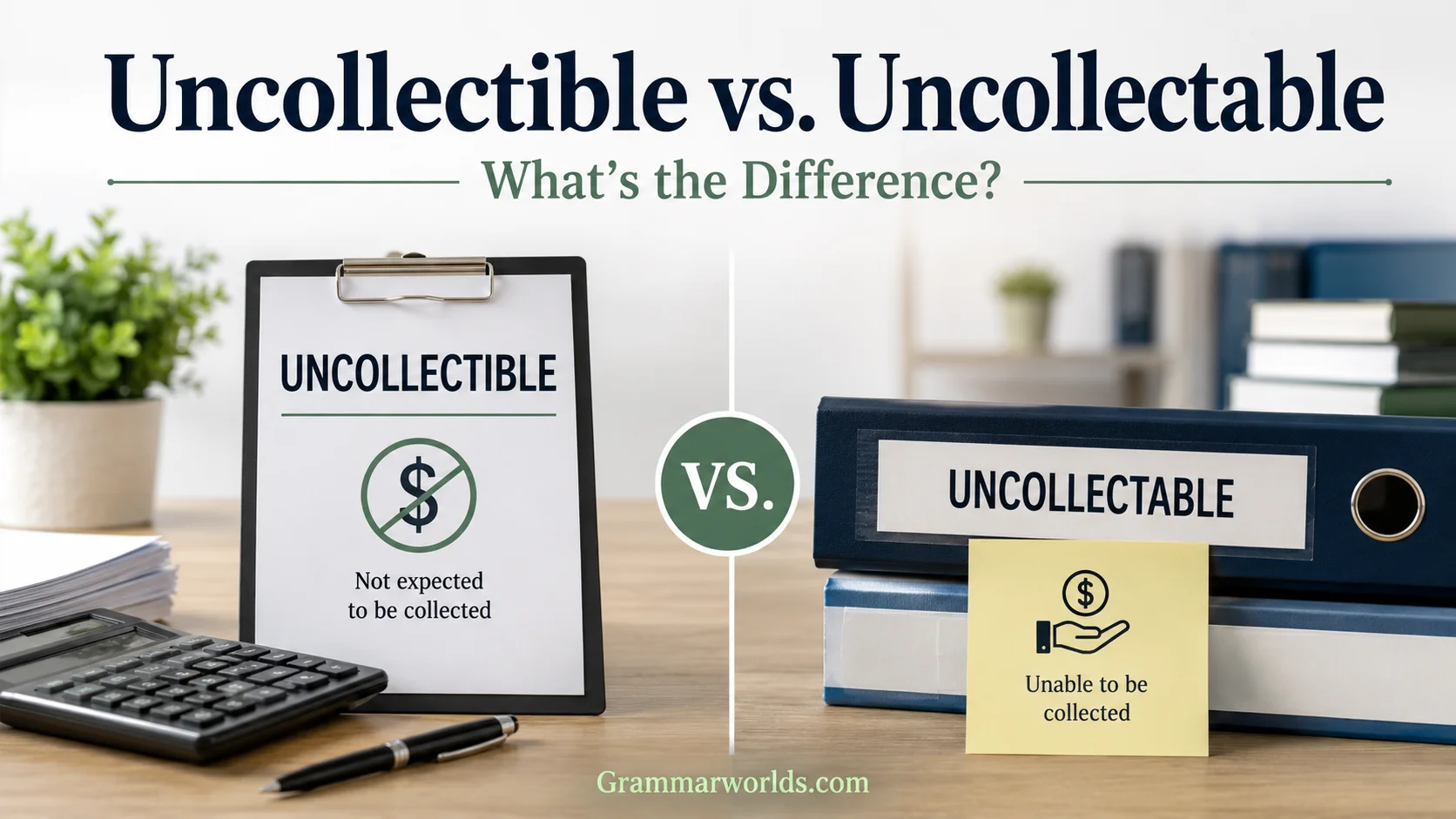
If you’ve ever written about unpaid debts, overdue invoices, or money that can’t be recovered, you’ve probably come across two very similar words: uncollectible and uncollectable.
At first glance, they appear identical except for their endings. That raises an obvious question: Is there actually a difference between uncollectible and uncollectable, or are they simply alternative spellings of the same word?
The short answer is that both words are correct. However, they are not used equally. One form dominates business writing, accounting, finance, and professional communication, while the other appears less frequently in modern English.
Understanding when and how to use these terms can help you write more clearly, especially in formal documents, financial reports, academic papers, and business communications.
This guide explains the meaning of both words, their usage differences, industry preferences, dictionary definitions, and practical examples so you can choose the right word with confidence.
Uncollectible vs. Uncollectable: The Short Answer
Both uncollectible and uncollectable mean:
Something that cannot be collected, recovered, obtained, or received.
In most situations, the words are interchangeable.
However, uncollectible is far more common in modern English, particularly in professional and financial contexts.
Quick Comparison Table
| Feature | Uncollectible | Uncollectable |
| Meaning | Cannot be collected | Cannot be collected |
| Correct spelling | Yes | Yes |
| Dictionary recognized | Yes | Yes |
| Common in accounting | Very common | Rare |
| Common in finance | Very common | Rare |
| Modern usage frequency | Higher | Lower |
| Preferred in business writing | Yes | Usually not |
| Interchangeable with the other word | Yes | Yes |
Key Takeaway
If you’re unsure which spelling to choose, uncollectible is usually the safest option because it is the dominant form in business, accounting, legal, and professional writing.
What Does “Uncollectible” Mean?
The adjective uncollectible describes something that cannot reasonably be collected, recovered, or obtained.
Most often, the word appears in financial settings where a business determines that money owed by a customer will likely never be paid.
Dictionary Meaning
The word combines:
- Un- (not)
- Collect
- -ible (capable of)
Together, the word literally means:
“Not capable of being collected.”
Common Uses of Uncollectible
The term appears frequently in:
- Accounting
- Banking
- Finance
- Credit management
- Legal collections
- Tax administration
Examples
- The company wrote off several uncollectible accounts.
- Management identified the debt as uncollectible.
- The court judgment became uncollectible after the debtor declared bankruptcy.
- The agency classified the unpaid balance as uncollectible.
In nearly every case, the word refers to money, assets, fees, taxes, or obligations that are unlikely to be recovered.
Real-World Business Example
Imagine a company sells products worth $50,000 to a customer.
After several months:
- The customer stops responding.
- Collection efforts fail.
- The customer files for bankruptcy.
At that point, the company may classify the amount owed as an uncollectible debt.
The debt still exists legally, but the likelihood of receiving payment becomes extremely low.
What Does “Uncollectable” Mean?
Uncollectable carries the same core meaning as uncollectible.
It describes something that cannot be collected or recovered.
Definition
The word uses the suffix -able instead of -ible.
As a result, it literally means:
“Not able to be collected.”
The meaning remains essentially identical.
Common Examples
- The taxes became uncollectable.
- The debt was deemed uncollectable.
- Several invoices proved uncollectable.
Most readers would understand these sentences exactly as they would if the word uncollectible were used instead.
Why Some Writers Use It
Some writers prefer uncollectable because it appears more logically connected to the base verb “collect.”
Consider similar constructions:
- Accept → Acceptable
- Predict → Predictable
- Adapt → Adaptable
Following that pattern, some people naturally choose uncollectable.
However, language doesn’t always follow strict logic. Actual usage matters more than theoretical consistency.
Is There Actually a Difference Between Uncollectible and Uncollectable?
This is where many articles create confusion.
The truth is surprisingly simple.
The Meanings Are Essentially Identical
Modern dictionaries generally define both words in nearly identical ways.
There is no universally recognized distinction in meaning.
Both words describe something that cannot be collected.
The Real Difference Is Usage Frequency
The biggest difference involves how often each word appears.
Uncollectible dominates:
- Financial reports
- Accounting standards
- Business publications
- Corporate documents
- Legal writing
Uncollectable appears less often and is generally viewed as a secondary spelling variant.
Think of It Like Other Word Pairs
English contains many pairs where one version becomes more common over time.
Examples include:
| Preferred Form | Less Common Variant |
| Irreplaceable | Irreplaceible |
| Dependable | Dependible |
| Collectible | Collectable |
| Uncollectible | Uncollectable |
The less common form may still be correct, but professional writers tend to favor the dominant version.
Why Businesses Usually Choose “Uncollectible”
Business writing values consistency and established terminology.
That explains why uncollectible became the preferred form across multiple industries.
Accounting Terminology
Accounting professionals routinely use phrases such as:
- Uncollectible accounts
- Uncollectible receivables
- Uncollectible debt
- Uncollectible balances
These terms appear in textbooks, financial statements, and accounting standards worldwide.
Allowance for Uncollectible Accounts
One of the most common accounting concepts is the allowance for uncollectible accounts.
This refers to an estimate of customer debts that a company expects will never be collected.
Example
Suppose a business has:
| Item | Amount |
| Total Accounts Receivable | $500,000 |
| Estimated Uncollectible Accounts | $25,000 |
The company records an allowance of $25,000 to reflect expected losses.
This process improves financial reporting accuracy because it acknowledges potential bad debts before they occur.
Why the Industry Standard Matters
When professionals repeatedly use the same terminology, it becomes standard practice.
As a result:
- Auditors expect it.
- Accountants recognize it.
- Investors understand it.
- Regulators encounter it regularly.
That widespread adoption reinforces the dominance of uncollectible.
Uncollectible vs. Uncollectable in Major Dictionaries
Most major dictionaries recognize both words.
However, they often identify one spelling as the primary entry.
Dictionary Comparison
| Dictionary | Uncollectible | Uncollectable |
| Merriam-Webster | Listed | Listed |
| Cambridge | Listed | Listed |
| Collins | Listed | Listed |
| Oxford | Listed | Listed |
What Dictionary Evidence Shows
Several patterns emerge:
- Both words are valid.
- Definitions are nearly identical.
- Uncollectible receives broader usage.
- Professional writing favors uncollectible.
This evidence supports what we see in real-world publications.
The distinction involves preference rather than correctness.
Also Read This :Emersion vs. Immersion: Differences, Meanings, and Correct Usage
Usage Examples in Different Contexts
Understanding the words becomes easier when you see them in context.
Business Examples
Uncollectible
- The company wrote off $100,000 in uncollectible receivables.
- Management reviewed all uncollectible customer accounts.
- Several invoices became uncollectible after the client closed operations.
Uncollectable
- The debt eventually became uncollectable.
- Auditors classified the balance as uncollectable.
- Collection efforts failed, making the amount uncollectable.
Both versions work grammatically.
However, business professionals would usually choose the first set.
Legal Examples
- The judgment became uncollectible due to bankruptcy proceedings.
- The fine was considered uncollectable after the statute expired.
- Lawyers determined that recovery was unlikely because the assets were uncollectible.
Tax Examples
Government agencies frequently encounter:
- Uncollectible taxes
- Uncollectible penalties
- Uncollectible assessments
These situations occur when taxpayers lack sufficient assets or income to satisfy obligations.
Everyday Examples
Although less common, both words can appear outside finance.
Examples include:
- The membership fee became uncollectible.
- The promised payment proved uncollectable.
- The organization treated the pledge as uncollectible.
Which Word Is More Common?
Frequency matters because it affects how natural your writing sounds.
When readers repeatedly encounter one form, it becomes their default expectation.
Modern Usage Trends
Across books, journals, business reports, and online publications:
Uncollectible appears significantly more often than uncollectable.
This trend has remained consistent for decades.
Why Uncollectible Became Dominant
Several factors contributed to its rise.
Professional Adoption
Accounting textbooks standardized the term.
Financial Reporting
Corporate reports repeatedly used uncollectible debt terminology.
Educational Influence
Business schools taught the term to generations of students.
Regulatory Documentation
Government agencies incorporated the wording into policies and publications.
Together, these influences reinforced one spelling over the other.
Practical Impact
Using the more common version offers several benefits:
- Greater reader familiarity
- Stronger professional credibility
- Better alignment with industry standards
- Improved consistency across documents
Uncollectible vs. Uncollectable in American and British English
Some spelling differences exist between American and British English.
Examples include:
| American English | British English |
| Color | Colour |
| Analyze | Analyse |
| Center | Centre |
However, the situation with uncollectible and uncollectable is different.
American English
American business writing overwhelmingly favors:
Uncollectible
The word appears extensively in:
- Accounting standards
- Corporate reports
- Banking documents
- Tax guidance
British English
British English recognizes both forms as well.
However, modern professional usage still leans toward uncollectible, especially in financial contexts.
Regional Differences Are Minimal
Unlike many spelling disputes, there is no strong geographic divide.
The preference for uncollectible appears in both American and British professional writing.
Common Mistakes Writers Make
Even experienced writers occasionally misuse these terms.
Assuming One Word Is Wrong
Many people believe uncollectable is incorrect.
That isn’t true.
Both words are legitimate.
Switching Spellings Mid-Article
Consistency matters.
Choose one spelling and use it throughout the document.
Ignoring Industry Standards
A business report filled with “uncollectable” may look unusual because readers expect “uncollectible.”
Confusing Uncollectible With Bad Debt
These concepts overlap but are not identical.
Important Distinction
| Term | Meaning |
| Uncollectible | Cannot realistically be collected |
| Bad Debt | Debt recognized as a financial loss |
A debt may become uncollectible before it is officially recorded as bad debt.
That distinction matters in accounting.
How to Choose the Right Word
Most writers don’t need a complicated decision process.
Use “Uncollectible” When
You are writing:
- Business articles
- Financial reports
- Accounting documents
- Corporate communications
- Legal analyses
- Academic papers
Use “Uncollectable” When
You are:
- Following a house style guide
- Matching existing text
- Maintaining consistency with previous documents
A Simple Rule to Remember
If your audience includes:
- Accountants
- Financial professionals
- Investors
- Lawyers
- Business executives
Choose uncollectible.
It aligns with modern expectations and industry conventions.
Case Study: How a Company Handles Uncollectible Accounts
Consider a wholesale distributor that sells goods on credit.
Initial Sale
The company ships:
- Products worth $20,000
- Payment due in 60 days
Collection Attempts
After several months:
- Reminder notices are sent.
- Collection calls are made.
- Payment plans are offered.
No payment arrives.
Financial Review
Management evaluates:
- Customer history
- Financial condition
- Collection probability
The company concludes the debt is uncollectible.
Accounting Treatment
The balance is:
- Removed from active receivables.
- Recorded as a loss.
- Included in bad debt expense calculations.
This example demonstrates why the term appears so frequently in accounting literature.
Quick Reference Guide
Use This Table When You’re Unsure
| Situation | Recommended Word |
| Accounting textbook | Uncollectible |
| Financial statement | Uncollectible |
| Corporate report | Uncollectible |
| Business blog | Uncollectible |
| Legal document | Uncollectible |
| General writing | Either |
| Informal communication | Either |
Best Choice for Most Writers
Uncollectible
It is the form readers encounter most often and the one professionals generally expect.
FAQs
Is uncollectable a real word?
Yes. Uncollectable is a legitimate English word recognized by major dictionaries. It means something that cannot be collected or recovered.
Is uncollectible more correct than uncollectable?
No. Both words are correct. However, uncollectible is much more common in modern professional writing.
Which spelling do accountants use?
Accountants overwhelmingly use uncollectible, particularly in phrases such as “uncollectible accounts” and “allowance for uncollectible accounts.”
Do dictionaries recognize both spellings?
Yes. Major dictionaries generally include both uncollectible and uncollectable.
Can I use uncollectible and uncollectable interchangeably?
In most contexts, yes. Their meanings are essentially identical.
Conclusion
The debate between uncollectible vs. uncollectable is much simpler than many writers assume.Both words are correct. Both carry essentially the same meaning. Both describe something that cannot be collected, recovered, or obtained.The real distinction lies in usage rather than definition.Uncollectible dominates modern English, especially in accounting, finance, banking, business communication, and legal writing. It appears more frequently in professional publications, educational materials, and financial reports.Uncollectable remains an accepted alternative spelling. You can use it without being grammatically incorrect. However, readers may encounter it less often.