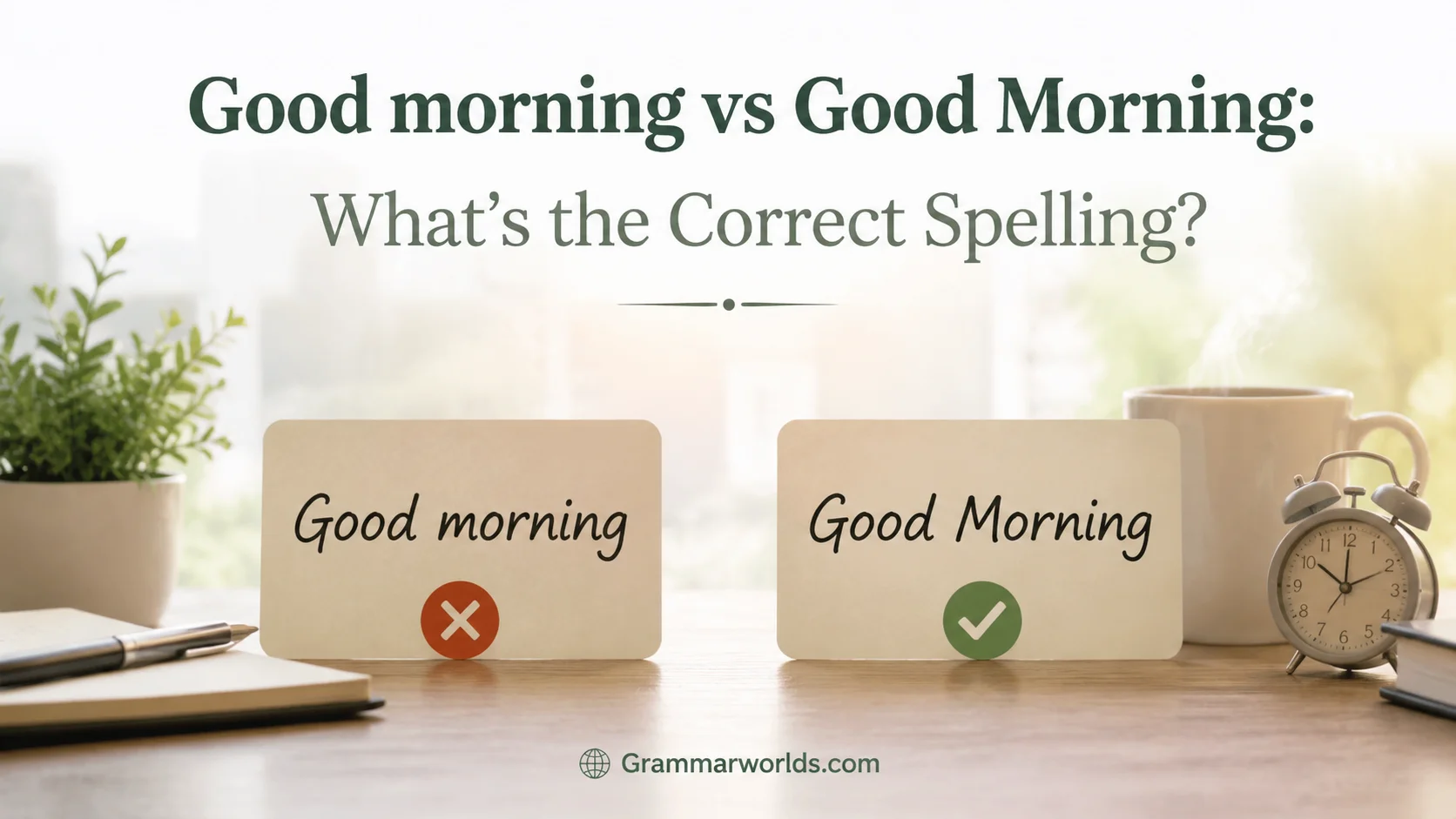
Many English learners are unsure whether Goodmorning, goodmorning, or Good Morning is right.
In my editing experience, this is one of the most common mistakes because the phrase appears frequently in conversations, emails, messages, and everyday greetings. The correct form is Good morning, written as two words, not one word.
This greeting follows standard grammar rules in the English language, making it the correct option for formal writing and informal writing. When you compare both forms, the difference becomes clear, improving understanding, proper usage, and clear communication.
The context and time often decide how morning is determined in a situation. For example, coworkers on an early shift may greet each other with Good morning even at 2 a.m., while others may still consider it nighttime. If you still have a question, it is answered below in this guide.
Goodmorning vs Good Morning: Quick Comparison Table
Before exploring the details, let’s look at the main difference between these two forms.
| Word/Phrase | Correct or Incorrect? | Meaning | Common Usage |
| Good morning | ✅ Correct | A greeting used during the morning hours | Conversations, emails, messages, professional communication |
| Goodmorning | ❌ Incorrect in standard English | Not recognized as a standard English word | Usernames, hashtags, branding, informal online writing |
The key difference is simple: “Good morning” is a phrase, while “Goodmorning” is a misspelling when used as a greeting.
For example:
✅ Correct:
Good morning, everyone! I hope you’re having a great day.
❌ Incorrect:
Goodmorning, everyone! I hope you’re having a great day.
The meaning is easy to understand in both examples, but only the first one follows standard English rules.
Is Goodmorning One Word or Two Words?
The most common question people ask is: Is goodmorning one word or two?
The answer is clear: Good morning is two words.
The phrase contains two separate parts:
- Good → an adjective that describes something positive.
- Morning → a noun that refers to the early part of the day.
Together, these words create a greeting that means you are wishing someone a pleasant morning.
Examples:
- Good morning, Sarah.
- Good morning, everyone at the office.
- I hope you have a good morning.
In each example, “good” describes the quality of the morning. The two words work together but remain separate.
English does have many combined words, such as:
- breakfast
- classroom
- notebook
- sunflower
However, not every combination becomes one word. Good morning has remained a two-word phrase because it functions as a greeting rather than a single concept.
Why Is Good Morning Written as Two Words?
The reason Good morning stays separated comes down to English grammar.
When one word describes another word, English usually keeps them separate.
Examples:
| Adjective | Noun | Correct Phrase |
| Good | morning | Good morning |
| Beautiful | day | Beautiful day |
| Happy | birthday | Happy birthday |
| Bright | future | Bright future |
The word “good” tells us what kind of morning someone is having or wishing for. Since “good” modifies the noun “morning,” they remain two separate words.
Think about it like this:
A morning is a part of the day. You are wishing someone a good morning, just like you wish someone a happy birthday or a beautiful day.
You would not normally write:
- Happybirthday ❌
- Beautifulday ❌
The same rule applies to:
- Goodmorning ❌
- Good morning ✅
Meaning of Good Morning
The phrase “Good morning” has a few different uses depending on the situation.
As a Friendly Greeting
The most common use is simply saying hello in the morning.
Examples:
- “Good morning, Mike! How are you today?”
- “Good morning! Did you sleep well?”
- “Good morning, everyone. Welcome to the meeting.”
This type of greeting creates a friendly and positive atmosphere.
As a Polite Opening
People often use Good morning at the beginning of professional conversations.
Examples:
- “Good morning, I’m calling about my appointment.”
- “Good morning, thank you for joining today’s meeting.”
- “Good morning, I wanted to discuss the project update.”
In workplaces, this greeting sounds respectful without being overly formal.
As a Morning Wish
Sometimes people use the phrase to wish someone a pleasant start to their day.
Examples:
- “Have a good morning at work.”
- “I hope you have a good morning.”
- “Wishing you a good morning and a productive day.”
Here, “good morning” works as a positive wish rather than only a greeting.
Meaning of Goodmorning
Unlike Good morning, the word Goodmorning does not have an accepted meaning in standard English.
Most dictionaries do not recognize “goodmorning” as a proper word.
However, you may still see it in places like:
- Social media usernames
- Website names
- Business names
- Hashtags
- Creative designs
For example:
- @goodmorningdaily
- #goodmorningquotes
- A company named “GoodMorning Media”
These examples are branding choices, not grammar rules.
A business may remove spaces from a name because usernames and website addresses often cannot contain spaces. That does not mean the spelling has become correct in everyday writing.
Good Morning vs Goodmorning in Professional Writing
Professional communication requires clear and accurate language. A greeting may seem small, but it often appears as the first line someone reads.
Using Good morning correctly can make your writing appear more professional.
Email Example
Correct:
Good morning, Mr. Johnson,
I hope you’re doing well. I’m writing to follow up on our discussion.
Incorrect:
Goodmorning Mr. Johnson,
I hope you’re doing well.
The second example communicates the message, but the spelling mistake creates an unnecessary distraction.
Workplace Messages
Correct:
Good morning team, the updated schedule is available now.
Incorrect:
Goodmorning team, the updated schedule is available now.
Small grammar details matter because workplace communication represents your professionalism.
Academic and Formal Writing
Students, researchers, and professionals often write emails to:
- Teachers
- Employers
- Clients
- Organizations
Starting with Good morning creates a respectful tone.
Examples of Good Morning Used Correctly
The phrase works in many situations.
Casual Conversations
- Good morning! How was your weekend?
- Good morning, are you ready for today?
- Good morning! Hope you have an amazing day.
Workplace Communication
- Good morning, everyone. Let’s begin the meeting.
- Good morning, I have completed the report.
- Good morning team, here are today’s updates.
Formal Communication
- Good morning, Dr. Williams. Thank you for your response.
- Good morning, I appreciate your time and assistance.
Social Media Posts
- Good morning! Start today with a positive mindset.
- Good morning everyone, wishing you success today.
The phrase works because it is simple, polite, and universally understood.
Also Read This : In Line vs Inline: What’s the Difference?
Common Mistakes People Make With Good Morning
Even though Good morning seems simple, people often make small mistakes.
Writing Goodmorning as One Word
This is the biggest mistake.
Incorrect:
Goodmorning everyone.
Correct:
Good morning everyone.
The fix is easy: remember the space.
Forgetting Capital Letters
At the beginning of a sentence, capitalize “Good.”
Correct:
Good morning, everyone.
Incorrect:
good morning, everyone.
However, if the phrase appears in the middle of a sentence, capitalization depends on the sentence structure.
Example:
She wished everyone a good morning before leaving.
Missing the Comma in Direct Greetings
When directly addressing someone, a comma improves clarity.
Correct:
Good morning, Emma.
Incorrect:
Good morning Emma.
The comma shows that you are speaking directly to Emma.
Using Good Morning at the Wrong Time
“Good morning” usually applies from early morning until around noon.
A general guide:
| Time | Common Greeting |
| 12:00 AM–11:59 AM | Good morning |
| 12:00 PM–5:00 PM | Good afternoon |
| 5:00 PM onward | Good evening |
The exact timing may vary by culture and personal preference.
Is Good Morning Capitalized?
Capitalization depends on where the phrase appears.
At the Beginning of a Sentence
Correct:
Good morning! Welcome to our event.
“Good” receives a capital letter because it starts the sentence.
In an Email Greeting
Correct:
Good morning, Jennifer,
This is the standard style for professional emails.
In the Middle of a Sentence
Correct:
I hope you had a good morning.
Here, “good” is lowercase because it is not starting a sentence.
Good Morning vs Good Night: Why People Get Confused
Many people confuse good morning with goodnight because both are common greetings.
Here is the difference:
| Phrase | Meaning | Usage |
| Good morning | Greeting someone at the start of the day | Hello |
| Good night | Saying goodbye or wishing someone rest | Farewell |
Examples:
Morning:
Good morning, everyone. Let’s start the meeting.
Night:
Good night, see you tomorrow.
Although “goodnight” sometimes appears as one word in informal writing, “good night” is the traditional and widely accepted form when used as a phrase.
Good Morning in Different Languages and Cultures
Morning greetings exist in almost every culture. They help people start conversations with kindness and respect.
| Language | Translation of Good Morning |
| Spanish | Buenos días |
| French | Bonjour |
| German | Guten Morgen |
| Italian | Buongiorno |
| Japanese | Ohayō gozaimasu |
These greetings show that starting the day with a positive message is a universal human habit.
Good Morning in Digital Communication
Modern communication has changed how people write greetings.
You may see:
- Good morning 😊
- Good morning everyone!
- GM (short form)
- #GoodMorning
In casual online spaces, people often shorten words or remove spaces. For example, usernames usually cannot contain spaces.
However, when writing:
- Emails
- School assignments
- Business messages
- Formal documents
you should use the correct spelling:
✅ Good morning
not:
❌ Goodmorning
Digital shortcuts are useful, but they should not replace proper grammar in important communication.
How to Remember the Correct Spelling of Good Morning
A simple trick can help you remember.
Think of the phrase as:
A good morning
The word “good” describes the “morning,” just like:
- a beautiful flower
- a happy child
- a bright future
Because they describe each other, they stay separate.
Another easy reminder:
If you can place “a” between the words, they are usually separate.
Example:
- A good morning ✅
- A beautiful day ✅
- A happy birthday ✅
You cannot say:
- A goodmorning ❌
FAQs
Is goodmorning a correct word?
No. Goodmorning is not considered a standard English word. The correct spelling is Good morning with two separate words.
Should I write good morning in an email?
Yes. Good morning is a polite and professional greeting for emails, especially when contacting coworkers, clients, teachers, or employers.
Why do some people write goodmorning?
People may write good morning because of typing habits, social media trends, usernames, or simple spelling mistakes. Online usage does not always follow grammar rules.
Is Good Morning capitalized?
Capitalize Good when it starts a sentence or greeting. The word “morning” usually stays lowercase unless it appears in a title.
Can good morning be written as one word?
No. In standard English writing, the correct form is good morning as two words.
Conclusion
The difference between Goodmorning vs Good Morning is simple but important. The correct English greeting is “Good morning” with a space between the words.
Although you may see “Goodmorning” online, it usually appears as a username, brand style, or informal mistake. It does not follow standard English grammar.
Using the correct spelling helps your messages look clearer and more professional. Whether you are greeting a friend, writing an email, or starting a business conversation, “Good morning” is always the right choice.