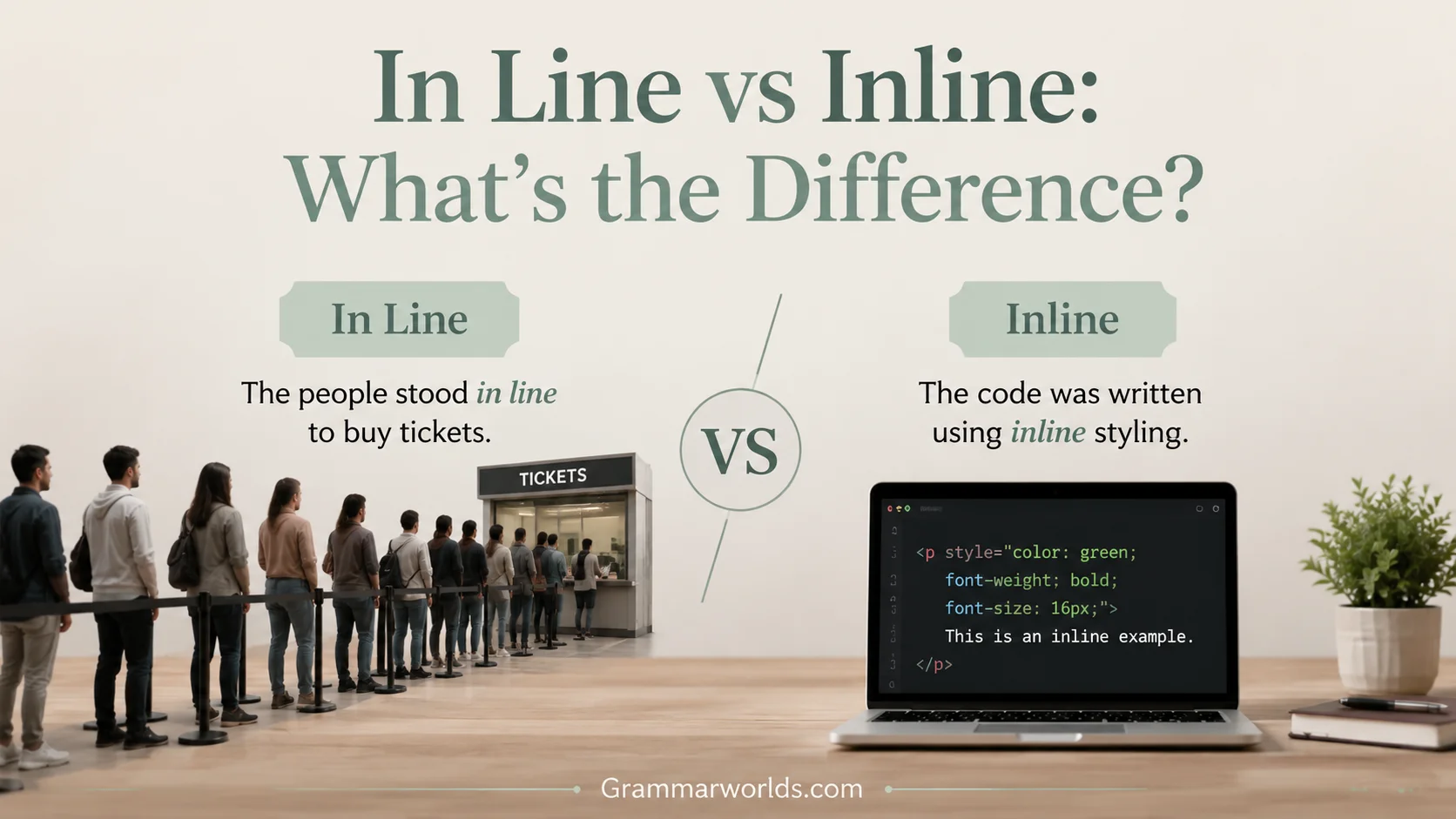
In Line vs Inline: What’s the Difference? explains why writers pause while choosing forms and understanding grammar and usage. Many writers have faced this moment while typing an email, report, or code and wondered which version looks correct. These similar-looking terms may appear identical, but their meaning
context, and purpose are different. Using the correct form improves professional writing, clear communication, and proper usage. Understanding these words, sentences, and grammar rules helps readers receive a message with better clarity, accuracy, and confidence.
The key is knowing how each form works in different situations. In line often shows agreement, position, or connection with a standard, while inline belongs mainly to technical writing, software code, coding language, and the digital world. In-line appears in some specific technical terms and older writing styles.
What Does “In Line” Mean?
In line is a two-word phrase that describes a position, arrangement, sequence, or relationship between things. It often refers to something being placed in a row or following a certain standard.
The phrase works as a combination of the preposition “in” and the noun “line.” Since it describes a relationship or position, the words remain separate.
You commonly see in line used in three major ways:
- Physical arrangement.
- Waiting or taking a turn.
- Agreement or consistency.
In Line Meaning Related to Physical Position
The most familiar use of in line involves objects or people arranged one after another.
Imagine customers waiting at a busy coffee shop. Each person stands behind another person. They create a visible line. In this situation, they are standing in line.
Examples:
- The students stood in line before entering the classroom.
- The cars were parked in line along the road.
- The books were placed in line on the shelf.
- The runners waited in line before the race started.
Here, in line describes physical placement.
In Line Meaning Related to Waiting
In American English, people commonly use in line when talking about queues.
Examples:
- I waited in line for two hours to buy concert tickets.
- She got in line early because the store had limited products.
- Please stand in line until your number is called.
This meaning is especially common in daily conversations.
A useful comparison:
| Phrase | Meaning | Example |
| Stand in line | Wait in a queue | I stood in line at the bank. |
| Get in line | Join a queue | Customers got in line quickly. |
| Stay in line | Remain organized | Children stayed in line during the trip. |
In Line Meaning Related to Agreement
The phrase in line with has another important meaning. It means something matches, follows, or agrees with another thing.
Examples:
- The company’s decision is in line with customer expectations.
- Her performance is in line with industry standards.
- The results are in line with previous research.
In these examples, nobody is standing in a physical line. Instead, something is consistent with a plan, rule, or expectation.
A simple way to remember this use:
In line with = matches or agrees with.
What Does “Inline” Mean?
Inline is a single word. It usually describes something that exists inside another structure, appears directly within something else, or is built into a larger system.
The word is especially common in:
- Technology.
- Writing.
- Web design.
- Engineering.
- Manufacturing.
Unlike in line, which focuses on position or agreement, inline focuses on integration.
Think of it like this:
Something in line stands beside others. Something inline sits inside something else.
Inline Meaning in Writing and Formatting
Modern writing uses inline frequently, especially when discussing digital content.
An inline element appears directly within the normal flow of text instead of appearing separately.
Common examples include:
- Inline citations
- Inline links
- Inline definitions
- Inline comments
- Inline references
Inline Citation Example
An inline citation appears immediately after the information it supports.
Example:
Climate change affects global weather patterns (Smith, 2025).
The citation sits inside the sentence, so it is called an inline citation.
Compare this with a separate bibliography placed at the end of a paper.
| Type | Meaning |
| Inline citation | Citation placed directly within text |
| Reference list | Sources collected separately at the end |
Inline Link Example
A hyperlink placed directly inside a sentence is an inline link.
Example:
You can learn more about grammar rules through this language guide.
The link appears naturally within the content instead of being listed separately.
Inline Meaning in Technology and Programming
The technology world uses inline more than almost any other field.
Developers use the word to describe content, code, or features placed directly inside another section.
Inline Code
Inline code refers to small pieces of programming code written within regular text.
Example:
Use the HTML tag <p> to create a paragraph.
The code appears within the sentence, so it is inline code.
Inline CSS
Inline CSS means adding styling directly inside an HTML element.
Example:
<p style=”color: blue;”>Hello World</p>
The style information appears inside the HTML tag instead of a separate stylesheet.
Inline Function
In programming, an inline function is a function inserted directly into a program’s execution area.
Developers use inline functions because they can sometimes improve speed by reducing the need for separate function calls.
Common programming examples include:
- Inline functions in C++.
- Inline methods in Java.
- Inline expressions in scripting languages.
Inline Meaning in Engineering and Manufacturing
The word inline also appears in technical industries.
In engineering, inline means a component is placed directly within an existing system.
Examples:
| Term | Meaning |
| Inline filter | A filter installed directly in a pipeline |
| Inline pump | A pump placed within a fluid system |
| Inline engine | Engine cylinders arranged in a straight row |
| Inline inspection | Quality checking performed during production |
For example, an inline water filter does not sit beside the water system. It connects directly inside the pipe structure.
In Line vs Inline: The Main Difference Explained
The biggest difference between in line and inline comes down to one question:
Is something standing, matching, or following a pattern? Or is it inserted inside something else?
Use:
- In line → when describing position, order, waiting, or agreement.
- Inline → when describing something integrated directly into another thing.
| Feature | In Line | Inline |
| Number of words | Two words | One word |
| Main idea | Position or agreement | Integration or insertion |
| Common use | Queues and consistency | Technology and formatting |
| Grammar type | Phrase | Compound word |
| Example | People are standing in line | The page has inline images |
Easy Memory Trick
Picture two different scenes:
In line:
People waiting outside a movie theater.
Inline:
A picture placed inside a paragraph.
The first shows a row. The second shows something included within another structure.
When Should You Use “In Line”?
Knowing the situations where in line works will prevent many writing mistakes.
Use “In Line” for Physical Arrangements
Whenever people or objects form a row, choose in line.
Examples:
- The employees waited in line for their security badges.
- The chairs were arranged in line with the stage.
- The children walked in line behind their teacher.
The phrase describes visible placement.
Use “In Line” for Rules, Expectations, and Standards
The expression in line with is very common in business and professional writing.
It means something follows a specific direction or requirement.
Examples:
- The new policy is in line with government regulations.
- The marketing campaign is in line with the company’s goals.
- The budget changes are in line with financial plans.
Businesses often use this phrase because it communicates alignment and agreement.
Example:
“Our updated strategy remains in line with customer needs.”
This means the strategy still matches what customers expect.
When Should You Use “Inline”?
The word inline works when something appears directly inside another element or becomes part of a larger structure. Unlike in line, it does not describe waiting, alignment, or agreement.
You should choose inline when the idea is about integration, placement within content, or built-in functionality.
Common situations include:
- Digital content.
- Software development.
- Website design.
- Technical documentation.
- Engineering systems.
Use “Inline” for Things Added Directly Within Something
When one element appears inside another element instead of being separated, inline is usually the correct choice.
Examples:
- The writer added an inline explanation to clarify the term.
- The website displays inline advertisements between paragraphs.
- The editor included an inline note for readers.
- The application supports inline editing.
The key idea is direct placement.
Instead of creating a separate section, file, or window, the information appears exactly where it is needed.
Think of inline content like a note written directly on the page instead of a separate sticky note attached somewhere else.
Use “Inline” in Digital and Technical Writing
Technology has made inline one of the most common compound words in modern English.
Digital tools often place information directly inside existing systems. Because of this, developers, designers, and writers frequently use terms containing inline.
Common Inline Technology Terms
| Term | Meaning | Example |
| Inline image | Image displayed within content | A blog post containing a picture between paragraphs |
| Inline code | Code shown inside normal text | Explaining a programming command |
| Inline CSS | Styling written directly in HTML | Adding design rules inside an element |
| Inline editing | Changing content directly on the same page | Editing a profile without opening a new screen |
| Inline comment | A note written beside code | Explaining what a programming line does |
In Line vs Inline in Website Content
Website owners, bloggers, and developers often confuse these terms because both appear in digital discussions.
However, they describe different things.
Example: Inline Image
Correct:
The article contains an inline image showing the process.
Why?
Because the image appears directly inside the article.
Incorrect:
The article contains an in line image.
This suggests the image is standing in a row, which is not the intended meaning.
Example: Inline Link
Correct:
The writer added an inline link to a related article.
The link appears naturally within the sentence.
Example:
Learn more about grammar mistakes through our writing guide.
The hyperlink becomes part of the sentence itself.
Common Mistakes When Using In Line and Inline
Even experienced writers sometimes mix up in line vs inline because the difference depends on context rather than spelling alone.
Here are the most common mistakes and how to fix them.
Mistake: Writing “Inline” When Talking About a Queue
Incorrect:
I waited inline at the restaurant.
Correct:
I waited in line at the restaurant.
Why?
The person is waiting in a physical queue. Nothing is being inserted into anything.
More examples:
❌ We stood inline for tickets.
✅ We stood in line for tickets.
❌ Customers were inline outside the store.
✅ Customers were in line outside the store.
Mistake: Writing “In Line” for Digital Features
Incorrect:
The developer added an in line comment.
Correct:
The developer added an inline comment.
Why?
The comment appears directly inside the code. It does not describe a physical arrangement.
More examples:
❌ inline image → wrong when written as in line image
✅ inline image
❌ in line editing → wrong in software contexts
✅ inline editing
Mistake: Confusing “In Line With” and “Inline”
This mistake happens often because the phrases look similar.
However, they have completely different meanings.
In Line With
Means:
- Consistent with.
- Matching.
- Following.
Example:
The company’s actions are in line with its values.
Meaning:
The actions match the company’s values.
Inline
Means:
- Inserted directly.
- Included within.
- Built into.
Example:
The website uses inline video content.
Meaning:
The video appears directly within the website.
In Line vs Inline vs Online: Understanding Similar Words
English contains many compound words that look related but have different meanings. In line, inline, and online are good examples.
They may appear similar, but each word serves a different purpose.
| Word | Meaning | Example |
| In line | Waiting, arranged, or matching | The customers stood in line. |
| Inline | Included directly inside something | The page has inline images. |
| Online | Connected through the internet | She purchased the product online. |
In Line vs Online
These two are often confused because they sound similar when spoken quickly.
However, they describe completely different situations.
Example:
I waited in line to buy a laptop online.
This sentence contains both words:
- In line = waiting physically.
- Online = buying through the internet.
Another example:
The customer stood in line while ordering online.
The person waited in a physical queue but used the internet for the purchase.
Inline vs Online
The difference between these terms matters in technology.
Inline
Something exists inside another digital element.
Example:
The developer created an inline form.
The form appears directly on the webpage.
Online
Something connects to the internet.
Example:
The customer completed the form online.
The action happened through the internet.
Also Read This : Half Day vs Half-Day: What’s the Difference Used Each?
In Line vs Inline in Different Industries
Different industries use these words in different ways. Understanding the context makes the correct choice easier.
Business and Workplace Writing
Professional communication frequently uses in line because businesses often discuss goals, policies, and expectations.
Examples:
- Our results are in line with quarterly targets.
- The new plan is in line with company objectives.
- The project remains in line with the original timeline.
In business writing, in line with shows alignment.
A manager might say:
“The department’s progress is in line with the yearly strategy.”
This means the department follows the planned direction.
Businesses also use inline when discussing technology tools.
Examples:
- Inline approval systems.
- Inline comments in documents.
- Inline editing features.
Example:
The software allows inline editing, which saves employees time.
The user changes information directly instead of opening another page.
In Line vs Inline in Education and Academic Writing
Students and researchers commonly encounter inline when working with citations and formatting.
Inline Citations
An inline citation places a source directly after the information it supports.
Example:
Regular exercise can improve overall health (Johnson, 2026).
The citation appears within the paragraph, so it is called an inline citation.
In Line With Academic Standards
Academic writing also uses in line with.
Examples:
- The research follows methods in line with university requirements.
- The paper structure is in line with academic guidelines.
Here, the phrase means agreement or compliance.
In Line vs Inline in Software Development
Software development uses inline constantly.
Developers use inline terms because modern software often places information directly within code or interfaces.
Inline Comments
An inline comment explains a specific part of code.
Example:
let total = price * quantity; // Calculates final cost
The explanation sits directly beside the code.
That makes it an inline comment.
Inline Functions
Inline functions allow certain programming instructions to be placed directly where they are needed.
Benefits may include:
- Faster execution in some situations.
- Easier code organization.
- Reduced function call overhead.
However, developers must use them carefully because excessive inline code can make programs harder to manage.
In Line vs Inline in Engineering and Manufacturing
Engineering uses inline to describe systems where components operate directly within a production or mechanical process.
Examples:
Inline Inspection
Manufacturers inspect products while they move through production.
Instead of stopping the entire process for testing, companies place inspection tools directly into the production line.
Inline Filters
An inline filter connects directly to a system.
Examples:
- Water filtration systems.
- Fuel filtration systems.
- Industrial pipelines.
The filter becomes part of the existing setup.
Inline Engines
An inline engine has cylinders arranged in a straight row.
Example:
A four-cylinder inline engine places all cylinders in one line rather than a V-shaped arrangement.
Grammar Rules Behind In Line and Inline
The difference between these terms comes from how English creates compound words.
Many English words begin as separate phrases and later combine into one word.
Examples:
- Web site → website.
- E mail → email.
- On line → online.
- In line → inline (in certain technical uses).
However, not every phrase combines completely.
In line remains separate when it describes position or agreement.
Example:
The workers stood in line.
It does not become:
❌ The workers stood inline.
That changes the meaning.
Why Did “Inline” Become One Word?
The word inline developed because people needed a quick way to describe something integrated into another structure.
Technology especially encouraged this change.
For example:
- Inline image.
- Inline code.
- Inline editing.
These terms describe objects that become part of a larger system.
How to Remember the Difference Between In Line and Inline
A simple memory trick can help you choose the correct spelling.
Remember This Rule:
If something waits, follows, or matches → use “in line.”
Examples:
- Wait in line.
- Stand in line.
- In line with expectations.
If something is inserted, included, or built inside → use “inline.”
Examples:
- Inline image.
- Inline code.
- Inline citation.
Quick Comparison Formula
| Question | Correct Choice |
| Are people waiting? | In line |
| Are things arranged in a row? | In line |
| Does something match a rule? | In line |
| Is something placed inside content? | Inline |
| Is something built into software? | Inline |
| Is something integrated into a system? | Inline |
Examples of In Line vs Inline in Sentences
Seeing real examples makes the difference much easier to understand.
Examples Using “In Line”
- The shoppers waited in line outside the store.
- The students walked in line behind the teacher.
- The company’s results are in line with expectations.
- The chairs were placed in line with the wall.
- The project remains in line with the original plan.
- The players stood in line before the ceremony.
Examples Using “Inline”
- The article includes an inline image.
- The developer added an inline comment.
- The website supports inline editing.
- The professor used inline citations.
- The software provides an inline preview.
- The designer created an inline menu.
Case Study: How One Word Changes the Meaning
Consider these two sentences:
Sentence One:
The customer waited in line for support.
Meaning:
The customer waited in a queue.
Sentence Two:
The customer used inline support tools.
Meaning:
The support tools appeared directly inside the system.
The spelling difference creates two completely different ideas.
This small grammar choice matters because unclear wording can confuse readers, especially in professional or technical writing.
FAQs:
Is “inline” always written as one word?
Yes, inline is usually written as one word when it describes something that is placed directly inside another element or system. This usage is common in technology, writing, design, and engineering.
Examples:
- Inline citation
- Inline image
- Inline code
- Inline editing
However, you should not combine in line into inline when you mean waiting, arranging, or following a pattern.
Correct:
The customers stood in line outside the store.
Incorrect:
The customers stood inline outside the store.
The meaning changes completely.
Is “in line” grammatically correct?
Yes, in line is grammatically correct and remains two separate words when it describes position, order, or agreement.
You should use in line when talking about:
- People waiting.
- Objects arranged in a row.
- Something matching a standard or expectation.
Examples:
- We waited in line for tickets.
- The employees stood in line for registration.
- The company’s strategy is in line with market trends.
A helpful reminder is that in line usually describes a relationship between things rather than something being inserted into another thing.
Is it correct to say “wait inline” or “wait in line”?
The correct phrase is “wait in line.”
When someone waits for a turn, they join a physical or virtual queue. The phrase describes their position in that queue.
Correct examples:
- I waited in line at the grocery store.
- She waited in line for three hours.
- They are waiting in line to enter the event.
“Wait inline” is incorrect in standard English because inline does not describe a waiting position.
Should I write “inline citation” or “in line citation”?
The correct term is “inline citation.”
An inline citation appears directly within a sentence or paragraph instead of being placed separately in a reference section.
Example:
Regular exercise supports better heart health (Miller, 2026).
The citation sits inside the text, so it is called an inline citation.
You will often see inline citations in:
- Academic papers.
- Research articles.
- Blog posts.
- Online publications.
Is “inline” the same as “inside”?
Not exactly. Although inline can mean something is placed inside another structure, it has a more specific meaning.
Inside simply means something is contained within another thing.
Example:
The keys are inside the drawer.
Inline means something is directly integrated into an existing structure or flow.
Example:
The website displays an inline video.
The video appears within the webpage content rather than opening separately.
So while both words suggest placement within something, inline focuses on connection and integration.
Conclusion
A simple way to remember the difference is to think about placement. If people are standing, objects are arranged, or something follows expectations, use in line. If something is built into content, software, or a system, use inline.
Using the correct form improves your grammar and makes your writing easier to understand. A small spelling choice can change the meaning of a sentence, so always consider what you are trying to describe before choosing the word