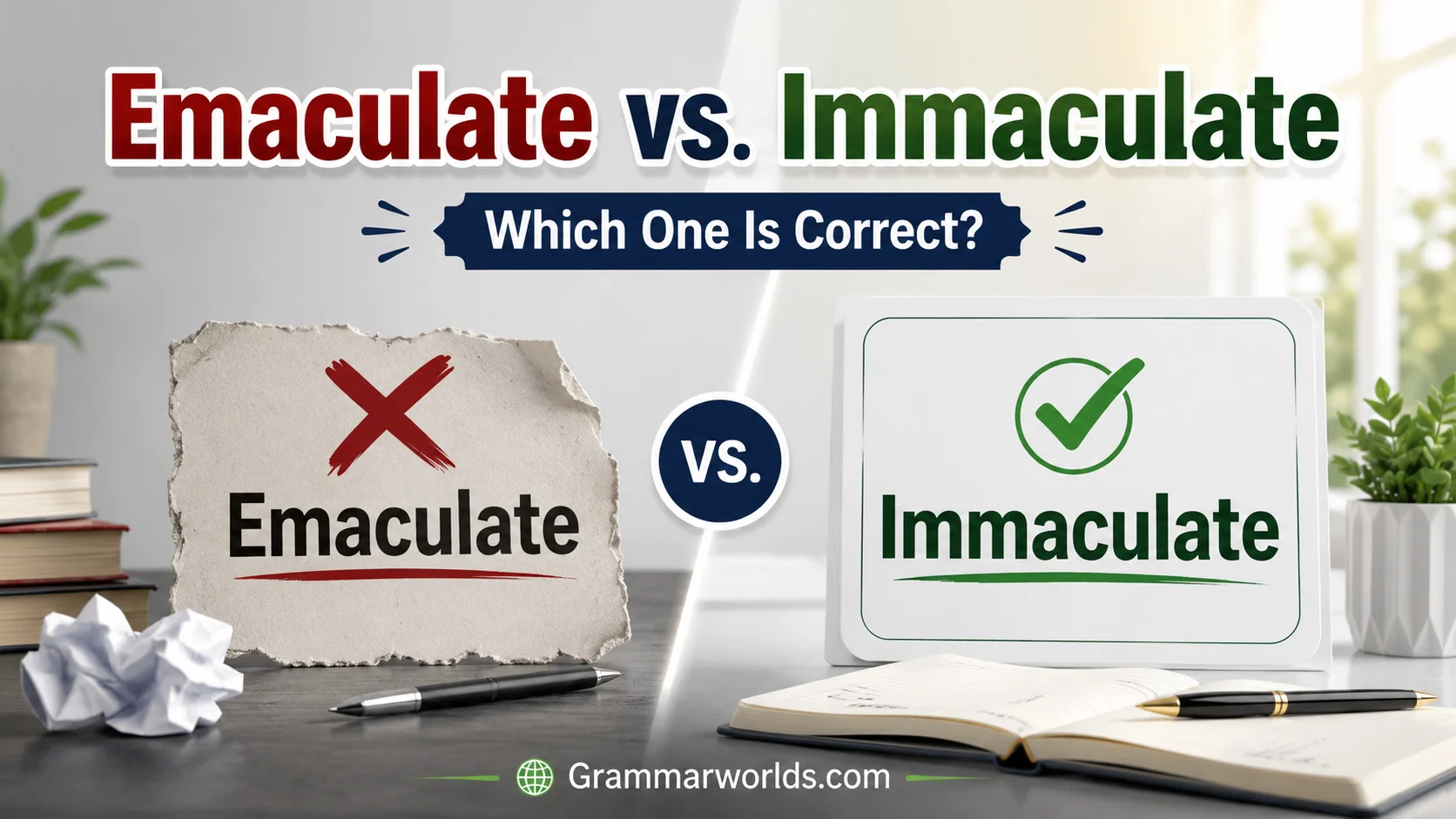
If you’ve ever typed “emaculate” and wondered whether it was correct, you’re not alone. Thousands of people search for “emaculate vs. immaculate” every month because the two spellings sound similar when spoken aloud. However, only one of them is recognized as a proper English word.
The short answer is simple: immaculate is the correct spelling, while emaculate is a misspelling.
Still, there’s more to the story. Understanding why people make this mistake, what immaculate actually means, how to pronounce it correctly, and when to use it can help you avoid embarrassing spelling errors in both personal and professional writing.
This guide covers everything you need to know about emaculate vs. immaculate, including definitions, examples, pronunciation, common mistakes, word origins, and frequently asked questions.
Emaculate vs. Immaculate: The Short Answer
When comparing emaculate vs. immaculate, only immaculate is correct.
Here’s a quick comparison:
| Word | Correct Spelling? | Meaning |
| Immaculate | Yes | Perfectly clean, spotless, flawless, or free from mistakes |
| Emaculate | No | Misspelling of immaculate |
If you’re writing an email, academic paper, social media post, business document, or website content, you should always use immaculate.
Quick Example
✅ The hotel room was immaculate.
✅ Her presentation was immaculate.
❌ The hotel room was emaculate.
❌ Her presentation was emaculate.
The incorrect spelling may not always trigger a spell checker immediately depending on the software you’re using, which makes understanding the correct form even more important.
What Does “Immaculate” Mean?
The word immaculate describes something that is perfectly clean, free from flaws, or exceptionally well-maintained.
In everyday English, people use it to praise something that appears nearly perfect.
Dictionary Meaning
Immaculate (adjective):
- Completely clean
- Spotless
- Without faults or defects
- Free from mistakes
- Perfectly maintained
Although cleanliness is the most common association, the word extends far beyond physical appearance.
For example:
- An immaculate house
- An immaculate suit
- An immaculate performance
- An immaculate reputation
- An immaculate record
In each case, the meaning shifts slightly while retaining the idea of perfection and freedom from defects.
Common Synonyms
The English language offers several alternatives to immaculate.
| Synonym | Meaning |
| Spotless | Completely clean |
| Pristine | In original, untouched condition |
| Flawless | Without defects |
| Impeccable | Exceptionally high quality |
| Perfect | Lacking faults |
| Untarnished | Not damaged or stained |
Although these words overlap, immaculate often carries a stronger sense of meticulous care and attention to detail.
Why Do People Spell Immaculate as Emaculate?
Misspellings rarely happen without a reason. The confusion between emaculate and immaculate stems from several linguistic factors.
Pronunciation Creates Confusion
Many English speakers pronounce words quickly during conversation.
When spoken casually, immaculate may sound similar to:
“em-maculate”
As a result, some people assume the word begins with “e” rather than “i.”
This phenomenon occurs frequently in English because pronunciation doesn’t always perfectly match spelling.
The Double “M” Problem
Another source of confusion is the double “m.”
The correct spelling contains:
I-M-M-A-C-U-L-A-T-E
Many people unintentionally simplify the spelling because double consonants often create uncertainty.
Memory-Based Typing Errors
Most adults type from memory rather than consciously spelling every word.
When people encounter less common words such as immaculate, they often rely on sound rather than visual memory.
This can lead to errors such as:
- Emaculate
- Imaculate
- Immaculite
- Immaculant
- Immaculatee
English Is Not Fully Phonetic
One challenge of English spelling is that words aren’t always written exactly as they sound.
Consider these examples:
| Pronunciation | Correct Spelling |
| Nite | Night |
| Thru | Through |
| Definately | Definitely |
| Emaculate | Immaculate |
This inconsistency explains why spelling mistakes remain common even among educated writers.
How to Pronounce Immaculate Correctly
Learning the proper pronunciation can make the spelling easier to remember.
Standard Pronunciation
Immaculate
Phonetic pronunciation:
ih-MAK-yuh-lit
Or:
ih-MAK-yuh-luht
Syllable Breakdown
The word contains four syllables:
Im – mac – u – late
Breaking it into smaller pieces often improves spelling accuracy.
Pronunciation Memory Trick
Think of the word like this:
Im + mac + u + late
Starting with “Im” instead of “Em” helps reinforce the correct spelling.
Common Pronunciation Mistakes
People sometimes say:
- Emaculate
- Em-maculate
- Immac-you-late
While accents vary, the spelling remains unchanged regardless of pronunciation differences.
Examples of Immaculate Used Correctly
Understanding real-world usage helps reinforce the meaning.
Everyday Conversation Examples
- The kitchen looked immaculate after the renovation.
- She keeps her apartment immaculate throughout the year.
- His white sneakers remained immaculate despite the rain.
- The garden appeared immaculate from every angle.
Professional Writing Examples
- The report was immaculate and free from errors.
- The company’s records were maintained in immaculate condition.
- The design team delivered an immaculate presentation.
- Every detail of the proposal was immaculate.
Academic Examples
- The research paper demonstrated immaculate organization.
- Her citation formatting remained immaculate throughout the thesis.
- The professor praised the student’s immaculate work.
Real Estate Examples
Real estate agents frequently use the word.
Examples include:
- Immaculate family home.
- Immaculate interior finishes.
- Immaculate landscaping.
- Immaculate condition throughout.
The term helps communicate exceptional care and maintenance.
Common Mistakes Related to Immaculate
Even strong writers occasionally misspell the word.
Here are some of the most common errors.
| Incorrect Spelling | Correct Spelling |
| Emaculate | Immaculate |
| Imaculate | Immaculate |
| Immaculant | Immaculate |
| Immaculite | Immaculate |
| Immaculatee | Immaculate |
Why These Mistakes Happen
Most errors result from:
- Phonetic assumptions
- Fast typing
- Limited exposure to the word
- Confusion over double consonants
A Useful Memory Trick
Focus on the beginning:
IMM
Not:
EMA
Remember:
Immaculate starts with “I’m.”
Visualizing the first three letters correctly can dramatically reduce spelling mistakes.
How to Remember the Correct Spelling
Many people struggle with spelling because they memorize words as sounds rather than visual patterns.
Fortunately, a few simple techniques can help.
Visual Pattern Method
Write the word several times:
- Immaculate
- Immaculate
- Immaculate
The repeated visual exposure strengthens memory.
Association Technique
Associate the word with perfection.
Imagine:
Immaculate = Image of perfection
The connection can make recall easier.
Chunking Method
Break the word into manageable sections:
Im + mac + ulate
Smaller chunks are easier to remember than one long sequence.
Proofreading Strategy
When editing your writing, specifically look for:
- Words beginning with “ema”
- Words that resemble immaculate
This targeted review catches mistakes before publication.
Immaculate in Different Contexts
One reason the word remains popular is its versatility.
Immaculate Appearance
When describing people, immaculate suggests exceptional grooming and presentation.
Examples:
- Immaculate hairstyle
- Immaculate uniform
- Immaculate makeup
The focus isn’t simply cleanliness. It includes precision and attention to detail.
Immaculate Condition
Collectors often use the term when evaluating valuable items.
Examples:
- Immaculate classic car
- Immaculate baseball card
- Immaculate vintage watch
In these contexts, the word implies near-perfect preservation.
Immaculate Performance
Athletes, musicians, and professionals can deliver immaculate performances.
Examples:
- Immaculate execution
- Immaculate timing
- Immaculate technique
Here, the meaning shifts toward flawless performance rather than physical cleanliness.
Immaculate Reputation
Organizations and individuals often strive for an immaculate reputation.
Examples:
- Immaculate ethics record
- Immaculate professional standing
- Immaculate public image
The emphasis becomes moral or professional excellence.
Also Read This :Uncollectible vs. Uncollectable: What’s the Difference?
Word Origin and Etymology
The history of a word often reveals why it carries its modern meaning.
Latin Origins
The word immaculate comes from the Latin term:
immaculatus
This word combines:
- in- meaning “not”
- maculatus meaning “stained” or “spotted”
The original meaning was essentially:
“Not stained.”
Over time, English adopted the term and expanded its usage.
Historical Development
Initially, immaculate appeared primarily in religious and formal contexts.
As English evolved, the word entered everyday language.
Today it commonly describes:
- Homes
- Clothing
- Work quality
- Personal appearance
- Records
- Properties
Despite its age, the core idea remains unchanged:
Freedom from stains, defects, or imperfections.
Immaculate in Religious Usage
The word carries special significance within Christianity.
General Religious Meaning
In religious contexts, immaculate refers to purity and freedom from moral stain.
This usage predates many modern secular applications.
Understanding the Immaculate Conception
One of the most frequently misunderstood religious phrases is Immaculate Conception.
Many people incorrectly assume it refers to the conception of Jesus.
In Christian theology, particularly within Catholic teaching, the term refers to the conception of Mary without original sin.
The phrase uses “immaculate” in its original sense of being unstained or free from corruption.
Why This Matters
Understanding the religious background helps explain why the word often conveys more than simple cleanliness.
It frequently suggests:
- Purity
- Integrity
- Moral perfection
- Freedom from defects
These deeper meanings continue to influence modern usage.
Immaculate vs. Similar Words
Although several words resemble immaculate, each carries unique shades of meaning.
Immaculate vs. Spotless
| Immaculate | Spotless |
| Can describe objects, people, work, and reputations | Usually refers to cleanliness |
| Broader meaning | Narrower meaning |
Every spotless room may be immaculate.
Not every immaculate achievement is spotless.
Immaculate vs. Flawless
Flawless emphasizes the absence of errors.
Immaculate emphasizes perfection plus exceptional care.
Examples:
- Flawless code
- Immaculate presentation
The second suggests polish and attention to detail beyond simple correctness.
Immaculate vs. Perfect
Perfect is broader.
Immaculate often implies visible excellence and maintenance.
Examples:
- Perfect solution
- Immaculate office
The words overlap but aren’t always interchangeable.
Immaculate vs. Impeccable
These two are very close in meaning.
However:
- Impeccable often describes behavior or standards.
- Immaculate often highlights condition and appearance.
Examples:
- Impeccable manners
- Immaculate suit
Both convey excellence, but their usage differs slightly.
Real-World Case Studies of Immaculate Usage
Luxury Real Estate Marketing
Luxury property listings frequently use the word immaculate because it instantly signals quality.
Instead of writing:
“The home is clean.”
Agents write:
“The home is presented in immaculate condition.”
The second phrase creates a stronger impression.
Automotive Sales
Car dealerships regularly advertise:
- Immaculate interior
- Immaculate exterior
- Immaculate service history
Buyers associate the word with trust and careful ownership.
Professional Branding
Businesses often strive for an immaculate brand image.
This includes:
- Consistent messaging
- Error-free communication
- High-quality customer service
An immaculate reputation can become a powerful competitive advantage.
Quick Facts About the Word Immaculate
| Fact | Details |
| Part of Speech | Adjective |
| Correct Spelling | Immaculate |
| Common Misspelling | Emaculate |
| Origin | Latin |
| Core Meaning | Free from stains, flaws, or defects |
| Common Use | Appearance, condition, performance, reputation |
| Religious Use | Purity and freedom from sin |
FAQs
Is emaculate a real word?
No. Emaculate is not recognized as a standard English word. It is a common misspelling of immaculate.
Why do people write emaculate instead of immaculate?
Most people spell it incorrectly because pronunciation can make the first syllable sound like “em.” Fast speech, memory-based typing, and unfamiliarity with the word also contribute to the mistake.
How do you spell immaculate correctly?
The correct spelling is:
What does immaculate mean?
Immaculate means perfectly clean, spotless, flawless, or free from defects and mistakes.
Is immaculate a positive word?
Yes. The word almost always carries a positive meaning. It typically describes excellence, cleanliness, precision, or exceptional quality.
Conclusion
When it comes to emaculate vs. immaculate, there’s no real debate. Immaculate is the only correct spelling, while emaculate is simply a common misspelling that appears because of pronunciation confusion and typing errors.Beyond its spelling, immaculate is a powerful word that conveys much more than cleanliness. It can describe a spotless home, a flawless performance, a well-maintained vehicle, an outstanding reputation, or anything that reflects exceptional care and attention to detail. Its roots trace back to Latin, where it originally meant “unstained,” a meaning that still influences how the word is used today.If you’re ever unsure, remember that immaculate starts with “imm” and refers to something that is free from flaws, defects, or imperfections. Using the correct spelling will make your writing look more polished, professional, and credible.