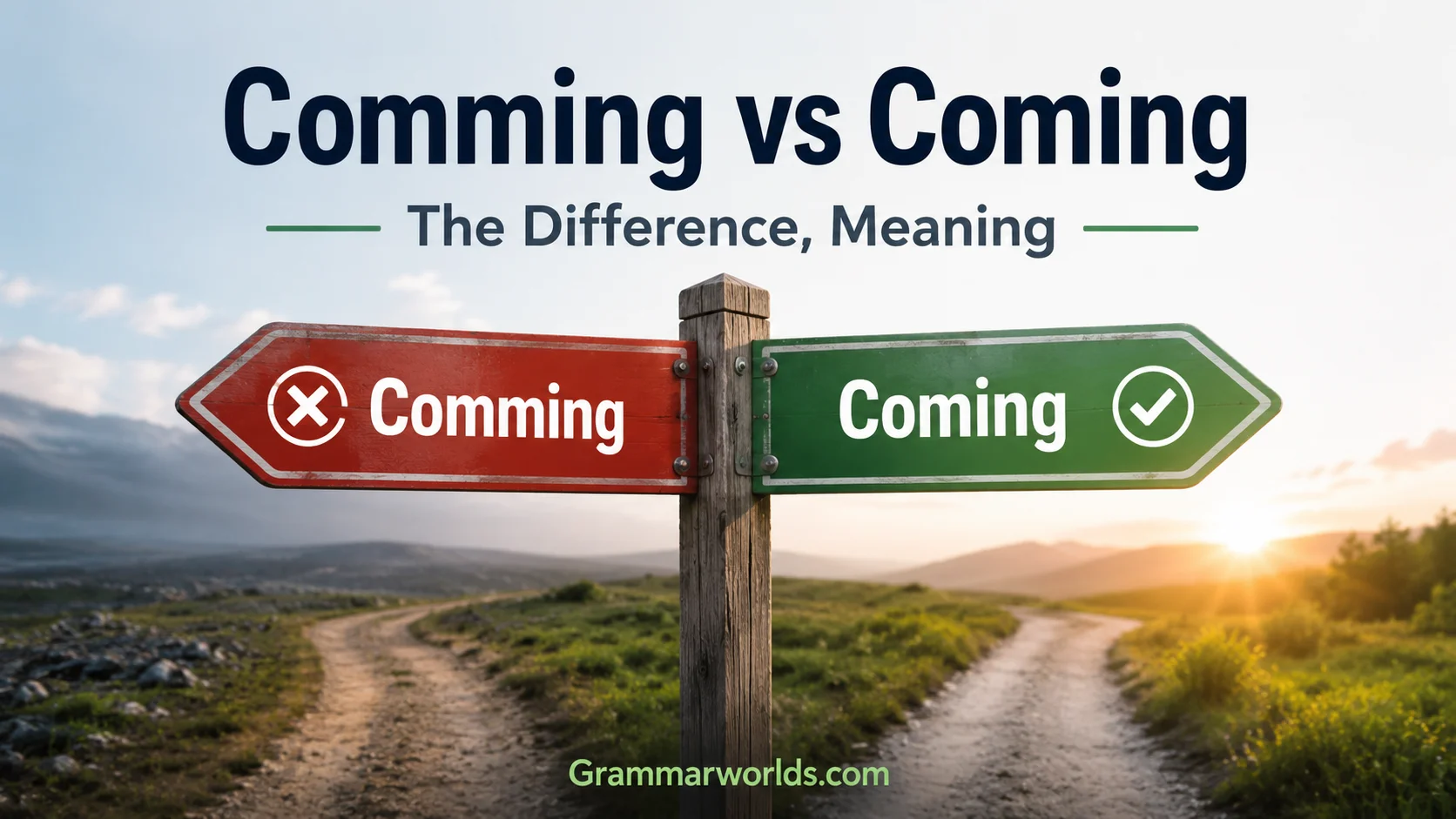
Have you ever typed “comming” and wondered whether it was correct? You’re not alone. Thousands of English learners and native speakers search for Comming vs Coming every month because the two spellings look surprisingly similar.
The confusion usually happens when people apply the wrong spelling rule. English contains many words that double a consonant before adding -ing, so it’s easy to assume that come should become comming. However, that’s not how the word works.
The truth is simple: coming is the correct spelling, while comming is a misspelling in modern English.
Understanding why this happens can help you avoid similar mistakes in dozens of other words. In this guide, you’ll learn the difference between comming and coming, discover the grammar rule behind the correct spelling, see real examples, and learn practical tricks to remember the right form every time.
Comming vs Coming: The Quick Answer
If you’re looking for the short answer, here it is:
✅ Coming = Correct spelling
❌ Comming = Incorrect spelling
The word coming is the present participle and gerund form of the verb come.
Examples:
- I am coming home.
- She is coming tomorrow.
- The holidays are coming soon.
The spelling comming is not accepted in standard English and should be avoided in academic, professional, and everyday writing.
Comming vs Coming: Side-by-Side Comparison
| Feature | Comming | Coming |
| Correct English Spelling | No | Yes |
| Found in Standard Dictionaries | No | Yes |
| Accepted in Formal Writing | No | Yes |
| Accepted in Academic Writing | No | Yes |
| Accepted in Business Communication | No | Yes |
| Present Participle of “Come” | No | Yes |
| Recommended Usage | Never | Always |
Whenever you must choose between comming vs coming, always select coming.
What Does “Coming” Mean?
The word coming serves several grammatical functions in English. Most commonly, it acts as the present participle of the verb come.
Coming as a Verb Form
In this role, coming describes movement toward a person, place, or event.
Examples:
- I’m coming with you.
- They are coming to dinner tonight.
- The train is coming into the station.
The action is ongoing or expected to happen soon.
Coming as an Adjective
Sometimes coming describes something that will occur in the future.
Examples:
- The coming week will be busy.
- During the coming months, sales may increase.
- The coming year could bring new opportunities.
Here, the word means upcoming, next, or approaching.
Coming as a Noun
Although less common, coming can function as a noun.
Examples:
- His coming surprised everyone.
- We celebrated her coming home.
In these situations, coming refers to the act of arriving.
Why Do People Write “Comming”?
The mistake isn’t random. Several factors cause people to write comming instead of coming.
Confusion About Double Consonants
English spelling often doubles consonants before adding suffixes.
Consider these examples:
| Base Word | Correct Form |
| Run | Running |
| Swim | Swimming |
| Sit | Sitting |
| Stop | Stopping |
Because of these patterns, many writers assume come becomes comming.
However, come follows a different spelling rule.
Pronunciation Can Be Misleading
When people hear the word coming, they sometimes believe the middle sound suggests two “m” letters.
English pronunciation doesn’t always reveal spelling accurately. That’s one reason spelling errors occur so frequently.
Fast Typing and Autocorrect Issues
Modern communication encourages speed.
Whether you’re texting, emailing, or posting on social media, quick typing often leads to mistakes such as:
- comming
- comeing
- comng
- cming
Many people never notice the error before publishing their message.
Understanding the Grammar Rule Behind Coming
The easiest way to understand the correct spelling is to learn the underlying rule.
The Silent E Rule
When a verb ends in a silent e, English typically drops the e before adding -ing.
Formula:
Verb + ing = Drop Silent E + ing
Examples:
| Base Verb | Correct -ing Form |
| Come | Coming |
| Make | Making |
| Take | Taking |
| Give | Giving |
| Write | Writing |
| Drive | Driving |
| Arrive | Arriving |
| Move | Moving |
The same rule applies to come.
Come → Coming
Not:
Come → Comming
The second form breaks the spelling rule.
Why the M Does Not Double
Consonants usually double when a word follows a specific pattern:
- One syllable
- Short vowel sound
- Ends with consonant-vowel-consonant pattern
Examples:
- Run → Running
- Sit → Sitting
- Swim → Swimming
The word come does not follow this pattern when forming coming.
As a result, the “m” remains single.
The History Behind the Word “Come”
The verb come is one of the oldest words in the English language.
Its roots trace back to:
- Old English: cuman
- Proto-Germanic: kweman
- Proto-Indo-European origins dating back thousands of years
Over centuries, the spelling evolved while preserving its core meaning of movement toward a destination.
The modern form coming emerged naturally through standard English spelling conventions.
Because the word has existed for so long, dictionaries and grammar guides consistently recognize coming as the accepted form.
Examples of Coming in Everyday Sentences
Seeing the word in context makes it easier to remember.
Everyday Conversation Examples
- I’m coming over after work.
- Are you coming to the party?
- She’s coming home tonight.
- We are coming with you.
- The food is coming soon.
Academic Writing Examples
- New evidence is coming to light.
- Several changes are coming in the next semester.
- Researchers are coming closer to understanding the issue.
Professional Communication Examples
- The report is coming along well.
- Our meeting is coming up next week.
- Additional updates are coming shortly.
Social Media Examples
- New content is coming soon.
- Big news is coming tomorrow.
- Summer is coming fast.
Incorrect Examples Using Comming
Many spelling mistakes look harmless. However, they can damage credibility in professional and academic settings.
Common Errors
| Incorrect Sentence | Correct Sentence |
| I’m comming home. | I’m coming home. |
| She is comming tomorrow. | She is coming tomorrow. |
| The event is comming soon. | The event is coming soon. |
| They are comming with us. | They are coming with us. |
| Winter is comming. | Winter is coming. |
A single spelling error may seem small. Yet it can leave a poor impression in resumes, essays, emails, and business documents.
Common Phrases That Use Coming
Many popular English expressions contain the word coming.
Coming Soon
Meaning:
Something will happen in the near future.
Example:
- A new product is coming soon.
Coming Home
Meaning:
Returning to one’s residence.
Example:
- She’s coming home for the holidays.
Coming Back
Meaning:
Returning to a previous place or situation.
Example:
- He is coming back next month.
Coming Up
Meaning:
Approaching or about to occur.
Example:
- Our anniversary is coming up.
Coming Along
Meaning:
Making progress.
Example:
- The project is coming along nicely.
Coming Through
Meaning:
Successfully delivering or helping.
Example:
- She really came through when we needed support.
Coming of Age
Meaning:
Reaching adulthood or maturity.
Example:
- The novel is a classic coming-of-age story.
The Drop-the-E Rule Explained in Detail
One of the most valuable spelling rules in English involves dropping a silent e.
The Basic Principle
When a verb ends with a silent e, remove it before adding -ing.
Examples:
| Verb | Correct Form |
| Hope | Hoping |
| Love | Loving |
| Smile | Smiling |
| Write | Writing |
| Drive | Driving |
| Come | Coming |
This rule appears throughout English writing.
Also Read This :Seal vs Seel: The Difference Meanings
Easy Memory Trick
Think of it this way:
“The silent E steps aside when ING arrives.”
Many students remember the rule instantly after hearing that phrase.
Why This Rule Matters
Once you understand it, you can correctly spell dozens of words without memorizing each one individually.
Coming in Different Tenses
The word coming appears in several English tenses.
Present Continuous
Structure:
am/is/are + coming
Examples:
- I am coming.
- She is coming.
- They are coming.
Past Continuous
Structure:
was/were + coming
Examples:
- I was coming home.
- They were coming from school.
- She was coming to help us.
Future Continuous
Structure:
will be + coming
Examples:
- I will be coming tomorrow.
- They will be coming later.
- She will be coming next week.
Understanding these structures helps you use the word accurately in conversation and writing.
Comming vs Coming vs Other Common Misspellings
The confusion doesn’t stop with comming.
Several similar spelling mistakes appear frequently.
Comming vs Coming
Correct:
- Coming
Incorrect:
- Comming
Comeing vs Coming
Correct:
- Coming
Incorrect:
- Comeing
The silent e must disappear before adding -ing.
Cuming vs Coming
Correct:
- Coming
Incorrect:
- Cuming
This spelling often results from phonetic guessing.
Comin vs Coming
Correct:
- Coming
Informal:
- Comin’
You may see comin’ in song lyrics or dialogue, but standard writing uses coming.
Real-Life Case Study: How a Small Spelling Mistake Changes Perception
Imagine two job applicants.
Applicant A writes:
“I am comming to the interview on Tuesday.”
Applicant B writes:
“I am coming to the interview on Tuesday.”
Both candidates mean the same thing.
However, recruiters often notice spelling mistakes immediately. Studies on business communication consistently show that writing accuracy affects professional credibility.
The difference is only one letter. Yet readers may view Applicant B as more detail-oriented and professional.
That’s the power of correct spelling.
How to Remember the Correct Spelling Every Time
Learning a simple memory strategy can eliminate this mistake permanently.
Remember the Base Word
Start with:
Come
Then remove the silent e.
Add:
-ing
Result:
Coming
Visual Memory Method
Picture this:
COME
↓
Remove E
↓
COM
↓
Add ING
↓
COMING
The process takes only a few seconds.
Self-Editing Checklist
Before publishing anything, ask:
- Did I write “coming” with one m?
- Did I remove the silent e?
- Did spell check flag the word?
- Does the sentence sound natural?
This quick review catches most spelling errors.
Quick Quiz: Test Your Understanding
Choose the correct word.
Question 1
She is ______ tomorrow.
A. Comming
B. Coming
Answer: B. Coming
Question 2
Winter is ______ soon.
A. Coming
B. Comming
Answer: A. Coming
Question 3
We are ______ with you.
A. Coming
B. Comming
Answer: A. Coming
Question 4
Which spelling follows standard English rules?
A. Comming
B. Coming
Answer: B. Coming
Question 5
What happens to the silent E in “come”?
A. It stays
B. It is removed
Answer: B. It is removed
Key Takeaways About Comming vs Coming
Here are the most important points to remember:
- Coming is the correct spelling.
- Comming is a misspelling.
- The verb come drops its silent e before adding -ing.
- The letter m does not double.
- The word coming can function as a verb, adjective, or noun.
- Understanding the silent-e rule helps with many other English words.
- Correct spelling improves credibility in academic, professional, and personal writing.
FAQ
Is comming ever correct?
No. In standard modern English, comming is considered a spelling mistake. The correct form is always coming.
Why doesn’t coming have two m’s?
The word follows the silent-e rule. You remove the final e from come and add -ing, creating coming. English spelling rules do not require doubling the m.
Is coming a verb or an adjective?
It can be both. Most often, coming acts as a verb form. However, it can also function as an adjective when describing future events, such as “the coming year.”
Why do we remove the e in come?
English grammar generally drops a silent e before adding -ing. This pattern appears in words like making, driving, writing, and coming.
Is “coming soon” grammatically correct?
Yes. Coming soon is a standard English phrase that means something will happen in the near future.
Conclusion
The debate over Comming vs Coming has a clear answer. Coming is the correct spelling and comming is incorrect.The confusion usually comes from misunderstanding how English handles words ending in a silent e. Fortunately, the rule is easy to remember. Remove the silent e from come, add -ing, and you get coming.