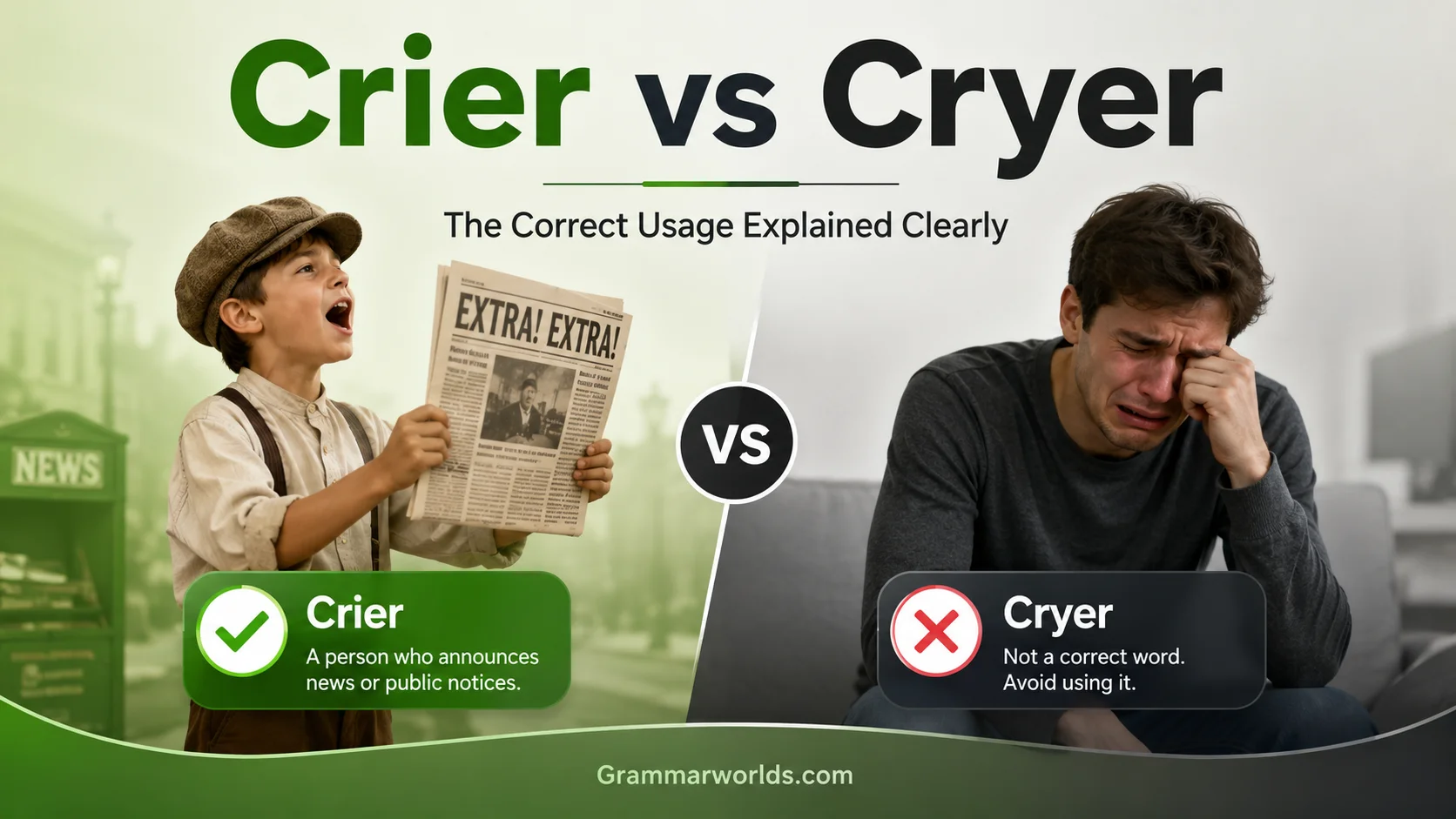
English has many words that look almost identical but carry different meanings. Crier vs Cryer is one of those confusing word pairs that makes many writers stop and wonder: Which spelling is correct?
Both crier and cryer are real English words. They both come from the verb “cry,” but they developed different meanings over time. The right choice depends on what you want to describe.
A crier usually refers to someone who cries out, calls loudly, announces something, or sometimes cries tears. A cryer, on the other hand, generally describes someone who cries often or easily, especially in an emotional way.
At first glance, the difference seems tiny. One letter changes the spelling. However, that small difference can change the meaning of your sentence completely.
For example:
- The town crier announced the news. ✅
(A person who publicly announces information) - The child was a frequent cryer. ✅
(A person who cries often)
Understanding this difference helps you write more accurately, especially in formal writing, storytelling, and everyday communication.
Crier vs Cryer: Quick Difference Between the Two Words
Before exploring each word in detail, here is the simple distinction:
| Word | Meaning | Main Idea | Example |
| Crier | A person who cries out, shouts, announces, or cries | Someone who makes a loud call or expresses emotion | “The town crier delivered the message.” |
| Cryer | A person who cries frequently | Someone who often sheds tears | “She was a cryer when she was younger.” |
The easiest way to remember the difference:
Crier = cries out
Cryer = cries tears
Although both words connect to “cry,” they focus on different actions.
What Does Crier Mean?
A crier is a noun that comes from the verb cry. It describes someone who cries out, calls loudly, or announces something.
The word has several meanings depending on the situation.
In modern English, crier is the more common and widely recognized spelling.
Main Meanings of Crier
A person who announces information publicly
The most famous use of crier appears in the phrase “town crier.”
Historically, a town crier was an official messenger who walked through towns and announced important information before newspapers, radio, and the internet existed.
A town crier might announce:
- Royal announcements
- New laws
- Public events
- Important community news
They often used a loud voice and a traditional phrase such as:
“Hear ye, hear ye!”
This role was especially common in Europe centuries ago. Today, town criers mostly appear in historical ceremonies, festivals, and cultural events.
Example:
The town crier announced the arrival of the royal guests.
Here, the person is not crying emotionally. They are calling out information.
Crier as Someone Who Cries
The word crier can also describe someone who cries.
For example:
The baby was a loud crier during the night.
In this sentence, crier means a person or animal that cries frequently or loudly.
This usage is common when describing:
- Babies
- Young children
- Animals
- People who express emotions through tears
However, when describing an adult who cries often, many people prefer the word cryer because it specifically emphasizes emotional crying.
Crier in Historical and Formal Contexts
The word crier appears frequently in formal settings.
Examples include:
- Town crier
- Court crier
- Market crier
A court crier, for example, traditionally announced the beginning of court sessions.
Example:
The court crier called everyone to attention before the judge entered.
The word carries a sense of someone using their voice publicly.
What Does Cryer Mean?
A cryer is a person who cries often or easily.
Unlike crier, which has a broader meaning, cryer focuses mainly on emotional crying.
A cryer might cry because of:
- Sadness
- Happiness
- Stress
- Frustration
- Emotional situations
The word often appears in casual conversations.
Examples:
My little brother was a cryer when he was five years old.
She is not a cryer, even during emotional movies.
In both examples, the word describes a person’s tendency to cry.
When Should You Use Cryer?
Use cryer when you want to describe someone’s emotional behavior.
Common situations include:
Describing personality
Example:
He has always been a sensitive cryer.
This suggests that the person becomes emotional easily.
Talking about childhood behavior
Children often cry more frequently than adults, so cryer appears commonly in discussions about childhood.
Example:
My daughter was a terrible sleeper and a frequent cryer as a baby.
Describing reactions to emotional events
Example:
I’m not usually a cryer, but that movie made me emotional.
Here, the speaker is describing their personal tendency to cry.
Crier vs Cryer: Understanding the Real Difference
The confusion happens because both words come from the same root.
The verb cry has more than one meaning:
| Meaning of Cry | Example Sentence |
| To shed tears | “The child began to cry.” |
| To shout loudly | “She cried for help.” |
| To announce publicly | “The messenger cried the news throughout the city.” |
Because “cry” can mean both emotional tears and loud calling, the related nouns developed different uses.
Crier focuses on calling or making a sound
Think about the word:
Crier → Cry + er
A crier is someone who performs the action of crying out.
Examples:
- A town crier announces news.
- A person cries for help.
- A baby cries loudly.
Cryer focuses on emotional tears
A cryer is someone who has a habit of crying.
Examples:
- Someone who cries during movies.
- Someone who becomes emotional easily.
- A child who cries frequently.
Crier vs Cryer: Comparison Table
| Feature | Crier | Cryer |
| Correct spelling | Yes | Yes |
| Common usage | Very common | Less common |
| Main meaning | Someone who cries out or announces | Someone who cries emotionally |
| Formal usage | Common | Limited |
| Historical connection | Strong | None |
| Example phrase | Town crier | Frequent cryer |
Why Do People Confuse Crier and Cryer?
The confusion comes from several reasons.
The Words Look Almost Identical
The spelling difference is only one letter:
- Crier
- Cryer
When people read quickly, they often treat them as interchangeable.
However, English often uses small spelling changes to create different meanings.
Similar examples include:
- Adviser vs advisor
- Traveler vs traveller
- Adviser vs advice-giver
Small differences can still matter.
The Verb “Cry” Has Multiple Meanings
Many people only think of crying as shedding tears.
However, “cry” also means:
- To shout
- To call
- To announce
For example:
The child cried because he was sad.
and
The guard cried out a warning.
Both sentences use “cry,” but the actions are completely different.
Also Read This :Tapping vs Taping: Difference and Correct Usage
Is Crier or Cryer More Common?
Between the two words, crier is more established and appears more often in dictionaries and written English.
It has a longer history because of phrases like:
- Town crier
- Court crier
- Public crier
Cryer exists, but writers usually use it in informal situations where they want to describe someone who cries frequently.
Here is a practical guide:
| Situation | Better Choice |
| Historical announcer | Crier |
| Public announcement | Crier |
| Court announcement | Crier |
| Someone who cries often | Cryer |
| Describing emotional behavior | Cryer |
Crier vs Cryer in Modern English
Everyday Conversation
In casual speech, both words may appear.
Examples:
My baby is such a crier.
She is a real cryer when watching sad movies.
Both sentences can make sense, but they create slightly different impressions.
The first focuses on crying as an action.
The second focuses on the person’s emotional nature
Professional and Academic Writing
In formal writing, word choice matters more.
If you are writing about history, literature, or official announcements, choose crier.
Example:
The town crier played an important role in medieval communities.
If you are describing emotions, choose cryer.
Example:
The character was portrayed as an emotional cryer who struggled to control tears.
Common Mistakes With Crier and Cryer
Using Cryer for a Public Announcer
Incorrect:
The royal cryer announced the message.
Correct:
The royal crier announced the message.
Why?
Because the person is calling out information, not crying emotionally.
Assuming Crier Only Means Someone Who Cries Tears
Incorrect idea:
A crier always means someone who cries.
Actually, crier has broader meanings.
A crier can:
- Announce news
- Shout warnings
- Cry emotionally
Context determines the meaning.
Choosing Based Only on Spelling
Many people choose words because they “look right.”
That approach can create mistakes.
Instead, ask:
What action is this person performing?
- Calling out? → Crier
- Crying emotionally? → Cryer
Easy Memory Trick for Crier vs Cryer
Use this simple trick:
Remember “Crier” with “Call”
Both words begin with a strong C idea:
Crier = Calls out
Think:
A town crier calls the town together.
Remember “Cryer” with “Tears”
Think:
A cryer cries tears.
The word connects directly with emotional crying.
Visual guide:
CRIER
|
|– Cries OUT
|– Calls
|– Announces
CRYER
|
|– Cries tears
|– Gets emotional
|– Sheds tears
Examples of Crier vs Cryer in Sentences
Crier Examples
- The town crier announced the king’s arrival.
- The court crier called the room to silence.
- The baby was a loud crier.
- The warning crier alerted everyone about the danger.
Cryer Examples
- She was a cryer when she was young.
- He admits that he is a cryer during emotional films.
- The toddler became a frequent cryer after missing a nap.
- My friend is not a cryer, but that speech moved him.
Real-Life Example: How Context Changes the Word
Imagine two different situations.
Situation One: A Historical Festival
A person walks through a village square announcing events.
Correct word:
The festival hired a town crier.
Why?
Because the person is making public announcements.
Situation Two: Watching a Sad Movie
Someone starts crying during an emotional scene.
Correct word:
She is a movie cryer.
Why?
Because the person cries emotionally.
The action decides the spelling.
FAQs
Is “crier” a real word?
Yes. Crier is a standard English word. It can describe someone who cries out, announces information, or sometimes cries tears.
Is “cryer” grammatically correct?
Yes. Cryer is also a correct English word. However, it is less common than crier and usually refers specifically to someone who cries often.
Is someone who cries called a crier or cryer?
Both words can work depending on the meaning.
Use:
- Crier for a general term or someone who cries out.
- Cryer for someone who frequently cries emotionally.
What is a town crier?
A town crier is a person who historically announced news publicly in towns and villages before modern communication methods existed.
Which spelling should I use: crier or cryer?
Choose based on meaning.
Use crier when someone calls out, announces, or makes a public cry.
Use cryer when someone cries tears frequently.
Conclusion
The difference between crier vs cryer comes down to meaning, not spelling. Although these two words look almost identical and both come from the verb “cry,” they describe different situations.A crier usually refers to someone who cries out, calls loudly, or makes an announcement. It is the word you will see in phrases like “town crier” or “court crier.” It can also describe someone who cries, especially when referring to babies or loud crying.A cryer, however, focuses on emotional crying. It describes someone who cries often or easily, such as a person who becomes tearful during movies, sad moments, or stressful situations.Both spellings are correct, but the context decides which one fits. When you understand the action behind the word, choosing between crier and cryer becomes simple..