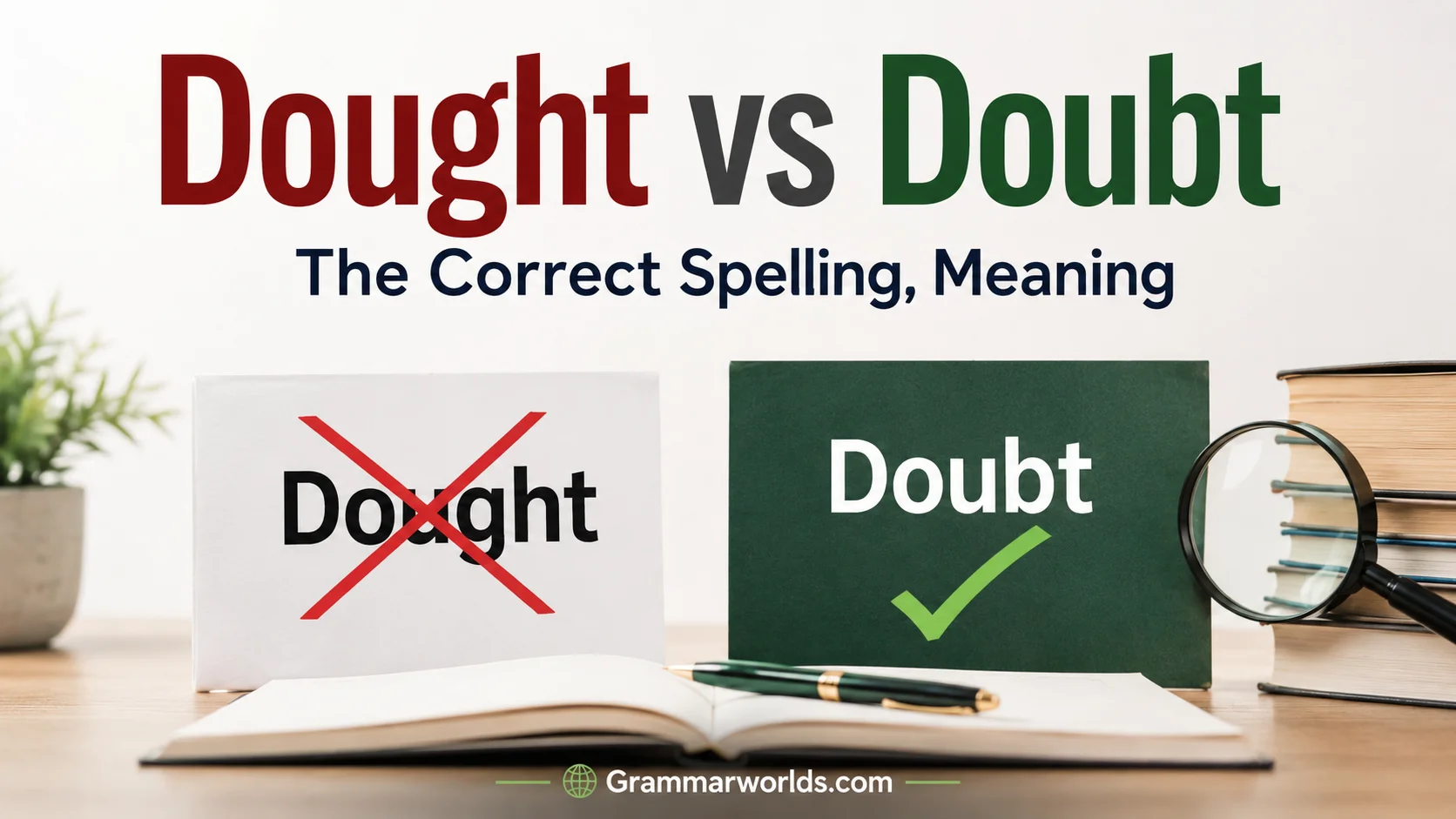
You have probably typed or seen “dought” at least once and paused for a second. It looks almost right. It even feels like it should exist in English.
But here’s the truth. It doesn’t belong in modern English at all.
The correct word is “doubt.”
This tiny spelling mistake causes confusion for learners, writers, and even native speakers in fast typing situations. The problem gets worse because English does not always follow clean spelling rules. Some letters stay silent. Some sounds mislead you. And some words simply break expectations.
In this guide on Dought vs Doubt Avoid Common English Mistakes, you will learn:
- Why “doubt” is correct and “dought” is not
- How this mistake happens in the first place
- What “doubt” actually means in real usage
- Simple tricks to stop making the error again
- Real examples that show correct usage in daily English
By the end, you will not only understand the difference. You will also remember it without trying too hard.
Let’s fix this once and for all.
Dought vs Doubt — The Correct Word Is Always “Doubt”
The simplest rule in this entire topic is clear:
“Doubt” is the correct spelling in modern English.
“Dought” is incorrect in standard usage.
What “Doubt” Actually Means
The word doubt expresses uncertainty. It describes a situation where you are not fully sure about something.
Here are its core meanings:
- Lack of certainty
- A feeling of hesitation
- Disbelief or questioning something
In real life, you use it constantly without thinking:
- “I doubt he will arrive on time.”
- “There is no doubt she worked hard.”
- “Do you doubt the result?”
It works both as a verb and a noun, which makes it extremely flexible in English.
Why “Dought” Is Wrong in Modern English
Let’s be very clear here.
- “Dought” is not used in modern English grammar or vocabulary
- It does not appear in standard dictionaries as a correct spelling
- It is considered a spelling error in writing
You might occasionally see it in two rare situations:
- Typing mistakes
- Confusion caused by similar sounding words like “thought” or “bought”
In older English texts, you may also see “dought” used in completely different historical contexts, but that usage is outdated and not relevant for modern communication.
So if you are writing essays, emails, blogs, or messages, stick with doubt every time.
Why People Confuse “Dought” and “Doubt” So Easily
If the correct answer is so simple, why does the mistake happen so often?
The answer lies in how English sounds versus how it is spelled.
Silent Letters Make English Tricky
The biggest reason is the silent “b” in “doubt.”
You do not pronounce it.
You say:
“dowt”
So your brain naturally tries to spell it the way it sounds.
That leads to creative but incorrect guesses like:
- dought
- dout
- dowt
English is full of these silent-letter traps. Words like:
- debt
- subtle
- thumb
follow the same pattern. They confuse learners because pronunciation hides the true spelling.
False Patterns from Similar Words
Another problem is pattern confusion.
English has many words that sound similar:
- thought
- bought
- fought
- brought
So learners assume “doubt” should follow the same pattern and become “dought.”
But English does not always obey patterns. It often breaks them without warning.
That’s what makes it tricky.
Typing Speed and Mental Guessing
Fast typing also creates errors.
When people type quickly, they often:
- rely on sound instead of spelling memory
- skip silent letters
- trust autocorrect too much
Sometimes autocorrect even fails to fix “dought” because it assumes you meant a real word in a different context.
That’s how mistakes slip through unnoticed.
Meaning Breakdown of “Doubt” in Real Usage
Let’s go deeper into how “doubt” actually works in English. This helps you remember the correct form naturally.
“Doubt” as a Verb
As a verb, doubt means to question or not fully believe something.
Examples:
- “I doubt his explanation.”
- “She doubts the story is true.”
- “Do you doubt what I said?”
It often shows hesitation or skepticism.
“Doubt” as a Noun
As a noun, it represents uncertainty itself.
Examples:
- “There is no doubt about her talent.”
- “He expressed doubt about the plan.”
- “I have serious doubts about this decision.”
Common Real-Life Usage Patterns
You will often see “doubt” used in these patterns:
- No doubt → certainty
- “No doubt, this is the best option.”
- In doubt → uncertainty
- “The outcome is still in doubt.”
- Without a doubt → strong certainty
- “She is, without a doubt, the best candidate.”
These phrases are extremely common in both spoken and written English.
Dought vs Doubt — Side-by-Side Comparison
Let’s make it crystal clear.
| Word | Status in English | Meaning | Example |
| Doubt | Correct | Uncertainty or hesitation | I doubt the claim is true. |
| Dought | Incorrect | No standard meaning in modern English | ❌ Avoid using |
This table alone solves most confusion instantly.
If you remember nothing else, remember this:
Only “doubt” belongs in modern English writing.
Why English Learners Keep Making This Mistake
This mistake is not about intelligence. It’s about language structure.
Let’s break it down.
English Spelling Does Not Match Sound
English is not a phonetic language. That means:
Words are not always spelled the way they sound.
For example:
- “knife” has a silent “k”
- “island” has a silent “s”
- “doubt” has a silent “b”
So spelling becomes memory-based instead of logic-based.
Also Read This :Bachelor vs Batchelor: Difference and Correct Usage
Overgeneralizing Language Rules
Learners often try to apply rules from other words.
For example:
- thought → seems like it should guide “doubt”
- bought → feels similar in sound structure
But English often ignores consistency.
Early Learning Habits Stick
If someone first learns “doubt” through speaking only, they may never see the written form enough to remember it correctly.
That creates long-term confusion.
Easy Memory Tricks to Always Spell “Doubt” Correctly
Now let’s make this stick in your mind permanently.
Remember the Silent “B” Trick
Think of it like this:
“I doUBt it, but I don’t say the B.”
The “b” is there. It just stays quiet.
Connect It to “Doubtful”
If you know “doubtful,” then “doubt” must be the root word.
- doubt → doubt + ful → doubtful
That pattern helps your brain lock it in.
Visual Chunking Method
Break it like this:
- DO
- UB
- T
It feels strange at first, but it reinforces memory.
Mental Association Trick
Picture someone whispering “b” in silence. It never gets spoken.
That small image helps many learners remember spelling better than rules alone.
Common Mistakes People Make With “Doubt”
Let’s look at real mistakes you should avoid.
Writing “Dought” Due to Sound Logic
This is the most common error.
People hear “dowt” and assume spelling matches sound.
Dropping Silent Letters in General
Learners sometimes simplify words incorrectly:
- dout ❌
- dought ❌
- dowt ❌
All are wrong.
Mixing With Similar Words
Confusion increases with words like:
- thought
- bought
- ought
- fought
These influence spelling guesses incorrectly.
FAQs
Is “dought” ever a correct spelling in English?
No, “dought” is not correct in modern English. It does not appear in standard dictionaries as a valid spelling. You might see it in rare historical texts, but in everyday writing, it is considered a mistake. Always use “doubt.”
Why is “doubt” spelled with a silent “b”?
The silent “b” comes from the word’s Latin origins. Over time, English pronunciation dropped the “b” sound, but the spelling stayed the same. That’s why you write doubt but pronounce it like “dowt.”
What is the easiest way to remember the correct spelling of “doubt”?
A simple trick helps:
Think of it as “I doUBt it, but I don’t say the B.”
The “b” is always there in writing but silent in speech. That mental image makes it easier to remember.
Why do people mistakenly write “dought” instead of “doubt”?
Most people spell it the way it sounds. Since “doubt” is pronounced “dowt,” learners assume it follows patterns like “thought” or “bought.” Fast typing and lack of exposure to written English also increase the mistake.
Can using “dought” affect my English writing score or communication?
Yes. In academic writing, exams, or professional communication, “dought” is considered incorrect and can lower your credibility. Using the correct spelling “doubt” shows stronger grammar accuracy and attention to detail.
Conclusion
The confusion between dought vs doubt comes down to one simple truth:
Only “doubt” is correct in modern English.
Once you understand the silent “b,” the mistake stops feeling random. It starts making sense.
Here’s what to remember:
- “Doubt” means uncertainty or hesitation
- “Dought” is a spelling error in modern English
- Silent letters often confuse learners
- Repetition and exposure build long-term accuracy
If you practice a little and stay aware, this mistake disappears quickly.
And the next time you see “dought,” you will not hesitate anymore. You will know exactly what is right.