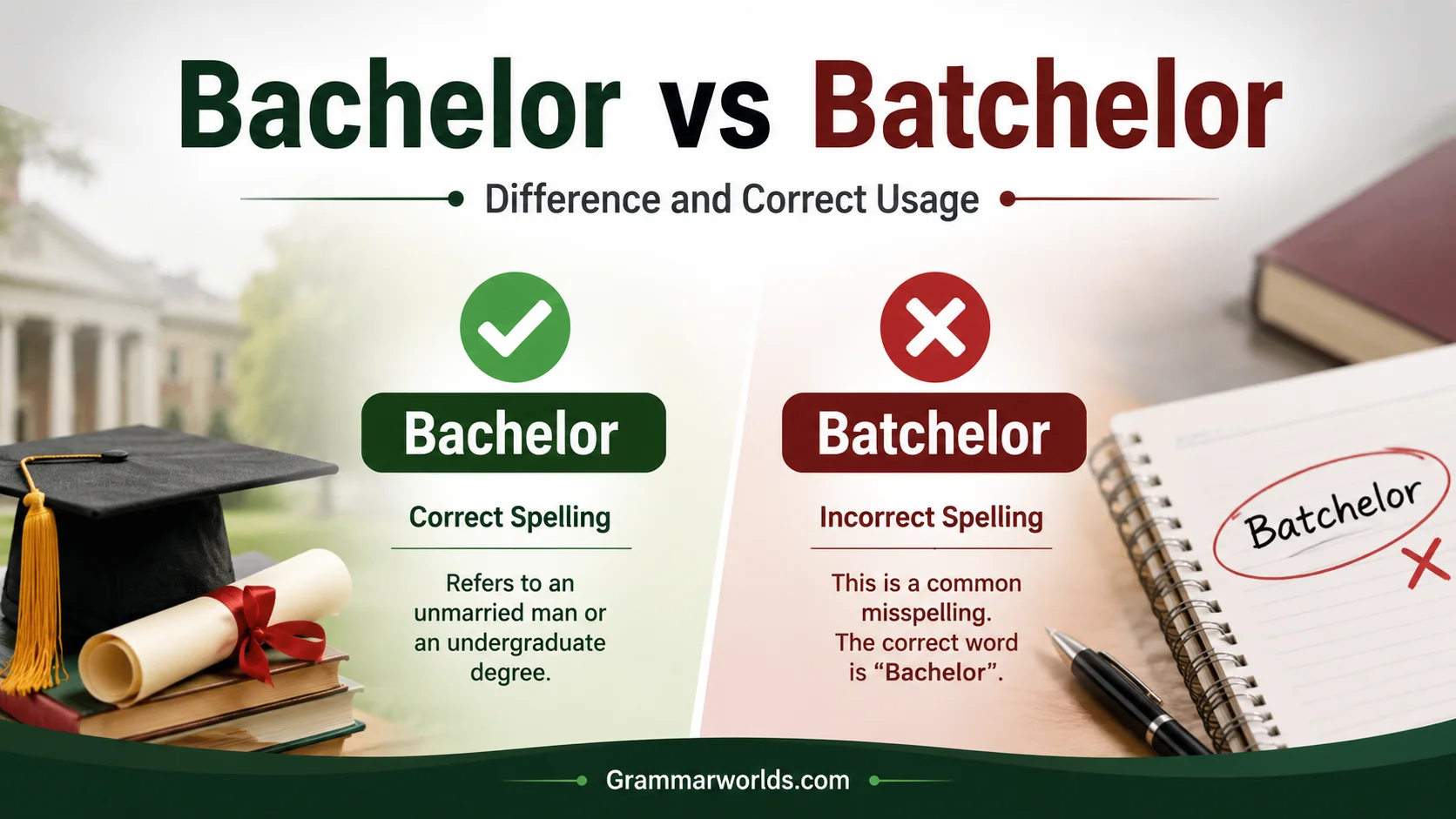
Spelling mistakes have a funny way of slipping into even confident writing. One of the most common mix-ups is “Bachelor vs Batchelor.” At first glance, it feels like both versions should be acceptable. They look almost identical. They even sound exactly the same when spoken aloud.
But here’s the truth that clears everything up fast: only “bachelor” is correct in modern English.
That might sound simple. However, the confusion runs deeper than a quick spelling error. It connects to history, language evolution, pronunciation habits, and even surnames that still exist today. Once you understand those layers, you will never second-guess this word again.
In this guide, you will learn:
- What “bachelor” actually means in different contexts
- Why “batchelor” appears in writing but is not standard
- How the word evolved over centuries
- Real examples that show correct and incorrect usage
- Memory tricks that lock the spelling into your mind
- Common mistakes students and writers still make
Let’s break it down in a way that finally makes it stick.
What Does “Bachelor” Mean? (Correct Spelling Explained)
The word bachelor has two major meanings in modern English. Both are widely used in academic and everyday communication.
Bachelor as an unmarried man
The most traditional meaning refers to a man who is not married.
Examples:
- He lived as a bachelor for most of his adult life.
- The film follows a wealthy bachelor navigating city life.
This usage often appears in literature, media, and social commentary. It can describe lifestyle, personality, or relationship status depending on context.
Bachelor as an academic degree
The second meaning refers to an undergraduate university qualification.
Examples:
- She earned a Bachelor of Science in Chemistry.
- He completed his Bachelor’s degree in Economics in 2022.
This usage is extremely common in academic records, job applications, and resumes.
Key grammatical forms
Here are the correct forms you will often see:
- Bachelor → noun (person or degree holder)
- Bachelor’s degree → possessive form (correct academic usage)
- Bachelors → plural noun (rare in formal writing without apostrophe when used generically)
A simple rule helps here:
If it looks professional or academic, “bachelor” is always the safe choice.
Is “Batchelor” a Correct Word?
This is where most confusion gets resolved.
The short answer: No, “batchelor” is not standard modern English.
Why you still see it sometimes
Even though it is incorrect in general usage, “batchelor” still appears in a few places:
- As a surname (family name)
- In historical documents or older texts
- In rare regional or archaic spellings
However, none of these cases make it acceptable in modern writing.
For example:
- Mr. Batchelor (surname) ✔️ correct as a name
- “He is a batchelor living in London.” ❌ incorrect usage
Important distinction
This is the key takeaway:
- Bachelor = correct English word
- Batchelor = surname or historical variation only
So if you are writing essays, emails, exams, or professional content, “batchelor” will always be marked wrong.
Why Do People Confuse Bachelor and Batchelor?
This confusion does not come out of nowhere. Several real linguistic reasons explain it.
They sound identical
Both words are pronounced the same way:
/ˈbætʃ.əl.ər/
Since pronunciation gives no clue, writers rely on memory. That is where mistakes creep in.
Influence of surnames
Many people have encountered the surname Batchelor in real life, books, or workplaces. Because surnames often preserve older spellings, they can mislead learners into thinking the spelling is correct for general use.
Old English variation habits
English spelling was not always standardized. Before modern dictionaries, writers often spelled words in multiple ways. Some of those older variants still survive as names today.
Typing errors and autocorrect
Modern writing tools also play a role:
- Fast typing leads to missed letters
- Autocorrect sometimes fails to correct uncommon names
- Muscle memory reinforces wrong spelling over time
So even though the rule is simple, real-world usage creates confusion.
Historical Background of the Word “Bachelor”
Understanding where the word comes from makes the spelling easier to remember.
Old French origin
The word bachelor comes from Old French:
bacheler
In medieval times, it referred to a young man or a novice knight.
Middle English adoption
Around the 13th–14th centuries, English borrowed the term and adapted it into:
bacheler → bachelor
During this transition, spelling variations were common. That is where forms like “batchelor” began appearing in informal writing.
Standardization of English
By the 18th and 19th centuries, dictionaries and grammar guides began standardizing spelling. The modern form “bachelor” became the official version in English literature and education.
Why “batchelor” survived at all
Even after standardization, surnames often preserve older spellings. That is why you still see “Batchelor” today in family names, even though the word itself changed.
Common Real-World Usage of “Bachelor”
The word appears in several important areas of everyday communication.
Academic usage
This is the most formal and widely recognized context.
Examples:
- Bachelor of Arts (BA)
- Bachelor of Science (BS)
- Bachelor of Business Administration (BBA)
These degrees are globally recognized and used in universities worldwide.
Social usage
Here, “bachelor” describes relationship status.
Examples:
- A lifelong bachelor living in the countryside
- The city is known for its bachelor lifestyle culture
This usage often appears in journalism, storytelling, and media.
Professional documents
You will frequently see “bachelor” in:
- Resumes
- Job applications
- Academic transcripts
- LinkedIn profiles
In these settings, spelling accuracy matters a lot. A small mistake can make writing look careless.
Also Read This :Signer vs Signor: Difference and Correct Usage
Common Mistakes People Make
Even strong writers slip up with this word. Here are the most frequent errors.
Mistake 1: Writing “batchelor” instead of “bachelor”
This is the most obvious error. It usually comes from confusion with surnames.
Incorrect:
- He completed his Batchelor of Science
Correct:
- He completed his Bachelor of Science
Mistake 2: Incorrect apostrophe placement
People often confuse possessive form in academic writing.
Incorrect:
- Bachelors degree
- Bachelor degree
Correct:
- Bachelor’s degree
The apostrophe shows possession. It means the degree belongs to a bachelor level of study.
Mistake 3: Overthinking silent spelling rules
Some writers assume extra letters are needed because of pronunciation. English does not always follow phonetic spelling.
Remember:
English spelling often preserves history more than sound.
Bachelor vs Batchelor — Quick Comparison Table
| Feature | Bachelor | Batchelor |
| Standard spelling | Yes | No |
| Modern English usage | Correct | Incorrect |
| Academic acceptance | Fully accepted | Rejected |
| Used in surnames | Rare | Yes |
| Found in exams | Yes | No |
| Meaning | Degree holder / unmarried man | Not a valid common noun |
This table makes one thing clear: only one form belongs in everyday writing.
Memory Trick to Remember the Correct Spelling
You do not need complex grammar rules to remember this. A simple trick works better.
The “No Extra T” Rule
Think of it like this:
A bachelor stands alone. No extra letters needed.
The word does not need a “T” after “ba.”
Break it visually
Split it in your mind:
- BACHE + LOR
No “T” fits naturally in that structure.
Association trick
Picture a single man standing alone at a party. That image reinforces the meaning of “bachelor” and helps lock in the correct spelling.
Examples of Correct vs Incorrect Usage
Seeing the word in action helps reinforce the rule.
Correct examples
- He decided to remain a bachelor.
- She completed her Bachelor of Arts in 2026.
- The university offers a Bachelor’s program in engineering.
- Many novels describe the lonely life of a bachelor in the city.
Incorrect examples
- He is a batchelor living in Paris.
- She earned a Batchelor of Science degree.
- The Batchelor’s degree requires four years of study.
One small spelling mistake can change how professional your writing appears.
Case Study — Why Spelling Accuracy Matters in Academic Writing
Let’s look at a realistic scenario.
Student assignment example
A university student writes:
“I completed my Batchelor of Commerce from a recognized university.”
The content is correct. However, the spelling error changes perception.
What happens next
- Teachers immediately flag the spelling
- Academic credibility drops slightly
- The student loses easy marks
- The document looks less professional overall
Now compare the corrected version:
“I completed my Bachelor of Commerce from a recognized university.”
Same meaning. Different impact.
Key takeaway
In academic and professional settings, spelling is not decoration. It is credibility.
Even a small error like this can influence evaluation.
FAQs
Is “batchelor” ever correct?
“Batchelor” is only correct as a surname. In general English writing, it is incorrect.
What is the correct spelling of bachelor’s degree?
The correct form is:
Bachelor’s degree
The apostrophe shows possession. It refers to a degree at the bachelor level.
Why is it spelled bachelor and not batchelor?
The spelling evolved from Old French “bacheler.” Over time, English standardized it to “bachelor” while dropping extra letters that were not needed.
Can I use batchelor in academic writing?
No. Academic institutions treat it as a spelling error. Always use “bachelor.”
Is bachelor the same in British and American English?
Yes. Both British and American English use the same spelling:
bachelor
There is no regional variation for this word.
conclusion
At first, “Bachelor vs Batchelor” feels like a minor spelling issue. However, it reveals something bigger about English itself. The language carries history, evolution, and standardization within every word.
Here is the simplest way to remember it:
- Bachelor = correct, modern, standard
- Batchelor = surname or historical form only
If you are writing essays, resumes, emails, or content, always stick with bachelor. That one choice keeps your writing clean, professional, and confident.
Language rewards precision. And now you have one less mistake to worry about.