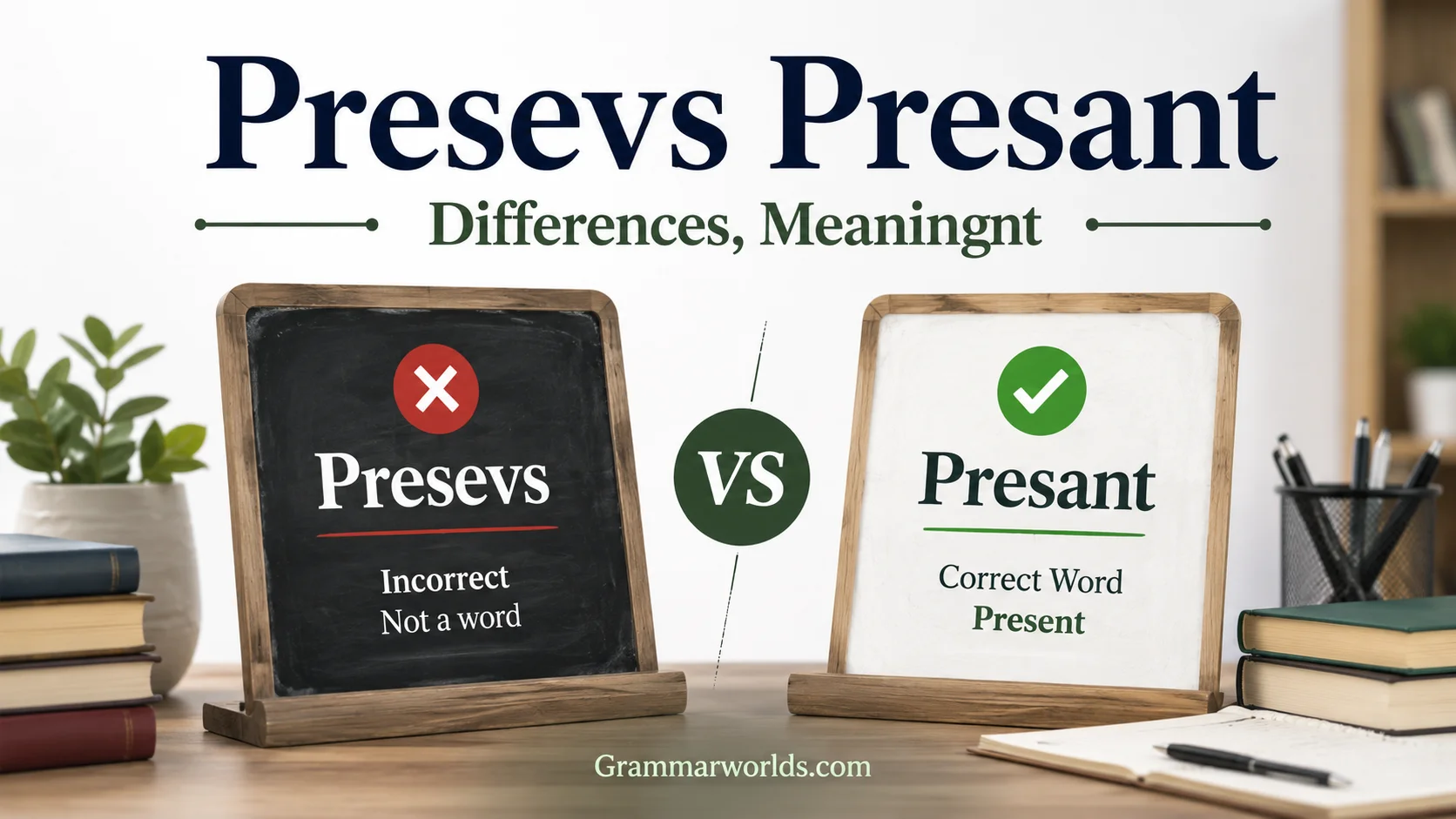
Have you ever typed “presant” and wondered whether it was correct? You’re not alone. Thousands of people search for present vs presant every month because the two words sound almost identical when spoken. However, only one spelling is accepted in standard English.
The short answer is simple: “Present” is correct, while “presant” is a misspelling.
Although the difference involves just one letter, using the wrong spelling can affect your credibility in academic writing, business communication, job applications, emails, and everyday correspondence.
In this detailed guide, you’ll learn exactly why present is correct, why people commonly write presant, how to use present correctly in different contexts, and practical tips to avoid making this mistake in the future.
Present vs Presant: The Quick Comparison
Before diving deeper, let’s clear up the confusion immediately.
| Word | Correct Spelling? | Meaning | Standard English Usage |
| Present | Yes | A gift, current time, or to show/introduce something | Accepted |
| Presant | No | No recognized meaning | Not accepted |
Key Takeaway
If you’re choosing between present and presant, always choose present.
The spelling presant does not appear as a legitimate English word in major dictionaries. It is simply a spelling error.
Is “Presant” a Real Word?
One of the most common questions people ask is whether presant exists as a real English word.
The answer is straightforward: No, it does not.
Major dictionaries, style guides, educational institutions, and grammar resources recognize only present.
You won’t find presant listed as:
- A noun
- A verb
- An adjective
- A formal alternative spelling
- A British English variation
- An American English variation
Instead, dictionaries typically identify it as a misspelling of present.
Why Dictionaries Matter
Dictionaries serve as the official reference point for accepted spelling and usage. When a word appears consistently in reputable dictionaries, it becomes part of standard language.
Because presant lacks dictionary recognition, writers should avoid using it in:
- Academic papers
- Business reports
- Professional emails
- Resumes
- Cover letters
- Blog posts
- Published content
Using the correct spelling helps your writing appear polished and trustworthy.
Why Do People Write “Presant”?
Here’s the interesting part.
Most people don’t misspell present because they don’t know the word. They misspell it because English pronunciation often creates confusion.
Several factors contribute to this common mistake.
Pronunciation Influences Spelling
When people say “present” quickly, the middle vowel sound can become less distinct.
For example:
Present → PREZ-uhnt
The second syllable often sounds similar to:
- ent
- ant
- unt
As a result, some writers incorrectly assume the word ends with -ant instead of -ent.
Typing Errors
Many spelling mistakes happen simply because people type quickly.
Common examples include:
- Presant
- Presnt
- Presetn
- Preeent
- Presenet
Fast typing increases the chance of swapping or replacing letters.
English Learners Face Additional Challenges
People learning English as a second language often rely on pronunciation when spelling unfamiliar words.
Unfortunately, English isn’t always phonetic.
For example:
| Pronunciation | Correct Spelling |
| Diferent | Different |
| Goverment | Government |
| Presant | Present |
The spoken form doesn’t always reveal the correct spelling.
Regional Accents Can Contribute
Different accents pronounce words differently.
In some regions, the vowel sound in present may resemble the sound in ant, making the incorrect spelling feel natural even though it isn’t correct.
What Does “Present” Mean?
One reason present causes confusion is that it serves multiple grammatical functions.
It can act as:
- A noun
- A verb
- An adjective
Understanding these roles helps you use the word correctly.
Present as a Noun
As a noun, present usually means a gift.
Definition
A present is something given to another person without expecting payment in return.
Examples
- She received a birthday present.
- The children opened their Christmas presents.
- He bought a thoughtful present for his mother.
Common Situations
People frequently use “present” when discussing:
- Birthdays
- Weddings
- Holidays
- Graduations
- Anniversaries
- Celebrations
Example in Context
Imagine your friend graduates from college.
You might say:
“I bought her a present to celebrate her achievement.”
In this sentence, present clearly means a gift.
Present as an Adjective
As an adjective, present means existing now or happening at the current time.
Definition
Present describes something that belongs to the current moment.
Examples
- The present situation requires immediate action.
- We need to focus on present challenges.
- The present economy differs from the past economy.
Common Uses
You’ll often see present used in:
- Business reports
- News articles
- Academic writing
- Government publications
- Scientific studies
Example in Context
A company discussing market conditions might write:
“The present market environment favors innovation.”
Here, present means current.
Present as a Verb
As a verb, present means to show, introduce, offer, or formally display something.
Definition
To present something means to provide it for consideration or observation.
Examples
- She will present the report tomorrow.
- The lawyer presented evidence in court.
- The company presented its new product line.
Professional Usage
Business professionals use this form regularly.
Examples include:
- Presenting proposals
- Presenting findings
- Presenting solutions
- Presenting research
- Presenting recommendations
Example in Context
A project manager might say:
“I’ll present our quarterly results during the meeting.”
In this case, present means to show or explain information.
How to Use “Present” Correctly in Sentences
Knowing the definition is helpful. Seeing the word in action is even better.
Let’s examine real-world examples.
Present as a Noun in Sentences
Examples:
- Every child received a present at the party.
- The wedding present arrived yesterday.
- Her present was wrapped in silver paper.
- We found the perfect anniversary present.
- The graduation present surprised everyone.
Notice how each sentence uses present as a thing that someone receives.
Present as an Adjective in Sentences
Examples:
- The present leadership team has improved performance.
- We must address the present challenges.
- Present conditions favor economic growth.
- The present generation relies heavily on technology.
- Scientists continue studying present climate trends.
In these examples, present describes something current.
Present as a Verb in Sentences
Examples:
- The CEO will present next year’s strategy.
- Doctors presented the findings at a conference.
- The teacher presented a new lesson.
- The committee presented several recommendations.
- Researchers presented compelling evidence.
Here, present means showing or delivering information.
Common Mistakes Involving Present and Presant
Small spelling mistakes often create bigger problems than people realize.
While readers may understand your intended meaning, incorrect spelling can damage professionalism.
Mistake in Professional Emails
Incorrect:
I will presant the report tomorrow.
Correct:
I will present the report tomorrow.
Business communication requires accuracy.
A simple spelling error can make a message appear rushed or careless.
Mistake in Academic Writing
Incorrect:
The presant study examines language acquisition.
Correct:
The present study examines language acquisition.
Academic writing relies heavily on credibility and precision.
Mistake in Social Media Content
Incorrect:
I got an amazing presant today!
Correct:
I got an amazing present today!
While social media is more casual, correct spelling still improves readability.
Why Spell Check Doesn’t Always Save You
Many people assume technology catches every mistake.
Unfortunately, that’s not always true.
Some systems:
- Ignore uncommon words
- Miss context-based errors
- Fail when autocorrect is disabled
- Allow user-added dictionary entries
Because of this, proofreading remains important.
Also Read This :Maintained vs. Maintenanced: Differences Explained
Quick Editing Tip
Search your document for:
- Presant
- Presants
- Presanted
- Presanting
Then replace them with:
- Present
- Presents
- Presented
- Presenting
This simple check eliminates several common mistakes.
Present vs Presant: Side-by-Side Examples
The easiest way to remember the difference is to compare them directly.
| Incorrect Usage | Correct Usage |
| I bought a presant. | I bought a present. |
| The presant situation is improving. | The present situation is improving. |
| She will presant the proposal. | She will present the proposal. |
| His birthday presant arrived early. | His birthday present arrived early. |
| The presant team performed well. | The present team performed well. |
What Makes the Correct Version Right?
The answer is simple.
Present follows standard English spelling conventions and appears in dictionaries.
Presant does not.
Whenever you encounter uncertainty, remember:
If you’re referring to a gift, current time, or introducing something, the spelling is always “present.”
Easy Memory Tricks to Remember the Correct Spelling
Many writers struggle with recurring spelling mistakes.
Fortunately, a few simple tricks can help.
Remember the “-ent” Ending
The correct word ends with:
ENT
Not:
ANT
Visualize the word:
Pres + ent = Present
This mental breakdown helps reinforce the proper spelling.
Connect It to Related Words
Look at words from the same family:
| Word Family | Correct Form |
| Present | ✓ |
| Presented | ✓ |
| Presenter | ✓ |
| Presentation | ✓ |
Notice something?
Every related word begins with present.
None begin with presant.
Use Repetition
Writing the word several times can strengthen memory.
Practice:
- Present
- Present
- Present
- Present
Repetition helps the correct spelling become automatic.
Read More Frequently
Strong readers generally become strong spellers.
Regular exposure to correctly written words trains your brain to recognize proper spelling patterns.
Frequently Confused Words Similar to Present
The English language contains many words that resemble present.
Understanding the differences prevents additional confusion.
Present vs Presence
Present
Means:
- A gift
- Current
- To show
Presence
Means:
- The state of being somewhere
- Physical attendance
Examples:
- Her presence improved the atmosphere.
- His present made everyone smile.
These words share the same root but different meanings.
Present vs Presenter
Present
Can function as a noun, verb, or adjective.
Presenter
Refers to a person who presents something.
Examples:
- The presenter explained the topic.
- She will present the topic.
One is a person. The other is an action or object.
Present vs Presentation
Present
Usually refers to giving or showing.
Presentation
Refers to the event, speech, or display itself.
Examples:
- I will present the results.
- My presentation begins at noon.
This distinction appears frequently in workplace communication.
Present vs Represent
Because both words contain “present,” writers occasionally confuse them.
Present
Means to show or introduce.
Represent
Means to stand for or symbolize.
Examples:
- She will present the findings.
- The logo represents the company.
The meanings differ significantly.
Real-World Importance of Correct Spelling
Some people dismiss spelling mistakes as minor issues.
However, research consistently shows that readers form opinions quickly based on writing quality.
Professional Impact
Employers often evaluate:
- Attention to detail
- Communication skills
- Professionalism
- Competence
Frequent spelling mistakes can negatively influence these perceptions.
Academic Impact
Students who use accurate spelling often:
- Communicate ideas more clearly
- Earn better grades
- Produce stronger essays
- Build credibility with instructors
Business Impact
Businesses benefit from error-free writing because it:
- Builds trust
- Enhances brand image
- Improves readability
- Reduces misunderstandings
One misspelled word may seem small.
Repeated errors create a different impression.
Quick Reference Summary Table
| Question | Answer |
| Is present correct? | Yes |
| Is presant correct? | No |
| Is presant in dictionaries? | No |
| Can present be a noun? | Yes |
| Can present be a verb? | Yes |
| Can present be an adjective? | Yes |
| Is presant accepted in British English? | No |
| Is presant accepted in American English? | No |
FAQs
Is Presant Ever Correct?
Standard English does not recognize presant as a valid spelling. Whenever you need the word, use present instead.
Why Do So Many People Spell Present as Presant?
The mistake usually occurs because pronunciation can make the ending sound similar to -ant. Fast typing and unfamiliarity with spelling patterns also contribute.
What Is the Difference Between Present and Presant?
The difference is simple: present is the correct English spelling, while presant is a spelling mistake. Whether you’re referring to a gift, the current time, or the act of showing something, the correct word is always present.
Is Presant Accepted in Any English Dictionary?
No. Major dictionaries do not recognize presant as a valid English word. If you use it in formal writing, spell-check tools will usually flag it as an error and suggest present as the correct spelling.
Why Is Present Commonly Misspelled as Presant?
Many people spell present as presant because of pronunciation. In everyday speech, the second syllable can sound similar to “-ant,” leading writers to choose the wrong vowel when spelling the word.
Conclusion
Understanding the difference between present vs presant is easier than many people think. While the two spellings may sound similar when spoken, only present is correct in standard English. The word can describe a gift, refer to the current moment, or mean to introduce, show, or deliver something. In every case, the spelling remains the same.On the other hand, presant is simply a misspelling. It does not appear in recognized dictionaries, style guides, or grammar references. Using the correct spelling helps you communicate clearly and maintains professionalism in academic, business, and everyday writing.