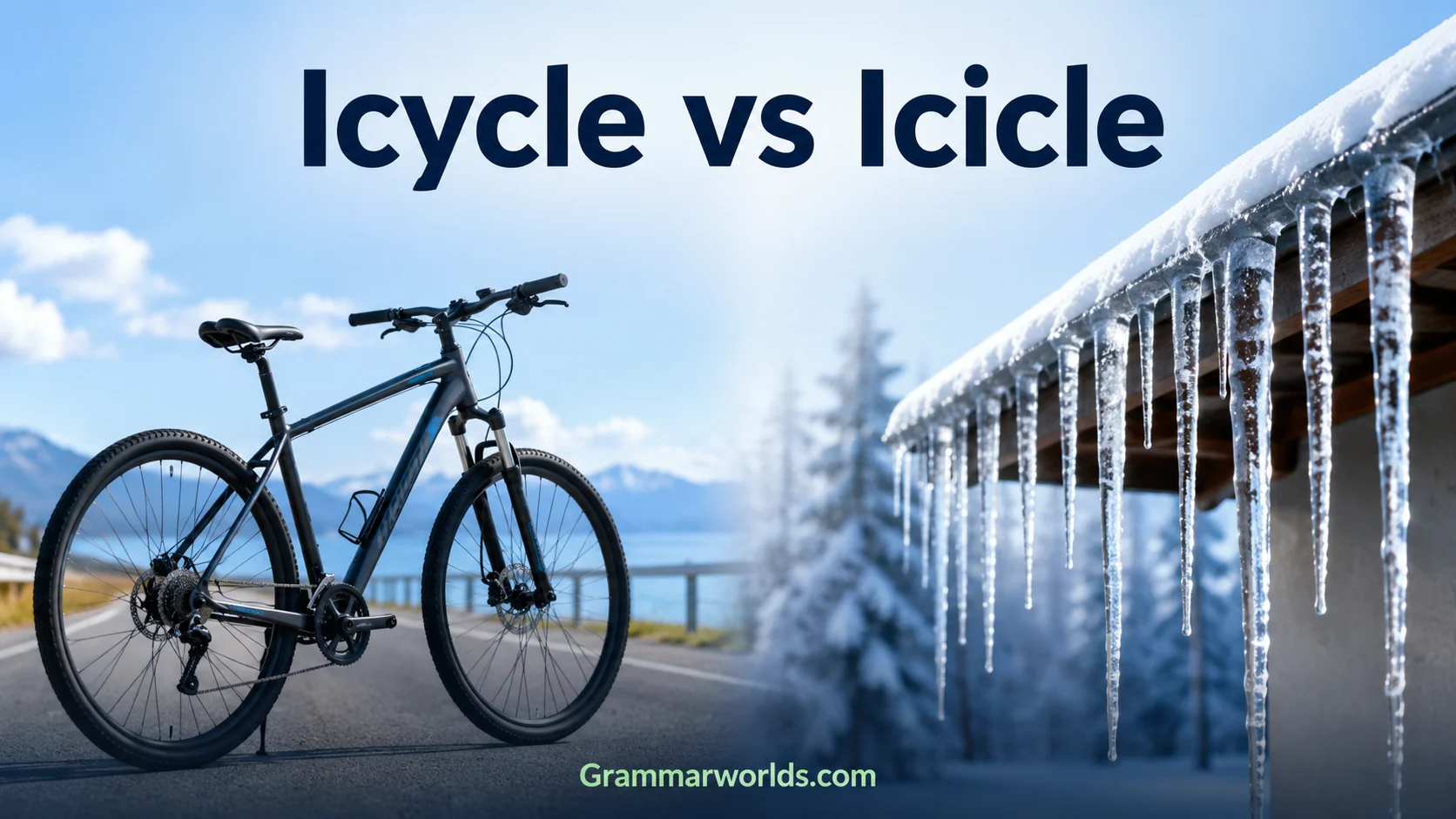
Have you ever stopped while typing the word icicle and wondered whether it should actually be spelled icycle? You’re not alone.
Thousands of people search for “icycle vs icicle” every year because the two spellings look surprisingly similar. The confusion becomes even more understandable when you consider how the word sounds when spoken aloud. Many people hear “icycle” even though the correct spelling is actually icicle.
English contains countless words that don’t follow predictable spelling patterns. Words such as colonel, yacht, and Wednesday often trip people up. Icicle belongs in that same category. Its pronunciation doesn’t perfectly match its spelling, which causes many writers to question whether they should use icycle or icicle.
The good news is that the answer is straightforward.
In standard English, icicle is the correct spelling, while icycle is generally considered a misspelling unless it appears as a brand name, product name, username, or creative title.
This guide explains the difference between icycle and icicle, why the confusion happens, how to remember the correct spelling, and when you might legitimately encounter the word icycle.
Icycle vs Icicle: The Quick Answer
If you’re looking for the shortest possible explanation, here it is:
| Word | Standard English Word? | Meaning | Correct Usage |
| Icicle | Yes | A hanging piece of frozen water | Yes |
| Icycle | No (usually) | Common misspelling or proper name | No |
The Bottom Line
When referring to frozen water hanging from a roof, branch, cliff, or other surface, always use icicle.
For example:
✅ An icicle hung from the edge of the roof.
✅ The morning sun made the icicles sparkle.
❌ An icycle hung from the edge of the roof.
❌ The morning sun made the icycles sparkle.
In everyday writing, academic work, journalism, and professional communication, icicle is the only accepted spelling.
What Does Icicle Mean?
An icicle is a narrow, tapering piece of ice that forms when dripping water freezes.
Most icicles appear during winter when temperatures fall below freezing. Water melts during warmer periods of the day and then freezes again as temperatures drop.
Dictionary Definition
An icicle is:
“A hanging, tapering piece of ice formed by the freezing of dripping water.”
The word specifically describes ice that hangs downward and gradually narrows toward the bottom.
How Icicles Form
Although they may look simple, icicles develop through a fascinating natural process.
Here’s how it happens:
- Snow or ice melts.
- Water drips from a surface.
- Air temperatures remain below freezing.
- The dripping water freezes.
- Additional water freezes around the original ice.
- The icicle grows longer over time.
The process repeats continuously until temperatures rise or the water source disappears.
Common Places Where Icicles Form
You can find icicles on:
- Roof edges
- Gutters
- Tree branches
- Cliffs
- Bridges
- Fences
- Power lines
- Mountain overhangs
In extremely cold regions, some icicles can grow several feet long.
Example Sentences
Here are some examples of proper usage:
- Thick icicles hung from the cabin roof.
- Children admired the sparkling icicles after the snowstorm.
- The sunlight reflected beautifully off the icicles.
- Workers removed dangerous icicles from the building entrance.
- Large icicles formed overnight during the cold snap.
Notice that every example uses the spelling icicle, not icycle.
Is Icycle a Real Word?
This is the question most people really want answered.
The short answer is no.
You won’t find icycle listed as a standard English noun in major dictionaries as an alternative spelling of icicle.
That means if you’re writing about frozen water formations, icycle is considered incorrect.
Why People Think Icycle Is a Real Word
Several factors contribute to the confusion.
The biggest reason is pronunciation.
When spoken quickly, icicle often sounds like:
- eye-sickle
- eye-sicle
- eye-cycle
That final pronunciation causes many people to assume the spelling should include the word “cycle.”
As a result, they write:
- icycle
- icycles
- an icycle
instead of:
- icicle
- icicles
- an icicle
What Dictionaries Say
Major dictionaries consistently recognize:
- Icicle ✅
They do not recognize:
- Icycle ❌ (as a standard noun meaning frozen water)
This distinction matters because dictionary acceptance determines standard spelling in formal English.
Why “Icicle” Is Often Misspelled as “Icycle”
Some spelling mistakes happen because people type too quickly.
Others happen because English itself creates confusion.
The mistake of writing icycle instead of icicle falls into the second category.
The Word Doesn’t Look Like It Sounds
One reason people struggle with icicle is that its spelling appears unusual.
Let’s break it down:
Icicle
I + cic + le
At first glance, many readers don’t instinctively know how to pronounce it.
The brain often searches for familiar patterns and replaces unfamiliar letter combinations with something more recognizable.
That’s where cycle enters the picture.
The Influence of Familiar Words
English speakers frequently encounter words such as:
- Bicycle
- Tricycle
- Motorcycle
- Recycle
- Cycle
Because these words are common, many people subconsciously apply the same spelling pattern.
For example:
| Correct Word | Similar Familiar Word |
| Icicle | Bicycle |
| Icicle | Tricycle |
| Icicle | Recycle |
| Icicle | Cycle |
The visual similarity creates a mental shortcut that leads to the misspelling.
English Is Full of Spelling Traps
Consider these examples:
| Pronunciation | Correct Spelling |
| Nite | Night |
| Thru | Through |
| Wensday | Wednesday |
| Definately | Definitely |
| Icycle | Icicle |
Many spelling errors happen because people write words exactly as they hear them.
A Simple Trick to Remember the Correct Spelling
Fortunately, remembering the correct spelling is easier than many people think.
Memory Trick: Ice Appears Twice
Look carefully at the word:
ICICLE
Notice something interesting?
The word visually contains the idea of “ice” twice.
You can think of it this way:
ICICLE = ICE + ICE + little ending
While this isn’t a linguistic breakdown, it serves as a powerful memory aid.
Visual Reminder
Imagine an icicle growing layer by layer.
Each layer adds more ice.
More ice creates a larger icicle.
The repeated “ice” concept makes the spelling easier to remember.
Quick Formula
Remember:
Ice creates icicles.
Not:
Cycle creates icycles.
That simple association helps eliminate the mistake instantly.
Icicle Pronunciation Explained
Pronunciation often drives spelling mistakes.
Understanding how icicle sounds can prevent future confusion.
Standard Pronunciation
The word is commonly pronounced as:
EYE-sih-kul
Phonetic representation:
/ˈaɪ.sɪ.kəl/
Syllable Breakdown
The word contains three syllables:
I – ci – cle
Spoken naturally:
eye-si-kul
Because the final syllables blend together in fast speech, listeners sometimes hear:
eye-cycle
rather than:
eye-si-kul
That subtle difference explains why so many people mistakenly write icycle.
Regional Variations
Different accents may slightly alter pronunciation.
However, regardless of accent:
- American English uses icicle
- British English uses icicle
- Canadian English uses icicle
- Australian English uses icicle
The spelling remains the same.
Also Read This :Presevs Presant: Differences, Meaningnt
Examples of Correct and Incorrect Usage
Seeing examples side by side often helps reinforce proper usage.
Correct Usage
| Sentence | Correct? |
| The icicle fell from the roof. | Yes |
| Beautiful icicles decorated the cabin. | Yes |
| The sun melted the icicle. | Yes |
| Children admired the giant icicles. | Yes |
Incorrect Usage
| Sentence | Correct? |
| The icycle fell from the roof. | No |
| Beautiful icycles decorated the cabin. | No |
| The sun melted the icycle. | No |
| Children admired the giant icycles. | No |
Common Corrections
| Incorrect | Correct |
| icycle | icicle |
| icycles | icicles |
| an icycle | an icicle |
| giant icycle | giant icicle |
When “Icycle” Might Actually Be Correct
Although icycle is not the standard spelling of icicle, there are situations where it may legitimately appear.
Context matters.
Brand Names
Companies sometimes choose unique spellings to make their brands memorable.
For marketing purposes, a business may use:
- Icycle
- I-Cycle
- iCycle
as a trademarked name.
In those cases, the spelling belongs to the brand rather than the dictionary.
Product Names
Some products use creative spellings.
Examples may include:
- Software applications
- Fitness products
- Transportation services
- Technology startups
- Gaming products
A company can legally create a product called “Icycle” even though the standard word remains icicle.
Usernames and Online Handles
The internet encourages creative naming.
You might see:
- @IcycleGaming
- @IcyclePro
- @OfficialIcycle
These are usernames rather than dictionary words.
Creative Works
Authors, artists, and developers often invent spellings to stand out.
You may encounter Icycle in:
- Video games
- Books
- Music projects
- Fictional worlds
- Graphic novels
In those situations, the spelling functions as a proper noun.
Commonly Confused Winter Words
People who search for icycle vs icicle often confuse other winter-related terms as well.
Understanding the differences helps improve vocabulary.
Icicle vs Iceberg
Although both consist of frozen water, they are very different.
| Feature | Icicle | Iceberg |
| Forms from dripping water | Yes | No |
| Floats in water | No | Yes |
| Found on roofs | Yes | No |
| Found in oceans | No | Yes |
| Size | Small to medium | Massive |
An iceberg can weigh millions of tons.
An icicle usually weighs a few ounces or pounds.
Icicle vs Frost
Frost forms differently.
Frost
- Thin layer of ice crystals
- Appears on surfaces
- Covers grass, windows, and cars
Icicle
- Hanging formation
- Forms from dripping water
- Extends downward
Think of frost as a blanket and an icicle as a hanging spike.
Icicle vs Hail
Many people confuse these frozen forms of water.
Hail
- Falls from thunderstorms
- Forms in clouds
- Drops from the sky
Icicle
- Forms on surfaces
- Grows gradually
- Remains attached until it melts or falls
One falls from above.
The other hangs in place.
Icicle vs Snow
Snow and icicles both involve frozen water, yet they form differently.
| Feature | Snow | Icicle |
| Forms in clouds | Yes | No |
| Falls from sky | Yes | No |
| Grows on surfaces | No | Yes |
| Crystal structure | Complex | Solid frozen layers |
Snowflakes develop in clouds.
Icicles develop after water drips and freezes.
Interesting Facts About Icicles
Icicles may seem ordinary, but science tells a fascinating story.
Icicles Grow From the Bottom
Many people assume icicles grow from the top.
In reality, growth occurs largely at the tip as water continues freezing.
They Can Become Dangerous
Large icicles sometimes cause injuries.
Property owners in cold climates often remove oversized icicles before they fall.
They Reveal Temperature Patterns
Scientists study icicles to better understand:
- Heat transfer
- Water movement
- Ice formation
- Winter weather conditions
They Are Not Always Pure Ice
Icicles often contain:
- Dust particles
- Minerals
- Air bubbles
- Environmental contaminants
As a result, they are generally unsafe to eat.
Why Correct Spelling Matters
Some people wonder whether spelling really matters.
In casual texting, mistakes may not cause serious problems.
In professional writing, however, correct spelling affects credibility.
Academic Writing
Teachers expect standard spelling.
Using icycle instead of icicle can lower writing quality.
Professional Communication
Employers, clients, and colleagues notice spelling errors.
Correct spelling demonstrates attention to detail.
Searchability
When publishing online content, using the correct word helps readers find your content through search engines.
Language Learning
Learning proper spelling strengthens vocabulary and communication skills.
Every correctly learned word becomes part of a stronger language foundation.
Final Verdict: Icycle or Icicle?
The debate between icycle vs icicle has a clear winner.
Icicle is the correct spelling in standard English. Dictionaries, educational institutions, publishers, and language experts all recognize icicle as the proper word for a hanging piece of frozen water.
Icycle, on the other hand, is usually a misspelling that results from pronunciation confusion and the influence of familiar words such as bicycle and cycle.
If you’re writing about winter weather, frozen water, roofs, trees, or natural ice formations, always use icicle.
The only time icycle may be appropriate is when it refers to a specific brand, product, username, company, or creative title.
When in doubt, remember this simple rule:
Ice makes icicles, not icycles.
FAQs
Is icycle a real word?
In standard English, no. Icycle is generally considered a misspelling of icicle. However, it may appear as a brand name, username, product name, or creative title.
Which spelling is correct: icycle or icicle?
Icicle is the correct spelling. It refers to a hanging formation of frozen water created when dripping water freezes.
Why do people spell icicle as icycle?
People often hear the word pronounced as “eye-cycle.” Because of that pronunciation, they mistakenly assume the spelling should contain the word cycle.
Is icycle in the dictionary?
Major English dictionaries recognize icicle as the correct word. They generally do not list icycle as an alternative spelling for the frozen water formation.
Can I use icycle in formal writing?
No. In formal, academic, business, and professional writing, you should use icicle..
Conclusion
The confusion between icycle vs icicle is easy to understand. The words sound similar when spoken aloud, which leads many people to assume that icycle is an acceptable spelling. However, standard English recognizes only icicle as the correct word for a hanging formation of frozen water.Whether you’re writing a school paper, creating online content, sending a professional email, or simply improving your vocabulary, using the correct spelling matters. It helps your writing look polished, prevents misunderstandings, and demonstrates attention to detail.