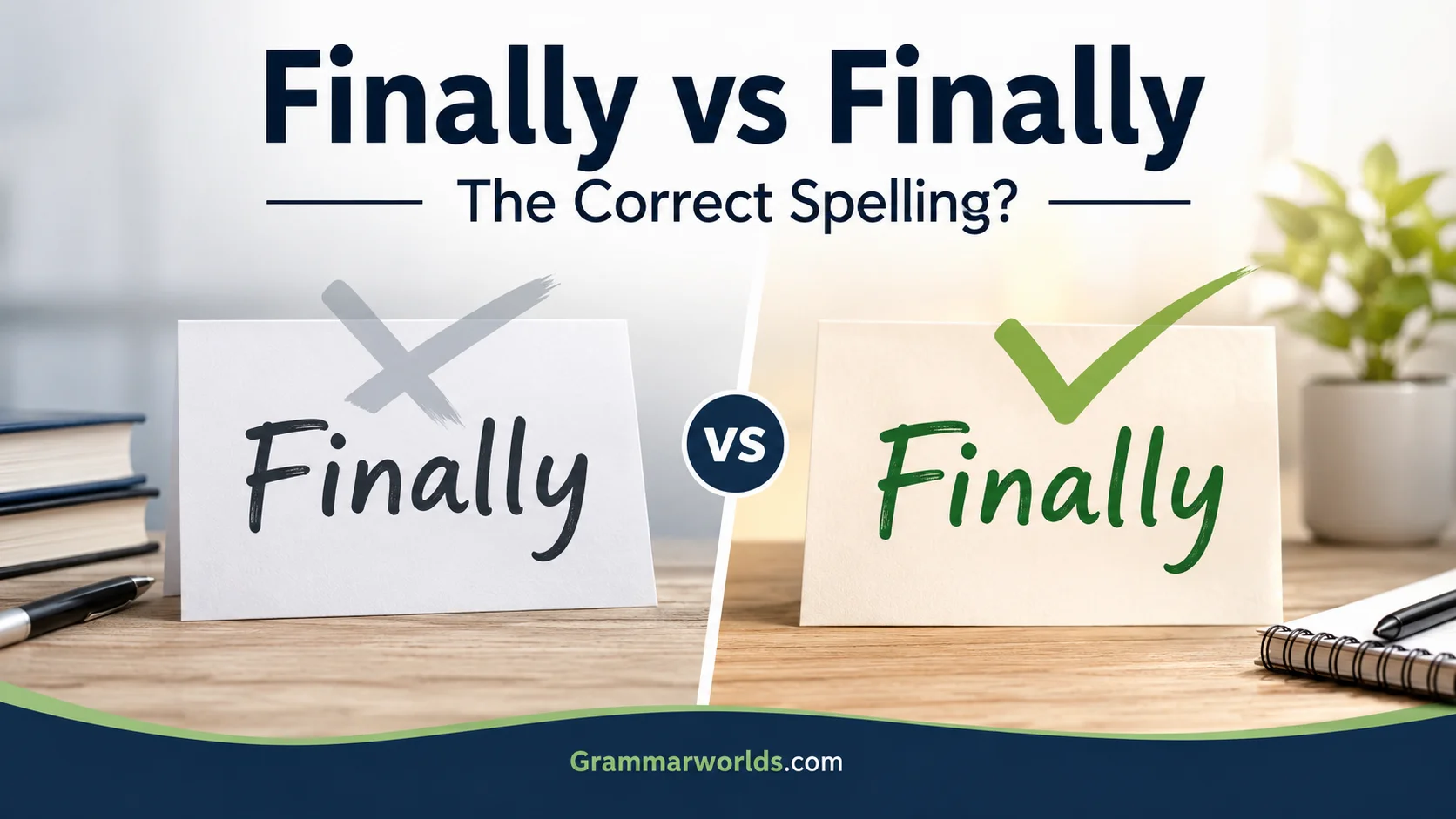
The guide Finally vs Finally The Correct Spelling? explains why Finaly is wrong and Finally is the correct spelling in English writing rules.
Many people feel confused because Finaly and Finally look almost the same, and when spoken they sound very similar. It is easy to miss one letter, but this small change creates the wrong form and becomes a common spelling mistake. In standard English, only Finally is accepted as the correct form. The base word final joins with the suffix -ly through proper word formation, creating an adverb that shows something happens after a long time, at last, or in the end. The final + ly structure keeps the extra letter l, while Finaly becomes a common misspelling due to a missing letter.
From my experience checking student writing, essays, emails, social media posts, and professional documents, this error usually appears during fast typing when writers rely on word sounds instead of English spelling rules. The brain can create doubt during a mid email pause or while sending a message, causing words to become miswritten. Proofreading and editing improve clarity, correctness, and writing skills while helping learners gain confidence.
Finaly vs Finally: Quick Answer
The answer is simple:
| Word | Correct or Incorrect? | Meaning |
| Finally | ✅ Correct | At last, after a delay, or as the last point |
| Finaly | ❌ Incorrect | A common spelling mistake |
The English language does not recognize “finaly” as a standard word. If you write it in a professional document, academic paper, or online article, most grammar tools will mark it as an error.
Correct examples:
- I finally completed my homework.
- She finally arrived after a long journey.
- Finally, we can start the meeting.
Incorrect examples:
- ❌ I finaly completed my homework.
- ❌ She finaly arrived home.
- ❌ Finaly, the problem was solved.
The meaning is usually understandable when someone writes “finaly,” but correct spelling creates a stronger impression. A small spelling error can distract readers from an otherwise excellent piece of writing.
Why Is Finally Spelled With Two Ls?
The reason finally has two Ls comes from its word structure.
The word is created from:
Final + ly = Finally
The base word is final, which already ends with one letter L. When the suffix -ly is added, another L appears before the “y.”
The spelling becomes:
F I N A L L Y
Not:
F I N A L Y
The second “L” connects the original word final with the suffix -ly.
This pattern appears in many English words.
| Base Word | Correct Form |
| Final | Finally |
| Actual | Actually |
| Equal | Equally |
| Usual | Usually |
| Real | Really |
A useful way to think about it is this:
The word “final” does not disappear when “-ly” is added. It carries its spelling into the new word.
Many spelling mistakes happen because writers remember the sound of a word but forget its structure.
What Does Finally Mean?
The word finally is an adverb. It describes when something happens or how an idea is organized.
It has three main meanings.
Finally Means “After a Long Wait”
The most common use of finally shows that something happened after waiting, difficulty, effort, or delay.
For example:
- “The bus finally arrived after thirty minutes.”
- “After months of training, she finally ran her first marathon.”
- “I finally found my lost keys.”
In these examples, finally carries an emotional meaning. It often suggests relief, excitement, frustration ending, or satisfaction.
Compare these sentences:
Without finally:
The company launched the product.
This only tells us an event happened.
With finally:
The company finally launched the product.
Now we understand there was a delay, preparation period, or challenge before the launch.
The word adds context without needing extra explanation.
Finally Means “At the End of a Sequence”
Writers often use finally when describing steps or stages.
Example:
First, collect the materials. Next, prepare the equipment. Finally, begin the experiment.
Here, finally tells readers they have reached the last step.
Common situations where this meaning appears:
- Instructions
- Recipes
- Tutorials
- Presentations
- Reports
- Essays
Example:
To complete the registration process, create an account, verify your email, and finally submit your application.
The reader immediately understands the order of events.
Finally Means “The Last Point in an Argument or Discussion”
In writing, finally can introduce the last idea after several previous points.
Example:
The company improved customer service, reduced costs, and finally increased profits.
It signals that the writer has reached the final item.
This usage appears frequently in:
- Business writing
- Academic papers
- Speeches
- Reviews
Example:
Finally, businesses must focus on customer trust because long-term relationships create lasting growth.
Finaly vs Finally Examples in Sentences
The easiest way to understand the difference is by comparing incorrect and correct examples.
| Incorrect Sentence | Correct Sentence |
| I finaly finished the book. | I finally finished the book. |
| She finaly answered my message. | She finally answered my message. |
| Finaly, the team won the championship. | Finally, the team won the championship. |
| We finaly reached our destination. | We finally reached our destination. |
The incorrect version does not change the meaning, but it creates a spelling error.
In professional settings, spelling mistakes can affect credibility.
For example:
A hiring manager reviewing a resume may notice:
“I finaly completed my certification.”
The message is clear, but the mistake may suggest a lack of attention to detail.
The corrected version:
“I finally completed my certification.”
looks more polished and professional.
Why Do People Spell Finally Incorrectly?
The finaly vs finally mistake happens for several simple reasons.
Pronunciation Does Not Reveal the Difference
When people pronounce finally, they usually hear:
“Final-lee”
The second “L” does not create a different sound.
Because the pronunciation stays the same, many writers forget the extra letter.
This happens with many English words.
Examples:
- Necessary
- Separate
- Definitely
- Actually
- Finally
English spelling often contains details that pronunciation does not reveal.
People Forget the Original Word
Another common reason is forgetting that finally comes from final.
Some writers mentally break it into:
❌ Final + y
instead of:
✅ Final + ly
Remembering the root word solves the problem.
Think:
If something is the last thing, it is “final.” When you describe it happening, it happens “finally.”
Fast Typing Creates Mistakes
Modern communication happens quickly. People write emails, messages, and posts in seconds.
During fast typing, repeated letters are easy to miss.
Examples:
- Finaly → Finally
- Actully → Actually
- Realy → Really
Spell-check tools help, but understanding the correct pattern makes you a stronger writer.
Also Read This: Waring vs Wearing What’s the Difference?
How to Remember the Correct Spelling of Finally
A few simple tricks can make the correct spelling automatic.
Memory Trick 1: Keep the Word “Final”
Remember:
FINAL + LY = FINALLY
The original word stays visible.
When you see finally, you should still recognize final inside it.
Memory Trick 2: Think of Two Ls as the Finish Line
Imagine the word is running toward a finish line.
The first L belongs to “final.”
The second L belongs to the “-ly” ending.
Together, they help the word reach the finish line:
FINA-LLY
A simple visual connection can make spelling easier.
Memory Trick 3: Create a Personal Sentence
Use a sentence that repeats the correct spelling:
“Finally has two Ls because the final word keeps its final L.”
Writing the word correctly several times builds memory through repetition.
Is Finally an Adjective or an Adverb?
Understanding grammar helps explain why the word exists.
Final Is an Adjective
An adjective describes a noun.
Examples:
- “This is the final chapter.”
- “The final decision was difficult.”
- “We reached the final stage.”
Here, final describes a thing.
Finally Is an Adverb
An adverb describes an action, event, or situation.
Examples:
- “She finally completed the course.”
- “They finally agreed.”
- “The project finally ended.”
Here, finally explains when something happened.
A quick comparison:
| Word | Grammar Type | Example |
| Final | Adjective | This is the final answer. |
| Finally | Adverb | I finally found the answer. |
How to Use Finally Correctly in Writing
Using finally correctly depends on the situation.
Use Finally When Something Takes Time
Examples:
- “The repairs finally finished.”
- “He finally apologized.”
- “The missing document finally appeared.”
The word suggests waiting or effort.
Use Finally for the Last Step
Examples:
- “Mix the ingredients and finally add the seasoning.”
- “Finally, review your work before submitting it.”
It helps readers follow an order.
Use Finally to Introduce a Conclusion
Examples:
- “Finally, we must consider the long-term effects.”
- “Finally, the research shows that consistency matters.”
This makes writing easier to follow.
When You Should Avoid Using Finally
Although useful, finally does not fit every situation.
For example:
Finally, the car is blue.
This sounds unusual because being blue is not an ending, delay, or conclusion.
Better:
The car is blue.
Another example:
Finally, my favorite color is green.
This only works if you were discussing several colors before it.
Better:
My favorite color is green.
Always use finally when there is a sense of completion, order, or waiting.
Alternatives to Finally
Sometimes another word works better.
Here are common alternatives:
| Alternative | Meaning | Example |
| Eventually | After some time | She eventually found a solution. |
| Ultimately | The final result | Ultimately, the decision was successful. |
| At last | After waiting | At last, the guests arrived. |
| In the end | Final outcome | In the end, everything worked out. |
| Lastly | Final item in a list | Lastly, check the final details. |
Choosing the right word makes your writing sound more natural.
Real-World Examples of Finally in Use
Example 1: Business
“After years of development, the company finally released its new software.”
Meaning:
- The release took time.
- The company completed a long process.
Example 2: Education
“After studying every evening, Maria finally passed her exam.”
Meaning:
- She worked hard.
- The result came after effort.
Example 3: Daily Life
“The weather finally improved after a week of storms.”
Meaning:
- The improvement was expected.
- The waiting period ended.
Faqs:
Is “finaly” a correct English word?
No. “Finaly” is not a correct English spelling. It is a common mistake caused by leaving out the second “l.” The correct spelling is finally.
How many Ls are in finally?
The word finally has two Ls.
Correct spelling:
F-I-N-A-L-L-Y
Why do people write finaly instead of finally?
People usually write finaly because the second “l” is silent in pronunciation. Since both spellings sound the same, writers sometimes forget the extra letter.
What is another word for finally?
Depending on the sentence, alternatives include:
- Eventually
- Ultimately
- At last
- Lastly
- In the end
Each word has a slightly different meaning, so choose based on the context.
Is finally a formal word?
Yes. Finally works in both casual and formal writing.
Examples:
Casual:
“I finally finished cleaning my room.”
Formal:
“Finally, the report highlights the importance of customer satisfaction.”
It is widely accepted in conversations, academic writing, and professional communication.
Conclusion
The difference between finaly vs finally comes down to one small but important detail: the second “l.” While “finally” is a common spelling mistake, “finally” is the only correct form in English.
The easiest way to remember it is to break the word apart:
Finally = Finally
The word keeps the original spelling of final, which already ends with an l, and the -ly ending adds another one.
Whether you are talking about something that happened after a long wait, the last step in a process, or the final point in an explanation, finally is the word you need.