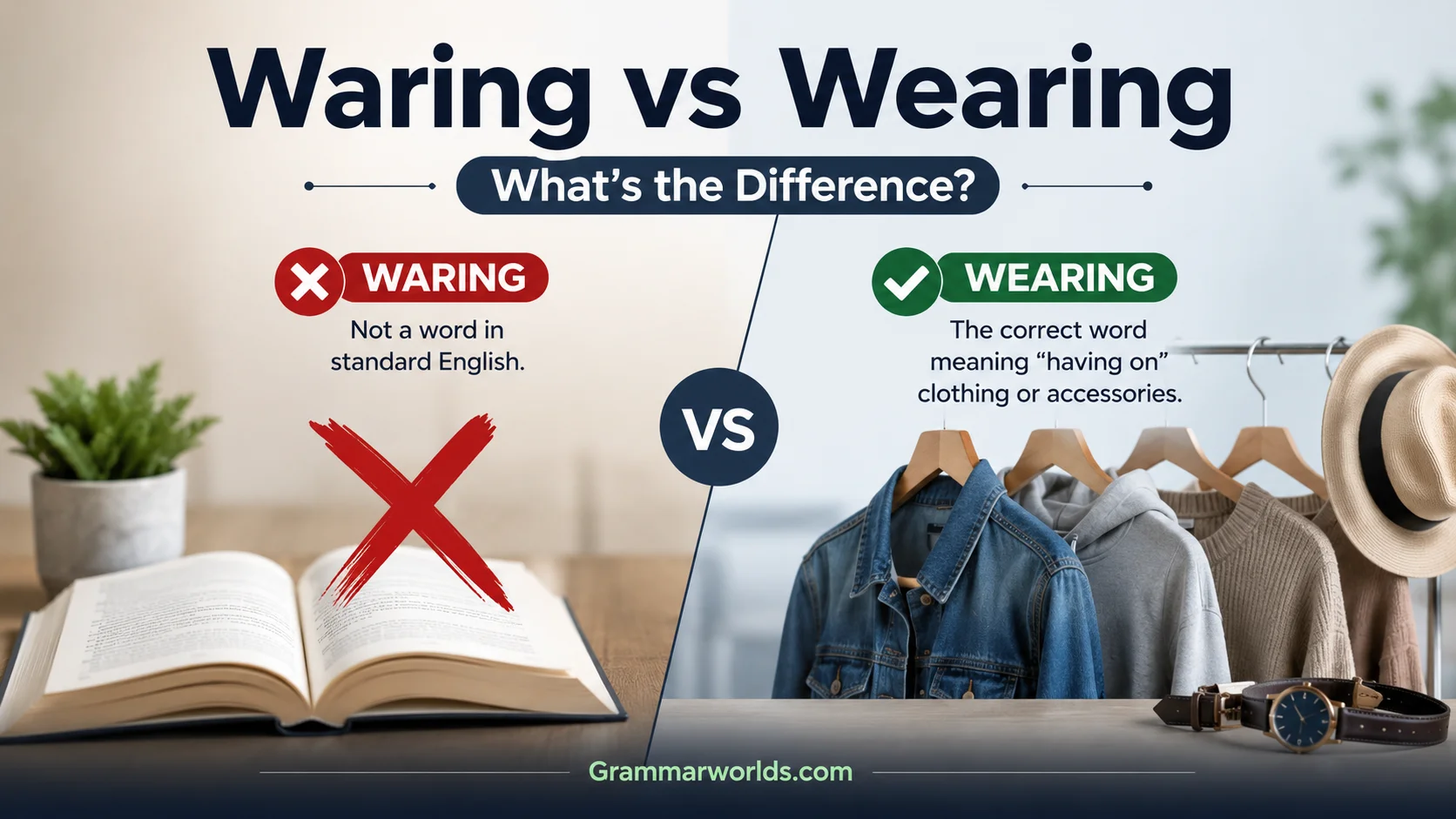
Waring vs Wearing What’s the Difference? becomes easier to understand when you notice that both words have similar spelling and pronunciation, but their meanings are different. Wearing is a common English word used for putting on clothes, accessories, uniforms, jewelry, and other items on the body.
It describes what someone has on, including an outfit, garments, attire, apparel, and ornaments connected with fashion and personal belongings in everyday English. Many learners rely on pronunciation and accidentally replace the word, creating spelling mistakes in written English.
Waring is a real word but a rare word, uncommon term, and uncommon word mainly found as a proper surname, specific names, or through historical writing, literature, and literary context. Understanding this comparison, explanation, and distinction helps students, professionals, and writers avoid mistakes and improve spoken English, verbal communication, and written communication. Learning the definition, key differences, examples, grammar rules, sentence structure, and correct usage builds stronger vocabulary development, language skills, and English improvement for daily writing, academic writing, workplace writing, emails, and assignments.
Waring vs Wearing: The Quick Difference
The easiest way to understand waring vs wearing is to compare their meanings.
| Word | Meaning | How Common Is It? | Example |
| Wearing | Having clothes, jewelry, accessories, or something else on your body | Very common | She is wearing a blue jacket. |
| Waring | Usually a surname or proper noun, not the normal form of “wear” | Rare | Waring is a family name. |
The biggest takeaway is simple:
If you are talking about clothes, shoes, watches, glasses, uniforms, or accessories, use wearing.
Examples:
✅ He is wearing a black suit.
❌ He is waring a black suit.
✅ She is wearing sunglasses.
❌ She is waring sunglasses.
The missing “e” turns a correct sentence into a spelling mistake.
What Does Wearing Mean?
Wearing is the present participle form of the verb wear.
A present participle is a verb form that usually ends in “-ing” and helps describe an action happening now or around a particular time.
For example:
- I wear a jacket in winter.
- I am wearing a jacket today.
The first sentence describes a habit. The second describes something happening now.
The word wearing has several meanings depending on context.
Wearing Clothes and Accessories
The most common meaning of wearing is having clothing or accessories on your body.
This includes:
- Shirts
- Pants
- Dresses
- Shoes
- Hats
- Jewelry
- Watches
- Glasses
- Uniforms
Examples:
- Sarah is wearing a green sweater.
- The students are wearing school uniforms.
- He was wearing a new pair of sneakers.
- I’m wearing my favorite watch today.
In these examples, wearing means something is currently on the person’s body.
A useful way to remember this meaning:
You wear something that you put on your body.
You wear:
- clothes
- perfume
- makeup
- jewelry
- shoes
- glasses
You do not usually “wear” things that you hold.
For example:
✅ She is carrying a handbag.
❌ She is wearing a handbag.
However, if the handbag hangs from your shoulder, you can say:
✅ She is wearing a shoulder bag.
Wearing as Showing a Symbol or Identity
The word wearing does not only describe clothing. It can also describe showing something through appearance.
For example:
- He is wearing a wedding ring.
- She is wearing a badge that shows she works at the hospital.
- The athletes are wearing medals after the competition.
In these situations, wearing communicates something about a person.
A wedding ring may represent marriage. A uniform may represent a profession. A badge may represent membership or authority.
Clothing often carries meaning beyond appearance.
A person wearing a military uniform, for example, communicates their role. Someone wearing a team jersey shows support for a sports team.
Wearing as Damage or Gradual Use
Another important meaning of wearing relates to damage caused by repeated use.
When something becomes weaker, thinner, or damaged over time, it can be described as wearing out.
Examples:
- My old shoes are wearing out.
- The paint on the door is wearing away.
- The tires are wearing down after many miles.
- This fabric is wearing thin.
Here, wearing does not mean putting something on your body. Instead, it describes the effects of time and use.
Think about your favorite pair of shoes.
At first, they look brand new. After months of walking, the soles become thinner. The color fades. The material changes.
That process is called wearing out.
What Does Waring Mean?
The word waring creates confusion because it looks like it should be the same as wearing.
However, waring is not the normal present participle form of “wear.”
If you write:
She is waring a dress.
You have made a spelling mistake.
The correct sentence is:
She is wearing a dress.
So, does waring exist?
Yes, but it is uncommon.
Waring as a Surname
The most common place you will see Waring is as a surname.
A surname is a family name passed down through generations.
Examples:
- Thomas Waring
- Elizabeth Waring
- The Waring family
When Waring appears as a name, it is usually capitalized.
Compare:
- She is wearing a jacket.
- Mr. Waring is my teacher.
The first describes an action. The second identifies a person.
Capitalization helps show the difference.
Waring in Company and Brand Names
Sometimes Waring appears in business names or organizations because it comes from a founder’s surname.
For example, the name may appear in:
- Company names
- Product brands
- Historical references
In these cases, Waring functions as a name, not as a verb.
You should not replace wearing with waring just because the spelling looks similar.
Why Do People Confuse Waring and Wearing?
The confusion between waring vs wearing happens for several reasons.
Understanding these reasons makes it easier to avoid the mistake.
The Silent “E” Problem in English
English spelling has many words where the final e disappears when adding “-ing.”
Examples:
| Base Word | Correct -ing Form |
| make | making |
| bake | baking |
| write | writing |
| dance | dancing |
Because of these examples, learners often think:
“The e disappears before ing.”
But English has exceptions.
With wear, the “e” stays:
| Base Word | Correct Form |
| wear | wearing |
| see | seeing |
| agree | agreeing |
The spelling stays because removing the “e” would create the wrong word.
Also Read This : Midday vs Mid Day What’s the Difference, Each?
The Missing Letter Changes the Root Word
The difference between wearing and waring is not just about spelling.
The root words are different.
Wearing:
wear + ing = wearing
The root word is wear.
Waring:
war + ing = waring
The root word becomes war.
The meaning completely changes.
Compare:
- wear → clothing or use
- war → conflict or fighting
Removing the “e” changes the foundation of the word.
Waring vs Wearing Examples in Sentences
Seeing examples is one of the fastest ways to understand the difference.
| Incorrect | Correct | Reason |
| She is waring a red coat. | She is wearing a red coat. | Clothing requires “wearing.” |
| He was waring glasses. | He was wearing glasses. | Glasses are something you put on. |
| They are waring uniforms. | They are wearing uniforms. | Uniforms are worn, not “warred.” |
Now compare examples where Waring is correct:
| Sentence | Meaning |
| James Waring wrote the article. | Waring is a surname. |
| The Waring family moved overseas. | Waring identifies a family name. |
Common Mistakes With Wearing
Many spelling errors happen because people follow a familiar pattern instead of checking the original word.
Here are common mistakes.
Mistake: Writing “Waring” for Clothes
Incorrect:
She is waring a beautiful dress.
Correct:
She is wearing a beautiful dress.
The word comes from wear, so keep the “e.”
Mistake: Thinking Every Verb Drops “E” Before “Ing”
Incorrect assumption:
Every word ending with e loses the e before ing.
That rule does not work for every English word.
Examples:
Correct:
- wear → wearing
- see → seeing
- be → being
English contains many spelling patterns with exceptions.
Mistake: Confusing Waring With Warring
Another common confusion involves warring.
These words look similar but have different meanings.
| Word | Meaning | Example |
| Wearing | Having something on | She is wearing boots. |
| Waring | Usually a name | Mr. Waring arrived. |
| Warring | Fighting or in conflict | The two groups were warring. |
| Warning | Giving notice of danger | The sign is warning drivers. |
A single letter can completely change a sentence.
Easy Trick to Remember Wearing
Here is a simple memory trick:
You wear clothes, so wearing keeps the “e.”
Think about the word:
wear + ing = wearing
The “e” belongs to the original word.
Imagine your favorite jacket.
You do not “war” your jacket. You wear it.
That small mental picture can help you remember the correct spelling.
Wearing vs Similar English Words
English has many words that look almost identical but have different meanings.
Understanding related words improves your spelling.
| Word | Definition | Example |
| Wear | To have something on your body | I wear glasses. |
| Wearing | The action of having something on | I am wearing glasses. |
| Wore | Past tense of wear | I wore a jacket yesterday. |
| Worn | Past participle of wear | My shoes are worn. |
| War | Conflict or fighting | The country experienced war. |
| Warring | Fighting against another group | The nations were warring. |
Learning word families makes English much easier.
A Simple Case Study: How One Letter Changes Meaning
Imagine a student writing an essay about fashion.
They write:
“Many people enjoy waring traditional clothing during festivals.”
The reader may understand the intended meaning, but the spelling is wrong.
The corrected sentence:
“Many people enjoy wearing traditional clothing during festivals.”
That one extra letter makes the sentence accurate.
This example shows why spelling matters. Small mistakes can distract readers and reduce confidence in your writing.
Quick Reference Guide: Waring vs Wearing
| Question | Answer |
| Is “wearing” correct for clothes? | Yes. |
| Is “waring” the correct spelling of wearing? | No. |
| Does wearing come from wear? | Yes. |
| Is Waring a real word? | Yes, usually as a name. |
| Should you write “waring shoes”? | No. Write “wearing shoes.” |
Faqs:
Is “waring” a correct English word?
Yes, waring can appear as a word, but it is very uncommon in normal conversation. Most often, it appears as a surname or part of a proper name.
If you are describing clothing or accessories, waring is incorrect.
Is wearing the correct spelling for clothes?
Yes. Wearing is the correct spelling when talking about clothes, accessories, or something placed on your body.
Examples:
- She is wearing a jacket.
- He is wearing a watch.
- They are wearing uniforms.
Why is it wearing and not waring?
The word comes from the verb wear.
When adding “-ing,” the original spelling remains:
wear + ing = wearing
Removing the “e” creates a different spelling that does not represent the verb.
Is waring just a spelling mistake?
Usually, yes.
If someone writes:
He is waring a hat.
They almost certainly mean:
He is wearing a hat.
However, Waring can be correct when it refers to a person’s name.
How do I remember the difference between waring and wearing?
Remember this phrase:
“You wear what you put on.”
Clothes are something you wear, so the word keeps the e:
wear → wearing
Conclusion
The difference between waring vs wearing is simple once you understand the meaning behind each word.
Wearing is the correct choice when you talk about clothes, accessories, uniforms, or something becoming damaged through use.
Waring is rarely used in everyday English. It usually appears as a surname or proper name.
The easiest rule to remember is:
If you put it on your body, you’re wearing it.
That extra “e” makes all the difference. Keep it in place, and your spelling will stay correct.