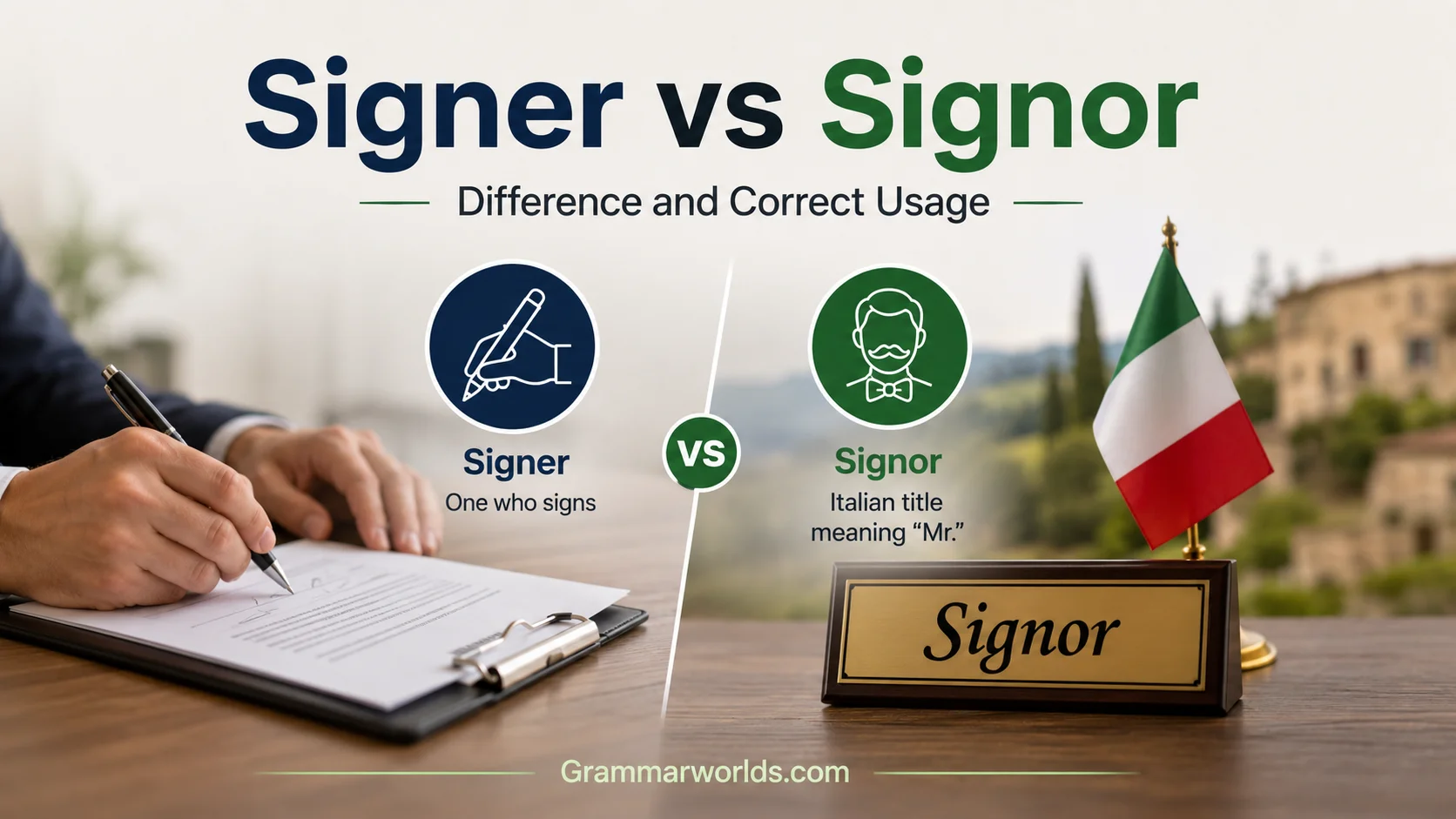
You’ve probably seen Signer and Signor and paused for a second. They look similar. They even feel like they might mean the same thing. However, they come from completely different worlds.
One belongs to legal and digital documentation. The other comes straight from Italian language and culture.
That small spelling difference changes everything. One letter can shift meaning from someone who signs a contract to a respectful Italian title like “Mr.”
In this guide, you’ll finally get clarity. You’ll see:
- What each word actually means
- Where people use them in real life
- Why confusion happens so easily
- How to never mix them up again
Let’s break it down in a clean, practical way.
The Short Answer: Signer vs Signor Explained Quickly
Before going deep, here’s the simplest distinction:
- Signer → A person who signs something (contracts, forms, agreements)
- Signor → An Italian honorific meaning “Mr.”
They are not interchangeable. Not even close.
Quick Comparison Table
| Word | Meaning | Language | Context | Example |
| Signer | Person who signs a document | English | Legal, business | The signer approved the contract. |
| Signor | Italian title for Mr. | Italian | Formal address names | Signor Rossi arrived early. |
A good way to remember it:
Signer = action (signing)
Signor = title (respectful address)
What Does “Signer” Mean?
The word Signer refers to a person who signs a document or agreement. It is widely used in legal, business, and administrative settings.
Core Meaning
A signer is:
- The person who signs a contract or form
- The individual who gives written approval
- Someone legally bound by a signature
Where You’ll See “Signer” in Real Life
You’ll encounter this word in situations like:
- Employment contracts
- Rental agreements
- Bank forms
- Online terms and conditions
- Legal affidavits
- Digital e-signature platforms like DocuSign
Simple Examples
- The signer must verify their identity before submitting the form.
- Each signer agrees to the terms listed in the contract.
- The document requires two authorized signers.
Legal Importance of a Signer
In law, a signer is not just someone who scribbles a name. That signature often means:
- Acceptance of responsibility
- Legal agreement to terms
- Proof of consent
For example, in contract law, a signature can make an agreement legally binding, even if it’s digital.
What Does “Signor” Mean?
Now let’s shift gears completely.
The word Signor comes from Italian. It is a respectful title used before a man’s last name. It is similar to “Mr.” in English.
Core Meaning
Signor = Sir / Mr. (Italian usage)
It is used to show:
- Respect
- Formal address
- Cultural politeness in Italian language
Where You’ll See “Signor”
You’ll mostly see it in:
- Italian names in literature
- Italian business or hospitality settings
- Travel situations in Italy
- Formal introductions
Simple Examples
- Signor Bianchi will join us for dinner.
- I spoke with Signor Ferrari about the reservation.
- The letter was addressed to Signor Romano.
Important Note
In modern Italy, Signor is still commonly used, especially in formal speech and writing. However, in casual conversation, Italians often just use surnames or first names depending on context.
Signer vs Signor: A Clear Side-by-Side Breakdown
Let’s make the difference even sharper.
Also Read This :Holiday vs Holliday: Which Spelling Is Correct in English?
| Feature | Signer | Signor |
| Language origin | English | Italian |
| Meaning | One who signs documents | Title meaning Mr. |
| Usage context | Legal, business, digital | Formal address in Italian |
| Function | Action-based role | Honorific title |
| Grammar type | Noun | Honorific noun |
| Common in | Contracts, forms | Names, greetings |
Key Insight
- Signer = action-based identity
- Signor = cultural respect marker
They belong to completely different systems of language.
When Should You Use “Signer”?
Let’s make this practical.
You use Signer anytime a signature is involved.
Legal Documents
Think:
- Contracts
- Agreements
- Deeds
Example:
- The signer must read all clauses before signing.
Employment Forms
Example:
- The employee becomes a legal signer of the agreement once they sign the offer letter.
Banking and Finance
Example:
- The authorized signer can access the company account.
Real Estate
Example:
- Each signer on the lease is responsible for rent payments.
Digital Platforms
Today, most signing happens online.
Examples:
- DocuSign
- Adobe Sign
Example sentence:
- The signer received a verification email before approval.
When Should You Use “Signor”?
Now let’s place Signor in real-world settings.
Formal Italian Address
Example:
- Signor Rossi, please follow me.
Hospitality and Travel
Example:
- The hotel concierge greeted us and said, “Good evening, Signor.”
Business Communication in Italy
Example:
- Dear Signor Bianchi, we confirm your appointment.
Literature and Historical Texts
You’ll often see “Signor” in:
- Classic novels
- Historical accounts
- Italian dialogue in English translations
Example:
- The old manuscript mentioned Signor Leonardo as the town’s merchant.
Why People Confuse Signer and Signor
This confusion is actually very common. Here’s why it happens:
Similar Spelling
Only one letter separates them:
- signer
- signor
That tiny difference is easy to miss when typing fast.
Similar Sound in Speech
In fast speech or accents, both can sound nearly identical, especially to non-native English speakers.
Auto-correct Errors
Many users accidentally:
- Type “signor” when they mean “signer”
- Or the reverse
Lack of Context Awareness
People often see one word in isolation and assume it fits everywhere.
Easy Trick to Remember the Difference
Here’s a memory trick that actually works:
Trick 1: Break the Words
- Signer = Sign + er
- Someone who signs
- Signor = Sounds like “Senior”
- A respectful title like “Mr.”
Trick 2: Think of Italy
If you see “Signor,” imagine:
- Italy
- Pasta
- Formal greetings
- “Mr. Rossi”
Trick 3: Think Legal vs Cultural
- Signer → paperwork
- Signor → people in Italy
Simple mental split.
Common Mistakes to Avoid
Let’s correct real-world errors.
Mistake Examples
❌ The signor signed the lease.
✔ The signer signed the lease.
❌ Signer Rossi arrived at the meeting.
✔ Signor Rossi arrived at the meeting.
❌ We need one signor for the contract.
✔ We need one signer for the contract.
Real-Life Example Comparison
Scenario 1: Contract Signing
- The signer reviewed the agreement before signing.
- Multiple signers participated in the contract approval.
Scenario 2: Italian Business Meeting
- Signor Rossi presented the proposal.
- We thanked Signor Bianchi for his time.
Synonyms of “Signer”
Depending on context:
- Signatory (formal/legal)
- Endorser
- Approver
- Subscriber (digital/legal)
- Witness (specific contexts only)
Important Note
Not all synonyms fit every situation. “Signatory” is the closest legal equivalent.
Titles Similar to “Signor”
Let’s expand your understanding.
| Title | Language | Meaning |
| Signora | Italian | Mrs. |
| Signorina | Italian | Miss |
| Monsieur | French | Mr. |
| Señor | Spanish | Mr. |
| Herr | German | Mr. |
| Sir | English | Honorific |
Key Insight
“Signor” is part of a broader European tradition of formal address systems.
FAQs
What is the difference between signer and signor?
Signer is someone who signs documents. Signor is an Italian title meaning Mr.
Is signor used in English?
Yes, but only when referring to Italian names or formal Italian contexts
Is signer a legal term?
Yes. It is commonly used in contracts and legal documents.
Can signor be used in business?
Yes, but mainly in Italian business communication.
Is signor the same as Mr.?
Yes, it is the Italian equivalent of Mr.
conclusion
Here’s the simplest way to lock it in your memory:
- Use Signer when talking about someone who signs a document or agreement.
- Use Signor when addressing or referring to an Italian man respectfully.
They may look alike, but they live in completely different language worlds.
Once you understand that separation—legal action vs cultural title—you’ll never confuse them again.