Have you ever typed a word and stopped because the spelling just didn’t look right? Unaffected vs Uneffected is one of those confusing word pairs that makes many writers pause. Both words look almost identical, and they sound similar when spoken quickly. However, only one spelling works in standard English.
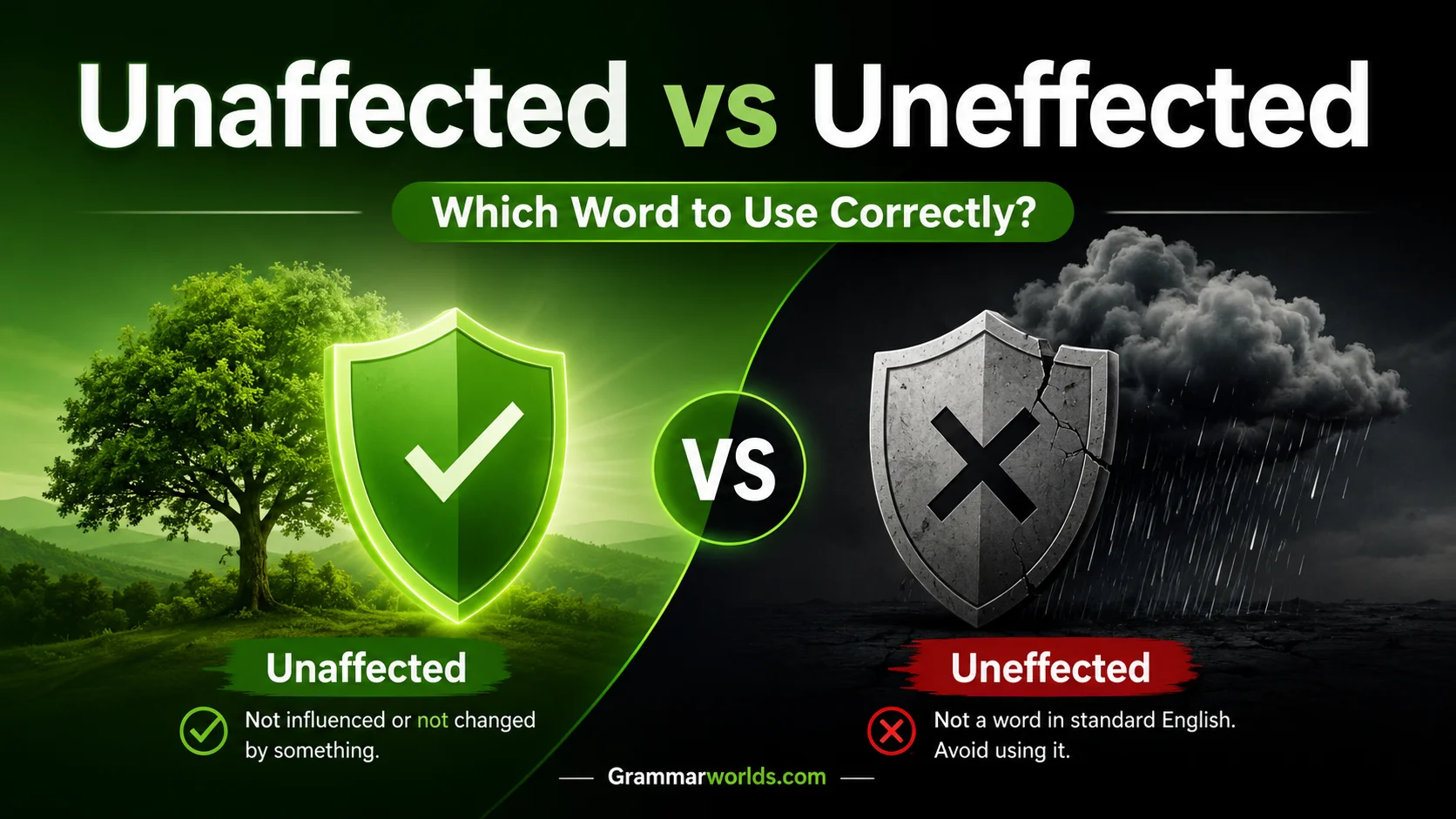
The correct word is unaffected. It means not influenced, not changed, or not emotionally affected by something. The spelling uneffected is generally considered incorrect and does not appear as an accepted standard English word in major dictionaries.
This small spelling difference can make a big impact. Using the wrong form in an email, essay, article, or professional document can make your writing look less polished.
In this guide, you’ll learn the difference between unaffected vs uneffected, why people confuse these words, how to use unaffected correctly, and simple ways to remember the right spelling.
| Word | Correct Usage | Meaning |
| Unaffected | ✅ Correct | Not influenced, changed, or emotionally moved |
| Uneffected | ❌ Incorrect in standard English | Usually a spelling mistake of “unaffected” |
Quick answer: Use unaffected. Avoid uneffected unless you are discussing it as a spelling mistake.
What Does Unaffected Mean?
Unaffected is an adjective that describes something or someone that remains unchanged or untouched by an outside influence.
The word combines:
- Un- = not, opposite of, or absence of something
- Affected = influenced, changed, or emotionally moved
Together, unaffected means not affected.
For example:
- “The company remained unaffected by the market downturn.”
- “She appeared unaffected by the criticism.”
- “The plants were surprisingly unaffected by the cold weather.”
In each sentence, something happened, but the person, object, or situation did not experience a noticeable change.
Think of it like a strong tree during a storm. The wind may shake the branches, but the roots keep it standing. The tree remains unaffected because the outside force does not change its condition.
The Meaning of Unaffected in Different Contexts
The meaning of unaffected stays similar, but its use changes depending on the situation.
Emotional Meaning
When describing emotions, unaffected means someone does not show strong feelings or does not appear influenced by something.
Examples:
- “He looked unaffected after hearing the surprising news.”
- “The actor remained unaffected by negative reviews.”
This does not always mean the person has no feelings. It simply means they do not show a visible emotional reaction.
For example, someone might feel disappointed internally but remain calm and controlled on the outside.
Physical or Environmental Meaning
In science, health, and nature-related discussions, unaffected describes something that does not experience change because of a condition.
Examples:
- “The building remained unaffected after the earthquake.”
- “The medication left some patients unaffected.”
- “The crops were mostly unaffected by the drought.”
Here, the word focuses on physical results rather than emotions.
Business and Financial Meaning
Companies often use unaffected when discussing markets, profits, or operations.
Examples:
- “The brand remained unaffected by the economic slowdown.”
- “Sales were unaffected by the temporary website outage.”
This means the event did not create a significant negative or positive impact.
Social and Personal Situations
People also use unaffected when describing confidence, behavior, or reactions.
Examples:
- “She remained unaffected by the pressure of the competition.”
- “His confidence was unaffected by the criticism.”
The word often suggests stability and emotional control.
Is Uneffected a Real Word?
The short answer is no, not in standard English.
Although uneffected looks like it should exist, English dictionaries generally do not recognize it as a correct word. Most people who write uneffected actually mean unaffected.
This mistake happens because English contains many words that use the prefix un-.
Examples:
- unhappy → not happy
- unclear → not clear
- unfinished → not finished
- unaffected → not affected
Because people know this pattern, they sometimes create spellings that seem logical but are not accepted.
The problem comes from confusing the word effected with affected.
Many writers think:
- affected → unaffected
- effected → uneffected
However, English does not always work by simply adding prefixes. The correct opposite of affected is unaffected, not uneffected.
Why People Confuse Unaffected vs Uneffected
The confusion between unaffected vs uneffected happens for several reasons.
Similar Appearance
The two words differ by only one letter:
- unaffected
- uneffected
When reading quickly, the difference can easily disappear.
Your brain often recognizes the overall shape of a word instead of analyzing every individual letter. That is why spelling mistakes can slip through even when you know the correct form.
Confusion Between Affect and Effect
The biggest reason behind this mistake is the common confusion between affect and effect.
These two words look similar but have different meanings.
| Word | Meaning | Example |
| Affect | To influence something | “Stress can affect your health.” |
| Effect | A result or outcome | “The effect was immediate.” |
The adjective affected comes from affect, not effect.
Correct:
- “The weather affected the game.”
- “The game was unaffected by the weather.”
Incorrect:
- “The game was uneffected by the weather.”
Pronunciation Confusion
When people hear the word spoken, the first vowel sound can be unclear.
Unaffected is pronounced:
un-uh-FEK-tid
Because the first syllable is weak, some people mistakenly spell it with an “e”:
un-eh-FEK-ted
However, pronunciation does not always reveal spelling in English. Many English words contain silent letters or unexpected patterns.
Unaffected vs Uneffected: Side-by-Side Comparison
Understanding the difference becomes easier when you compare them directly.
| Category | Unaffected | Uneffected |
| Correct spelling | ✅ Yes | ❌ No |
| Dictionary recognition | Accepted | Generally not accepted |
| Part of speech | Adjective | Not standard English |
| Meaning | Not influenced or changed | No recognized meaning |
| Professional use | Recommended | Avoid |
| Common reason for use | Correct vocabulary | Spelling mistake |
The safest rule is simple:
If you mean “not affected,” write “unaffected.”
How to Use Unaffected Correctly
Using unaffected correctly depends on understanding what remains unchanged.
Here are common sentence patterns.
Describing a Person’s Reaction
Use unaffected when someone does not show a reaction.
Examples:
- “The criticism left her unaffected.”
- “He seemed unaffected by the pressure.”
- “The athlete remained unaffected by the crowd noise.”
These examples show emotional strength or lack of visible response.
Describing Objects or Things
You can use unaffected for physical objects, systems, or situations.
Examples:
- “The computer files were unaffected by the virus.”
- “The bridge remained unaffected after years of heavy traffic.”
- “The machine continued working unaffected by the temperature change.”
Describing Results or Outcomes
Businesses, researchers, and analysts often use this word.
Examples:
- “The company’s revenue remained unaffected.”
- “The experiment results were unaffected by minor changes.”
- “Customer demand remained unaffected during the holiday season.”
Also Read This : Rug vs Rag: What’s the Difference?
Common Synonyms for Unaffected
Depending on the situation, you can replace unaffected with several similar words.
| Synonym | Meaning |
| Unchanged | Remained the same |
| Untouched | Not altered or damaged |
| Uninfluenced | Not controlled by outside forces |
| Unmoved | Not emotionally affected |
| Stable | Remaining consistent |
| Resistant | Able to withstand influence |
Examples:
- “The building was unaffected by the storm.”
- “The building remained untouched by the storm.”
Both sentences work, but they create slightly different impressions.
Common Antonyms of Unaffected
The opposite of unaffected depends on the context.
| Antonym | Meaning |
| Affected | Influenced or changed |
| Changed | Became different |
| Altered | Modified |
| Moved | Emotionally influenced |
| Impacted | Experienced an effect |
Examples:
- “She was unaffected by the comments.”
- “She was affected by the comments.”
The first sentence shows no noticeable impact. The second shows that the comments created a reaction.
FAQs
Is “uneffected” a correct spelling?
No, uneffected is not considered a correct spelling in standard English. Most dictionaries do not recognize it as a valid word. In almost every situation, writers who use uneffected mean unaffected.
The correct spelling is:
✅ Unaffected = not influenced, changed, or affected
Incorrect:
❌ Uneffected
Example:
- Correct: “The new policy left the employees unaffected.”
- Incorrect: “The new policy left the employees uneffected.”
Why is “unaffected” spelled with an “a” instead of an “e”?
The spelling comes from the word affected, which is based on the verb affect, meaning “to influence or have an impact on something.”
When you add the prefix un- to show the opposite meaning, you get:
un + affected = unaffected
The spelling does not change to match the word effect. Although affect and effect look similar, they have different meanings and uses.
A simple way to remember it:
Affect → Affected → Unaffected
What is the difference between affected and unaffected?
The difference is whether something experiences an influence or change.
Affected means something was influenced, changed, or impacted.
Example:
- “The storm affected the crops.”
This means the storm caused some kind of change.
Unaffected means something stayed the same despite an event or influence.
Example:
- “The storm left some crops unaffected.”
This means those crops did not experience damage or change.
| Word | Meaning | Example |
| Affected | Changed or influenced | “The news affected his mood.” |
| Unaffected | Not changed or influenced | “The news left him unaffected.” |
Can “unaffected” describe emotions?
Yes, unaffected can describe a person’s emotions, reactions, or attitude.
When you say someone is unaffected, it usually means they do not show a strong emotional response to something.
Examples:
- “She remained unaffected by the criticism.”
- “He appeared unaffected by the pressure of the competition.”
- “The actor seemed unaffected by the negative comments online.”
However, remember that looking unaffected does not always mean someone has no feelings. A person may feel something internally but choose not to show it.
How can I remember the correct spelling of unaffected?
A simple memory trick is to connect the word with its root:
Affected = influenced
Unaffected = not influenced
Remember that unaffected starts with “affect,” not “effect.”
You can also use this sentence:
“Something that is not affected remains unaffected.”
The same “a” stays in both words, making the spelling easier to remember.
Conclusion
When choosing between unaffected vs uneffected, the correct choice is clear: use unaffected.
The word unaffected is a standard English adjective that means not influenced, not changed, or not emotionally moved by something. You can use it when talking about people, objects, situations, businesses, or events.
The spelling uneffected may look logical, but it is not accepted in standard English. It usually appears because writers confuse affect and effect or try to create an opposite form that does not follow English spelling rules.
Remember:
- ✅ Unaffected = correct
- ❌ Uneffected = incorrect spelling
Whether you are writing an email, an article, an academic paper, or a professional report, choosing the right word improves clarity and credibility. A single letter can change how polished your writing appears.
So the next time you wonder about unaffected vs uneffected, stick with the proven choice:
Unaffected is the correct word to use.