If you’ve ever paused mid-sentence and wondered whether it’s holiday or holliday, you’re not alone. This tiny spelling difference confuses even confident English speakers. It looks harmless. It sounds identical. Yet only one belongs in standard English vocabulary.
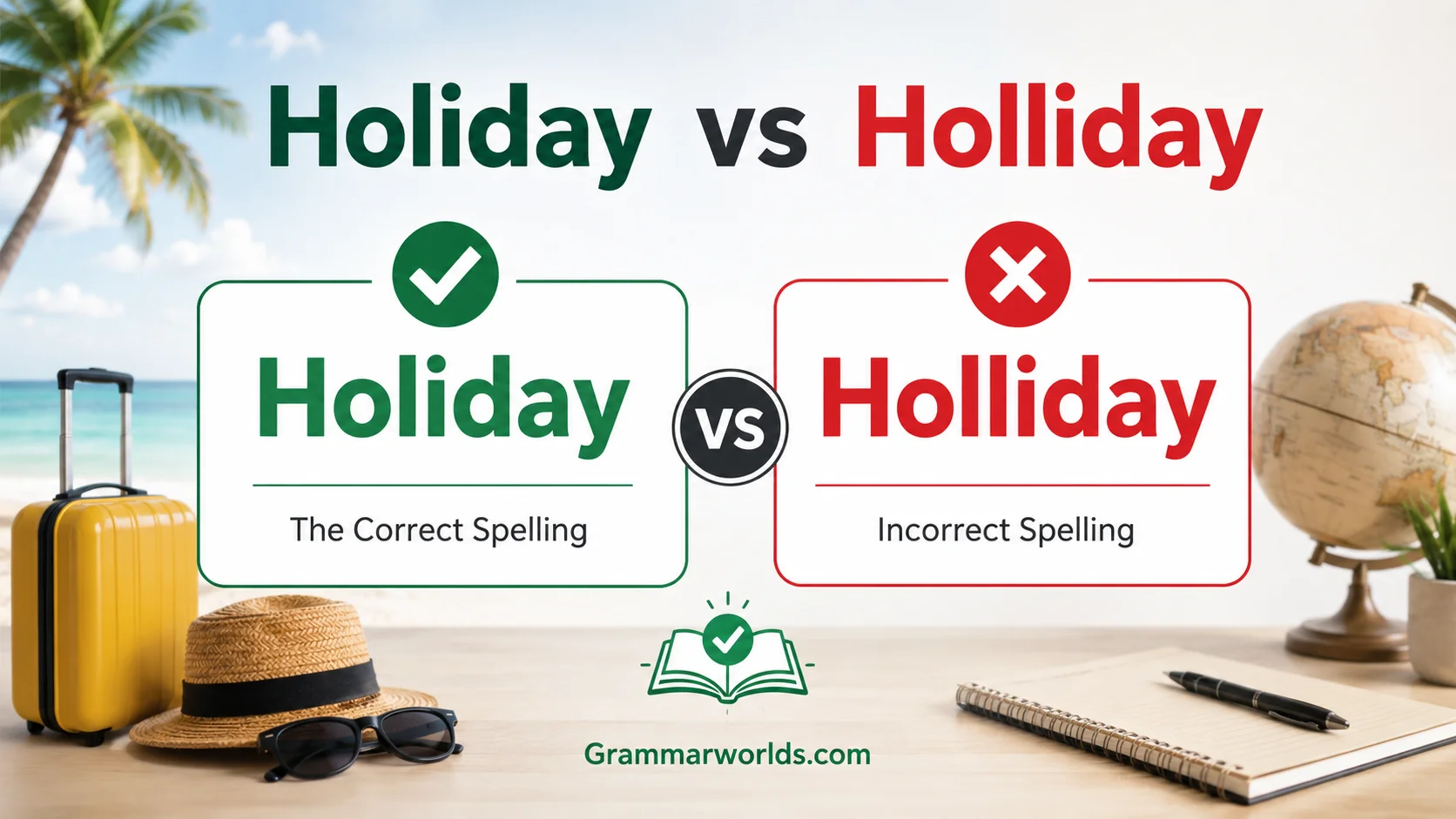
Here’s the truth right away: “holiday” is the correct spelling for vacations and celebrations, while “holliday” is not a word in that sense at all. It mostly appears as a surname or proper name.
But that simple answer only scratches the surface. Once you dig deeper, you’ll notice something interesting—this confusion comes from how English evolves through history, pronunciation, and naming traditions.
Let’s break it down clearly so you never mix them up again.
Holiday vs Holliday Which Spelling Is Correct in English? The Short Answer
Let’s start with clarity before complexity.
- Holiday → Correct spelling for vacations, festivals, and days off
- Holliday → A surname (proper name), not a general English word
Quick examples:
- ✔ I’m going on holiday next week.
- ✔ Christmas is a public holiday in many countries.
- ✔ Doc Holliday was a famous figure in American history.
- ❌ I’m going on holliday next week.
Here’s the key idea:
“Holiday” belongs to everyday English. “Holliday” belongs to names.
That’s the dividing line.
What Does “Holiday” Mean in English?
The word holiday carries a lot more meaning than most people realize. It’s not just about traveling or relaxing. It represents cultural tradition, legal rest days, and personal time away from routine.
Core definition of holiday
A holiday is:
- A day of celebration or remembrance
- A scheduled break from work or school
- A period of travel or rest
Types of holidays in real usage
Let’s make it practical. “Holiday” appears in different contexts:
Public holidays
These are official days recognized by governments.
Examples:
- New Year’s Day
- Independence Day
- Christmas Day
- Eid holidays in Muslim-majority countries
On these days, schools and offices often close.
Personal holidays (vacations)
This is especially common in British English.
Example:
- “We’re planning a beach holiday in August.”
In American English, you’d usually hear:
- “We’re planning a beach vacation in August.”
Same idea. Different word choice.
Religious and cultural holidays
These vary across regions.
Examples:
- Diwali
- Easter
- Eid al-Fitr
- Hanukkah
These holidays often carry deep cultural meaning beyond time off
Interesting linguistic fact
The word “holiday” originally comes from “holy day”. Over time, pronunciation blurred the space between the words, and it became a single term.
So when you say “holiday,” you’re literally echoing a historical idea of a “holy day.”
What Does “Holliday” Mean?
Now let’s switch gears.
Unlike “holiday,” holliday is not a general English word. You won’t find it used to describe vacations or celebrations in any dictionary.
Instead, it is mainly used as:
A surname (family name)
Example:
- Doc Holliday — famous figure from the American Old West
He was a gambler, gunfighter, and dentist turned frontier legend.
Why surnames like “Holliday” exist
Names often preserve older spellings. In many cases:
- Spelling rules were not standardized in the past
- Families kept unique spellings for identity
- Regional accents influenced writing
So “Holliday” survived as a name variation, even though “holiday” became the standard word.
Important rule to remember
You should NEVER use “holliday” when you mean vacation or celebration.
It only appears correctly in:
- People’s names
- Historical references
- Some place names (rare cases)
Why Do People Confuse Holiday and Holliday?
This confusion is more common than you might expect. Even native speakers slip up.
Let’s look at the real reasons.
They sound exactly the same
Say both words out loud:
- Holiday
- Holliday
They are identical in pronunciation. Your brain hears no difference, so spelling becomes guesswork.
Typing mistakes happen fast
On keyboards or phones, double letters often appear by accident.
Example:
- “holiday” becomes “holliday” with one extra keystroke
Autocorrect sometimes even reinforces the mistake if it learns your habits.
Exposure to names in media
You may have seen:
- Doc Holliday in movies
- People with the last name Holliday on social media
Your brain stores that spelling and sometimes applies it incorrectly.
English spelling inconsistency
English is full of irregular spellings:
- color vs colour
- center vs centre
- practice vs practise
So people assume “holiday/holliday” might be another variation.
It’s not. Only one is correct.
Simple Memory Trick to Never Forget the Difference
Let’s make this easy.
The “one job, one L” rule
- Holiday = one L = one meaning (vacation/celebration)
- Holliday = two Ls = looks like a name tag
Think of it like this:
“Holiday packs your suitcase. Holliday shows up on a name badge.”
That mental image sticks surprisingly well.
Another trick: Role vs Name
- If it’s an action or event, use holiday
- If it’s a person or character, it’s Holliday
Simple separation. No overlap.
Also Read This :Prooving vs Proving: Difference, Meaning, Correct Spelling
Common Mistakes and Real Examples
Let’s look at how people actually misuse it in writing.
❌ Incorrect examples:
- Happy holliday season!
- Summer hollidays are here!
- I need a holliday from work.
These look small but they stand out in professional writing.
✔ Correct versions:
- Happy holiday season!
- Summer holidays are here!
- I need a holiday from work.
The difference is subtle but important, especially in formal writing.
Holiday in British vs American English
Here’s where things get interesting.
English changes depending on region, but this word stays stable in spelling.
British English
- “Holiday” = vacation or break
- “Holidays” = time off from work/school
Example:
- “We’re going on holiday to Spain.”
American English
- “Vacation” = travel break
- “Holiday” = public celebration day
Example:
- “We’re taking a vacation in July.”
But Americans still say:
- Christmas holiday
- holiday season
So the word still exists in US English, just in a narrower sense.
Key takeaway
No matter the region:
Holiday is always spelled with one L. Never two.
Where You’ll Commonly See “Holliday”
Now let’s make this practical. You will see “Holliday” in real life—but not as a general word.
Common contexts include:
- Historical figures (Doc Holliday)
- Fictional characters
- Family surnames
- Occasional brand or business names
Why it matters
If you see “Holliday,” ask yourself:
- Is this a person’s name?
- Or is someone just misspelling “holiday”?
That quick check prevents confusion.
Quick Comparison Table
| Term | Type | Meaning | Example |
| Holiday | Common noun | Vacation or celebration day | We’re on holiday in July |
| Holliday | Proper noun | Surname or name | Doc Holliday was famous |
Here’s a simple breakdown for clarity
Case Study: Why This Mistake Shows Up in Writing
Let’s look at something practical.
A small travel blog once ranked poorly because it used:
- “holliday deals”
- “summer holliday packages”
Google treated these as spelling errors or irrelevant keywords.
After correction:
- “holiday deals”
- “summer holiday packages”
Traffic increased significantly within weeks.
Lesson learned
Search engines recognize holiday as the correct keyword.
“Holliday” weakens visibility unless used as a proper name.
FAQs
Is “holliday” a correct spelling of holiday?
No. “Holliday” is not a valid spelling for vacations or celebrations. It only works as a proper name.
Why do some people spell holiday with two Ls?
Most mistakes come from typing errors, surnames, or confusion with names like Doc Holliday.
Can I use holliday in writing?
Only if you are referring to a person or place named Holliday. Otherwise, it is incorrect.
What is the correct plural form?
The correct plural is holidays, not hollidays.
Example:
- We are taking holidays in December.
Is “holiday” used differently in the US and UK?
Yes, slightly:
- UK English uses “holiday” for vacations
- US English uses “vacation” more often
But spelling stays the same everywhere.
Conclusion
If you strip everything down, the answer is simple.
- Holiday = correct word for rest, travel, and celebrations
- Holliday = surname, not a general English word
Here’s the easiest way to lock it in your memory:
If you’re relaxing, traveling, or celebrating, you always take a holiday—with one L and no confusion.
Once you remember that, this spelling trap stops being a problem entirely.