You’ve probably seen it before. Someone writes prooving in a message or post, and something feels off. Your brain pauses for a second. “Is that right… or not?”
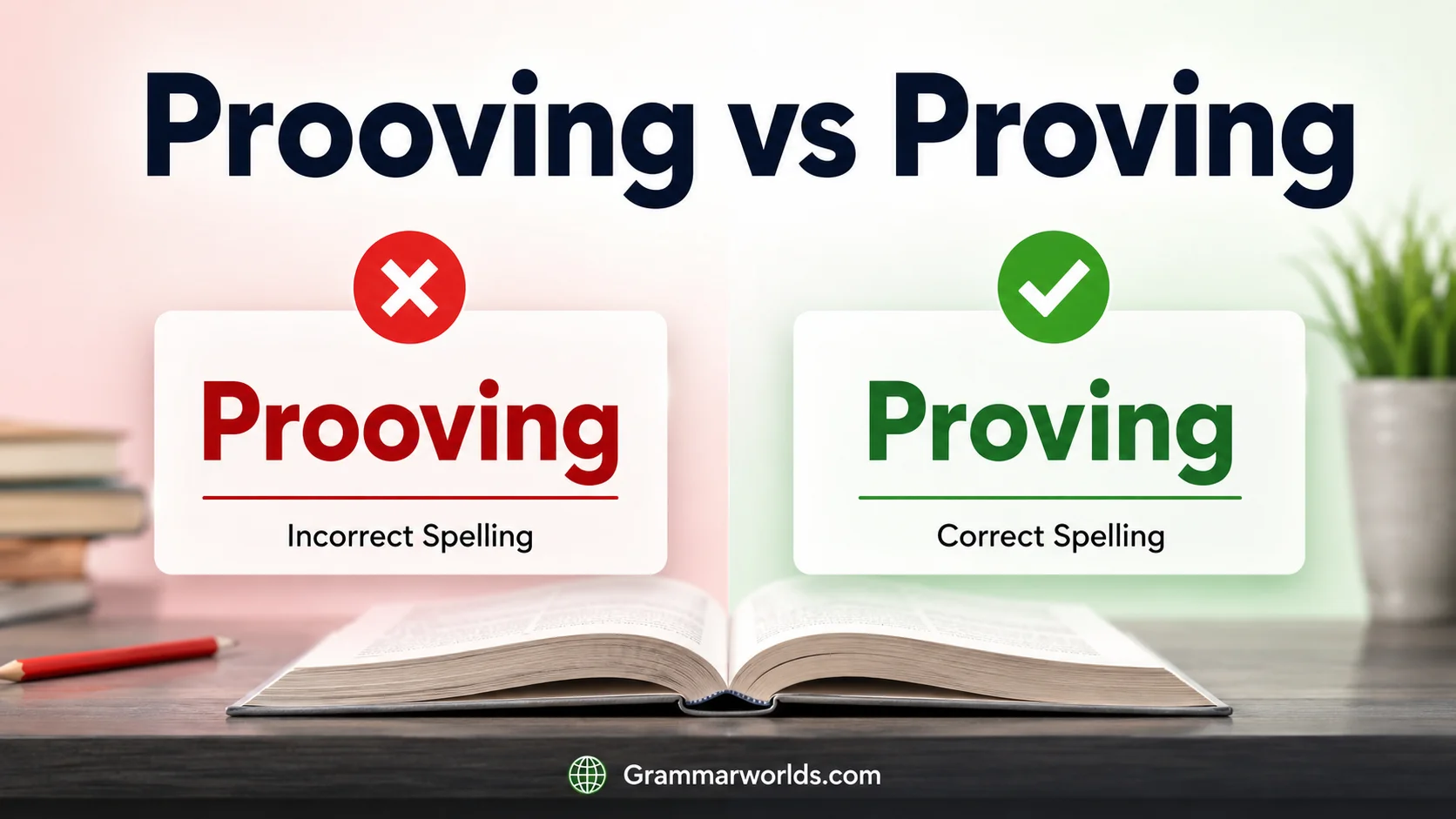
Here’s the simple truth right away: “Proving” is correct. “Prooving” is not a real English word.
Still, the confusion makes sense. English spelling often feels like a maze with missing signs. Words change form, letters drop, and patterns don’t always look obvious at first glance.
In this guide, you’ll learn:
- The correct spelling and meaning of proving
- Why people mistakenly write prooving
- The grammar rule behind the spelling change
- Real examples you can actually use
- Memory tricks that make the mistake easy to avoid
Let’s clear this up properly so you never second-guess it again.
Is It Prooving or Proving? The Correct Answer
Let’s settle it immediately.
The correct spelling is: PROVING
The incorrect spelling is: PROOVING
The reason is simple. English drops the silent “e” from the base verb prove before adding “-ing.”
So:
- prove → proving ✔️
- proove → prooving ❌ (incorrect structure)
Quick clarity table
| Word | Status | Meaning |
| proving | ✅ Correct | Present participle of “prove” |
| prooving | ❌ Incorrect | Misspelling, not recognized in English |
Even advanced writers sometimes slip into “prooving” because it looks like it should be right. But English doesn’t follow appearance. It follows structure.
What Does “Proving” Mean in English?
The word proving comes from the verb prove, which means to show that something is true or correct using evidence or facts.
Simple definition:
Proving = showing truth or validity through evidence
Pronunciation:
/ˈpruː.vɪŋ/ (PROO-ving)
Part of speech:
- Verb form (present participle / gerund)
- Used in continuous tenses or noun-like forms
Real meaning in context
“Proving” shows up when something is in progress.
For example:
- Someone is actively demonstrating truth
- Evidence is being tested
- A claim is being verified
Example sentences:
- She is proving her theory with experiments.
- The lawyer is proving the client’s innocence.
- This test is proving how effective the method is.
Notice something important: it always feels active. Something is happening right now.
Why Do People Write “Prooving”?
This mistake is more common than you might think. And it doesn’t come from carelessness alone.
Here’s why it happens.
1. Overgeneralizing spelling patterns
Many English words double vowels:
- soon → sooon (wrong but feels logical)
- cool → coooling (incorrect in grammar systems learners guess)
So people assume:
👉 prove → prooving
But English doesn’t double “o” in this case.
2. Influence of pronunciation
When spoken quickly, “proving” sounds stretched:
- PROO-ving
That “oo” sound tricks the brain into thinking there are two “o” letters.
3. Confusion with other verbs
Some verbs do double consonants or vowels in different forms:
- run → running
- sit → sitting
So learners assume consistency where English actually has exceptions.
4. Lack of exposure in writing
If you mostly hear English instead of reading it, spelling errors like this become more likely.
Why “Proving” Drops the Silent “E”
Now let’s look at the grammar rule that actually matters.
English has a very stable rule for verbs ending in -e:
When a verb ends in a silent “e,” drop the “e” before adding “-ing.”
The transformation rule:
- take off “e”
- add “ing”
Examples that follow the same rule
| Base Verb | Correct -ing Form |
| prove | proving |
| move | moving |
| love | loving |
| improve | improving |
| remove | removing |
| approve | approving |
Why English does this
If we didn’t drop the “e,” pronunciation would get messy.
For example:
- “prooveing” would break flow
- it would look awkward and slow
So English simplifies it for smooth reading and speech.
Proving vs Prooving: Side-by-Side Comparison
Let’s make this crystal clear.
| Feature | Proving | Prooving |
| Correct spelling | ✔️ Yes | ❌ No |
| Found in dictionaries | ✔️ Yes | ❌ No |
| Used in formal writing | ✔️ Yes | ❌ Never |
| Grammar-approved | ✔️ Yes | ❌ No |
| Native usage | ✔️ Common | ❌ Incorrect |
If you ever hesitate, remember this:
👉 Only one version survives in real English usage — proving
How “Proving” Is Used in Real Life
The word appears everywhere. It’s not just grammar books.
Let’s look at real-world usage.
In education
- Students are proving scientific theories in labs
- Math problems often involve proving equations
In law
- Lawyers focus on proving guilt or innocence
- Evidence plays a key role in proving cases
In business
- Companies are proving product value to customers
- Marketing teams work on proving ROI
In everyday life
- You might be proving a point in an argument
- Someone could be proving themselves in a new job
Case Study: How One Spelling Mistake Changes Professional Writing
A small error like prooving can actually affect credibility.
Example situation:
A freelance writer submits an article:
“We are prooving that this method works.”
What happens next:
- Editor flags it immediately
- Client questions attention to detail
- Writer’s professionalism gets reduced
Correct version:
“We are proving that this method works.”
That single missing correction can decide whether content gets accepted or rejected in professional environments.
Also Read This :Vinal vs Vinyl: Which Is the Correct One to Use?
Common Phrases Using “Proving”
Here are phrases you’ll see often in real communication:
- proving a point
- proving yourself
- proving innocence
- proving guilt
- proving effectiveness
- proving eligibility
- proving ownership
- proving value
- proving identity
Each phrase signals evidence or validation in progress.
Words That Follow the Same Pattern
English is more predictable than it seems once you see patterns.
| Verb | Correct -ing Form |
| prove | proving |
| move | moving |
| love | loving |
| improve | improving |
| believe | believing |
| achieve | achieving |
| solve | solving |
| receive | receiving |
Once you recognize this structure, spelling becomes far easier.
Common Mistakes Writers Make
Even strong writers slip up sometimes.
Frequent errors:
- Writing prooving out of habit
- Trusting pronunciation over spelling rules
- Overthinking vowel patterns
- Ignoring silent “e” rule
Why spellcheck doesn’t always save you
Some tools only flag obvious errors. But if auto-correct is off, “prooving” might slip through unnoticed.
That’s why understanding the rule matters more than relying on software.
Memory Tricks to Never Forget the Correct Form
Let’s make this stick in your mind.
Trick 1: The “Drop It” rule
If a verb ends in silent “e,” just drop it before “ing.”
Simple. Clean. Reliable.
Trick 2: Visual memory hook
Picture the word proving as:
“prove + ing → drop the e → proving”
Trick 3: Compare with familiar words
You already use:
- moving
- loving
- improving
So treat “proving” the same way.
FAQs
Is “prooving” a real word?
No. “Prooving” is not recognized in English dictionaries. It is a spelling mistake.
Why is it not spelled “prooving”?
Because English drops the silent “e” before adding “-ing.” The correct form is “proving.”
Is “proving” grammatically correct?
Yes. “Proving” is the correct present participle of the verb “prove.”
What is the base verb of “proving”?
The base verb is prove.
Can “prooving” ever be correct?
No. It has no correct usage in standard English.
conclusion
Spelling mistakes like prooving seem small, but they shape how readers see your writing. Once you understand the rule, it stops being confusing. It becomes automatic.Proving is correct. Prooving is not.The word comes from prove + ingEnglish drops the silent “e” before adding “-ing”This pattern applies to many verbs like move, love, and improveUsing the correct form strengthens your writing credibility instantly