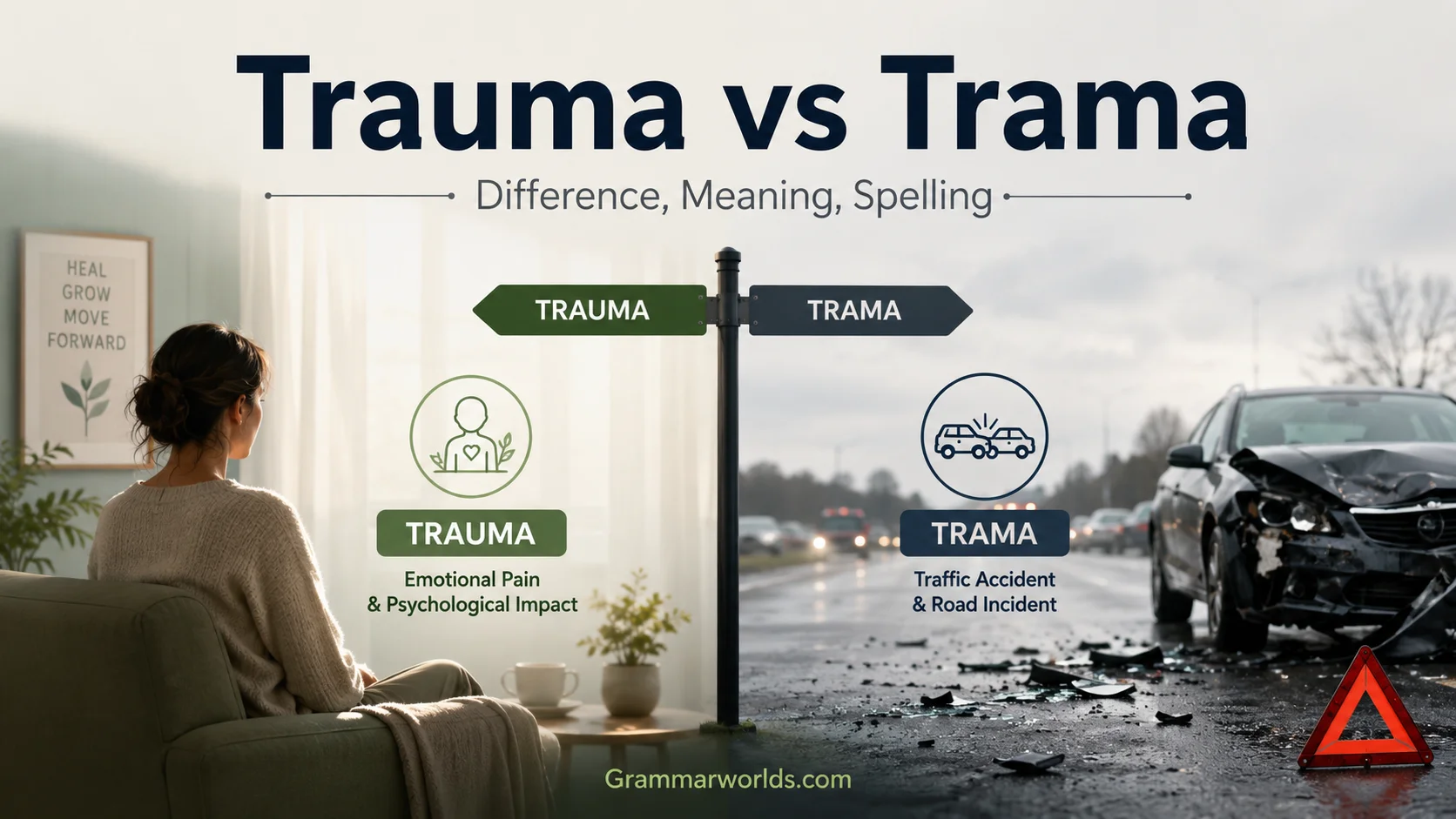
Have you ever typed “trama” when you meant “trauma”? You’re not alone.
Many English learners, students, writers, and even native speakers occasionally confuse these two spellings. At first glance, the difference seems tiny. After all, only one letter separates them. Yet that missing letter completely changes whether the word is correct in standard English.
Understanding the difference between trauma vs trama matters because the word trauma appears frequently in medicine, psychology, education, healthcare, journalism, and everyday conversation. Using the wrong spelling can make your writing look careless and may even affect credibility in professional settings.
The good news is that the distinction is straightforward. In standard English, trauma is the correct word, while trama is usually a misspelling.
This comprehensive guide explains the meaning of trauma, why people write trama by mistake, how to remember the correct spelling, and how to use trauma properly in sentences.
Trauma vs Trama: Quick Comparison
Before diving deeper, let’s look at the key differences.
| Feature | Trauma | Trama |
| Correct English spelling | Yes | No |
| Recognized in dictionaries | Yes | Generally no |
| Part of speech | Noun | Usually a misspelling |
| Meaning | Physical or emotional injury | No standard English meaning |
| Common usage | Very common | Usually an error |
| Academic acceptance | Accepted | Not accepted |
Quick Answer
If you’re choosing between trauma and trama, use trauma.
The word trama is typically a spelling mistake caused by accidentally leaving out the letter “u.”
What Does Trauma Mean?
The word trauma refers to a deeply distressing physical or emotional experience that affects a person’s well-being.
Originally, the term described a physical wound or injury. Over time, its meaning expanded to include psychological injuries caused by difficult experiences.
Dictionary Definition of Trauma
Trauma generally means:
A serious physical injury or a deeply disturbing emotional experience that causes lasting effects.
Today, healthcare professionals, psychologists, counselors, teachers, and researchers use the term regularly.
For example:
- A car accident can cause physical trauma.
- The loss of a loved one can cause emotional trauma.
- Childhood abuse may lead to long-term psychological trauma.
Because the word appears in many fields, understanding its proper spelling is essential.
Types of Trauma
Trauma is not limited to one kind of experience. Experts typically categorize it into several forms.
Physical Trauma
Physical trauma refers to bodily injury.
Common examples include:
- Car accidents
- Falls
- Sports injuries
- Burns
- Gunshot wounds
- Severe cuts
- Fractures
Hospitals often have specialized trauma units designed to treat life-threatening injuries quickly.
Example
A patient involved in a highway collision may suffer severe trauma to the chest and head.
In medical settings, trauma can describe both the injury itself and the emergency care required to treat it.
Emotional Trauma
Emotional trauma occurs when a distressing experience overwhelms a person’s ability to cope.
Common causes include:
- Abuse
- Neglect
- Violence
- Natural disasters
- Serious accidents
- Sudden loss
- Witnessing frightening events
Unlike physical wounds, emotional trauma cannot always be seen. However, its effects can be significant.
People experiencing emotional trauma may struggle with:
- Anxiety
- Depression
- Sleep problems
- Fear
- Trust issues
- Emotional numbness
Childhood Trauma
Childhood trauma has become one of the most studied areas in psychology.
Children may experience trauma through:
- Physical abuse
- Emotional abuse
- Bullying
- Domestic violence
- Family instability
- Neglect
Research consistently shows that adverse childhood experiences can influence health and behavior later in life.
However, trauma does not automatically determine someone’s future. Supportive relationships, therapy, and healthy environments often help individuals recover and thrive.
What Does Trama Mean?
When comparing trauma vs trama, many people wonder whether trama is an actual English word.
In standard English, the answer is usually no.
Is Trama a Real Word?
Major English dictionaries recognize trauma as the correct spelling.
The spelling trama is generally considered incorrect.
Most instances of “trama” occur because:
- Someone typed too quickly.
- The letter “u” was accidentally omitted.
- English is not the writer’s first language.
- A spelling checker was not used.
As a result, professional writing should avoid the spelling “trama.”
When You Might See Trama
Although it is not standard English, you may encounter the word online.
Typographical Errors
The most common explanation is a typing mistake.
Because the letters in “trauma” appear close together, many people accidentally skip the “u.”
For example:
Incorrect: She experienced trama after the accident.
Correct: She experienced trauma after the accident.
Influence From Other Languages
In some languages, similar-looking words exist with different meanings.
As a result, multilingual writers may occasionally transfer spelling patterns into English.
This phenomenon is common among language learners and does not necessarily indicate poor writing skills.
Search Engine Queries
Thousands of people search for spelling-related questions every year.
Many users type:
- trama meaning
- trama vs trauma
- how to spell trauma
- is trama a word
Because of these searches, grammar websites often publish articles explaining the difference.
Why People Confuse Trauma and Trama
Several factors contribute to the confusion.
The Missing Letter Problem
The simplest explanation is that people forget the letter u.
The word contains an unusual vowel combination:
t-r-a-u-m-a
Since English includes many irregular spellings, writers sometimes simplify it incorrectly.
Pronunciation Confusion
Pronunciation also plays a role.
Many people pronounce trauma as:
TRAW-muh
Because the “u” sound isn’t strongly emphasized, listeners may assume the word contains fewer letters than it actually does.
This often leads to the incorrect spelling “trama.”
Also Read This :Comming vs Coming: The Difference, Meaning
Visual Similarity
The human brain frequently recognizes words by shape rather than letter-by-letter analysis.
Since trauma and trama look similar, readers may overlook the missing letter.
That small difference can easily escape notice during proofreading.
How to Spell Trauma Correctly Every Time
Fortunately, remembering the correct spelling is simple.
Use a Memory Trick
Think of this phrase:
Trauma has a U because difficult experiences can affect YOU.
The letter U becomes easier to remember when linked to the word “you.”
Break It Into Syllables
Divide the word into parts:
Trau-ma
Seeing the word in syllables makes it easier to memorize.
Practice Writing It
Repetition strengthens memory.
Write the word several times:
- Trauma
- Trauma
- Trauma
Soon the correct spelling becomes automatic.
Common Misspellings to Avoid
Many spelling mistakes occur alongside “trama.”
| Incorrect Spelling | Correct Spelling |
| Trama | Trauma |
| Traumma | Trauma |
| Truama | Trauma |
| Tramua | Trauma |
| Trahma | Trauma |
Proofreading carefully helps eliminate these errors.
Trauma in Sentences
Understanding definitions is helpful. Seeing the word used correctly is even better.
Medical Examples
- The patient suffered severe trauma after the collision.
- Doctors stabilized the trauma victim immediately.
- Trauma specialists worked throughout the night.
Emotional Health Examples
- Childhood trauma can influence adult relationships.
- She attended counseling to address past trauma.
- Emotional trauma often requires time and support to heal.
Educational Examples
- Teachers increasingly receive trauma-informed training.
- Schools now recognize the impact of trauma on learning.
- Trauma-sensitive classrooms can improve student outcomes.
Everyday Examples
- The experience left lasting trauma.
- Many survivors eventually overcome trauma with support.
- The incident caused emotional trauma throughout the community.
Why Trama Is Usually Incorrect in Sentences
The spelling “trama” should generally be avoided.
Incorrect vs Correct Examples
| Incorrect Sentence | Correct Sentence |
| He experienced trama after the crash. | He experienced trauma after the crash. |
| Childhood trama affected her confidence. | Childhood trauma affected her confidence. |
| The hospital treats trama patients. | The hospital treats trauma patients. |
| Therapy helped reduce her trama. | Therapy helped reduce her trauma. |
Notice that every corrected sentence uses trauma.
Trauma vs Trama: Side-by-Side Usage Guide
Understanding when to use each term makes the distinction clear.
Use Trauma When Referring To
- Physical injuries
- Psychological distress
- Emotional wounds
- Medical treatment
- Mental health discussions
- Academic research
- Healthcare settings
Use Trama When
In standard English writing:
- Almost never
The only exceptions might involve:
- Quoting an original mistake
- Discussing spelling errors
- Referring to a foreign-language term with a different meaning
For normal English communication, choose trauma.
Word Origin and Etymology of Trauma
Learning where a word comes from often makes it easier to remember.
Greek Origins
The word trauma comes from the Greek word:
τραῦμα (traûma)
Its original meaning was:
“wound” or “injury”
The concept focused primarily on physical damage.
Development in Medicine
Medical professionals adopted the term centuries ago.
Doctors used trauma to describe:
- Wounds
- Physical injuries
- Bodily damage
Over time, the word became standard medical terminology.
Expansion Into Psychology
Psychologists later expanded the meaning.
Rather than describing only physical wounds, trauma began to include emotional and psychological injuries.
Today, both meanings remain valid.
How the Meaning of Trauma Changed Over Time
Language evolves constantly.
The meaning of trauma has broadened significantly.
Historical Meaning
Originally:
- Physical wound
- Bodily injury
- Medical damage
Modern Meaning
Today:
- Physical injury
- Emotional suffering
- Psychological distress
- Long-term mental effects
This broader definition reflects growing understanding of mental health.
Related Words and Forms of Trauma
Several related terms appear frequently in writing and conversation.
Traumatic
Traumatic is an adjective.
It describes something that causes trauma.
Examples:
- A traumatic event
- A traumatic experience
- A traumatic injury
Traumatized
Traumatized describes someone affected by trauma.
Examples:
- The survivor felt traumatized.
- Many witnesses were traumatized by the disaster.
- Children may become traumatized after severe neglect.
Traumatizing
This adjective describes something capable of causing trauma.
Examples:
- The event was traumatizing.
- Witnessing violence can be traumatizing.
- The experience proved deeply traumatizing.
Trauma-Informed
A modern phrase used in education, healthcare, and social services.
Trauma-informed approaches recognize that past experiences may affect behavior and decision-making.
Examples include:
- Trauma-informed teaching
- Trauma-informed therapy
- Trauma-informed healthcare
Common Grammar and Usage Mistakes
Even when people spell trauma correctly, other errors occur.
Using Trauma as a Verb
Trauma is a noun.
Incorrect:
- The accident traumaed him.
Correct:
- The accident traumatized him.
- The accident caused trauma.
Confusing Trauma With Drama
These words look somewhat alike but have completely different meanings.
| Word | Meaning |
| Trauma | Serious physical or emotional injury |
| Drama | Exciting, emotional, or theatrical events |
Example
Correct: The accident caused trauma.
Correct: The television show created drama.
Mixing them changes the meaning entirely.
Misspelling Trauma in Professional Writing
Errors involving trauma can reduce credibility in:
- Academic papers
- Medical reports
- Research articles
- Business communications
Always proofread carefully.
Spell-check tools help but should not replace manual review.
Trauma vs Other Commonly Misspelled Words
English contains many words that writers frequently misspell.
| Correct Word | Common Misspelling |
| Trauma | Trama |
| Separate | Separete |
| Receive | Recieve |
| Necessary | Necesary |
| Occasion | Ocassion |
| Accommodation | Accomodation |
| Definitely | Definately |
Recognizing common mistakes improves overall writing quality.
Real-World Case Study: Why Correct Spelling Matters
Imagine two job applicants submitting reports.
Applicant A writes:
“The patient experienced trauma following the accident.”
Applicant B writes:
“The patient experienced trama following the accident.”
Both intended the same meaning.
However, employers reviewing medical or professional documents may view the second version as less polished.
One missing letter can affect first impressions.
That’s why attention to spelling remains important in education and professional communication.
Quick Reference Chart
| Question | Answer |
| Is trauma a real word? | Yes |
| Is trama a real English word? | Usually no |
| Which spelling is correct? | Trauma |
| What does trauma mean? | Physical or emotional injury |
| Is trauma used in psychology? | Yes |
| Is trauma used in medicine? | Yes |
| Should trama be used in formal writing? | No |
FAQs
Is Trama a Correct English Word?
No. In standard English, trama is generally considered a misspelling of trauma.
Is Trauma the Correct Spelling?
Yes. Trauma is the accepted spelling used in dictionaries, medical literature, academic research, and everyday communication.
Why Do People Write Trama Instead of Trauma?
Most people accidentally omit the letter u. Fast typing, pronunciation confusion, and unfamiliarity with the spelling often cause the error.
Can Trama Be Used in Any Situation?
Generally no. In English writing, trauma is almost always the correct choice.
Is Trauma Always Emotional?
A broken bone may involve physical trauma, while a distressing life event may cause emotional trauma.
Conclusion
When comparing trauma vs trama, only one spelling belongs in standard English. The correct word is trauma. It refers to physical injuries, emotional distress, or psychological wounds that result from difficult experiences.Although trama occasionally appears online, it is usually a typographical error caused by leaving out the letter u. Understanding this distinction helps you write more accurately and communicate with confidence.