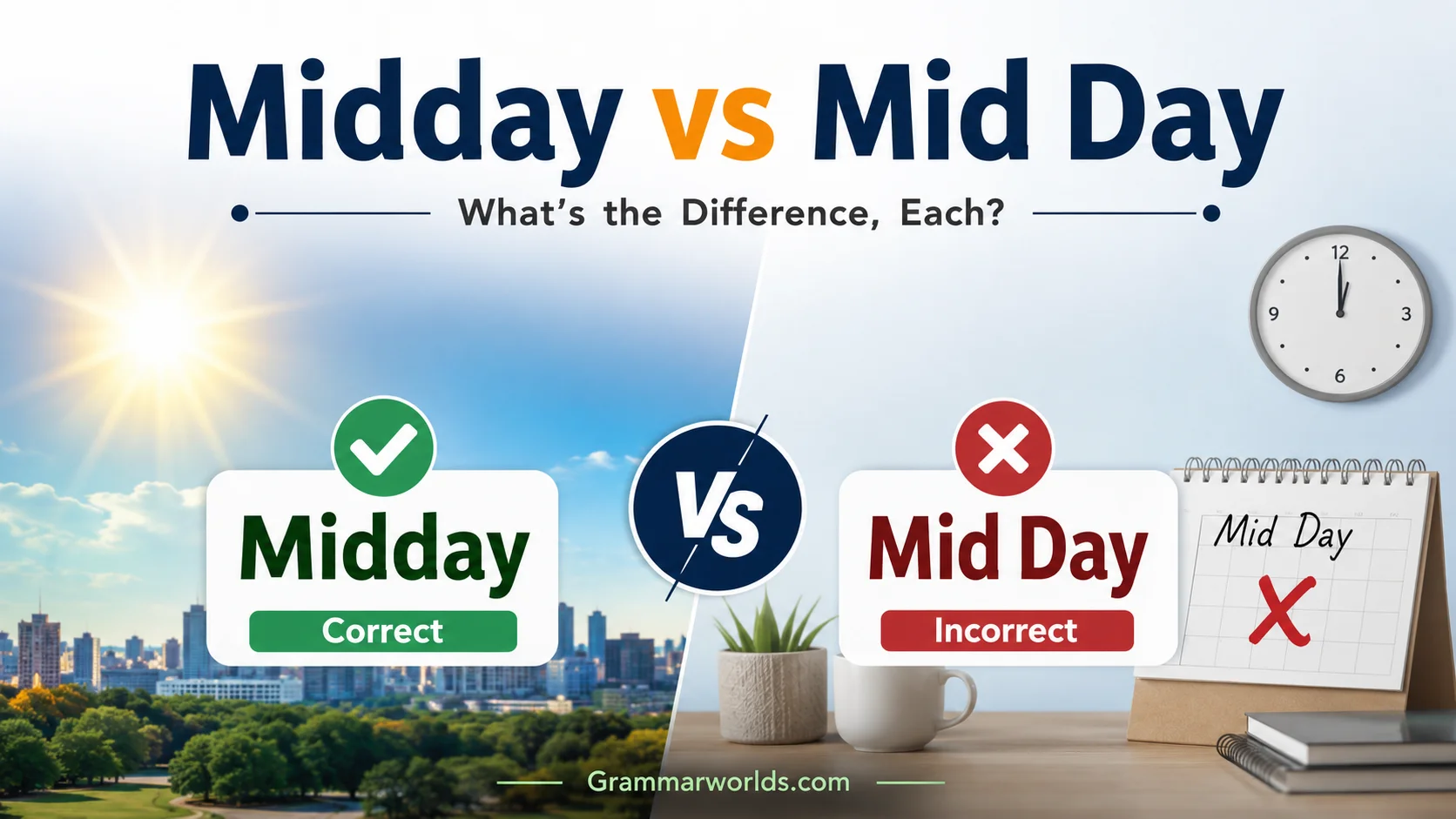
Midday vs Mid Day What’s the Difference, Each? helps English learners understand spelling choices, grammar rules, and modern usage trends clearly. When I guide students and professionals through this common word.
I often notice grammar confusion and spelling confusion because it appears in different online versions. The correct spelling depends on modern English, English grammar, and current spelling standards. Midday is the standard spelling in most situations, while Mid-Day and mid day may create uncertainty because of the hyphen, spaced words, and hyphenated forms developed through language change. This linguistic evolution shows how a word can move from separate parts into a single unit through modern standardization.
The difference becomes easier to understand through writing accuracy, communication skills, and professional writing standards. From my experience reviewing content, I have seen repeated mistakes caused by a mid-sentence pause where writers question deciding separation, hyphenation, or the correct form. Checking modern dictionaries, style guides, and professional publications provides useful references for improving spelling accuracy, writing skills, and overall communication.
Midday vs Mid Day: The Quick Answer
The difference between midday and mid day comes down to how English treats compound words.
| Term | Correctness | Meaning | Common Usage |
| Midday | Standard spelling | The middle of the day, around noon | Very common |
| Mid day | Rare and context-specific | “Mid” describing the middle of a particular day | Uncommon |
In modern English, midday is the form you will use almost every time.
Examples of correct midday usage:
- “The temperature reaches its highest point at midday.”
- “We scheduled the meeting for midday.”
- “The farmer takes a break during the midday heat.”
- “The package should arrive by midday tomorrow.”
The word feels natural because English speakers have used midday as a single word for centuries.
What Does Midday Mean?
Midday means the middle of the day. It usually refers to the period around 12:00 p.m., although the exact meaning depends on context.
Unlike noon, which points to a specific moment, midday describes a broader period.
Think of it like this:
- Noon = exactly 12:00 p.m.
- Midday = the general middle portion of the day
For example:
“The meeting starts at noon.”
This means the meeting begins exactly around 12:00 p.m.
However:
“The streets become crowded around midday.”
This does not mean exactly 12:00 p.m. It means the middle part of the day when activity increases.
What Time Is Considered Midday?
There is no universal clock time that defines midday. Different cultures and situations use the term differently.
Generally, midday falls somewhere between:
- Late morning
- 12:00 p.m.
- Early afternoon
Most people consider midday to be approximately:
| Time Range | Description |
| 11:00 a.m. – 1:00 p.m. | Common midday period |
| 12:00 p.m. | Exact middle point of the day |
| 1:00 p.m. – 2:00 p.m. | Sometimes considered late midday |
The meaning changes depending on the situation.
For example:
- A restaurant may call 11:30 a.m. a midday rush.
- A weather report may describe temperatures peaking around midday at 12–2 p.m.
- A workplace may schedule a “midday update” at 1 p.m.
Language is flexible because people use words based on shared understanding, not only strict definitions.
What Does Mid Day Mean?
The phrase “mid day” is not usually the preferred spelling when you simply mean the middle of the day.
However, there are rare situations where writers separate the words intentionally.
Here, “mid” acts as a separate modifier meaning “middle” or “halfway through.”
For example:
- “The project reached its mid-day review stage.”
- “The team analyzed the mid-day performance report.”
Even in these examples, many editors would still prefer:
- “midday review”
- “midday performance report”
The one-word form usually sounds smoother.
Why Is Midday Written as One Word?
English often combines words that become closely connected over time.
These are called compound words.
A compound word forms when two separate words join together to create a single concept.
Examples:
| Two Words | Compound Word |
| sun + light | sunlight |
| moon + light | moonlight |
| day + break | daybreak |
| noon + time | noontime |
| mid + day | midday |
Originally, many compound words appeared as separate words. Over time, frequent usage caused them to merge.
The same happened with midday.
People repeatedly used “mid day” to describe a specific time, and eventually the one-word version became the accepted standard.
Midday vs Noon: Are They the Same?
Although people often use midday and noon interchangeably, they are slightly different.
| Word | Meaning | Example |
| Midday | The general middle period of the day | “The park is busiest around midday.” |
| Noon | Exactly 12:00 p.m. | “The meeting starts at noon.” |
A simple comparison:
Imagine the day as a highway.
Noon is the exact mile marker. Midday is the surrounding stretch of road.
Noon gives you a precise point. Midday gives you a general area.
Examples:
Specific time:
“The train arrives at noon.”
General period:
“The train station gets crowded around midday.”
Both sentences are correct, but they communicate slightly different ideas.
Midday vs Afternoon: What Is the Difference?
Many people assume midday and afternoon mean the same thing, but they describe different parts of the day.
Midday
Refers to the center of the day.
Usually:
- Around noon
- Near 12 p.m.
- Between morning and afternoon
Afternoon
Refers to the period after noon.
Usually:
- Starts around 12 p.m.
- Continues until evening
A timeline makes the difference clearer:
Morning Midday Afternoon Evening
6 AM ————– 12 PM ————– 3 PM —————- 6 PM
For example:
- “I eat lunch at midday.”
- “I have meetings in the afternoon.”
The first focuses on the central point of the day. The second describes a longer period afterward.
Common Mistakes With Midday vs Mid Day
Small spelling mistakes can affect how professional your writing appears. Here are the most common errors.
Writing “Mid Day” in Normal Sentences
The biggest mistake is separating the word when referring to the time of day.
Incorrect:
“The mid day sun was extremely hot.”
Better:
“The midday sun was extremely hot.”
The second version looks cleaner and follows standard English usage.
Confusing Midday With Midnight
These words look similar but refer to opposite times.
| Word | Meaning |
| Midday | Middle of the day |
| Midnight | Middle of the night |
Examples:
- “The store closes at midnight.”
- “The store opens at midday.”
A simple memory trick:
- Day = daylight = midday
- Night = darkness = midnight
Assuming Every “Mid” Word Follows the Same Rule
English does not always follow a single pattern.
Some “mid” words are combined:
- midday
- midnight
- midterm
- midyear
Others are usually separated:
- mid century
- mid twenties
- mid season
However, some forms depend on style guides and context.
For example:
- “mid-century architecture” is common.
- “midcentury architecture” is also used.
English spelling often develops through usage rather than strict mathematical rules.
How to Use Midday in Professional Writing
The word midday works well in business communication because it sounds clear and polished.
Examples:
Workplace Emails
“Please submit your report by midday Friday.”
This sounds professional without being overly formal.
Project Updates
“The team will provide a midday progress update.”
Scheduling
“The conference begins at midday and continues until late afternoon.”
Using “midday” can make your writing sound more precise than vague phrases like “around lunch.”
How to Use Midday in Everyday Conversation
Although “midday” sounds slightly formal, people use it naturally in everyday speech.
Examples:
- “I usually go for a walk around midday.”
- “The heat is strongest at midday.”
- “Let’s meet around midday for coffee.”
In casual conversations, people may also say:
- around noon
- lunchtime
- early afternoon
The best choice depends on the tone.
Also Read This : Which vs Witch vs Witch What’s the Difference?
Midday in Weather, Travel, and Daily Life
The word appears frequently in situations where timing matters.
Weather
Weather reports often use midday because temperatures and sunlight change significantly during this period.
Example:
“Temperatures will rise sharply by midday.”
Travel
Travel plans often use midday for approximate schedules.
Example:
“The bus should arrive around midday.”
Agriculture
Farmers commonly refer to midday because sunlight and heat influence outdoor work.
Example:
“Workers avoid heavy tasks during the midday heat.”
Health and Fitness
People discuss midday habits such as:
- midday meals
- midday workouts
- midday breaks
The word creates a clear mental image of a specific part of the day.
Synonyms and Alternatives for Midday
Sometimes another word fits better depending on your meaning.
| Alternative | Meaning | Best Use |
| Noon | Exact 12 p.m. | Precise schedules |
| Lunchtime | Meal period | Casual speech |
| Early afternoon | After noon | Broader timing |
| Middle of the day | Explanation or formal writing | Clarity |
Examples:
Instead of:
“The event begins at midday.”
You might write:
“The event begins at noon.”
if you mean exactly 12:00 p.m.
Or:
“The event begins in the early afternoon.”
if it starts later.
Why Choosing the Right Word Matters
Small language choices influence how readers understand your message.
Compare these sentences:
“The delivery arrives mid day.”
and:
“The delivery arrives midday.”
The second sentence feels more polished because readers recognize it as the standard form.
Correct spelling helps your writing:
- Look professional
- Communicate clearly
- Avoid distractions
- Build credibility
A single missing space may seem insignificant, but details often separate average writing from excellent writing.
Faqs:
Is midday one word or two words?
Midday is one word. It is the standard spelling used in modern English when referring to the middle of the day.
Is “mid day” incorrect?
Not always, but it is uncommon. In most cases, writing “mid day” looks outdated or unnecessary. The preferred form is midday.
Is midday the same as noon?
No. Noon refers specifically to 12:00 p.m., while midday refers to the general middle period of the day.
For example:
- “The meeting starts at noon.” (exact time)
- “The office becomes busy around midday.” (general period)
Is midday morning or afternoon?
Midday sits between morning and afternoon. It represents the transition point around noon.
Should I write midday in formal writing?
Yes. Midday works well in formal writing, professional documents, emails, reports, and everyday communication.
Conclusion
When deciding between midday vs mid day, choose midday in almost every situation.
The standard rule is:
✅ Use midday when you mean the middle of the day.
Examples:
- “The store closes at midday.”
- “The midday sun is powerful.”
- “We will meet around midday.”
Use mid day only in rare situations where “mid” functions separately as a modifier. Even then, the one-word form often works better.