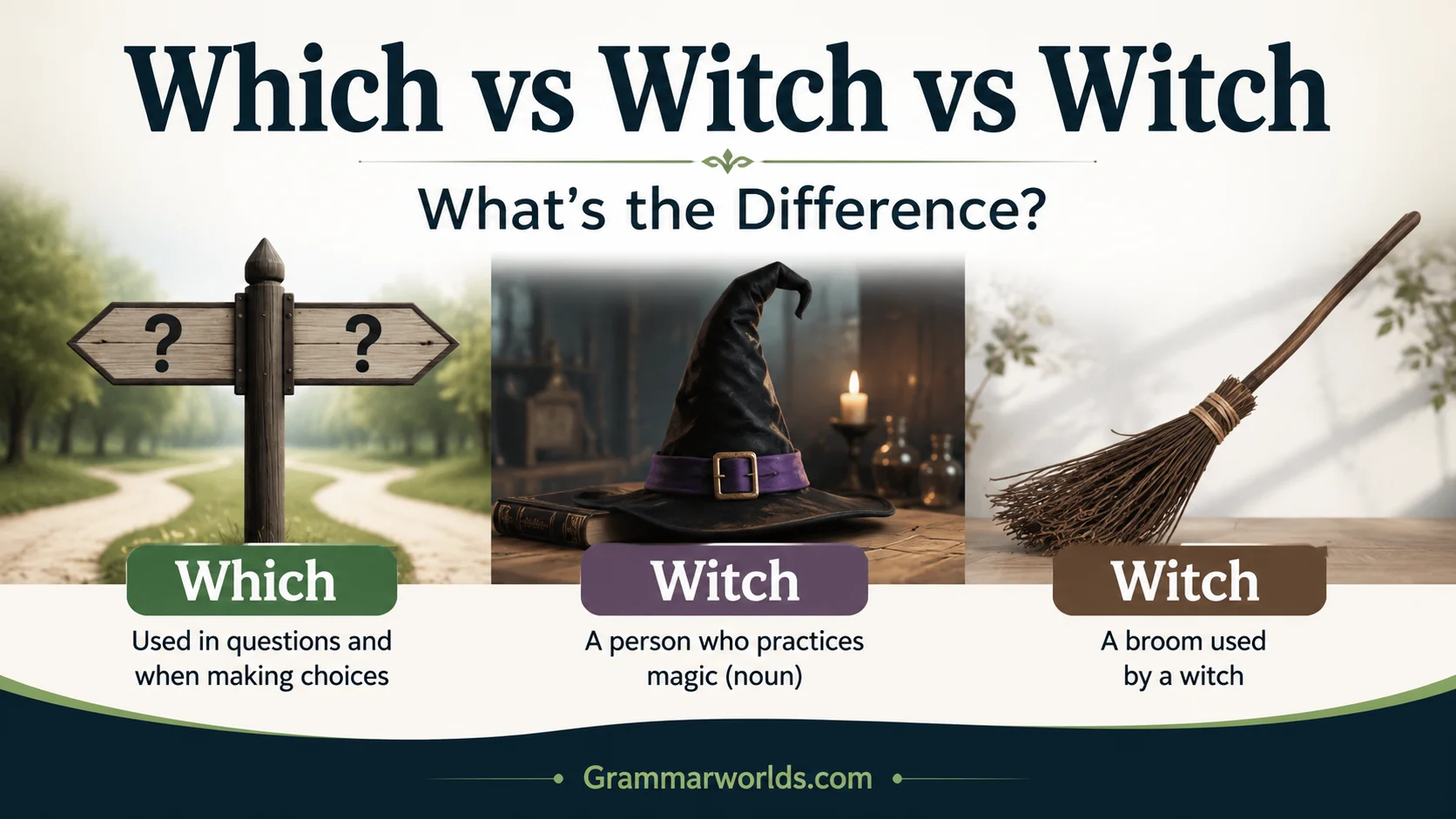
Which vs Witch vs Witch What’s the Difference? explains how homophones confuse writers because sounds match but meanings differ in English usage. Learning English becomes an easy task when you know why certain words may look and sound like others but become used incorrectly.
The pair of words which and which are often mixed up because they are said exactly the same way, yet they mean totally different things. These commonly confused word pairs can make confident writers mix up choices while typing, but a clear guide can clear up confusion with a simple, practical explanation. Many learners struggle with homophones, pronunciation, and clues, but using examples, clear examples, and quick tricks makes the difference easy to remember without memorizing complex grammar rules. This approach helps avoid common mistakes, improve writing, and make communication more professional.
Mastering which, witch, and wich helps writers avoid confusion by understanding their distinct meanings and functions. Homophone confusion may cause spelling mistakes, writing errors, incorrect spelling, and misspelling, affecting clear communication, effectiveness, and professional writing. Understanding definitions, meanings, word meanings, word differences, semantic difference, lexical distinction, and overall distinction improves
Which vs Witch vs Wich: Quick Comparison
Before exploring each word in detail, here is a simple overview.
| Word | Meaning | Part of Speech | How It Is Used | Example |
| Which | Used to ask about choices or add information about something | Pronoun, determiner | Questions and descriptive clauses | Which dress do you prefer? |
| Witch | A person associated with magic, spells, or supernatural powers | Noun | Stories, history, folklore, and culture | The witch created a magical potion. |
| Wich | An old word element connected to settlements or trading places | Historical word element | Mostly found in place names | Sandwich, Norwich, Ipswich |
The easiest way to remember them:
- Which = choice
- Witch = magic
- Wich = place names and history
What Does “Which” Mean?
The word which is one of the most frequently used words in English. Unlike witch and wich, it appears in everyday conversations, emails, books, and professional writing.
People use which mainly in two ways:
- To ask questions.
- To connect additional information to a noun.
Let’s look at both uses.
Which as a Question Word
When you need someone to choose between options, you usually use which.
Think of which as a word that points toward a decision.
Examples:
- Which restaurant should we visit?
- Which phone should I buy?
- Which color looks better with this jacket?
- Which route is faster?
In each sentence, the speaker expects a choice.
The options may be stated directly:
Which dessert would you like: cake or ice cream?
Or they may be understood from the situation:
Which one is yours?
The listener already knows there are several possible choices.
Which vs What: Understanding the Difference
Many English learners confuse which with what because both can ask questions.
The difference usually depends on whether the choices are limited or unlimited.
| Word | Best Used When | Example |
| Which | The options are limited or known | Which shirt do you want, the blue one or the black one? |
| What | The possibilities are broad or unknown | What shirt do you want to buy? |
Compare these examples:
Which movie should we watch?
This suggests there are specific movies available.
Maybe your friend has already selected five options.
What movie should we watch?
This opens the conversation to any movie.
The difference is small, but it changes the feeling of the sentence.
Which as a Relative Pronoun
The word which can also connect ideas inside a sentence.
In grammar, this is called a relative pronoun.
It introduces information about a thing, object, or idea.
Examples:
- The laptop, which I bought last year, still works perfectly.
- The restaurant which serves Italian food is near my office.
- She showed me the painting which won the competition.
Here, which links the main sentence with extra details.
Restrictive vs Nonrestrictive “Which” Clauses
This is one of the most important grammar differences involving which.
Nonrestrictive Which Clauses
A nonrestrictive clause adds extra information. The sentence still makes sense without it.
These clauses use commas.
Example:
My car, which I bought in 2022, has never broken down.
The important information is:
My car has never broken down.
The phrase which I bought in 2022 simply adds extra detail.
Restrictive Which Clauses
A restrictive clause identifies exactly which thing you mean.
It does not use commas.
Example:
The car which I bought in 2022 has a hybrid engine.
Here, the phrase tells the reader which car you mean.
Maybe you own several cars. The clause identifies one specific vehicle.
Common Examples of “Which” in Everyday English
You will see which everywhere.
Here are common examples:
Making Decisions
- Which candidate should we choose?
- Which plan works better?
- Which option saves more money?
Asking for Information
- Which train goes downtown?
- Which book did you recommend?
- Which website has the correct information?
Adding Details
- The house, which was built in 1905, is now a museum.
- The company, which started as a small business, now operates globally.
What Does “Witch” Mean?
The word witch has a completely different meaning from which.
A witch is a person associated with magic, spells, supernatural abilities, or witchcraft.
The word appears frequently in:
- Fairy tales
- Fantasy novels
- Movies
- Video games
- Historical discussions
- Folklore
Examples:
- The witch prepared a mysterious potion.
- The children dressed as witches for Halloween.
- The fantasy novel follows a young witch learning magic.
Witch in Folklore and Fantasy
For centuries, stories around the world have included witches.
Different cultures have described witches in many ways. Some stories portray them as dangerous characters while others present them as wise healers, protectors, or powerful figures.
Popular fiction often creates its own versions of witches.
For example:
- Some witches cast spells.
- Some use magical objects.
- Some communicate with supernatural beings.
- Some appear as heroes rather than villains.
The meaning depends heavily on the story’s setting.
A witch in a horror movie may look completely different from a witch in a fantasy adventure.
Witch in History
The historical meaning of witch is more complicated than many fictional portrayals suggest.
In many societies, people accused others of practicing harmful magic. These accusations sometimes led to trials and punishments.
One famous example is the Salem witch trials, where dozens of people were accused of witchcraft in colonial Massachusetts.
Important facts:
- The Salem trials began in 1692.
- More than 200 people were accused.
- 20 people were executed.
- The events later became one of the most studied examples of mass hysteria in history.
Today, historians study these events to understand social fears, legal systems, and cultural beliefs of the tim.
Also Read This : Distress vs Duress Understanding The Difference ?
Modern Uses of the Word Witch
Today, witch appears in many different contexts.
It can refer to:
Fictional Characters
Examples:
- Fantasy stories
- Movies
- Television shows
- Video games
Historical Discussions
Example:
The book examines accusations of witchcraft during the 17th century.
Modern Spiritual Practices
Some people use the term to describe personal spiritual beliefs or practices connected with nature, rituals, or traditions.
The meaning depends on the speaker and the context.
What Does “Wich” Mean?
Among the three words, wich is the least common.
Most people rarely use wich as a standalone word in modern English.
Instead, it usually appears as part of another word, especially place names.
Examples:
- Sandwich
- Norwich
- Ipswich
- Greenwich
Many people assume wich connects to the food sandwich, but the history is different.
The Historical Meaning of “Wich”
The element -wich comes from Old English and related Germanic language roots.
Historically, it referred to:
- A settlement
- A trading place
- A dwelling area
- A specialized location
Over time, the word became part of many English place names.
For example:
- Sandwich originally referred to a settlement in England.
- Norwich developed from an old settlement name.
- Ipswich also contains this historical element.
The modern meaning of wich is not connected to magic or the question word which.
Why Is Sandwich Called Sandwich?
The word sandwich has a fascinating history.
It comes from the English town of Sandwich.
The food name became popular because of John Montagu, 4th Earl of Sandwich.
According to the popular story, the Earl wanted food he could eat while continuing his activities. A meal placed between slices of bread became associated with his title.
Over time, the word sandwich entered everyday English as the name of the food.
The -wich ending is historical, not magical.
Which vs Witch vs Wich Pronunciation
One reason these words confuse people is pronunciation.
In most English accents:
- Which
- Witch
- Wich
sound the same or very similar.
These words are called homophones.
A homophone is a word that:
- Sounds the same as another word.
- Has a different spelling.
- Has a different meaning.
Other examples of homophones include:
| Word Pair | Meaning Difference |
| Two / Too / To | Number, also, direction |
| Their / There / They’re | Possession, location, they are |
| Flower / Flour | Plant, baking ingredient |
English contains many homophones because the language developed from several different sources over hundreds of years.
Faqs:
Are “which” and “witch” pronounced the same?
Yes, in most English accents, which and witch sound the same. They are homophones, meaning they share the same pronunciation but have different spellings and meanings.
The difference appears in writing, not in speech.
For example:
- Which book should I read?
- The witch appeared in the story.
When you hear these words spoken, you must use the surrounding sentence to understand the meaning.
Is “wich” a real English word?
Yes, wich is a real word element, but it is rarely used as a standalone word in modern English.
You will usually find it inside historical place names such as:
- Sandwich
- Norwich
- Ipswich
- Greenwich
The word comes from older English language roots connected with settlements, trading areas, or places where people lived or worked.
It does not mean a magical person, and it does not work as a replacement for which.
How can I easily remember the difference between which and witch?
A simple memory trick is to connect each word with its meaning:
- Which = choice
Think: “Which one will you choose?” - Witch = magic
Think: “A witch uses spells.” - Wich = places
Think: “You usually find -wich inside a place name.”
A quick sentence can help:
“Which choice will you make? The witch has magic. The sandwich has -wich.”
The meanings stay separate when you connect each spelling with a clear image.
Why do people confuse which, witch, and wich?
People confuse these words because English pronunciation does not always match spelling.
Many English words developed from different languages over centuries. As a result, some words ended up sounding the same even though they have completely different origins.
For example:
- Which comes from Old English roots connected with questions and choices.
- Witch comes from Old English words connected with magic and supernatural beliefs.
- Wich comes from historical place-name elements.
The sound is similar, but the history and meaning are different.
Is the “wich” in sandwich related to a witch?
No. The wich in sandwich has nothing to do with a witch who practices magic.
The word sandwich comes from the English place name Sandwich, which contains an old historical element related to settlements.
The food received its name from the title of the Earl of Sandwich, not from the word witch..
Conclusion
The difference between which vs witch vs wich becomes simple once you focus on meaning instead of pronunciation.
English has many confusing word pairs because spelling and pronunciation do not always follow the same path. Once you learn the meaning behind each word, these small differences become much easier to remember.
The next time you hear someone say “which,” don’t let the sound trick you. Look at the context, choose the right spelling, and your writing will stay clear and accurate.