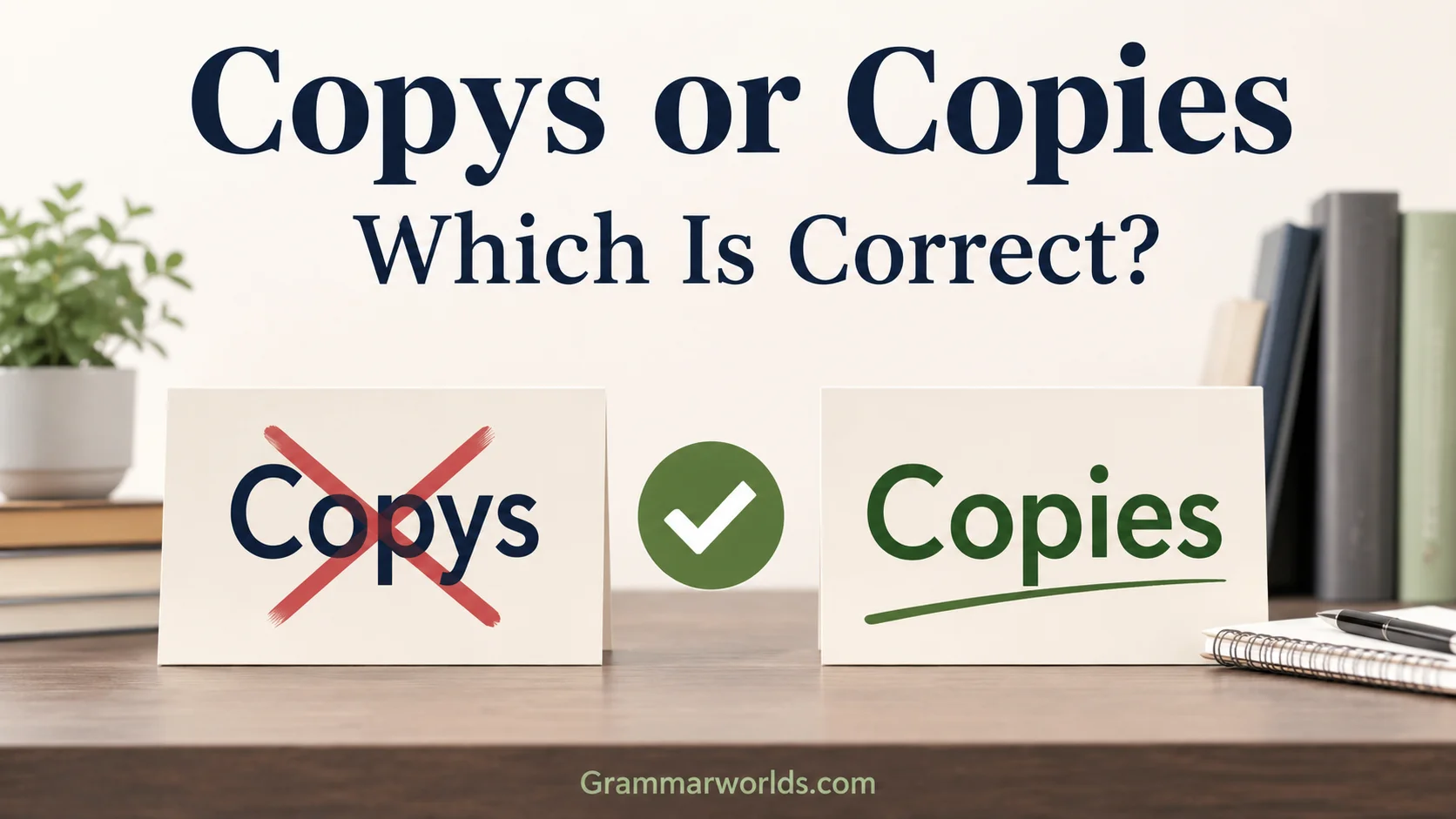
If you’ve ever stopped while writing and wondered whether to use copys or copies, you’re not alone. This is one of the most common spelling questions in English grammar. The confusion usually appears when people try to make the word copy plural.
The good news is that the answer is straightforward.
Copies is the correct plural form of copy.
Copys is incorrect and should not be used in standard English writing.
While the rule itself is simple, understanding why it works can help you avoid similar mistakes with dozens of other words. Once you learn the pattern, you’ll be able to confidently spell words like stories, cities, babies, and families without hesitation.
This guide explains the grammar rule behind copies, shows real-world examples, highlights common mistakes, and provides memory tricks that make the correct spelling easy to remember.
Copys or Copies: The Correct Spelling
Let’s answer the main question immediately.
| Singular | Correct Plural | Incorrect Plural |
| Copy | Copies | Copys |
The plural form of copy is always copies.
Correct Examples
- I printed three copies of the report.
- Please bring two copies of your resume.
- The teacher distributed copies of the worksheet.
- We keep backup copies of important files.
Incorrect Examples
- I printed three copys of the report.
- Please bring two copys of your resume.
- The office stored several copys of the contract.
In every standard form of English, including American, British, Canadian, and Australian English, copies remains the accepted plural spelling.
Why Is “Copies” Correct?
English spelling follows patterns rather than random rules. The word copy follows a common pluralization pattern used by thousands of English nouns.
The word copy ends with:
- A consonant (p)
- Followed by the letter y
When a noun ends in a consonant + y, English grammar requires you to:
- Remove the y
- Add ies
The transformation looks like this:
Copy → Copies
This rule has existed in English for centuries and appears in countless everyday words.
The Formula
Consonant + Y = Remove Y + Add IES
Because copy ends with the consonant p followed by y, it becomes copies.
Understanding the Consonant + Y Rule
Many English spelling mistakes happen because writers apply the wrong plural rule.
Most nouns simply add s.
Examples include:
- Book → Books
- Car → Cars
- Pen → Pens
- House → Houses
However, words ending in consonant + y behave differently.
Common Examples
| Singular | Plural |
| Baby | Babies |
| City | Cities |
| Story | Stories |
| Lady | Ladies |
| Family | Families |
| Country | Countries |
| Library | Libraries |
| Party | Parties |
| Copy | Copies |
Notice the pattern.
Every singular noun ends in a consonant followed by y.
Every plural noun changes y to ies.
Once you recognize this pattern, the spelling of copies becomes much easier to remember.
Why “Copys” Is Wrong
Many people assume that all nouns become plural by adding s.
That assumption works for many words. It doesn’t work for copy.
When someone writes copys, they are ignoring the consonant + y spelling rule.
Think about these examples:
- Storys ❌
- Familys ❌
- Citys ❌
- Babys ❌
All of these spellings look incorrect because English speakers naturally recognize the pattern.
The same principle applies to copy.
Therefore:
- Copies ✅
- Copys ❌
What Does the Word “Copy” Mean?
Understanding a word’s meaning often makes its usage clearer.
The noun copy has several meanings depending on the context.
A Duplicate of Something
This is the most common meaning.
Examples:
- A copy of a contract
- A copy of a passport
- A copy of a report
In this sense, a copy is an exact reproduction of an original item.
Printed Material
Publishers and printers frequently use the word copy.
Examples:
- The first copy of the magazine arrived today.
- The bookstore ordered 500 copies of the novel.
Written Content
In marketing and advertising, “copy” refers to written promotional content.
Examples:
- The copy on the website needs revision.
- The advertising copy increased sales.
Digital Files
Technology has expanded the use of the word.
Examples:
- Save a copy of the document.
- Create backup copies of your files.
Although the meanings vary, the plural form remains the same:
copy → copies
Singular vs. Plural Forms of Copy
Many grammar errors occur because writers confuse singular and plural forms.
The distinction is simple.
| Form | Meaning |
| Copy | One |
| Copies | More than one |
Singular Examples
- I need a copy of the agreement.
- She printed a copy of the article.
- Please bring a copy of your identification.
Plural Examples
- I need several copies of the agreement.
- She printed five copies of the article.
- Please bring two copies of your identification.
A useful trick is to look at the quantity.
If you’re talking about one item, use copy.
If you’re talking about multiple items, use copies.
When Do You Add “S” Instead of “IES”?
This is where many learners become confused.
Not every word ending in y changes to ies.
The preceding letter determines which rule applies.
If a Vowel Comes Before Y
Simply add s.
| Singular | Plural |
| Toy | Toys |
| Boy | Boys |
| Key | Keys |
| Day | Days |
| Journey | Journeys |
| Monkey | Monkeys |
Notice something important.
Each word contains a vowel before the letter y.
Examples:
- Toy = o + y
- Boy = o + y
- Key = e + y
Because a vowel comes before the y, you simply add s.
Also Read This :Unenroll vs Disenroll: What’s the Difference?
Compare the Difference
| Word Type | Singular | Plural |
| Consonant + Y | Copy | Copies |
| Consonant + Y | Story | Stories |
| Vowel + Y | Toy | Toys |
| Vowel + Y | Key | Keys |
This comparison helps explain why copies is correct while copys is not.
Real-Life Examples of “Copies” in Everyday Writing
Grammar becomes easier when you see words in context.
Education
Schools use the word frequently.
Examples:
- The teacher handed out copies of the assignment.
- Students received copies of the syllabus.
- Extra copies were available at the front desk.
Business
Professional workplaces rely on documentation.
Examples:
- Copies of the contract were emailed to clients.
- Human resources keeps copies of employee records.
- The manager requested additional copies for the meeting.
Government and Legal Documents
Official paperwork often requires duplicates.
Examples:
- Bring two copies of your passport.
- The court requested certified copies of the certificate.
- Copies of the application were submitted yesterday.
Technology
Digital environments use the word constantly.
Examples:
- Save multiple copies of important projects.
- Backup copies prevent data loss.
- Cloud storage maintains copies across servers
Common Mistakes People Make With “Copy”
Even experienced writers occasionally make errors.
Here are the most frequent mistakes.
Using “Copys”
This is by far the most common mistake.
Incorrect:
- Three copys were printed.
Correct:
- Three copies were printed.
Using Singular When Plural Is Needed
Incorrect:
- Please submit three copy of the report.
Correct:
- Please submit three copies of the report.
Confusing Copy and Copy’s
Many people mix up plural and possessive forms.
Incorrect:
- Several copy’s were distributed.
Correct:
- Several copies were distributed.
The apostrophe changes the meaning completely.
Copy, Copies, and Copy’s: Understanding the Difference
These three forms serve different grammatical purposes.
Copy
Copy is singular.
Example:
- I need a copy of the report.
Copies
Copies is plural.
Example:
- I need several copies of the report.
Copy’s
Copy’s shows possession.
Example:
- The copy’s cover page is damaged.
Comparison Table
| Word | Function | Example |
| Copy | Singular noun | One copy |
| Copies | Plural noun | Three copies |
| Copy’s | Possessive noun | The copy’s cover |
Remember this distinction because apostrophe errors are among the most common grammar mistakes in English.
Easy Trick to Remember the Correct Plural
Memory techniques can make spelling much easier.
The Family Rule
Think about familiar words.
- Baby → Babies
- Family → Families
- City → Cities
- Story → Stories
- Copy → Copies
Your brain already accepts these spellings.
Adding copies to the same pattern creates a simple mental shortcut.
The Y-to-IES Rule
Remember this sentence:
“When a consonant stands before Y, IES comes into play.”
It may sound simple, but it works.
Whenever you see:
Consonant + Y
Your brain should automatically think:
IES
Words Similar to Copy That Follow the Same Rule
Learning related words helps reinforce grammar patterns.
Common Examples
| Singular | Plural |
| Story | Stories |
| Country | Countries |
| Lady | Ladies |
| Family | Families |
| Library | Libraries |
| Dictionary | Dictionaries |
| Party | Parties |
| Baby | Babies |
| City | Cities |
| Copy | Copies |
Why Pattern Recognition Matters
Research in language learning shows that people remember spelling rules more effectively when they learn groups of related words rather than isolated examples.
Instead of memorizing:
- Copy → Copies
Learn the broader pattern:
- Story → Stories
- Family → Families
- City → Cities
- Copy → Copies
This approach creates stronger long-term recall.
A Practical Case Study: The Office Printing Error
Consider a simple workplace scenario.
An employee sends an email saying:
“Please print ten copys for tomorrow’s meeting.”
Several coworkers immediately notice the spelling mistake.
The intended meaning remains clear. However, the error creates an unprofessional impression.
Now compare that with:
“Please print ten copies for tomorrow’s meeting.”
The second version follows standard English grammar and appears polished.
This example highlights why spelling matters in professional communication.
A small mistake can affect credibility.
Why Correct Spelling Matters
Some people argue that minor spelling errors don’t matter.
In casual texting, that may be true.
In professional, academic, and business writing, correct spelling carries significant weight.
Benefits of Correct Spelling
- Improves readability
- Builds credibility
- Enhances professionalism
- Prevents misunderstandings
- Creates a stronger first impression
Whether you’re writing a resume, report, email, or research paper, proper grammar signals attention to detail.
Quick Grammar Summary: Copys or Copies
| Question | Answer |
| Correct plural of copy? | Copies |
| Is copys correct? | No |
| Why does copy become copies? | Consonant + y changes to ies |
| Singular form? | Copy |
| Plural form? | Copies |
| Possessive form? | Copy’s |
| Common mistake? | Writing copys |
This table serves as a quick reference whenever you need a reminder.
FAQs
Is copys a real word?
No. Standard English dictionaries do not recognize copys as the correct plural form of copy.
Why does copy become copies?
The word ends with a consonant followed by y. English grammar requires changing y to ies when forming the plural.
Which is correct: copys or copies?
Copies is correct. Copys is incorrect.
What is the plural of copy in business writing?
The plural remains copies in all professional, academic, legal, and business contexts.
What grammar rule explains copies?
The rule states that nouns ending in a consonant followed by y change the y to ies when forming the plural.
Conclusion
When comparing copys or copies, the answer is clear.Copies is the correct plural form of copy, while copys is incorrect. The spelling follows a well-established English grammar rule that changes y to ies when a word ends in a consonant followed by y.Once you understand this pattern, you’ll also know how to spell similar plurals such as stories, cities, families, countries, and babies.Whenever you’re unsure, remember the simple formula