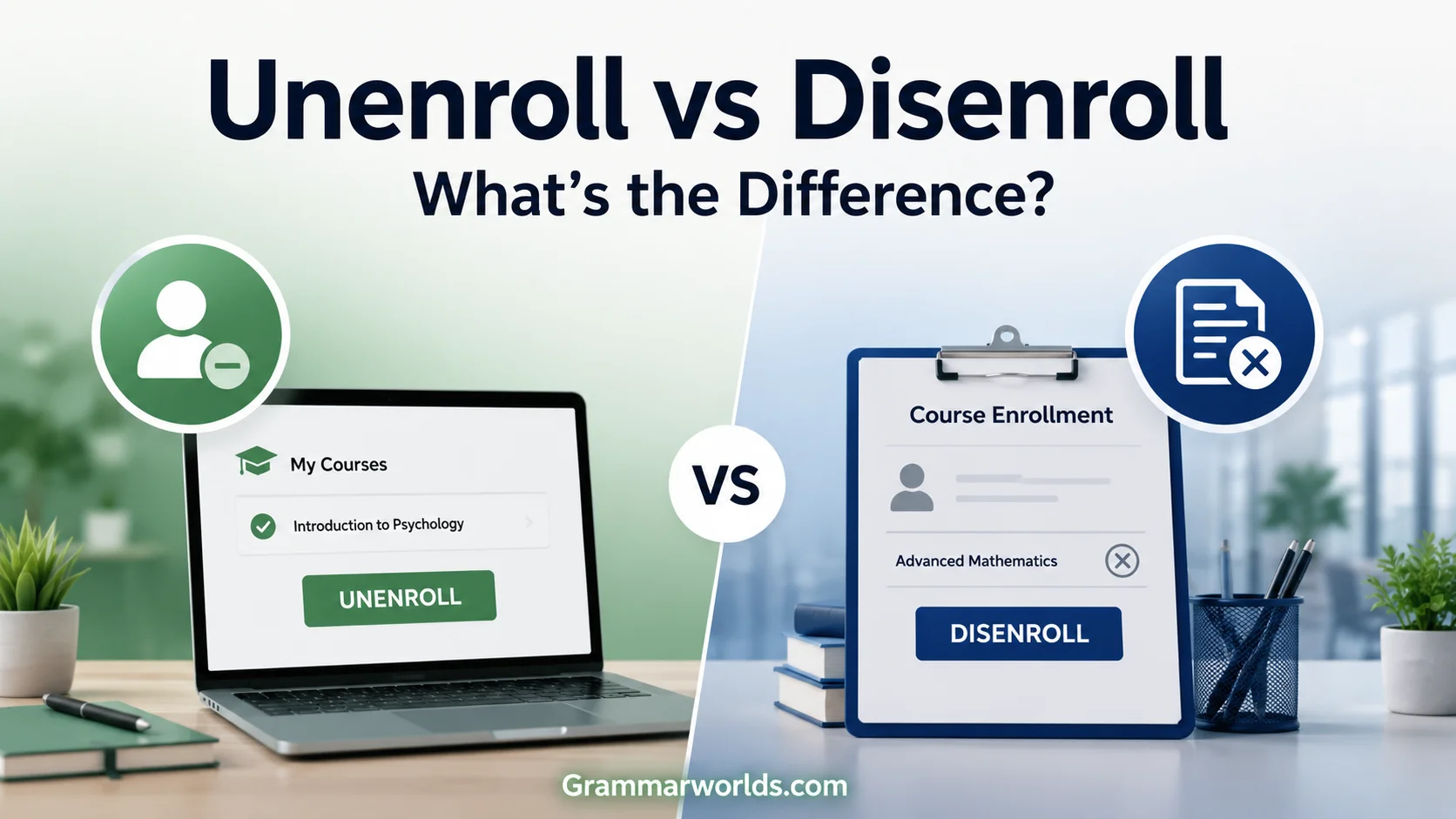
Have you ever wondered whether you should use unenroll or disenroll? At first glance, the two words seem identical. Both describe leaving a program, course, membership, or plan. However, context plays a major role in determining which term sounds natural and professional.
Many people encounter these words when dropping a college class, canceling a health insurance plan, leaving an online course, or withdrawing from a membership program. Because both terms involve ending enrollment, writers often use them interchangeably. Yet native speakers, institutions, and organizations tend to favor one over the other depending on the situation.
Understanding the difference between unenroll vs disenroll helps you communicate more clearly. It also prevents awkward wording in academic, healthcare, and professional settings.
This guide explains the meanings, differences, usage rules, examples, common mistakes, and best practices for choosing the correct term.
Unenroll vs Disenroll: The Quick Difference
The simplest distinction comes down to context.
Unenroll usually refers to voluntarily removing yourself from a class, course, school, training program, or educational system.
Disenroll commonly appears in healthcare, insurance, government programs, and administrative settings where a person is removed from participation or coverage.
Quick Comparison Table
| Feature | Unenroll | Disenroll |
| Primary Meaning | Remove enrollment | Remove enrollment |
| Most Common Context | Education | Healthcare and insurance |
| Typical Users | Students and schools | Insurance providers and agencies |
| Formality | Common and straightforward | More administrative |
| Educational Usage | Very common | Less common |
| Healthcare Usage | Rare | Very common |
| Membership Programs | Sometimes used | Frequently used |
| Government Programs | Less common | Common |
The One-Sentence Rule to Remember
If you’re leaving a class or course, use unenroll.
If you’re leaving an insurance plan or government program, use disenroll.
Although exceptions exist, this rule works in most situations.
What Does Unenroll Mean?
The word unenroll means to remove oneself or another person from an enrolled status.
The prefix un- typically indicates reversal. When added to “enroll,” it creates a word that means to reverse enrollment.
Think of it this way:
- Lock → Unlock
- Tie → Untie
- Plug → Unplug
- Enroll → Unenroll
The pattern feels natural because the prefix simply reverses the original action.
Common Situations Where Unenroll Is Used
Educational environments use this term most frequently.
Examples include:
- Dropping a college course
- Leaving an online class
- Withdrawing from a training program
- Canceling workshop registration
- Removing a student from a course roster
Many universities use the term in student portals and registration systems.
Examples of Unenroll in Sentences
- I decided to unenroll from the economics course.
- The student must officially unenroll before the deadline.
- You can unenroll from the online program through your dashboard.
- Employees may unenroll from optional training sessions.
- Parents can request to unenroll their children from after-school activities.
In each example, the focus remains on education, training, or learning programs.
What Does Disenroll Mean?
The word disenroll also means to remove enrollment status.
However, the prefix dis- often implies separation, removal, cancellation, or termination.
Examples include:
- Disconnect
- Discontinue
- Disapprove
- Disengage
As a result, disenroll often sounds more administrative and formal.
Organizations frequently use it when ending participation in structured programs.
Common Situations Where Disenroll Is Used
You’ll often encounter the term in:
- Medicare plans
- Medicaid programs
- Health insurance policies
- Government benefit programs
- Membership organizations
- Administrative records
Examples of Disenroll in Sentences
- The company will disenroll members who fail to renew coverage.
- You may disenroll from the healthcare plan during open enrollment.
- Participants can disenroll from the program at any time.
- The agency automatically disenrolled inactive members.
- She requested to disenroll from the insurance network.
Notice how these examples sound more bureaucratic and administrative than educational.
Are Unenroll and Disenroll Interchangeable?
Technically, yes.
Practically, not always.
Most dictionaries recognize both words. Both refer to ending enrollment. However, native speakers often associate them with different environments.
Situations Where Either Word Works
In casual conversation, either term may be acceptable.
For example:
- I decided to leave the program.
- I unenrolled from the program.
- I disenrolled from the program.
Most readers will understand the intended meaning.
Situations Where Only One Sounds Natural
Context influences expectations.
| Context | Preferred Word |
| College Course | Unenroll |
| Online Class | Unenroll |
| School Registration | Unenroll |
| Medicare Plan | Disenroll |
| Insurance Coverage | Disenroll |
| Government Benefit Program | Disenroll |
Choosing the expected term makes your writing sound more professional.
Why Context Matters More Than Grammar
Language evolves through usage.
Even when two words technically mean the same thing, communities often assign them different roles.
That is exactly what happened with unenroll and disenroll.
The difference isn’t primarily grammatical. Instead, it reflects common usage patterns.
Unenroll vs Disenroll in Education
Educational institutions overwhelmingly favor unenroll.
Students encounter the term throughout the enrollment process.
Common examples include:
- Course registration systems
- University portals
- Online learning platforms
- Training programs
- Certification courses
College and University Usage
When students drop classes, schools usually describe the action as unenrolling.
Examples:
- Unenroll from a course
- Unenroll from a semester program
- Unenroll from a training module
Most academic websites follow this convention.
K–12 School Usage
Elementary and secondary schools often use similar terminology.
Parents may:
- Unenroll a child from school
- Submit an unenrollment request
- Complete an unenrollment form
The wording feels natural because education remains the primary context.
Online Learning Platforms
Digital education providers frequently use unenroll.
Examples include:
- Unenroll from a coding course
- Unenroll from a language program
- Unenroll from a certification track
The term directly communicates that learning participation has ended.
Also Read This :Protestors or Protesters: Which Spelling Is Actually Correct?
Unenroll vs Disenroll in Healthcare and Insurance
Healthcare organizations strongly prefer disenroll.
In fact, many official documents rarely use unenroll at all.
Why Disenroll Dominates This Industry
Healthcare systems involve formal administrative procedures.
Insurance providers manage:
- Coverage eligibility
- Benefits administration
- Membership status
- Network participation
Because of this structure, disenroll became the standard term.
Medicare Disenrollment
Millions of Americans encounter the word during Medicare enrollment periods.
Examples include:
- Voluntary disenrollment
- Automatic disenrollment
- Medicare Advantage disenrollment
- Prescription plan disenrollment
The terminology appears throughout government and insurance documentation.
Health Insurance Plan Disenrollment
Individuals may disenroll due to:
- Job changes
- New coverage options
- Eligibility changes
- Relocation
- Cost concerns
Insurance companies consistently use “disenroll” because it aligns with industry terminology.
Employer Benefit Programs
Organizations often provide healthcare plans through employee benefits packages.
Workers may:
- Enroll in coverage
- Change coverage
- Disenroll from coverage
Again, administrative language favors disenroll.
Grammar and Word Formation Explained
Understanding the prefixes helps explain why both words exist.
Understanding the Prefix “Un-“
The prefix un- typically indicates reversal.
Examples include:
| Base Word | New Word |
| Lock | Unlock |
| Tie | Untie |
| Fold | Unfold |
| Plug | Unplug |
| Enroll | Unenroll |
The meaning remains straightforward.
You reverse a previous action.
Understanding the Prefix “Dis-“
The prefix dis- often indicates separation or removal.
Examples include:
| Base Word | New Word |
| Connect | Disconnect |
| Continue | Discontinue |
| Engage | Disengage |
| Qualify | Disqualify |
| Enroll | Disenroll |
This construction often sounds more formal.
Why Both Words Exist
English frequently creates multiple valid words from different prefixes.
Examples include:
- Inactive and dormant
- Unusual and atypical
- Unlock and disengage
Different industries then adopt whichever form suits their communication style.
The same process explains why both unenroll and disenroll remain accepted.
Regional Differences: American vs British English
Regional preferences also influence usage.
Usage in American English
American English uses both terms regularly.
However:
- Schools generally prefer unenroll
- Healthcare organizations prefer disenroll
This distinction remains fairly consistent.
Usage in British English
British English often favors alternative expressions.
Writers frequently use:
- Withdraw
- Remove registration
- Cancel enrollment
As a result, both unenroll and disenroll appear less frequently than in American usage.
Does Regional Preference Change Meaning?
No.
The meaning remains essentially the same.
Only frequency and context change.
Real-Life Examples of Unenroll vs Disenroll
Seeing the words in action makes the distinction easier to remember.
Education Example
A student decides to leave a psychology class before the semester begins.
Natural wording:
“The student chose to unenroll from the course.”
Healthcare Example
A patient switches insurance providers.
Natural wording:
“The member requested to disenroll from the health plan.”
Membership Example
A professional association allows members to leave voluntarily.
Natural wording:
“Members may disenroll from the organization at any time.”
Online Learning Example
Someone stops taking a digital marketing course.
Natural wording:
“You can unenroll directly from your account dashboard.”
Common Mistakes People Make
Many writers misuse these terms because the meanings overlap.
Using Unenroll in Insurance Documents
While understandable, it sounds unusual.
Most insurance professionals expect disenroll.
Using Disenroll for School Course Withdrawal
The meaning remains clear.
However, many educational institutions prefer unenroll.
Assuming One Word Is Incorrect
This is perhaps the biggest mistake.
Both words are legitimate English terms.
The real issue involves context rather than correctness.
Ignoring Industry Standards
Every field develops preferred terminology.
Using those conventions improves clarity and professionalism.
Similar Words People Often Confuse
Several related terms appear alongside unenroll and disenroll.
Understanding the distinctions helps avoid confusion.
Comparison Table
| Word | Best Context | Meaning |
| Withdraw | Education | Leave a course or program |
| Unenroll | Education | End enrollment status |
| Disenroll | Insurance | Remove participation or coverage |
| Deregister | Administration | Remove official registration |
| Opt Out | General | Choose not to participate |
| Cancel | Broad Usage | End an agreement or service |
| Unsubscribe | Digital Services | Stop receiving communications |
Withdraw vs Unenroll
Students often withdraw after a course begins.
Unenrolling usually occurs before participation progresses significantly.
Deregister vs Unenroll
Deregister sounds more technical.
Government agencies and administrative systems frequently use it.
Opt Out vs Disenroll
Opting out emphasizes choice.
Disenrollment emphasizes status removal.
Which Word Should You Use?
Choosing the right term becomes simple when you consider the setting.
Use Unenroll When
- Leaving a school
- Dropping a course
- Exiting a training program
- Canceling educational registration
- Leaving an online class
Use Disenroll When
- Leaving an insurance plan
- Exiting Medicare coverage
- Ending government program participation
- Canceling healthcare benefits
- Removing membership status
Quick Decision Guide
Are you leaving a class or course?
|
Yes
|
Use UNENROLL
↓
Are you leaving an insurance
or healthcare plan?
|
Yes
|
Use DISENROLL
↓
Not sure?
Follow the terminology
used by the organization.
When in doubt, check the wording used by the institution itself.
That approach rarely fails.
FAQs
Is Unenroll a Real Word?
Yes. Unenroll is a recognized English word that means to remove enrollment status, especially in educational settings.
Is Disenroll a Real Word?
Yes. Disenroll is also a valid English word. Healthcare providers, insurance companies, and government agencies frequently use it.
Which Word Is More Common?
The answer depends on the industry.
Educational institutions generally favor unenroll, while healthcare and insurance organizations usually prefer disenroll.
Can Schools Use Disenroll?
They can, but many schools prefer unenroll because it sounds more natural in academic contexts.
Can Insurance Companies Use Unenroll?
They can, but industry standards strongly favor disenroll.
Conclusion
The debate over unenroll vs disenroll isn’t really about right versus wrong. Both words are valid, recognized, and widely understood. The difference comes down to context.If you’re leaving a class, course, school, or training program, unenroll will usually sound more natural. If you’re ending participation in a healthcare plan, insurance policy, government benefit program, or membership system, disenroll is often the preferred choice.Think of these words as close cousins rather than rivals. They share the same basic meaning, yet each has developed a home in different professional environments. By matching your word choice to the setting, you’ll communicate more clearly and sound more knowledgeable.