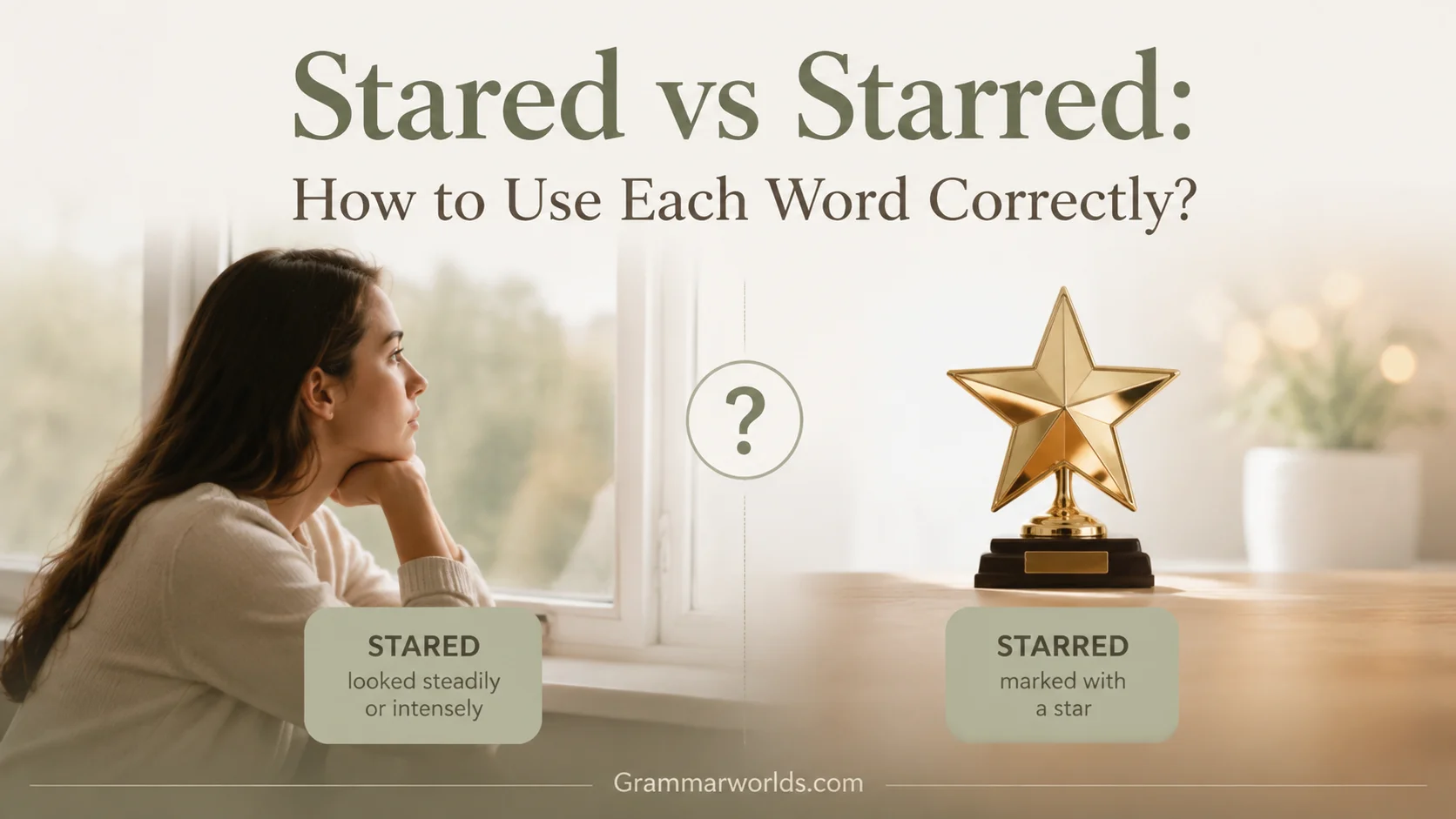
Stared vs Starred: How to Use Each Word Correctly? explains how these similar English words have different meanings and proper usage in context. In the English language, Stared and Starred are a pair that often causes confusion because they sound almost the same but have different purposes.
The correct word choice depends on the situation. Stared describes the act of looking fixedly and intently at someone or something for a long time, while Starred relates to a star or stars, showing a main performer or a mark of excellence and achievement.
These terms have a distinct meaning, and learning the difference helps you understand the correct spelling, usage, and meaning. A simple tip is remembering that one letter can change a word’s meaning completely.
Stared vs Starred: Quick Difference Between the Two Words
Before exploring the details, here is the simplest comparison:
| Word | Meaning | Root Word | Example |
| Stared | Looked at something intensely or continuously | Stare | The child stared at the colorful balloons. |
| Starred | Played a main role or marked something with a star | Star | The actor starred in a popular series. |
The easiest way to remember the difference:
- Stared = eyes
- Starred = star, celebrity, or symbol
Think about the extra “r” in starred. That extra letter connects it back to the word star.
What Does Stared Mean?
Stared is the past tense form of the verb stare.
When someone stares, they look at something for a longer time without looking away quickly. A stare is usually more intense than a normal look.
For example:
- You look at a clock to check the time.
- You stare at a clock when you cannot believe it stopped working.
The word often suggests that the person’s attention is strongly focused.
Definition of Stared
Stared means:
To look at someone or something continuously with your eyes fixed in one direction.
A person may stare because they feel:
- Curious
- Surprised
- Confused
- Amazed
- Angry
- Shocked
- Interested
The emotion behind the stare depends on the situation.
For example:
Sarah stared at the giant cake sitting on the kitchen table.
This sentence suggests that Sarah looked at the cake for a noticeable amount of time. Maybe she was surprised by its size or impressed by its design.
How to Use Stared in a Sentence
The word stared usually appears with the word at.
Common structure:
Subject + stared + at + person/object
Examples:
- The audience stared at the magician during the final trick.
- He stared at the computer screen after seeing the unexpected results.
- She stared at the old photograph and remembered her childhood.
- The tourists stared at the ancient building.
The word does not simply mean “looked.” It suggests a stronger and longer action.
Compare:
| Sentence | Meaning |
| She looked at the painting. | She noticed or viewed it. |
| She stared at the painting. | She examined it for a longer time. |
The second sentence creates a stronger image. You can imagine the person standing still, focusing completely on the painting.
Different Situations Where You Use Stared
The word stared appears in many everyday situations.
Stared Because of Surprise
People often stare when something unexpected happens.
Examples:
- Everyone stared when the magician disappeared from the stage.
- The students stared at the teacher after hearing the surprising announcement.
A surprising event naturally attracts attention. The eyes stay fixed because the brain needs time to process what happened.
Stared Because of Curiosity
People also stare when they want to understand something.
Examples:
- The child stared at the strange machine in the science museum.
- She stared at the unusual painting because she wanted to understand its meaning.
Curiosity creates a strong desire to observe.
Stared Because of Strong Emotions
A stare can communicate feelings without words.
Examples:
- He stared at his friend in disbelief.
- She stared at the empty chair, remembering someone important.
- The angry customer stared at the broken product.
In these examples, the stare communicates emotion more effectively than a simple description.
What Does Starred Mean?
Starred is the past tense form of the verb star.
Unlike stared, which relates to looking, starred relates to being a star or using a star symbol.
The word has two main meanings.
Meaning 1: Starred Means Played a Leading Role
The most common meaning of starred is appearing as a main performer in entertainment.
You will often see it used with:
- Movies
- Television shows
- Plays
- Theater productions
- Concerts
- Performances
The common phrase is:
starred in
Examples:
- Leonardo DiCaprio starred in Titanic.
- The actress starred in a successful television drama.
- The comedian starred in a new streaming series.
When someone stars in something, they usually have an important or leading role.
Stared vs Starred in Movies and Television
This is one of the most common places where people make mistakes.
Incorrect:
The actor stared in the movie.
Correct:
The actor starred in the movie.
Why?
Because the actor did not spend the movie looking at something. The actor performed a major role.
The correct word comes from star, meaning a famous or important performer.
Example:
Tom Hanks starred in Forrest Gump.
Meaning:
Tom Hanks played the main character.
Meaning 2: Starred Means Marked With a Star Symbol
The word starred can also mean adding a star symbol (*) to something.
People use stars to highlight information.
Examples:
- The teacher starred the most important questions.
- The editor starred the sections that needed changes.
- The website starred recommended products.
A star symbol often tells the reader:
- Pay attention
- This information matters
- This item is recommended
- This option is important
For example:
A restaurant menu might use a star next to its most popular dishes.
★ Customer Favorite
★ Chef Recommendation
The symbol helps people notice important choices quickly.
Why Does Star Become Starred With Two Rs?
Many people wonder why starred has two “r” letters.
The answer comes from English spelling rules.
When a short word ends with:
one vowel + one consonant
English often doubles the final consonant before adding endings like:
- -ed
- -ing
Examples:
| Base Word | Past Tense |
| Stop | Stopped |
| Plan | Planned |
| Drop | Dropped |
| Star | Starred |
The word star follows this pattern:
- Star ends with “a” + “r”
- Add “-ed”
- Double the final “r”
- Result: starred
Why Stare Becomes Stared Instead
The word stare works differently.
It already ends with the letter e.
When adding -ed, English usually removes the need for extra consonant doubling.
Examples:
| Base Word | Past Tense |
| Stare | Stared |
| Smile | Smiled |
| Dance | Danced |
| Care | Cared |
So:
- stare → stared
- star → starred
This spelling difference creates the visual difference between the two words.
Common Mistakes With Stared and Starred
Even experienced writers sometimes confuse these words because they sound identical.
Here are the most common errors.
Mistake 1: Writing “Stared” for an Acting Role
Incorrect:
Emma Stone stared in the movie La La Land.
Correct:
Emma Stone starred in the movie La La Land.
The actor did not stare. She performed a major role.
Mistake 2: Writing “Starred” for Looking at Something
Incorrect:
The boy starred at the fireworks.
Correct:
The boy stared at the fireworks.
The boy was watching the fireworks. No performance or star symbol was involved.
Mistake 3: Confusing Starred With Started
Some writers accidentally use started because it sounds similar.
Compare:
| Word | Meaning | Example |
| Stared | Looked intensely | She stared at the ocean. |
| Starred | Played a main role | He starred in the series. |
| Started | Began | The show started at 8 p.m. |
These three words sound related but have completely different meanings.
Stared vs Starred: Examples, Grammar Guide?
Seeing these words in context makes the difference much easier to understand. The meaning becomes clear when you connect each word with the situation around it.
Below are practical examples using both words.
Examples Using “Stared”
Example 1: Looking at Something Carefully
The scientist stared at the results on the screen before making a conclusion.
Here, stared means the scientist looked at the results for a long time because they were important.
Example 2: Showing Surprise
Everyone stared when the building lights suddenly turned off.
The people were surprised, so they kept looking at the unusual event.
Example 3: Showing Confusion
He stared at the instructions because he couldn’t understand the new software.
The person looked closely because he was trying to figure something out.
Example 4: Showing Emotion
She stared at the old family photo and smiled.
The stare shows emotional attention. She was not simply looking; she was remembering something meaningful.
Example 5: Describing an Awkward Situation
The two strangers stared at each other across the crowded room.
This suggests a long, noticeable look between two people.
Examples Using “Starred”
Example 1: Movies
The actress starred in a highly successful science-fiction movie.
This means she played an important role in the film.
Example 2: Television Shows
The actor starred in several award-winning television dramas.
The actor appeared as one of the main performers.
Example 3: Theater
The young performer starred in the school’s annual musical.
The performer had a leading part in the production.
Example 4: Marking Important Information
The manager starred the urgent tasks in the weekly report.
The manager added star symbols to highlight important tasks.
Example 5: Highlighting Favorites
Customers can quickly find starred products on the shopping website.
The products were marked with stars to show they were recommended.
Stared vs Starred vs Started: Understanding the Difference
Many people confuse these three words because they look and sound similar.
However, each one has a different meaning.
| Word | Pronunciation | Meaning | Example |
| Stared | /staird/ | Looked intensely | She stared at the beautiful sunset. |
| Starred | /staird/ | Played a major role or marked with a star | He starred in a famous movie. |
| Started | /star-tid/ | Began something | The meeting started at 9 a.m. |
Notice that:
- Stared and starred sound exactly the same.
- Started has a different ending sound.
- The context tells you which word is correct.
How to Remember the Difference Between Stared and Starred
Memorizing spelling rules can help, but simple mental connections work even better.
Here are some easy ways to remember.
Memory Trick 1: Stared = Eyes
Think:
Your eyes stare.
Whenever the sentence involves looking, watching, or observing, choose stared.
Examples:
- She stared at the painting.
- He stared at the unusual object.
- They stared at the accident scene.
A simple question can help:
“Is someone using their eyes?”
If yes, staring is probably the correct choice.
Also Read This : Trek vs Trecke: What’s the Real Difference?
Memory Trick 2: Starred = Star
Think:
A star shines, performs, or gets marked.
Use starred when talking about:
- Actors
- Singers
- Performers
- Famous people
- Star symbols
Examples:
- The singer starred in a musical.
- The actor starred in a blockbuster film.
- The teacher starred the important answers.
Memory Trick 3: Look at the Extra “R”
The additional r in starred connects it to the original word:
star → starred
The spelling reminds you that the word comes from star.
Meanwhile:
stare → stared
The word keeps its connection to looking.
Grammar Breakdown: Stared vs Starred
Understanding the grammar behind these words makes them easier to use correctly.
The Verb “Stare”
Base form:
Stare
Meaning:
To look at something for a long time.
Examples:
- I stare at the screen.
- They stare at the painting.
Past tense:
Stared
Examples:
- I stared at the screen.
- They stared at the painting.
Present participle:
Staring
Examples:
- She is staring at the window.
- They were staring at the unusual object.
Verb pattern:
| Form | Example |
| Stare | I stare at the sky. |
| Stared | I stared at the sky yesterday. |
| Staring | I am staring at the sky. |
The Verb “Star”
Base form:
Star
Meaning:
To feature as a main performer or mark something with a star.
Examples:
- She stars in the television series.
- The website stars recommended products.
Past tense:
Starred
Examples:
- She starred in the television series.
- The website starred recommended products.
Present participle:
Starring
Examples:
- A movie starring a famous actor.
- A show starring several talented performers.
Verb pattern:
| Form | Example |
| Star | He stars in the show. |
| Starred | He starred in the show last year. |
| Starring | He is starring in the new film. |
Real-World Examples of Stared and Starred
Understanding these words becomes easier when you see how people use them in everyday writing.
News Headlines
Entertainment websites often use starred:
“Award-winning actress starred in a new drama series.”
The meaning is about performance.
News stories might use stared differently:
“The crowd stared in amazement as the athlete broke the record.”
The meaning is about people watching.
Book and Movie Reviews
Correct:
“The film starred several talented actors.”
Meaning:
The movie featured those actors.
Incorrect:
“The film stared several talented actors.”
This suggests the movie looked at actors, which makes no sense.
Everyday Conversations
Correct:
“Why are you staring at me?”
Meaning:
Why are you looking at me so intensely?
Correct:
“Who starred in that movie?”
Meaning:
Who played the main role?
Why Do People Confuse Stared and Starred?
The confusion happens because English contains many words that sound the same but have different spellings and meanings.
These words are called homophones.
Other examples include:
| Word Pair | Difference |
| Their / There | Possession vs location |
| Two / Too | Number vs also |
| Right / Write | Correct vs create words |
| Stared / Starred | Looked vs performed |
When people hear these words, they rely on sound alone. Writing requires understanding the meaning.
A Simple Decision Guide: Should You Use Stared or Starred?
Use this quick checklist.
Choose “Stared” If:
✅ Someone is looking intensely
✅ The action involves eyes
✅ Someone watches something for a long time
✅ The sentence describes curiosity, surprise, or confusion
Examples:
- She stared at the painting.
- He stared at the strange machine.
Choose “Starred” If:
✅ Someone acted in a movie or show
✅ Someone performed a leading role
✅ Something received a star mark
✅ A symbol highlights importance
Examples:
- She starred in the movie.
- He starred in the important sections.
Common Sentence Corrections
Here are some incorrect sentences and their fixes.
| Incorrect | Correct | Reason |
| The actor starred in the film. | The actor starred in the film. | Acting roles use “starred.” |
| She stared at the painting. | She stared at the painting. | Looking uses “stared.” |
| The director starred in the movie. | The director starred in the movie. | A person stars in a production. |
| He stared at the message. | He stared at the message. | Reading closely uses “stared.” |
FAQs
What is the main difference between starred and starred?
Stared means looking at someone or something for a long time with fixed attention, while starred refers to being marked with a star, featuring as an important person, or achieving recognition.
Is starting a correct English word?
Yes, stared is a correct English word. It is the past tense of stare and describes the action of looking at something or someone with focused attention.
What does starred mean in English?
Starred means marked with a star, recognized for excellence, or featured as a main person in a movie, show, or event. It can also describe ratings using stars.
Do stared and starred sound the same?
Yes, stared and starred sound the same in many accents, making them homophones. However, their meanings and spellings are different.
How can I remember the difference between stared and starred?
You can remember that stared contains “are,” relating to the action of seeing or looking, while starred contains “star,” connecting it with stars, marks, or achievements.
Conclusion
Understanding the difference between stared and starred helps you use these words correctly in English writing and conversations. Although they sound similar, their meanings are completely different. Stared describes a focused look at someone or something, while starred relates to stars, recognition, ratings, or important roles. Learning the proper context of each word improves your vocabulary and helps you communicate more clearly.