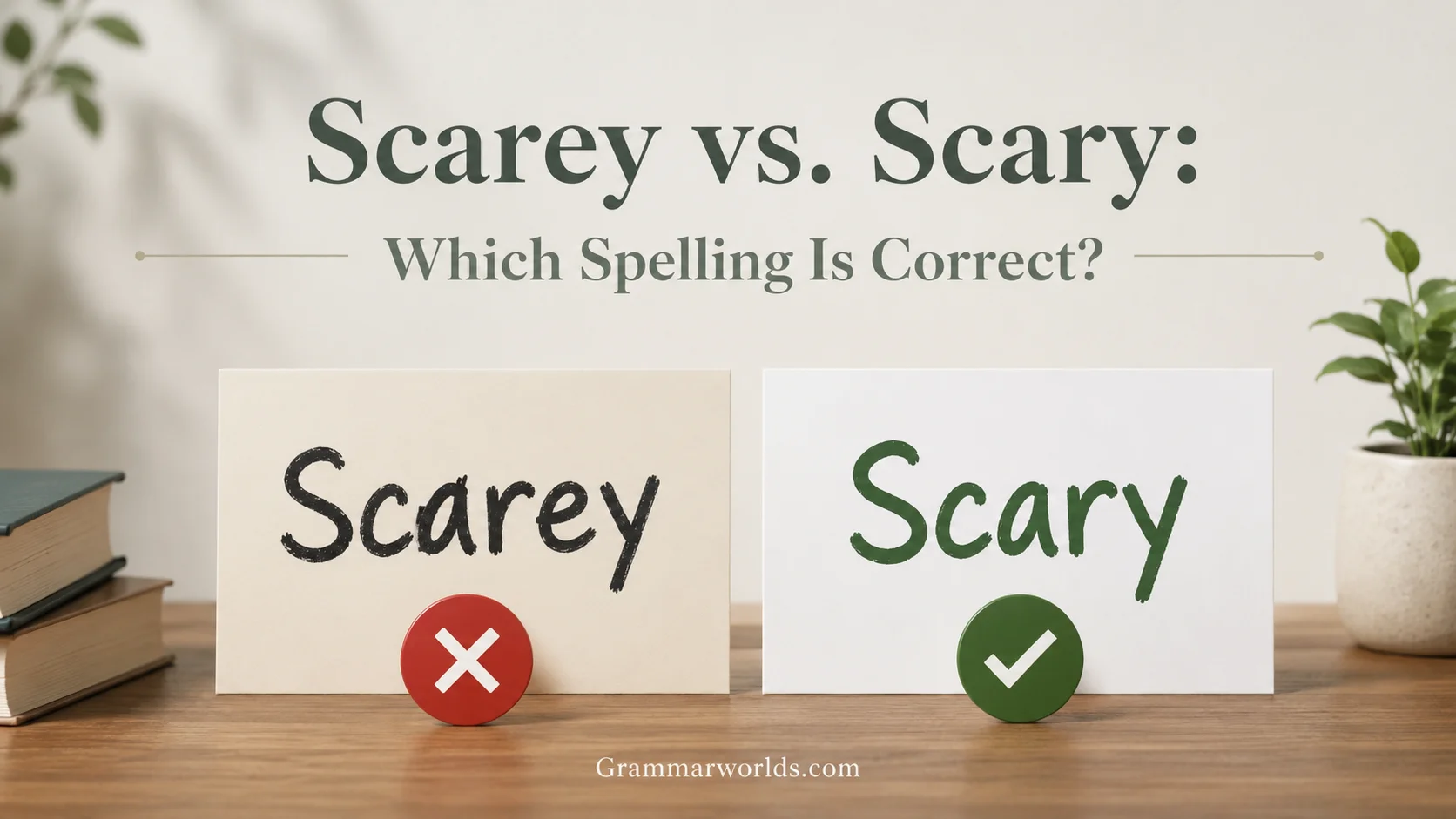
Scary vs. Scary: Which Spelling Is Correct? explains why scary is right and scary is wrong, helping writers understand spelling confusion today. Many English learners, students, writers, and professionals become confused when they see these words while reading online because both look similar.
The truth is that Scary is the correct spelling in standard English, while Scarey is an obsolete spelling of the same word that was used in the past but is no longer considered correct. The word scary describes something causing fear or fright, and it follows normal English spelling and word formation rules. Since both versions have an identical sound, pronunciation doesn’t help you find the right spelling.
This guide helps clear the air and establish a simple clear rule to understand the differences between these two words and use them correctly in every context. The common misspelling scarry often appears in casual posts, comments, informal writing, stories, and social media because of spelling assumption, rushed typing, and double consonants. Spellcheck usually flags it as wrong, but people still wonder why it appears.
Scarey vs. Scary: The Quick Answer
The difference between scarey vs. scary is simple:
| Word | Correct? | Meaning | Example |
| Scary | ✅ Correct | Something that causes fear or fright | “That haunted house was scary.” |
| Scarey | ❌ Incorrect in standard English | A common spelling mistake | “That haunted house was scarey.” |
The correct form is always:
Scare + y = Scary
Not:
Scare + ey = Scarey
The English language can be unpredictable, which is why this mistake happens so often. Many words contain the letters “ey” at the end, so adding an extra “e” can feel natural. However, scary follows its own spelling pattern.
What Does Scary Mean?
The word scary is an adjective that describes something that creates fear, alarm, or discomfort.
According to standard English usage, scary means “causing fear or fright.” It describes the thing that creates the emotion, not the person experiencing the emotion.
For example:
- “The clown in the movie was scary.”
- “The thunderstorm looked scary.”
- “Walking alone in the abandoned building felt scary.”
In each example, the subject creates a feeling of fear.
Scary Describes Something That Causes Fear
A simple way to understand scary is to remember this:
Something is scary. Someone feels scared.
For example:
- The roller coaster is scary.
- The child is scared.
The roller coaster creates emotion. The child experiences the emotion.
This difference is one of the most common areas of confusion in English.
Scary vs. Scared: Understanding the Difference
Although scary and scared look similar, they have different meanings.
| Word | Type | Meaning | Example |
| Scary | Adjective | Causes fear | “The movie was scary.” |
| Scared | Adjective | Feeling fear | “I was scared during the movie.” |
Think about it this way:
- A snake can be scary.
- You can feel scared when you see the snake.
The snake does not feel anything. It creates the reaction.
More Examples
Correct:
- “That was a scary story.”
- “She was scared after hearing the noise.”
- “The storm became scary as the wind grew stronger.”
Incorrect:
- “I was scary when I entered the dark room.”
This sentence changes the meaning completely. It suggests that you cause fear in others.
Why Do People Spell It “Scarey”?
The spelling mistake scarey happens because English spelling rules are not always obvious.
Many people look at the word scare and think:
scare + y = scarey
That seems logical. However, English spelling does not always work by simply adding letters.
The correct transformation removes the silent “e”:
scare → scary
This same pattern appears in several other words.
Examples:
| Base Word | Correct Adjective |
| scare | scary |
| shine | shiny |
| ice | icy |
| noise | noisy |
| spice | spicy |
The silent “e” often disappears before adding -y.
The Grammar Behind the Word Scary
Understanding how scary is formed makes the spelling easier to remember.
The word comes from the verb:
Scare
Meaning:
To frighten someone or cause fear.
When English speakers turn a verb into an adjective, they often add -y.
Examples:
- cloud → cloudy
- dirt → dirty
- rain → rainy
- scare → scary
The spelling changes slightly because keeping the silent “e” would make the word look unusual and break common English patterns.
Why Does the “E” Disappear?
Words ending in silent e often drop that letter when adding a suffix beginning with a vowel.
For example:
- scare + y → scary
- amaze + ing → amazing
- create + ion → creation
English keeps pronunciation and appearance balanced. Removing the extra “e” helps readers recognize the word more naturally.
Scary vs. Scarey Examples in Everyday Writing
Many spelling mistakes become easier to understand when you compare incorrect and correct sentences.
| Incorrect Sentence | Correct Sentence |
| “The movie was very scarey.” | “The movie was very scary.” |
| “That was a scarey experience.” | “That was a scary experience.” |
| “The abandoned house looked scarey.” | “The abandoned house looked scary.” |
| “The storm was getting scarey.” | “The storm was getting scary.” |
The correct spelling is always scary when you are describing something frightening.
Common Places Where People Use “Scarey”
Although scarey is not the standard spelling, you may still see it in certain situations.
1. Online Usernames
People sometimes create usernames with unusual spellings because common names are already taken.
Examples:
- ScareyGhost123
- ScareyNight
- ScareyStories
These are creative choices, not examples of correct spelling.
2. Brand Names and Titles
Some businesses, games, books, or fictional characters may intentionally use alternative spellings.
A creator might choose “Scarey” because it looks unique or memorable.
However, creative branding does not change standard English rules.
3. Casual Internet Writing
Social media encourages fast communication. People often type quickly and may not check spelling.
Common online mistakes include:
- definately instead of definitely
- alot instead of a lot
- recieve instead of receive
- scarey instead of scary
Frequent usage does not automatically make a spelling correct.
Is Scarey Ever Correct?
In normal writing, no.
If you are writing:
- an essay,
- a professional email,
- a blog post,
- a report,
- a school assignment,
you should use scary.
However, scarey can appear as a proper name or creative choice.
For example:
- A fictional character might be named “Scarey.”
- A company might use “Scarey” as a brand name.
- An online account might use “Scarey” as a username.
These examples are exceptions because names do not always follow traditional spelling rules.
Also Read This :Stared vs Starred: How to Use Each Word Correctly?
Scary vs. Similar Words: Choosing the Right Expression
English has many words that describe fear. Choosing the right one makes your writing more accurate.
| Word | Meaning | Example |
| Scary | Causes fear | “The movie was scary.” |
| Frightening | Creates strong fear | “The accident was frightening.” |
| Terrifying | Causes extreme fear | “The experience was terrifying.” |
| Creepy | Creates discomfort or unease | “The old house looked creepy.” |
| Spooky | Strange or ghost-like | “The forest felt spooky at night.” |
| Alarming | Causes concern or worry | “The news was alarming.” |
Scary vs. Frightening
These words are very similar.
Scary sounds more casual:
“That ghost story was scary.”
Frightening sounds slightly more formal:
“The situation became frightening.”
Scary vs. Terrifying
The difference is intensity.
A scary movie may make you nervous.
A terrifying movie may make you want to hide behind a pillow.
The word terrifying suggests a much stronger emotional reaction.
Common Mistakes When Using Scary
Even people who know the correct spelling sometimes misuse the word.
Mistake 1: Writing Scarey Instead of Scary
This is the most common mistake.
Remember:
✅ scary
❌ scarey
A helpful memory trick:
“A scare becomes scary.”
Mistake 2: Confusing Scary and Scared
Many learners mix these words because they share the same root.
Incorrect:
“I am scary of spiders.”
Correct:
“I am scared of spiders.”
The spider is scary.
You are scared.
Mistake 3: Using Scary When You Mean Surprising
Not everything unusual is scary.
For example:
- “The company’s growth was scary fast.”
Here, scary does not mean frightening. It means surprisingly extreme.
Similar expressions include:
- incredibly fast
- surprisingly large
- unbelievably difficult
Memory Trick: How to Remember Scary vs. Scarey
The easiest way to remember the spelling is:
The word “scare” loses the silent “e” before becoming “scary.”
Think of this example:
A haunted house gives you a scare.
That haunted house is scary.
The original word keeps its meaning but changes its form.
Another quick reminder:
Why Correct Spelling Matters
Spelling may seem like a small detail, but it affects how readers understand and trust your writing.
Correct spelling helps your writing appear:
- Professional
- Clear
- Credible
- Easy to understand
Imagine reading a news article filled with spelling mistakes. Even if the information is accurate, errors can make the content feel less reliable.
Using scary instead of scarey is a small improvement that makes your writing cleaner.
Scary in Popular Culture and Everyday Language
The word scary appears frequently in entertainment, conversations, and media.
People use it to describe:
- Horror movies
- Ghost stories
- Dangerous situations
- Unexpected events
- Extreme experiences
Examples:
- “That was one of the scariest movies I’ve ever watched.”
- “The abandoned hospital had a scary atmosphere.”
- “The weather forecast looks scary.”
The word has become a normal part of everyday English.
FAQs
1. Is Scary or Scarey the correct spelling?
Scary is the correct spelling in modern standard English. It means something that causes fear or fright. Scarey is an old spelling that is no longer commonly accepted in professional or academic writing.
2. Why do people write Scarey instead of Scary?
Many people write Scarey because they think words with similar sounds need extra letters. The pattern of adding double letters in words like carry and marry can make scarry or scarey seem reasonable, but scary follows the correct spelling rule.
3. Does Scarey have the same meaning as Scary?
Yes, Scarey was once used as another form of scary, and both refer to something that causes fear. However, scarey is now considered an obsolete spelling, while scary is the accepted form.
4. Why does Spellcheck mark Scarey as wrong?
Spellcheck marks Scarey as wrong because modern dictionaries and writing standards recognize scary as the correct spelling. Using scary helps your writing look more accurate and professional.
5. How can I remember the correct spelling of Scary?
A simple way to remember is that scary has only one r after the “a.” Think of the phrase “scary stories” or “scary movie” to practice the correct spelling in everyday examples.
Conclusion
The difference between Scarey vs. Scary is simple once you understand the spelling rule. Scary is the correct and widely accepted spelling in standard English, while scarey is an outdated version that may appear in older texts or casual writing. Although both words sound the same, choosing the correct spelling matters in professional content, academic content, and everyday communication. By remembering that scary is the standard form, you can avoid this common spelling mistake and write with more confidence.