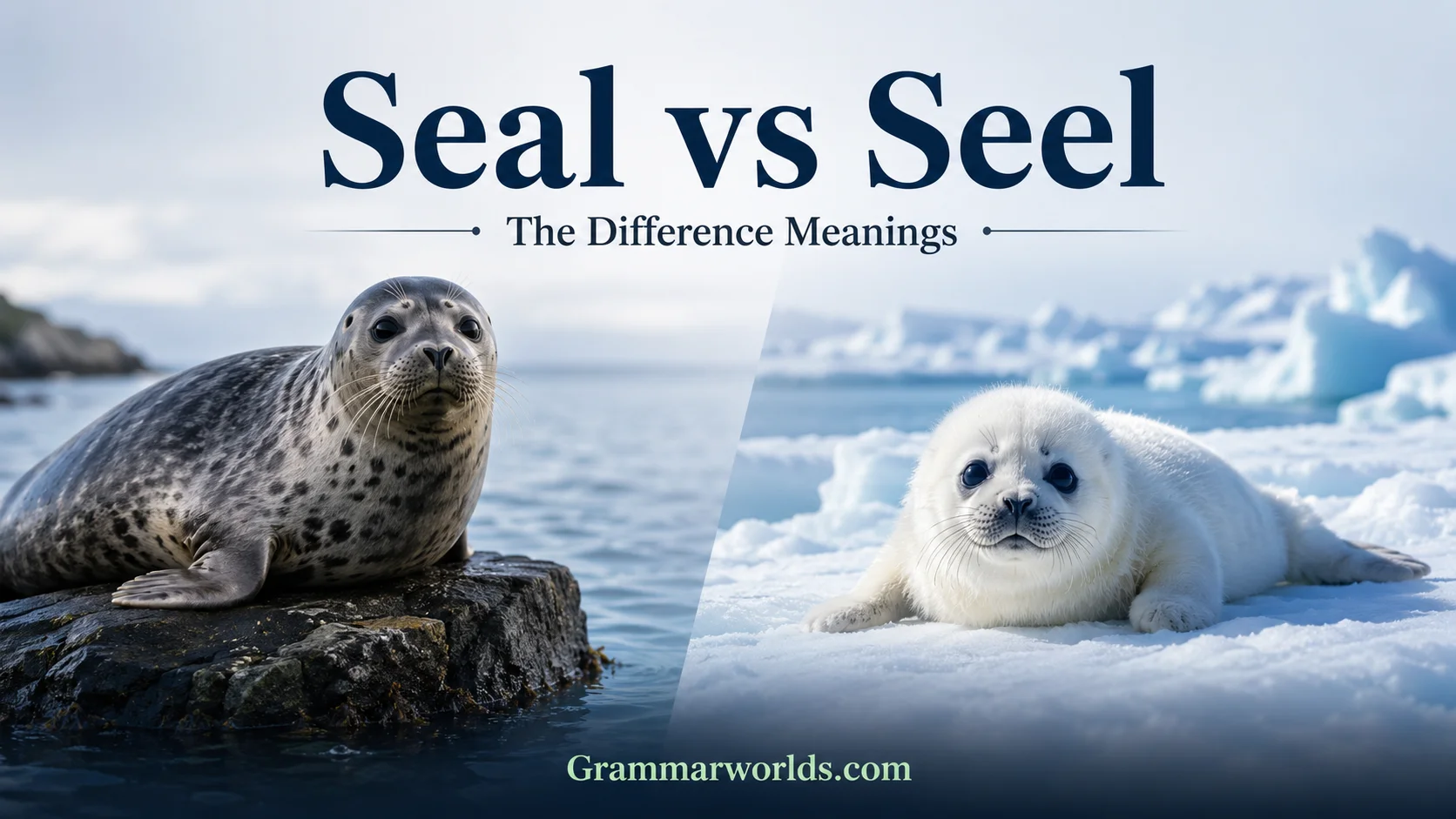
Many English words look similar yet carry completely different meanings. Seal and seel are a perfect example. At first glance, they appear to be simple spelling variations of the same word. However, they have distinct meanings, different histories, and completely different uses in modern English.
Most writers encounter the word seal regularly. You might seal an envelope, admire a seal at an aquarium, or see an official seal on a government document. The word seel, on the other hand, is so rare that many native English speakers have never seen it before.
This creates confusion. Is seel simply an alternative spelling of seal? Are they interchangeable? Which one should you use in professional writing?
The short answer is simple: seal is the correct word in almost every modern situation. Seel exists, but it belongs mainly to historical and specialized contexts.
This guide explains the difference between seal vs seel, shows when each word is appropriate, provides practical examples, and helps you avoid one of the most common spelling mistakes involving these two terms.
Seal vs Seel: The Key Difference at a Glance
The easiest way to understand the distinction is through a quick comparison.
| Word | Meaning | Part of Speech | Modern Usage |
| Seal | An animal, official mark, closure, or to close securely | Noun and Verb | Very common |
| Seel | To close or sew a bird’s eyes temporarily | Verb | Rare and archaic |
Quick Summary
If you remember only one thing from this article, remember this:
Use “seal” for everyday writing. Use “seel” only when discussing historical falconry or literary references.
In business emails, academic papers, social media posts, legal documents, and casual conversations, seal is almost always the correct choice.
What Does “Seal” Mean?
The word seal is remarkably versatile. It functions as both a noun and a verb and appears across many industries and fields.
Seal as a Noun
The noun form has several meanings.
A Marine Mammal
One of the most recognizable meanings refers to the aquatic animal.
Seals belong to a group of marine mammals known as pinnipeds. They spend much of their lives in oceans and coastal waters around the world.
Examples:
- A seal rested on the rocky shoreline.
- The children watched the seals swim gracefully through the water.
- Harbor seals are common along many coastlines.
Interesting Seal Facts
| Fact | Information |
| Classification | Marine mammal |
| Habitat | Oceans and coastal regions |
| Lifespan | Typically 20–30 years depending on species |
| Diet | Fish, squid, crustaceans |
| Predators | Sharks, killer whales, polar bears |
Because this meaning is so common, many people first think of the animal when they hear the word seal.
An Official Stamp or Mark
Another common meaning refers to an official emblem or stamp used to indicate authenticity.
Governments, universities, corporations, and organizations often use seals to certify documents.
Examples:
- The certificate bears the official seal of the university.
- The government seal appeared on every page.
- The company placed its seal on the contract.
Historically, seals were made from wax. Officials pressed engraved rings or metal stamps into hot wax to verify authenticity.
Even in today’s digital world, many institutions still use seals as symbols of authority.
A Closure or Protective Barrier
A seal can also refer to something that prevents leakage, contamination, or unwanted access.
Examples include:
- Door seals
- Window seals
- Jar seals
- Engine seals
- Waterproof seals
Examples in sentences:
- The rubber seal prevents water from entering the container.
- A damaged seal caused the machine to leak oil.
- Check the refrigerator seal regularly.
This meaning appears frequently in engineering, manufacturing, and construction.
Seal as a Verb
As a verb, seal usually means to close securely.
This is perhaps the most common usage in modern English.
Examples:
- Seal the envelope before mailing it.
- Please seal the package carefully.
- Workers sealed the cracks in the wall.
- The agreement was sealed yesterday.
The action involves securing something so that it cannot easily be opened, altered, or damaged.
Common Situations Where We Use “Seal”
People use the verb daily in situations such as:
- Mailing letters
- Packaging products
- Closing food containers
- Waterproofing buildings
- Signing contracts
- Protecting documents
Because the word appears so frequently, many spelling errors occur when writers mistakenly type seel instead.
Common Expressions Using “Seal”
English contains several popular idioms involving the word seal.
Seal the Deal
This phrase means to finalize an agreement.
Example:
The discount helped seal the deal.
Signed, Sealed, and Delivered
This expression means something has been completed successfully.
Example:
The project is signed, sealed, and delivered.
Seal Off
This phrase means to block access.
Example:
Police sealed off the street after the accident.
Seal Up
This expression means to close completely.
Example:
Workers sealed up the abandoned building.
Break the Seal
This phrase often refers to opening something that was previously closed.
Example:
Once you break the seal, the warranty becomes void.
These expressions further demonstrate how deeply rooted the word seal is in modern English.
What Does “Seel” Mean?
Unlike seal, the word seel is uncommon.
Many dictionaries classify it as archaic, meaning it belongs largely to historical English rather than everyday language.
Definition of Seel
Traditionally, seel means:
To close, sew, or partially shut the eyes of a bird.
The practice was associated primarily with falconry.
Falconers sometimes temporarily closed a bird’s eyelids to calm it during training.
Today, this practice is largely obsolete and considered historical.
Historical Background
The word derives from older forms of English and was more common several centuries ago.
During the Middle Ages and Renaissance periods, falconry played a significant role in aristocratic culture.
Training birds of prey required specialized techniques. One of these methods involved “seeling” a bird.
As falconry practices evolved, the word gradually disappeared from everyday speech.
Today, most people encounter it only in:
- Historical texts
- Classical literature
- Academic discussions
- Falconry history
How “Seel” Was Used Historically
To fully understand the word, it helps to examine its historical role.
Falconry was once a prestigious activity among nobles and royalty.
Birds such as:
- Falcons
- Hawks
- Goshawks
- Eagles
required extensive training.
Some trainers believed temporarily restricting a bird’s vision would make it calmer and easier to handle.
The act of performing this procedure became known as seeling.
Although modern readers may find the practice unusual, it reflected training methods of a different era.
Literary References
Writers occasionally used the term in literature.
One famous example appears in Shakespeare.
In Macbeth, Shakespeare uses the word in a poetic context:
“Seeling night…”
In this passage, the word suggests darkness covering or blinding the world.
The literary usage expands beyond falconry and creates a vivid metaphor.
Because Shakespeare remains widely studied, many readers first encounter seel through his work.
Example Sentences Using “Seel”
Here are examples that demonstrate correct usage.
Historical examples:
- The falconer seeled the young hawk before training.
- Medieval texts occasionally describe birds being seeled.
Literary examples:
- The poet used “seel” as a metaphor for darkness.
- Shakespeare employed the term to create dramatic imagery.
Modern explanatory examples:
- Few modern readers understand the meaning of seel without a dictionary.
- The word survives mainly in historical discussions.
Notice that every example relates to history, literature, or falconry.
Why Do People Confuse Seal and Seel?
Several factors contribute to the confusion.
Similar Pronunciation
In most English accents, seal and seel sound exactly alike.
Words that share pronunciation but differ in spelling and meaning are called homophones.
Because people hear the same sound, they often assume the words are interchangeable.
Only One Letter Differs
The spelling difference is minimal.
Compare them:
- Seal
- Seel
A single vowel change creates an entirely different word.
That small distinction makes typographical errors common.
Lack of Familiarity
Most people know seal.
Very few know seel.
When an unfamiliar word appears in spell check suggestions or old texts, readers may assume it is simply a misspelling.
However, seel is a legitimate word with its own historical meaning.
Pronunciation Comparison
Although their meanings differ dramatically, their pronunciation is nearly identical.
| Word | Pronunciation | Type |
| Seal | /siːl/ | Common word |
| Seel | /siːl/ | Archaic word |
Are They Homophones?
Yes.
Seal and seel are homophones.
Homophones share pronunciation but differ in meaning and spelling.
Other examples include:
| Word 1 | Word 2 |
| Pair | Pear |
| Flour | Flower |
| Knight | Night |
| Sea | See |
| Seal | Seel |
This similarity explains why spelling mistakes occur so often.
Seal vs Seel in Modern English
The difference becomes much clearer when we examine actual usage.
Which Word Is More Common?
The answer is overwhelming.
Seal appears millions of times more frequently than seel in modern publications.
You’ll find seal in:
- News articles
- Books
- Websites
- Legal documents
- Technical manuals
- Business communication
Meanwhile, seel appears mostly in:
- Historical archives
- Literary analysis
- Falconry studies
- Academic research
For practical purposes, modern writers almost never need the word seel.
Also Read This :Shute vs Chute: Differences, Meanings, Examples
When Should You Use “Seal”?
Use seal whenever you’re discussing:
- Closing something securely
- Official stamps
- Marine mammals
- Waterproofing
- Contracts
- Packaging
- Barriers and closures
Examples:
- Seal the envelope.
- The seal on the jar is broken.
- The seal swam across the bay.
- They sealed the agreement.
When Should You Use “Seel”?
Use seel only when discussing:
- Historical falconry
- Shakespearean language
- Medieval texts
- Literary analysis
- Historical bird-training practices
Examples:
- Historians studied how falconers seeled birds.
- Shakespeare used the word seel metaphorically.
Outside those contexts, choosing seal is almost always correct.
Seal vs Seel: Side-by-Side Examples
The following comparison highlights the difference.
| Incorrect Usage | Correct Usage | Why |
| Please seel the envelope. | Please seal the envelope. | Modern closing action requires seal. |
| Seel the package before shipping. | Seal the package before shipping. | Seal is the correct verb. |
| The company placed its seel on the contract. | The company placed its seal on the contract. | Official mark uses seal. |
| The seal swam near shore. | The seal swam near shore. | Animal meaning is correct. |
| The falconer seeled the hawk. | The falconer seeled the hawk. | Historical falconry term. |
This table makes one thing clear.
In modern communication, seal wins almost every time.
Common Mistakes Writers Make
Even experienced writers occasionally confuse these terms.
Replacing Seal with Seel
This is the most common mistake.
Incorrect:
Please seel the package.
Correct:
Please seal the package.
Assuming Both Words Mean the Same Thing
They do not.
The meanings differ completely.
One refers to closing, securing, authenticating, or a marine animal.
The other refers to a rare historical practice involving birds.
Misreading Historical Literature
Readers sometimes assume seel is a spelling error when it appears in older texts.
In many cases, the author intentionally used the historical word.
Understanding the context prevents misinterpretation.
Memory Trick to Remember the Difference
Simple memory devices can eliminate confusion.
Remember “Seal” for Securing
Both words start with S.
The word seal contains the letter A.
Think of:
- A = Attach
- A = Authenticate
- A = Apply closure
These actions relate to sealing something.
Remember “Seel” for Specialized History
Think of seel as a word you’ll mainly see in old books.
The spelling resembles see, making it easier to connect with eyes and vision.
Since the historical meaning involves a bird’s eyes, the association works surprisingly well.
FAQs
Is “Seel” a Real Word?
Although rare, seel is a legitimate English word. It traditionally means to close or sew a bird’s eyes temporarily, particularly in falconry.
Is “Seel” Still Used Today?
Most modern English speakers never use the word in everyday communication. It survives mainly in historical, literary, and academic contexts.
Can “Seel” Replace “Seal”?
The words have different meanings. In modern writing, seal is almost always the correct choice.
Which Word Should I Use in Everyday Writing?
Whether you’re discussing documents, packaging, animals, contracts, or closures, seal is the appropriate word.
Why Is “Seel” Found in Older Literature?
The word was more common centuries ago.Authors such as Shakespeare used it because it was part of the vocabulary of their time. Modern English has largely abandoned the term except in specialized contexts.
Conclusion
Understanding the difference between seal and seel is easier than it first appears. While the two words sound identical, their meanings are completely different.Seal is the word you’ll use in almost every modern context. It can refer to a marine mammal, an official mark, a protective barrier, or the act of closing something securely. From sealing an envelope to discussing a company seal, this word remains a common part of everyday English.Seel, on the other hand, is a rare and largely archaic term. Historically, it referred to the practice of temporarily closing a bird’s eyes during falconry training. Today, you’ll typically encounter it only in historical writings, literary analysis, or discussions of traditional falconry.When choosing between seal vs seel, remember this simple rule: if you’re writing for a modern audience, seal is almost certainly the correct choice. Reserve seel for specialized historical or literary contexts where its original meaning applies.