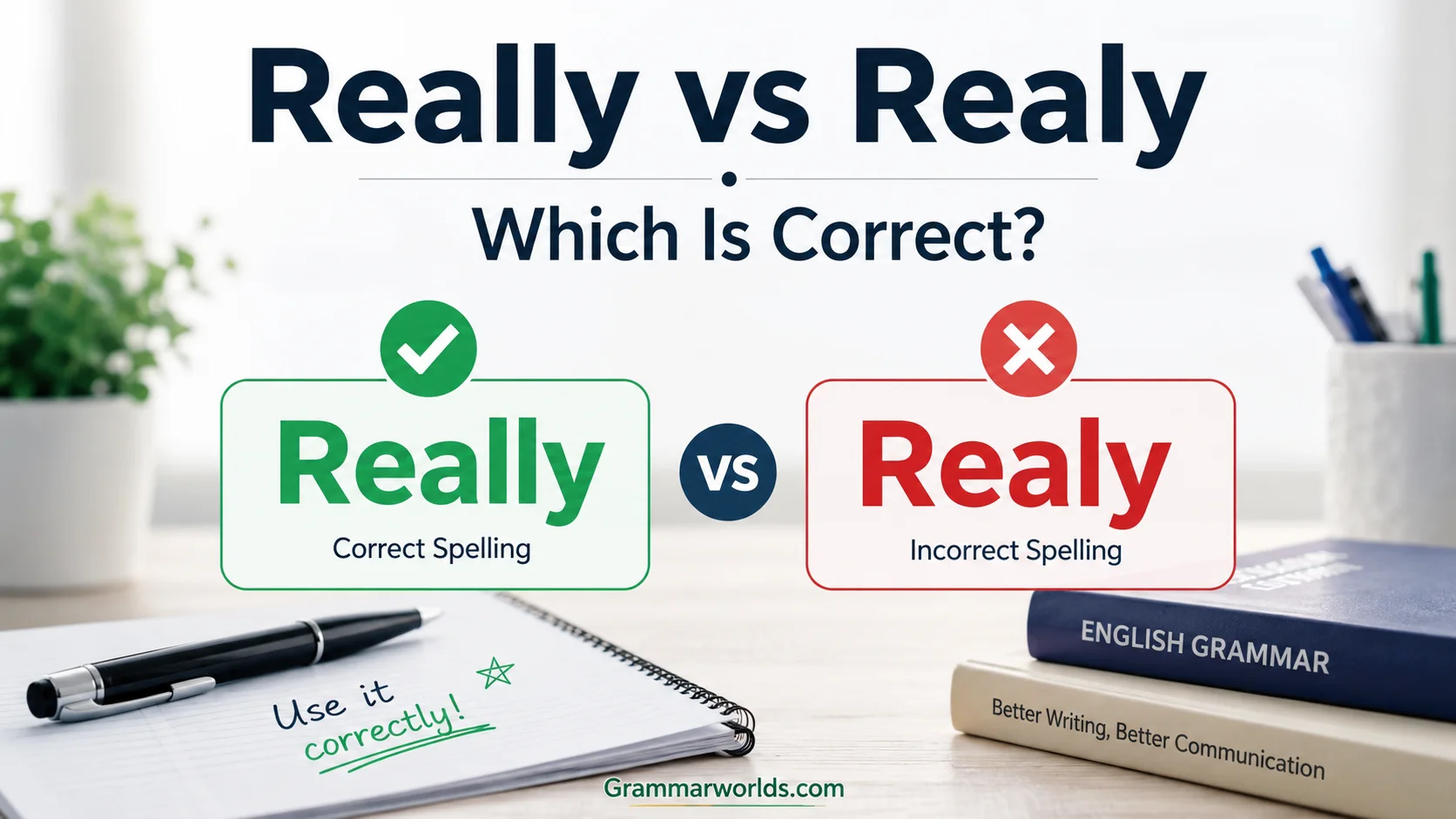
If you’re wondering whether you should write really or realy, the answer is simple.
Really is the correct spelling.
Realy is a spelling mistake. Although many people type it by accident, especially when writing quickly on a phone or keyboard, standard English dictionaries do not recognize realy as a word.
Here’s a quick comparison.
| Word | Correct? | Meaning |
| Really | ✅ Yes | An adverb used to emphasize, confirm, or strengthen a statement. |
| Realy | ❌ No | Incorrect spelling of really. |
Whenever you write emails, school assignments, business documents, blog posts, or social media updates, you should always choose really.
Quick takeaway
- Really = Correct spelling
- Realy = Incorrect spelling
- Really appears in all forms of English, including American and British English.
What Does “Really” Mean?
The word really is an adverb. It changes or strengthens the meaning of verbs, adjectives, other adverbs, or even entire sentences.
Most often, really means one of the following:
- Truly
- Actually
- Genuinely
- Very
- Indeed
Its exact meaning depends on the sentence.
For example:
- I really enjoyed the movie.
- The weather is really cold today.
- Do you really believe that story?
- She really can sing.
In each sentence, really adds emphasis and helps the reader understand how strongly the speaker feels.
Unlike many other adverbs, really appears naturally in both casual conversations and formal writing
Different Meanings of “Really”
Although it is only one word, really performs several jobs in English.
To Express Truth
Sometimes really means actually or in fact.
Examples:
- I really did complete the project yesterday.
- She really lives in New York.
- They really won the championship.
In these examples, really confirms that something is true.
To Add Emphasis
This is probably the most common use.
Examples:
- The cake tastes really delicious.
- That was a really exciting game.
- You look really happy today.
Here, really strengthens the adjective.
To Express Surprise
People often use really when reacting to unexpected news.
Examples:
- Really? I didn’t know that.
- Really? That’s amazing!
- Really? Tell me more.
In spoken English, tone of voice often changes the meaning.
To Strengthen Opinions
Writers and speakers use really to make opinions sound stronger.
Examples:
- I really recommend this book.
- We really appreciate your help.
- I really don’t agree with that decision.
The word makes the opinion sound more sincere.
To Intensify Another Adverb
Sometimes really modifies another adverb instead of an adjective.
Examples:
- She runs really fast.
- He speaks really clearly.
- They arrived really early.
Again, really increases intensity.
Why “Realy” Is Incorrect
Many English learners ask why realy isn’t accepted when it sounds almost identical to really.
The answer lies in English spelling rules.
The adjective is:
Real
When you add the suffix -ly, English keeps the double L.
Real
+
-ly
=
Really
The second L doesn’t disappear.
Because of this rule, writing realy removes a necessary letter.
Every major English dictionary—including Merriam-Webster, Cambridge Dictionary, Oxford English Dictionary, and Collins Dictionary—lists really as the correct spelling.
None recognize realy as a standard English word.
Why Do People Misspell “Really”?
Despite being a common word, really is one of the internet’s most frequently misspelled words.
There are several reasons.
Fast Typing
People often skip letters while typing quickly.
Instead of typing:
really
they accidentally type:
realy
One missing letter completely changes the spelling.
Mobile Keyboards
Smartphone keyboards encourage speed.
Autocorrect usually fixes realy, although it doesn’t always catch the mistake.
When autocorrect is disabled, the typo often remains.
Pronunciation Doesn’t Reveal the Double L
When spoken aloud, the two L letters sound like one.
That’s why many learners assume there should only be one L.
English spelling doesn’t always match pronunciation.
Learning English as a Second Language
Many learners memorize words based on sound.
Since really sounds simple, they often forget that spelling follows grammar rather than pronunciation alone.
Lack of Proofreading
Even experienced writers make typing mistakes.
Reading your work one final time catches errors like:
- realy
- definately
- seperate
- occured
Proofreading only takes a minute yet prevents embarrassing mistakes.
How to Spell “Really” Correctly Every Time
Fortunately, remembering the correct spelling isn’t difficult.
Here are several techniques that work.
Remember the Base Word
Start with the adjective.
Real
Now add -ly.
Real + ly = Really
Since real already ends with L, adding ly naturally creates LL.
Think About the Double L
A useful memory trick is:
Real has one L. Adding -ly gives really two Ls.
Many students find this easy to remember.
Read More
Frequent reading builds visual memory.
The more often you see really, the less likely you’ll misspell it.
Books, newspapers, blogs, and magazines all reinforce correct spelling.
Practice Commonly Misspelled Words
Create a small practice list.
For example:
| Incorrect | Correct |
| Realy | Really |
| Finaly | Finally |
| Actualy | Actually |
| Basicly | Basically |
| Definately | Definitely |
| Recieve | Receive |
| Seperate | Separate |
| Untill | Until |
Writing these words several times helps build long-term spelling habits.
Use Spellcheck as a Backup
Modern writing tools check spelling automatically.
However, don’t rely on technology alone.
Understanding why really is correct helps you write confidently, even when spellcheck isn’t available.
Also Read This : Choosing vs Chosing: How to Spell Choosing Correctly
When to Use “Really”
Knowing the correct spelling is only part of the story.
You also need to know when to use really.
Here are the most common situations.
Use “Really” for Emphasis
Examples:
- This book is really interesting.
- The food was really delicious.
- Your presentation was really impressive.
The word strengthens the description.
Use “Really” to Confirm Something
Examples:
- I really saw the accident.
- She really knows the answer.
- They really finished early.
Here, really confirms truth.
Use “Really” in Questions
Examples:
- Do you really think that’s true?
- Are you really moving abroad?
- Did he really say that?
Questions like these express curiosity or surprise.
Use “Really” to Show Strong Feelings
Examples:
- I really appreciate your support.
- We really enjoyed the concert.
- She really loves animals.
The speaker communicates genuine emotion.
Use “Really” Before Adjectives
Examples:
- really happy
- really tired
- really expensive
- really beautiful
- really difficult
This is one of the most common sentence patterns in English.
Use “Really” Before Adverbs
Examples:
- really slowly
- really carefully
- really well
- really quickly
Again, really strengthens the meaning.
Examples of “Really” in Everyday Sentences
Seeing real examples makes the difference much easier to remember.
Daily Conversation
- I’m really hungry.
- That sounds really fun.
- She’s really nice.
- We’re really excited.
School
- The lesson was really helpful.
- I really studied for the exam.
- Our teacher explained it really well.
Workplace
- Thank you. I really appreciate your assistance.
- The meeting was really productive.
- We really need a better solution.
Emails
- I really enjoyed meeting you yesterday.
- We really value your feedback.
- I really look forward to your reply.
Social Media
- I really love this photo.
- That vacation looked really amazing.
- I’m really proud of this achievement.
Each sentence sounds natural because really adds emphasis without changing the sentence structure.
Incorrect vs Correct Examples
One of the easiest ways to avoid mistakes is to compare incorrect and correct sentences side by side.
| Incorrect Sentence | Correct Sentence |
| I am realy excited. | I am really excited. |
| She realy enjoys music. | She really enjoys music. |
| That movie was realy funny. | That movie was really funny. |
| Do you realy know him? | Do you really know him? |
| They realy worked hard. | They really worked hard. |
| It realy matters. | It really matters. |
| We realy appreciate your help. | We really appreciate your help. |
| He realy tried his best. | He really tried his best. |
Notice that the only difference is one missing L. Even so, that small mistake immediately signals incorrect spelling.
Grammar Rule Behind “Really”
Understanding the grammar makes the spelling much easier to remember.
Really comes from the adjective real plus the suffix -ly, which forms an adverb.
Pattern:
| Adjective | Adverb |
| Real | Really |
| Slow | Slowly |
| Happy | Happily |
| Careful | Carefully |
| Quiet | Quietly |
Adverbs usually answer questions such as:
- How?
- To what degree?
- In what manner?
For example:
- She spoke really softly.
- They worked really hard.
- I was really surprised.
Understanding this simple grammar rule helps you remember both the spelling and the correct usage.
FAQs
Is realy ever a correct spelling?
No. Realy is never considered a correct spelling in standard English. The only accepted spelling is really. If you use realy in academic papers, professional emails, business documents, or published content, it will be treated as a spelling error. Most spellcheck tools and dictionaries automatically suggest changing realy to really.
Why does really have two Ls?
The word really is formed by combining the adjective real with the suffix -ly, which creates an adverb. Since real already ends with the letter L, adding -ly results in a double L:
- Real + ly = Really
Remembering this simple word formation makes the correct spelling much easier to recall.
Is really an adverb?
Yes. Really is an adverb because it modifies verbs, adjectives, other adverbs, or entire sentences. It often adds emphasis or expresses truth.
Examples:
- She really enjoyed the concert. (modifies the verb)
- The weather is really cold today. (modifies the adjective)
- He speaks really clearly. (modifies another adverb)
Can I use really in formal writing?
Yes. Really is perfectly acceptable in formal writing when it adds genuine emphasis. However, in highly academic, technical, or legal documents, writers sometimes prefer more precise alternatives such as truly, genuinely, indeed, actually, or significantly, depending on the context.
For example:
- Formal: The results were significantly different.
- Less formal: The results were really different.
Choose the word that best matches your audience and purpose.
What’s the easiest way to remember the correct spelling?
A simple memory trick is to think of the base word:
Real + ly = Really
Another helpful tip is to remember that real already ends with one L. When you add -ly, the word naturally contains two Ls. Reading regularly and proofreading your writing will also help you avoid this common spelling mistake.
Conclusion
The confusion between Really vs Realy is easy to solve once you understand the spelling rule. Really is the only correct spelling in English, while realy is simply a common typo caused by fast typing, pronunciation, or overlooking the second L.
Beyond spelling, knowing how to use really correctly will make your writing stronger and more natural. Whether you’re emphasizing a point, expressing surprise, confirming something is true, or strengthening an opinion, really is a versatile adverb that fits comfortably into everyday conversations, professional communication, and formal writing.