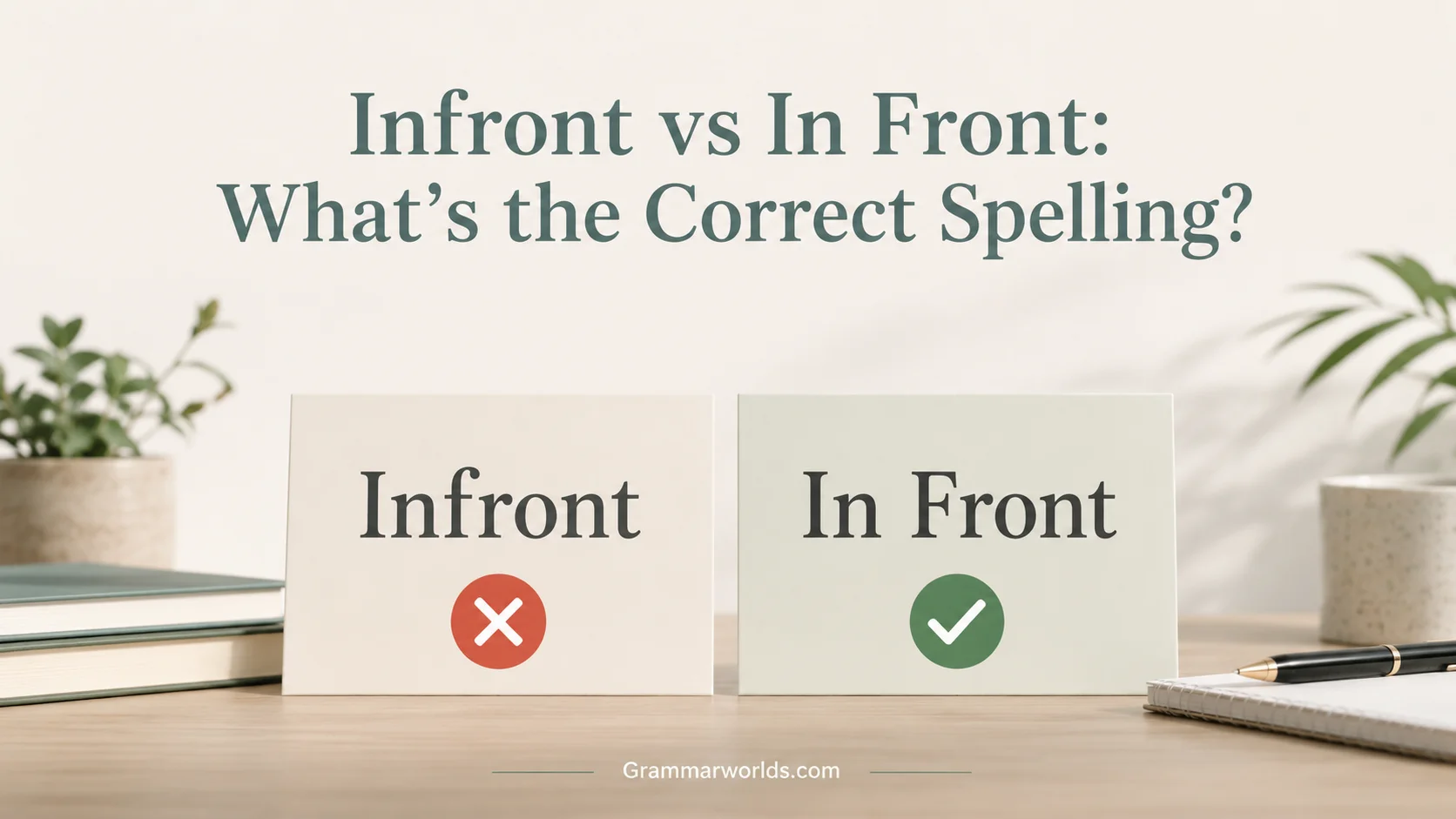
Infront vs In Front: What’s the Correct Spelling? explains why In Front is the Correct Spelling in English and why Infront is an incorrect form.
If you have ever paused mid-sentence and wondered which version to write, you are not alone. Many learners wonder because compound words in the English language can be written as a single-word or a two-word phrase. However, In Front is the correct phrase because it indicates a position or location relative to the front side of something. Infront is often used in informal contexts, emails, email messages, captions, and casual communication, but it does not conform to British or American grammar rules. To avoid this mistake, use the proper sentence in professional writing and exams.
From my editing experience, the easiest way to remember the difference is to compare it with phrases like stand in front of a house. If you have hesitated, this simple guide will help you understand the differences, meanings, usage, and why the incorrect version is frequently seen.
The Short Answer: Infront vs In Front
Let’s clear up the confusion immediately.
| Word | Correct? | Notes |
| In front | ✅ Yes | Correct in American and British English |
| Infront | ❌ No | Misspelling in standard English |
The phrase “in front” always appears as two separate words.
Correct examples
- She stood in front of the mirror.
- The restaurant is in front of the park.
- Please sit in front if you want a better view.
- The teacher stood in front of the class.
Incorrect examples
- She stood infront of the mirror.
- The restaurant is infront of the park.
- Please sit infront.
Although many people type “infront,” no major English dictionary recognizes it as the standard spelling.
Is “Infront” One Word?
Many writers assume “infront” is simply another compound word. It isn’t.
Unlike words that evolved into single words over time, “in front” has remained a two-word prepositional phrase throughout modern English.
Why People Write “Infront”
Several factors contribute to this mistake.
Similar Compound Words
English includes countless compound words:
- Inside
- Outside
- Upstairs
- Downstairs
- Upfront
- Into
- Throughout
Because these words exist, people naturally assume “in front” follows the same rule.
Unfortunately, English is full of exceptions.
Fast Typing
When typing quickly, many people remove spaces accidentally.
For example:
- infront
- alot
- atleast
- everytime
These spelling errors become habits over time.
Mobile Keyboards
Phone keyboards encourage speed. Writers often skip spaces without noticing.
Autocorrect doesn’t always catch “infront,” especially if the word has been added to a device’s personal dictionary.
Informal Internet Writing
Social media, messaging apps, and online forums prioritize speed over grammar.
Someone writes:
“I’m standing infront of your house.”
Others see the same spelling repeatedly and begin believing it’s correct.
Popularity doesn’t make a spelling correct.
Is “Infront” Ever Correct?
The answer is no in standard English.
Whether you’re writing American English or British English, professional editors expect “in front.”
Major dictionaries consistently list only the two-word version.
These include:
- Merriam-Webster
- Cambridge Dictionary
- Oxford English Dictionary
- Collins Dictionary
- Dictionary.com
If you’re writing:
- Academic papers
- College essays
- Business reports
- Website content
- News articles
- Books
Always write:
in front
Never write:
infront
What Does “In Front” Mean?
The phrase “in front” describes a position ahead of someone or something.
It usually refers to physical location, but it can also describe figurative situations.
Definition
In front means:
Ahead of someone or something in position, place, or direction.
It often appears with “of.”
Examples:
- The mailbox is in front of the house.
- She waited in front of the theater.
How “In Front” Functions in a Sentence
From a grammar perspective, “in front” is a prepositional phrase.
It tells readers where something is located.
Consider this sentence:
The bicycle is in front of the garage.
Here:
- In = preposition
- Front = noun
- Together they form a phrase showing location.
The phrase answers questions like:
- Where?
- In what position?
- Ahead of what?
Physical Position
This is the most common use.
Examples:
- The bus stopped in front of the school.
- A tree stands in front of my office.
- The children gathered in front of the stage.
- Park your car in front of the building.
Readers immediately understand the object’s location.
Direction or Movement
Sometimes the phrase describes movement.
Examples:
- He walked in front of me.
- The cyclist rode in front of the group.
- The dog ran in front of the truck.
- She stepped in front of the camera.
Here, the phrase indicates someone’s path or direction.
Figurative Meaning
Not every example involves physical space.
Sometimes “in front” expresses ideas.
Examples:
- The solution was right in front of you.
- Success is in front of anyone willing to work.
- Don’t ignore the opportunity standing in front of you.
These examples use the phrase metaphorically.
How to Use “In Front” Correctly
Using the phrase correctly is surprisingly simple once you understand its purpose.
Use It to Describe Location
Examples:
- The library sits in front of City Hall.
- Our hotel is in front of the beach entrance.
- The taxi stopped in front of the airport terminal.
Use It Before a Noun
Normally the phrase is followed by of plus a noun.
Pattern:
in front of + noun
Examples:
- in front of the store
- in front of my office
- in front of the audience
- in front of the class
- in front of the museum
Use It Without “Of” When the Context Is Clear
Sometimes of isn’t necessary.
Examples:
- Please come to the front.
- Sit in front.
- Everyone moved in front.
The missing noun is already understood.
Why “Infront” Is Incorrect
Many spelling mistakes happen because language evolves. This isn’t one of them.
“Infront” has never become part of standard English.
It Doesn’t Appear in Major Dictionaries
Professional dictionaries recognize words after widespread accepted usage.
Since “infront” isn’t accepted, it remains classified as a spelling error.
Professional Editors Correct It
Editors routinely replace:
❌ infront
with
✅ in front
Whether editing:
- Books
- Newspapers
- Websites
- Academic journals
The correction remains the same.
It Hurts Credibility
Small grammar mistakes influence how readers perceive your work.
Research in communication and digital marketing consistently shows that spelling errors reduce trust, increase perceived carelessness, and can negatively affect user experience.
Imagine reading:
“Meet us infront of the office.”
Many readers immediately notice the mistake.
Now compare:
“Meet us in front of the office.”
The second version appears polished and professional.
In Front vs Infront Comparison Table
| Feature | In Front | Infront |
| Standard English | ✅ Yes | ❌ No |
| Dictionary recognized | ✅ Yes | ❌ No |
| American English | ✅ Correct | ❌ Incorrect |
| British English | ✅ Correct | ❌ Incorrect |
| Academic writing | ✅ Yes | ❌ Never |
| Professional writing | ✅ Yes | ❌ Never |
| SEO content | ✅ Recommended | ❌ Avoid |
| School assignments | ✅ Correct | ❌ Incorrect |
Examples of Correct and Incorrect Usage
Learning through comparison makes the difference much easier to remember.
| ✅ Correct | ❌ Incorrect |
| She stood in front of the door. | She stood infront of the door. |
| Park in front of the building. | Park infront of the building. |
| The answer is in front of you. | The answer is infront of you. |
| We met in front of the station. | We met infront of the station. |
| He walked in front of the crowd. | He walked infront of the crowd. |
| The children lined up in front of the classroom. | The children lined up infront of the classroom. |
Quick Tip: If you’re ever tempted to write “infront,” insert a space between “in” and “front.” That’s the correct form every time.
Common Mistakes Writers Make
Even experienced writers occasionally make mistakes with “in front.” Most errors happen because English contains many similar-looking words. Knowing the common pitfalls helps you avoid them.
Writing It as One Word
This is the most frequent mistake.
Incorrect:
- We parked infront of the hotel.
Correct:
- We parked in front of the hotel.
Remember that “in front” always needs a space.
Confusing It with “Upfront”
Many people assume “in front” follows the same pattern as “upfront.” That’s understandable because both phrases involve position or openness in different contexts.
Compare them:
- She was upfront about the costs. ✅
- She stood in front of the audience. ✅
Although “upfront” is a recognized compound word, “in front” has not become one. Treat them as separate expressions with different grammatical histories.
Forgetting “Of”
When describing the position of one thing relative to another, the word “of” is usually required.
Incorrect:
- The statue is in front of the museum.
Correct:
- The statue is in front of the museum.
Dropping “of” makes the sentence grammatically incomplete.
Assuming Spell Check Will Catch It
Some writing tools flag “infront,” while others don’t. If your device has learned the misspelling or you’re using informal software, it may pass unnoticed.
A quick proofread is still your best defense.
Grammar Rule Behind “In Front”
One reason this spelling confuses so many people is that English contains hundreds of compound words. However, not every commonly used phrase eventually becomes a single word. “In front” is one of those exceptions.
Understanding the grammar behind it makes the correct spelling much easier to remember.
Why “In Front” Stays Two Words
The phrase “in front” consists of:
- In — a preposition
- Front — a noun
Together, they form a prepositional phrase that describes location or position.
Think about this sentence:
The children are in front of the school.
Here, front still functions as a noun. The phrase literally refers to the front part of something.
Because front retains its role as a noun, English keeps the words separate.
Compare these examples:
| Phrase | Correct? | Explanation |
| in front of the house | ✅ | Prepositional phrase |
| at the front of the house | ✅ | Similar grammatical structure |
| near the front entrance | ✅ | “Front” remains a noun |
| infront of the house | ❌ | Not recognized in standard English |
Unlike words such as inside or outside, “in front” never evolved into a standard compound word.
Understanding Prepositional Phrases
A prepositional phrase begins with a preposition and provides extra information about another word in the sentence. It often tells readers where, when, how, or in what direction something happens.
Examples include:
- in front of
- behind
- beside
- next to
- across from
- on top of
- under
- between
Notice how each phrase identifies location.
Consider these sentences:
- The dog slept under the table.
- The bicycle leaned against the wall.
- The flowers grew beside the fence.
- The bus stopped in front of the library.
Each highlighted phrase answers the question:
Where?
That’s exactly what “in front” does.
Also Read This : One Third vs One-Third: What’s the Correct Form?
Why English Doesn’t Treat It as a Compound Word
English develops naturally over centuries. Some word combinations become compounds while others remain separate forever.
For example:
| Two Words | One Word |
| in front | — |
| every day | everyday (different meaning) |
| any time | anytime (depends on usage) |
| set up | setup (different grammar) |
| log in | login (different grammar) |
Many writers assume “in front” should eventually become “infront.”
Language experts disagree.
Major dictionaries, grammar guides, publishers, universities, and style manuals continue to recommend the two-word version.
That’s why you’ll see “in front” in:
- Newspapers
- Books
- Government publications
- University writing guides
- Professional websites
- Academic journals
Memory Trick to Remember the Correct Spelling
Grammar rules are useful, but memory tricks make them stick.
Here are a few simple ways to remember the correct spelling.
Think About the Opposite
Consider these pairs:
- in front
- in back
Nobody writes:
- ❌ inback
Since “in back” stays two words, “in front” should too.
Replace “Front” with Another Noun
Try swapping front with another location word.
Examples:
- in house
- in room
- in garden
Each phrase keeps the space.
The same logic applies to in front.
Read It Naturally
Say these sentences aloud.
Stand in front of the door.
Now remove the space.
Stand infront of the door.
The second version looks awkward because it isn’t standard English.
If something feels unnatural while reading it aloud, double-check the spelling.
Proofreading Tip
Before publishing your work, search your document for:
infront
If you find it, replace every instance with:
in front
This simple search takes only a few seconds and prevents an easy-to-miss mistake.
Similar Word Pairs People Confuse
The confusion surrounding “in front” isn’t unique. English contains many word pairs that look similar but follow different grammar rules.
Learning these patterns can improve your writing far beyond this single phrase.
Into vs In To
These expressions have different meanings.
| Into | In To |
| Shows movement | “In” belongs with another phrase |
| She walked into the room. | She turned the report in to her manager. |
Everyday vs Every Day
These words often confuse even native speakers.
| Everyday | Every Day |
| Adjective | Adverbial phrase |
| everyday shoes | I exercise every day. |
Maybe vs May Be
| Maybe | May Be |
| Perhaps | Could be |
| Maybe it’ll rain. | This may be the answer. |
Any Time vs Anytime
| Anytime | Any Time |
| Adverb | Noun phrase |
| Call me anytime. | I don’t have any time today. |
A While vs Awhile
| A While | Awhile |
| Noun phrase | Adverb |
| Stay for a while. | Stay awhile. |
Setup vs Set Up
Another classic mistake.
| Setup | Set Up |
| Noun or adjective | Verb |
| The setup was easy. | Please set up the equipment. |
Login vs Log In
| Login | Log In |
| Noun | Verb |
| Your login failed. | Please log in first. |
Upfront vs Up Front
This pair deserves special attention because it often causes the “infront” mistake.
Upfront (one word) usually means:
- Honest
- Direct
- Paid before receiving goods or services
Examples:
- She was upfront about the risks.
- The company requires payment upfront.
Up front (two words) usually refers to physical position.
Example:
- We sat up front during the concert.
Even though upfront can be one word, in front never becomes infront.
FAQs
Is “infront” a correct spelling?
No. “Infront” is not a correct spelling in standard English. The correct form is “in front,” written as two separate words. This is the version recognized by major dictionaries and style guides in both American and British English.
Why is “in front” written as two words?
“In front” is a prepositional phrase made up of the preposition “in” and the noun “front.” Since “front” still functions as a noun in the phrase, English keeps the words separate rather than combining them into one word.
Can I use “infront” in formal or academic writing?
No. You should never use “infront” in formal writing, academic papers, business emails, or professional documents. Editors and teachers consider it a spelling mistake. Always use “in front” instead.
Is “in front of” always the correct phrase?
Yes. When describing the position of one object relative to another, the correct expression is “in front of.” For example, “The car is parked in front of the house.” This phrase is grammatically correct and widely accepted in all forms of English.
How can I remember the correct spelling of “in front”?
An easy way to remember it is to think of “front” as a separate place or position. Since you wouldn’t write “inhouse” instead of “in house,” you shouldn’t write “infront” either. Keeping a space between “in” and “front” will help you avoid this common spelling mistake.
Conclusion
The confusion surrounding Infront vs In Front is common, but the rule is simple once you understand it. “In front” is the only correct spelling in standard English, while “infront” is a misspelling that should be avoided in every type of writing. Whether you’re preparing a school assignment, writing a professional email, or publishing content online, using “in front” helps your writing appear polished, accurate, and credible.
Although many people mistakenly combine the words because of similar compound words like inside or upfront, English grammar treats “in front” as a two-word prepositional phrase. Keeping this rule in mind will help you write with greater confidence and avoid one of the most common spelling errors. Whenever you’re unsure, remember the simple rule: always keep the space—it’s “in front,” never “infront.”