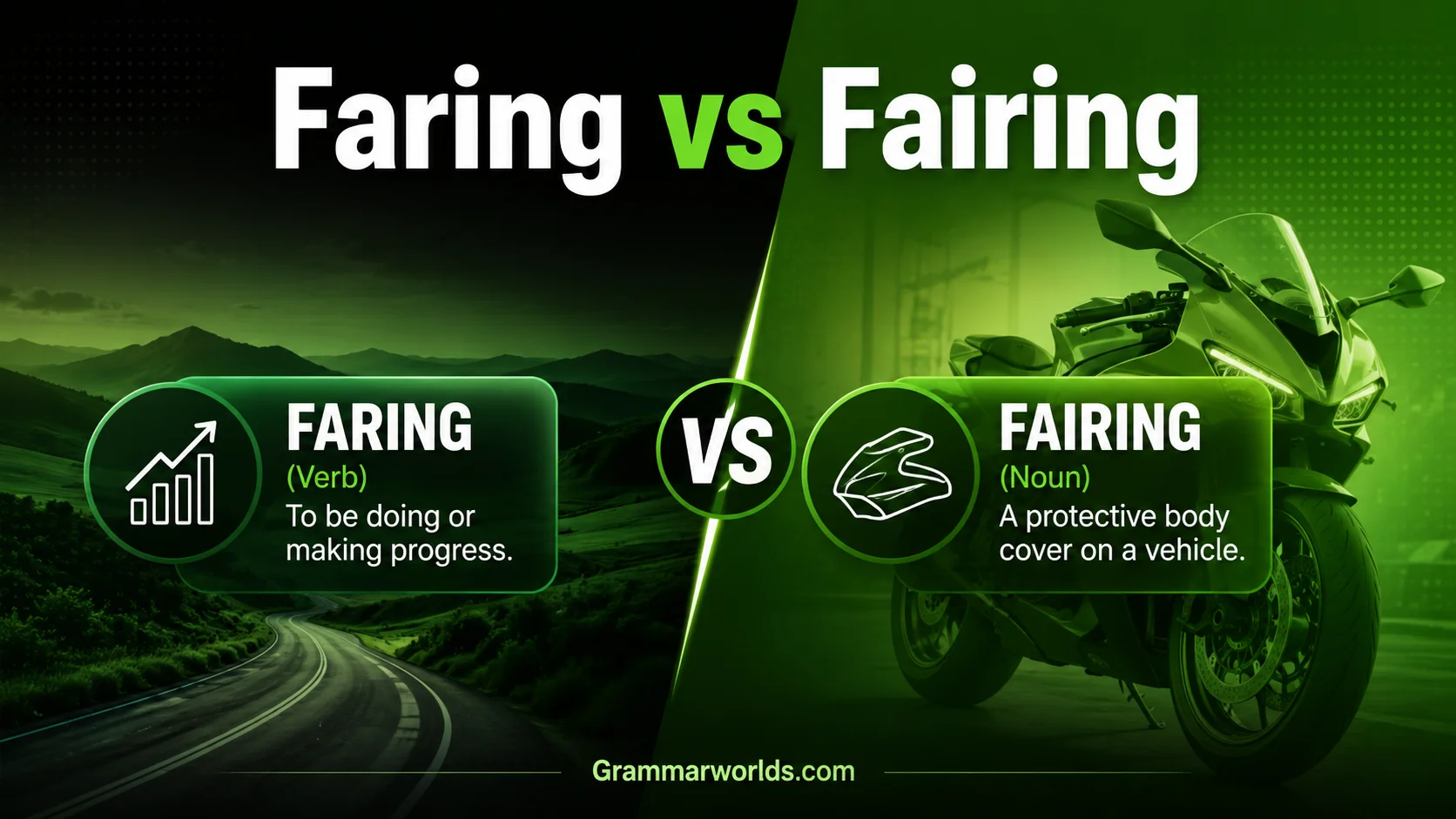
Learn Faring vs Fairing What’s the Difference? through simple examples that explain faring, fairing, meaning, usage, and common spelling confusion. Many experienced writers experience confusion between faring and fairing because these terms sound alike in spoken English. This common issue creates doubt about spelling, meaning, and correct usage in everyday writing, conversation, email, and professional communication. The word faring is used to describe someone’s state and how they are dealing with things in life.
A simple question like how are you faring asks about a person’s health, well-being, progress, and overall situation. When someone is faring well, it shows care, interest, and concern about their work, project, or personal situation. This connection with human experiences, coping, managing, and overcoming challenges helps people remember the correct phrase and create clarity, professionalism, strong writing, and a more polished style.
The fairing meaning belongs to a completely different context because fairing refers to a frame, covering, or physical component used in vehicles, transportation, and engineering. This structure provides protective design by lowering wind resistance, helping an object move faster with improved speed and performance.
Faring vs. Fairing: Quick Answer
Here’s the short version.
| Word | Meaning | Part of Speech | Common Uses |
| Faring | Doing, progressing, or getting along | Verb (present participle of fare) | Health, work, school, business, travel |
| Fairing | A streamlined covering that reduces air or water resistance | Noun | Motorcycles, aircraft, rockets, boats, racing bicycles |
The easiest way to remember
- Use faring when you’re talking about people, businesses, teams, or situations.
- Use fairing when you’re talking about machines or vehicles.
Think of it this way:
People fare. Vehicles wear fairings.
That simple sentence solves most cases.
What Does “Faring” Mean?
The word faring comes from the verb fare, which means to get along, perform, progress, or experience a particular condition.
Although the verb “fare” isn’t as common in everyday conversation as words like doing or performing, it remains widely used in both spoken and written English.
People often ask:
- How are you faring?
- How is your business faring?
- How are the crops faring after the storm?
- How is the economy faring this year?
In every example, faring refers to someone’s condition, progress, or success.
Common situations where “faring” appears
You’ll most often see faring in discussions about:
- Personal health
- Recovery from illness
- Business performance
- Academic progress
- Financial conditions
- Sports teams
- Economic reports
- Travel experiences
- Weather impacts
- Relationships
Notice that every example involves evaluating how something is going.
Examples of “Faring” in Sentences
Seeing the word in context makes the meaning much easier to remember.
Health
- My grandfather is faring much better after surgery.
- Patients are faring well following the new treatment.
- She asked how everyone was faring after the hurricane.
Business
- Small businesses are faring better than expected this quarter.
- Local restaurants aren’t faring well because of rising costs.
- The startup is faring surprisingly well despite fierce competition.
Education
- Students are faring well in online classes.
- New graduates are faring better in today’s job market than analysts predicted.
Sports
- Our team is faring much better this season.
- The rookie has been faring well against experienced opponents.
Travel
- Travelers are faring well despite flight delays.
- Tour operators are faring better now that tourism has recovered.
Every sentence asks or answers the same basic question:
“How is someone or something doing?”
Understanding the Verb “Fare”
Many people recognize faring but rarely use its base form, fare.
The verb dates back hundreds of years and originally meant to travel or to journey. Over time, its meaning expanded to include experiencing success, failure, or a particular condition.
For example:
- We fared well during the recession.
- She fared better than expected.
- They fared poorly in the competition.
Today, the verb appears most often in formal writing, journalism, literature, and professional communication.
Although “How are you doing?” has become more common in everyday speech, “How are you faring?” remains perfectly correct and often sounds slightly more thoughtful or literary.
What Does “Fairing” Mean?
Unlike faring, the word fairing has nothing to do with progress or well-being.
A fairing is a specially designed covering that improves the aerodynamic or hydrodynamic performance of a vehicle.
Its primary job is simple:
Reduce resistance caused by air or water.
Engineers carefully shape fairings so air flows smoothly around a vehicle instead of creating unnecessary drag.
The result is better efficiency, higher speeds, greater stability, and improved fuel economy.
Where Fairings Are Used
Fairings appear in many forms of transportation.
Motorcycles
Motorcycle fairings are probably the most recognizable.
They help:
- Reduce wind pressure on the rider
- Improve fuel efficiency
- Increase high-speed stability
- Protect internal components
- Improve rider comfort
Sport motorcycles typically have full fairings because they’re designed for speed.
Cruisers often use smaller windshield-style fairings.
Aircraft
Aircraft use fairings throughout their structure.
Examples include:
- Landing gear fairings
- Wing root fairings
- Engine fairings
- Tail fairings
These components smooth airflow and reduce turbulence.
Even relatively small fairings can noticeably improve an aircraft’s fuel efficiency over thousands of flight hours.
Rockets
Rocket fairings perform a unique job.
The large cone-shaped section at the top of many rockets is called the payload fairing.
It protects:
- Satellites
- Scientific instruments
- Spacecraft
- Cargo
During launch, the fairing shields delicate equipment from:
- Intense vibration
- Extreme temperatures
- Air pressure
- Wind forces
Once the rocket reaches thinner parts of Earth’s atmosphere, the fairing separates because it is no longer needed.
That separation is one of the most recognizable moments during modern space launches.
Boats
Boats also use fairings.
Instead of reducing air resistance, marine fairings reduce water resistance.
Benefits include:
- Improved speed
- Better handling
- Lower fuel consumption
- Reduced turbulence
Hydrodynamic fairings are especially important on submarines and high-performance racing boats.
Racing Bicycles
Competitive cyclists constantly look for aerodynamic advantages.
Modern time-trial bicycles sometimes incorporate carefully regulated fairing-like structures that reduce drag while remaining within competition rules.
Even small aerodynamic improvements can save valuable seconds over long distances.
Also Read This : Check-In vs Check :What’s the Difference?
Why Fairings Matter
At first glance, a fairing may look like decorative bodywork.
In reality, it serves several important engineering purposes.
Reduced Drag
Air creates resistance whenever an object moves through it.
A streamlined fairing allows air to flow smoothly around the vehicle.
Less drag means:
- Higher speeds
- Better efficiency
- Lower energy consumption
Improved Fuel Economy
Reducing drag lowers the amount of energy needed to maintain speed.
That translates into:
- Better gas mileage
- Lower operating costs
- Reduced emissions
Commercial aviation benefits enormously from aerodynamic improvements because even tiny efficiency gains save millions of dollars in fuel each year.
Better Stability
Fairings reduce turbulent airflow.
The result is:
- More predictable handling
- Better stability at high speeds
- Less buffeting from crosswinds
Motorcyclists especially notice this benefit during highway riding.
Protection
Many fairings protect expensive components from:
- Rain
- Dirt
- Road debris
- Ice
- Impact damage
Aircraft and spacecraft rely heavily on protective fairings because environmental conditions can become extremely harsh.
Reduced Noise
Smoother airflow also reduces wind noise.
This improves comfort for:
- Motorcycle riders
- Aircraft passengers
- Drivers
- Cyclists
Engineering often focuses on tiny improvements that combine to create significant overall performance gains.
Fairings are an excellent example.
Faring vs. Fairing: Side-by-Side Comparison
The similarities end with pronunciation.
| Feature | Faring | Fairing |
| Meaning | Progressing or doing | Streamlined covering |
| Part of Speech | Verb | Noun |
| Refers to People | Yes | No |
| Refers to Vehicles | No | Yes |
| Everyday Usage | Common | Mostly technical |
| Engineering Term | No | Yes |
| Pronunciation | Same as fairing | Same as faring |
Although they sound identical, they belong to entirely different parts of speech and serve completely different purposes.
That’s why context matters far more than pronunciation.
Faring vs. Fairing in Real-Life Context
Compare these examples.
| Incorrect | Correct |
| My motorcycle has a new faring. | My motorcycle has a new fairing. |
| How is your company fairing? | How is your company faring? |
| The rocket’s faring separated after launch. | The rocket’s fairing separated after launch. |
| She asked how I was fairing. | She asked how I was faring. |
| Engineers replaced the damaged faring. | Engineers replaced the damaged fairing. |
Reading both versions side by side helps your brain recognize the correct usage almost instantly.
Why People Confuse Faring and Fairing
English contains many homophones, and faring and fairing are a perfect example.
Several factors contribute to the confusion.
They sound exactly alike
Both words share the same pronunciation.
When speaking, listeners rely entirely on context.
When writing, however, spelling becomes essential.
Both words are legitimate
Spell-check won’t flag either word because both exist in the dictionary.
That’s why mistakes often survive proofreading.
One word is far less common
Most people encounter faring regularly.
Fairing, however, appears mainly in engineering, aviation, automotive, aerospace, and motorsports.
If you don’t work in those fields, you may rarely see it.
Autocorrect doesn’t understand context
Modern writing tools detect spelling errors well.
They don’t always detect word choice errors.
Typing:
How is your business fairing?
may receive no warning, even though faring is the correct choice.
That’s why understanding the meaning matters more than relying on software.
Faqs
Is faring a real word?
Yes. Faring is the present participle of the verb fare, which means to get along, perform, or progress. You’ll often see it in questions like, “How are you faring?” or statements such as, “The business is faring well despite economic challenges.” Although it isn’t as common as doing, it’s a well-established word in standard English.
Is fairing only used for motorcycles?
No. While motorcycle fairings are the most familiar example, the term applies to many types of vehicles and equipment. Engineers use fairings on:
- Airplanes
- Rockets
- Boats
- Racing bicycles
- High-performance cars
- Wind turbines and other specialized machinery
In every case, a fairing helps reduce air or water resistance, protects components, or improves overall efficiency.
How can I remember the difference between faring and fairing?
A simple memory trick can help:
- Faring = How are you doing?
- Fairing = A part of a vehicle.
Another easy phrase to remember is:
People fare. Vehicles have fairings.
If you’re talking about someone’s health, progress, or success, use faring. If you’re describing a streamlined cover on a motorcycle, airplane, or rocket, use fairing.
Why doesn’t spell-check catch mistakes between faring and fairing?
Spell-check programs focus on spelling, not meaning. Since faring and fairing are both correctly spelled English words, most writing tools won’t flag them as errors.
For example:
- ❌ How is your company fairing?
- ✅ How is your company faring?
Although the first sentence is incorrect, many spell-checkers won’t recognize the mistake because fairing is a valid word. That’s why understanding the context is the best way to choose the correct spelling.
Which word is more common in everyday English?
Faring appears far more often in everyday writing and conversation because people frequently discuss how someone or something is doing. You’ll see it in news articles, business reports, healthcare updates, and casual conversations.
Conclusion
The difference between faring and fairing is easier to remember than it first appears. Although the two words are perfect homophones, they belong to completely different contexts and have unrelated meanings.
Use faring whenever you’re describing how a person, business, team, or situation is progressing. It comes from the verb fare and answers questions like, “How are you faring?”
Use fairing when you’re referring to a streamlined covering on a vehicle or machine. Whether it’s attached to a motorcycle, airplane, rocket, or boat, a fairing reduces drag, improves efficiency, and often protects important components.