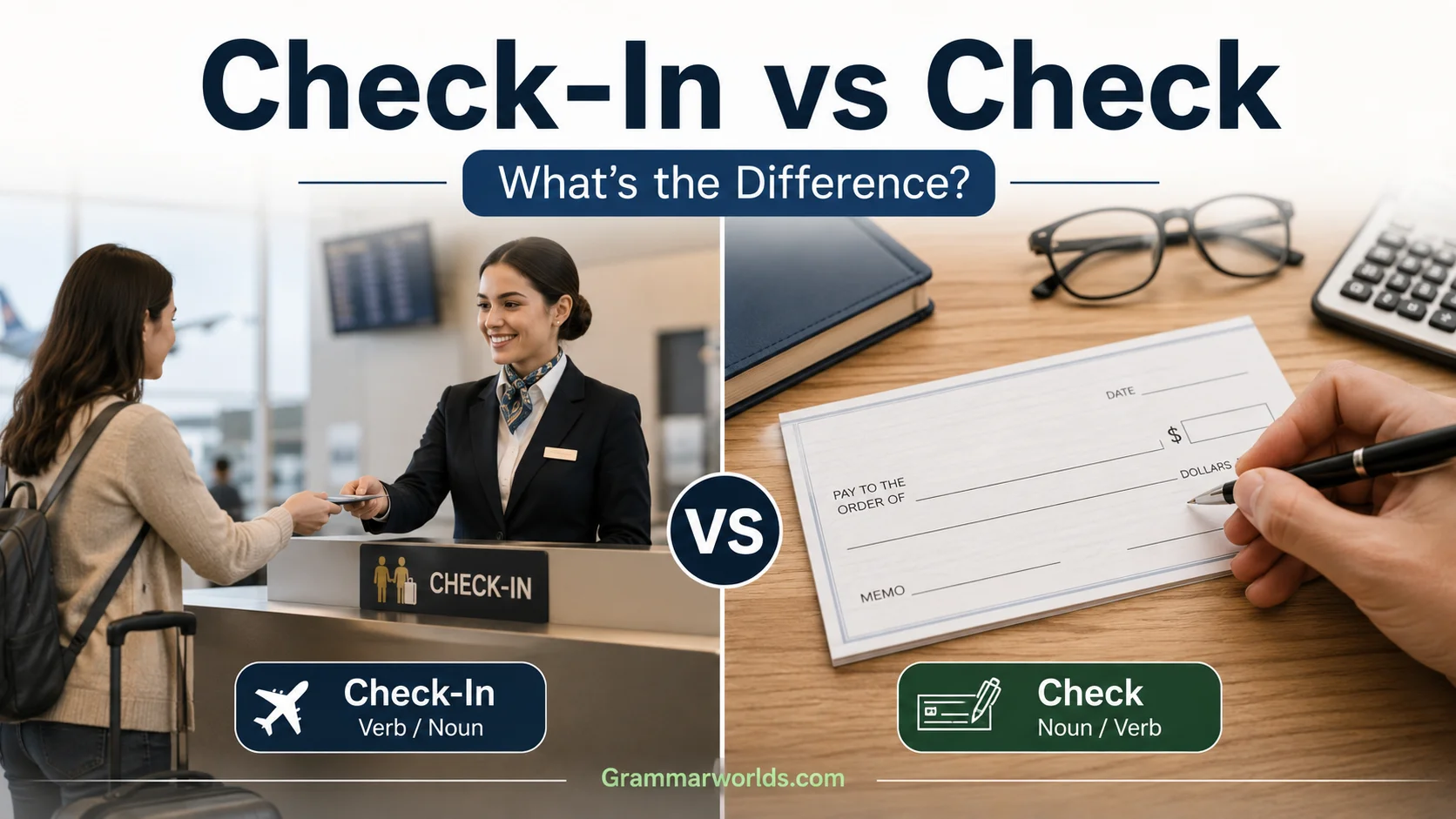
Understanding Check-In vs Check What’s the Difference? starts with knowing when to use check in and check-in, as both forms have different roles.
Wondering when and where to use these words is common because the hyphen can designate the versatility of the phrase in relation to parts of speech. The action shows something a person does, while the description relates to a place or time. With simple examples, it becomes important to know how both forms work without assuming they are the same things with only different punctuation. The former is something someone does, while the hyphenated version is usually a noun or adjective. The meaning can mean something different depending on the sentence and how we use them.
In real life, this difference matters because the verb form is widely used by passengers and workers every day. In UK aviation, around 39% used online check-in through a computer, while 15% used self-service airport terminals.
What Does Check-In Mean?
The phrase check in means to register, report your arrival, or confirm that you have reached a location or entered a process.
When written with a hyphen (check-in), it usually becomes a noun or adjective describing the registration process itself.
You encounter check-ins almost everywhere because organizations need to verify who has arrived before providing access or services.
Common places where people check in include:
- Hotels
- Airports
- Hospitals
- Conferences
- Events
- Workplaces
- Cruise terminals
- Gyms
- Medical appointments
- Online platforms
Although every industry has its own procedure, the purpose remains the same: confirm identity, verify eligibility, and grant access.
Hotel Check-In
For most travelers, hotels are the first place where they experience a check-in process.
When you check in, the hotel confirms your reservation before giving you access to your room.
A standard hotel check-in usually involves:
- Presenting identification
- Confirming the reservation
- Providing a payment method
- Receiving a room key or key card
- Reviewing hotel policies
- Confirming check-out time
For example:
- Correct: I checked in at the hotel around 4:00 PM.
- Correct: Hotel check-in begins at 3:00 PM.
- Incorrect: I checked the hotel at 4:00 PM.
Notice how checked in describes arriving, while checked would mean inspecting something.
Why Hotels Have Check-In Times
Many guests wonder why they can’t access their rooms early.
The answer is simple.
Housekeeping teams need time to clean, inspect, and prepare rooms after previous guests leave. That’s why most hotels establish standard check-in times between 2:00 PM and 4:00 PM, although luxury properties and boutique hotels sometimes offer early check-in for an additional fee or loyalty members.
Airport Check-In
Airports use check-in to verify passenger identity before boarding.
Years ago, travelers checked in only at airport counters. Today, airlines offer several options.
Common methods include:
| Check-In Method | How It Works | Best For |
| Online check-in | Complete check-in through a website or app | Most travelers |
| Self-service kiosk | Print boarding passes at the airport | Travelers without checked baggage |
| Airport counter | Airline staff assist passengers | International flights or special requests |
| Mobile check-in | Receive a digital boarding pass | Frequent travelers |
During airport check-in, airlines verify:
- Identity
- Passport information
- Visa requirements
- Ticket validity
- Baggage details
- Seating preferences
Only after completing check-in can passengers receive a boarding pass.
Workplace Check-Ins
Modern workplaces use the term check-in differently.
Instead of confirming physical arrival, a workplace check-in refers to a brief conversation between employees and managers.
Its purpose is to:
- Review progress
- Discuss priorities
- Solve challenges
- Provide feedback
- Align goals
For example:
- “Let’s have a quick check-in before the client meeting.”
- “Our weekly check-in lasts about fifteen minutes.”
Unlike annual performance reviews, regular check-ins encourage ongoing communication rather than one-time evaluations.
Digital Check-Ins
Technology has expanded the meaning of check-in beyond physical locations.
Today you can check in through:
- Mobile banking apps
- Fitness apps
- Event management platforms
- Social media
- Online conferences
- Appointment systems
For example, fitness applications often ask users to complete a daily check-in to record workouts, while event organizers use QR-code check-ins to track attendance.
These digital systems improve efficiency by reducing paperwork and speeding up verification.
What Does Check Mean?
Unlike check-in, the word check has several meanings.
Despite those different meanings, they all share one basic idea:
To confirm, inspect, examine, verify, or review something.
The exact definition depends on context.
Check as a Verb: Examine or Verify
This is the most common meaning.
When you check something, you inspect it carefully to make sure it’s correct.
Examples include:
- Check your homework.
- Check your spelling.
- Check your bank balance.
- Check the weather.
- Check your email.
- Check the instructions.
Here, you aren’t registering your arrival.
You’re simply reviewing information.
For example:
❌ I checked in my homework.
✅ I checked my homework.
Check as a Verb: Confirm Accuracy
Sometimes checking involves verifying facts rather than inspecting physical objects.
Examples include:
- Checking appointment dates
- Checking inventory
- Checking statistics
- Checking references
- Checking calculations
- Checking measurements
Professionals perform checks constantly because small mistakes often become expensive problems later.
Think of an accountant reviewing financial reports or an engineer inspecting construction plans.
One careful check can prevent thousands of dollars in losses.
Check as a Verb: Control or Stop Something
Another common definition means to restrain, slow, or prevent.
Examples include:
- Check inflation.
- Check the spread of disease.
- Check aggressive behavior.
- Check rising costs.
- Check excessive spending.
In these examples, check means control rather than inspect.
Check as a Noun: Restaurant Bill
In American English, people commonly ask for the check after eating.
For example:
- Could we have the check, please?
- I’ll pay the check tonight.
In British English, people usually say bill instead.
Although both words describe the amount owed, regional preference differs.
| American English | British English |
| Check | Bill |
| Could we get the check? | Could we get the bill? |
Check as a Noun: Payment Document
Before electronic banking became widespread, paper checks were one of the most common payment methods.
A bank check instructs a financial institution to pay a specified amount to a named recipient.
Although digital payments dominate today, checks remain common for:
- Payroll
- Insurance settlements
- Government payments
- Business transactions
- Large financial transfers
Check as a Noun: Inspection or Verification
Many industries perform routine checks.
Examples include:
- Security check
- Background check
- Health check
- Equipment check
- Safety check
- Compliance check
Each one confirms that requirements have been met.
Also Read This: Skied vs Skied: Which Spelling Is Correct?
Check-In vs Check: The Key Differences
Although these words look similar, they serve different purposes.
The easiest way to remember the distinction is this:
- Check in focuses on people arriving.
- Check focuses on things being verified.
The comparison below highlights the differences.
| Feature | Check In / Check-In | Check |
| Primary meaning | Register or confirm arrival | Examine, verify, inspect, review |
| Typical users | Travelers, employees, event attendees | Anyone verifying information |
| Common locations | Hotels, airports, hospitals, conferences | Anywhere |
| Can be a noun? | Yes (check-in) | Yes |
| Can be a verb? | Yes (check in) | Yes |
| Related to arrival? | Yes | Usually no |
| Related to inspection? | Rarely | Yes |
Real-Life Comparison
Imagine you’re flying overseas.
First, you check in online.
Next, you check your passport.
Then you check your baggage weight.
At the airport, security officers check your identification.
Finally, you board the aircraft because you’ve already completed check-in.
Notice how each word has a distinct role.
Check In vs Check-In vs Checkin: Grammar Rules Explained
One of the biggest sources of confusion isn’t the meaning.
It’s the spelling.
English changes the form depending on how the phrase functions in a sentence.
Understanding these grammar rules eliminates most writing mistakes.
Check In (Two Words)
Use check in when it’s a verb phrase.
In other words, someone is performing the action.
Examples:
- I need to check in before my flight.
- Guests should check in after 3:00 PM.
- Please check in at reception.
- She checked in online yesterday.
- They checked in early because the airport was crowded.
A simple test helps.
If you can replace the phrase with register, you’re probably looking at the verb form.
Example:
- I need to register.
- I need to check in.
Both sentences express the same action.
Check-In (Hyphenated)
Use check-in when it’s a noun or adjective.
It describes the process, place, or object rather than the action.
Examples:
- Hotel check-in starts at 3:00 PM.
- The check-in desk is on the first floor.
- Online check-in saves time.
- Check-in procedures have changed.
- The airline introduced self-service check-in kiosks.
Notice that check-in names something instead of describing an action.
A quick rule makes this easy:
- Doing something? → check in
- Naming something? → check-in
Is “Checkin” One Word?
In standard English, checkin is generally considered incorrect.
However, you may occasionally see it:
- Inside software interfaces
- As a database field
- In mobile applications
- As part of a brand or product name
- In programming environments where spaces and punctuation are removed
Those technical uses don’t change standard grammar.
For everyday writing, emails, business documents, academic papers, and professional communication, stick with:
- check in (verb)
- check-in (noun or adjective)
Avoid writing checkin unless you’re referring to a specific product, software label, or branded feature.
Faqs
Is check-in the same as check?
No. Although the words are related, they have different meanings.
Check in means to register your arrival, confirm your presence, or report your status. You use it when arriving at a hotel, airport, hospital, event, or even a workplace meeting.
Check, on the other hand, means to examine, inspect, verify, review, or confirm something. It can also refer to a restaurant bill in American English or a bank payment document.
Example:
- ✔️ I checked in at the hotel before 3:00 PM.
- ✔️ I checked my reservation to make sure the dates were correct.
Should I write check in or check-in?
It depends on how you’re using the phrase.
Use check in (two words) when it’s a verb describing an action.
Examples:
- Please check in at the front desk.
- Passengers can check in online 24 hours before departure.
Use check-in (hyphenated) when it’s a noun or an adjective.
Examples:
- Hotel check-in begins at 3:00 PM.
- The check-in counter is near Gate A.
A simple trick is to remember:
- Action = check in
- Thing or process = check-in
Is checkin one word?
In standard English, no.
The one-word form checkin is generally considered incorrect in formal writing. You may occasionally see it in software interfaces, databases, mobile apps, or brand names where spaces and punctuation are removed for technical reasons.
For professional writing, emails, academic papers, and everyday communication, always use:
- check in (verb)
- check-in (noun or adjective)
Following this rule helps your writing stay clear and grammatically correct.
Can I use check instead of check in at an airport or hotel?
No. The two expressions aren’t interchangeable.
When you arrive at a hotel or airport, you check in because you’re registering your arrival and confirming your identity.
Using check by itself changes the meaning.
Correct:
- I need to check in before my flight.
- We checked in at the hotel after dinner.
Incorrect:
- I need to check before my flight.
- We checked at the hotel.
The verb check alone doesn’t communicate the idea of registration or arrival.
How can I easily remember the difference between check-in and check?
The easiest memory trick is to focus on the purpose of the action.
| If you’re… | Use |
| Arriving somewhere | Check in |
| Registering your presence | Check in |
| Looking at or verifying something | Check |
| Inspecting information | Check |
| Reviewing details | Check |
Think of it this way:
- Check in = Enter
Conclusion
Understanding the difference between check-in vs check becomes much easier once you know what each term is designed to communicate. While they share the same root word, they serve entirely different purposes in everyday English.
Use check in when you’re registering your arrival, confirming your presence, or reporting to someone. This applies to hotels, airports, hospitals, conferences, workplaces, and many digital platforms. When referring to the registration process itself, use the hyphenated noun check-in.
Use check when you need to inspect, verify, review, examine, or confirm something. Whether you’re checking your flight time, reviewing a document, verifying payment details, or asking for the restaurant check, the word focuses on confirmation rather than arrival.