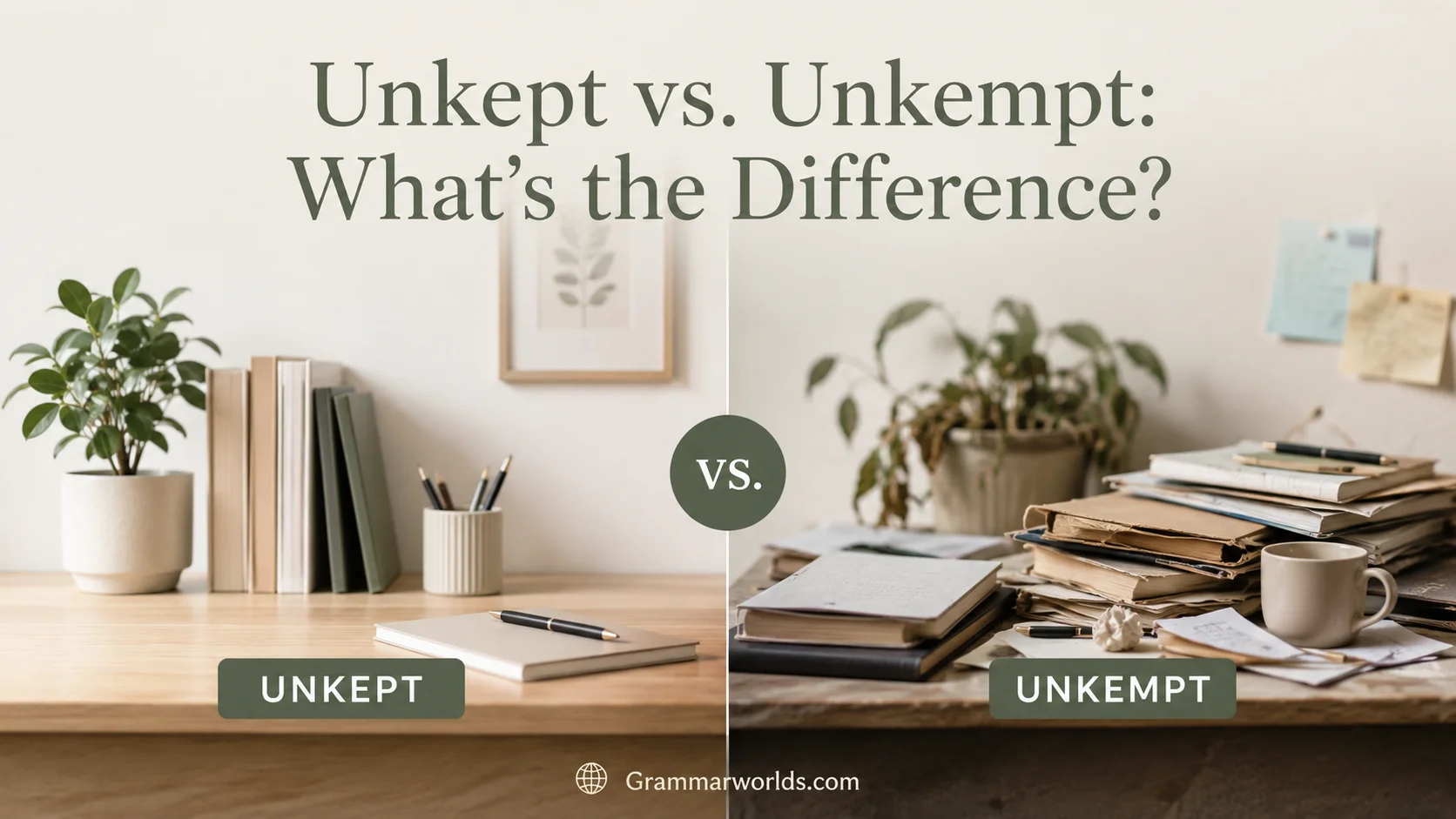
Unkept vs. Unkempt: What’s the Difference? explains confused words with different meanings, usage, and context for better writing clarity today.
These commonly confused words are easy to mix up because of their similarity, but knowing their important differences improves your word choice. Unkempt is an adjective connected with a person’s rough appearance, including a messy, untidy, or disheveled look. Its definition comes from the older term unkembed, meaning uncombed, making it closely linked with grooming and hair through etymologically considered origins.
Unkept describes something neglected or not properly maintained, such as properties, land, garden, and lawn areas. It can also refer to broken promises or a missed commitment. Although Microsoft Word spell check may catches the term, it remains a perfectly good word and a valid term. Understanding context, semantic difference, contextual meaning, and correct usage helps improve writing skills, clarity, and writing accuracy while creating better communication through accurate English terms.
Quick Answer: Unkept vs. Unkempt
If you’re in a hurry, here’s the simplest way to remember the difference.
| Feature | Unkept | Unkempt |
| Is it a real English word? | Yes, but uncommon | Yes |
| Common in modern English? | Rarely | Very common |
| Primary meaning | Not maintained or cared for | Messy, untidy, disheveled |
| Used for people? | Rarely | Frequently |
| Used for appearance? | Usually no | Yes |
| Used for places? | Occasionally | Frequently |
| Recommended for everyday writing? | Usually not | Yes |
Quick Rule: If you’re describing someone’s hair, clothes, beard, or overall appearance, unkempt is almost always the correct choice.
What Does “Unkempt” Mean?
The adjective unkempt describes someone or something that appears untidy, disheveled, or poorly groomed. It usually refers to visible appearance rather than maintenance.
Someone with tangled hair, wrinkled clothes, or a scruffy beard might look unkempt. Likewise, a lawn overrun with weeds or a neglected garden may also appear unkempt because of its messy condition.
Unlike many English words, unkempt has a fascinating history. It comes from the older adjective kempt, meaning well-combed or neatly arranged. While kempt still exists, modern speakers rarely use it outside expressions like well-kempt.
As a result, unkempt has become far more common than its positive counterpart.
Common situations where “unkempt” fits naturally
- Hair that hasn’t been brushed
- A beard that hasn’t been trimmed
- Wrinkled or dirty clothing
- A messy appearance
- Overgrown gardens
- Lawns filled with weeds
- Bushes that haven’t been pruned
Examples
✅ His unkempt hair suggested he had just woken up.
✅ The abandoned cottage sat behind an unkempt garden.
✅ After hiking for three days, everyone looked slightly unkempt.
Notice that each example focuses on appearance, not necessarily on whether someone intentionally neglected maintenance.
What Does “Unkept” Mean?
Unlike unkempt, the word unkept centers on maintenance rather than appearance.
It describes something that has not been kept in good condition, not maintained, or left uncared for.
Although dictionaries recognize the word, it appears far less frequently in modern English. Many writers naturally choose alternatives such as:
- neglected
- abandoned
- deteriorating
- poorly maintained
- uncared-for
Those alternatives often sound smoother and more precise.
Examples of “unkept”
✅ The cabin remained unkept for decades.
✅ Several unkept properties lowered neighborhood home values.
✅ The cemetery looked unkept after years without regular maintenance.
These examples describe maintenance rather than someone’s physical appearance.
Why Do People Confuse Unkept and Unkempt?
The confusion isn’t surprising. Several factors make these words look almost interchangeable.
Similar spelling
Only two letters separate them:
- unkept
- unkempt
When spoken quickly, they also sound somewhat alike.
Shared idea of neglect
Both words suggest that something isn’t in ideal condition.
For example:
- messy hair
- neglected lawn
- abandoned property
Because both imply disorder, many people assume they mean exactly the same thing.
The word “kept”
Most English speakers recognize the adjective kept from expressions like:
- well-kept garden
- well-kept home
- well-kept appearance
It’s easy to assume that adding un- creates the opposite:
- kept → unkept
While that logic feels natural, English doesn’t always follow predictable patterns.
Spellcheck doesn’t always help
Many writing programs accept unkept because it is technically a valid word. That doesn’t mean it’s the best choice.
Professional editors often replace unkept with unkempt whenever the subject is someone’s appearance.
Which Word Should You Use?
The easiest way to decide is to ask one simple question:
Am I describing appearance or maintenance?
If the answer is appearance, choose unkempt.
If the answer is maintenance, unkept may fit, although another adjective often works even better.
When describing a person
Use unkempt.
Examples include:
- unkempt hair
- unkempt beard
- unkempt clothes
- unkempt appearance
Correct
- She arrived with unkempt hair after the long flight.
- His unkempt beard made him look older.
Incorrect
- She arrived with unkept hair.
That sentence sounds unnatural to most native speakers.
When describing a yard or garden
Either word can occasionally work, but unkempt is much more common because readers focus on what they see.
Examples
✅ an unkempt garden
✅ an unkempt lawn
Possible but uncommon
✅ an unkept property
The second emphasizes maintenance, while the first emphasizes appearance.
When describing buildings
Context matters.
Consider these examples:
- an abandoned farmhouse
- a neglected warehouse
- an unkempt courtyard
- an unkept estate
If you’re talking about weeds, broken fences, or overgrown surroundings, unkempt often sounds more natural.
If you’re emphasizing years without maintenance, unkept can work.
When discussing promises or responsibilities
Neither adjective is ideal.
Instead, write:
- broken promise
- promise not kept
- neglected duties
- unfinished work
For example:
❌ an unkept promise
While understandable, many editors prefer:
✅ a broken promise
or
✅ a promise that wasn’t kept
Those alternatives read more naturally.
Unkept vs. Unkempt: Side-by-Side Comparison
| Situation | Best Choice | Reason |
| Hair | Unkempt | Standard English usage |
| Beard | Unkempt | Refers to appearance |
| Clothing | Unkempt | Describes grooming |
| Garden | Unkempt | Focuses on visual disorder |
| Lawn | Unkempt | Common expression |
| Property | Either | Depends on whether appearance or maintenance is emphasized |
| Building | Context-dependent | Appearance vs. maintenance |
| Promise | Neither | Use “broken” instead |
| Duties | Neither | Use “neglected” or “unfinished” |
Is “Unkept” Grammatically Correct?
Yes.
Contrary to a common myth, unkept is grammatically correct. The issue isn’t grammar—it’s usage.
English contains many words that are technically correct but uncommon. Native speakers simply prefer alternatives that sound more natural.
That’s exactly what happens here.
Modern English overwhelmingly favors unkempt when describing appearance.
Professional writing, journalism, fiction, academic publications, and everyday conversation all reflect this preference.
That doesn’t make unkept wrong. It simply makes it rare.
Think of it this way.
Imagine two roads leading to the same destination.
One is a wide highway.
The other is a narrow trail that few travelers use.
Both roads exist. One simply makes more sense for most journeys.
That’s the relationship between unkempt and unkept in modern English.
Is “Unkept” an Actual Word?
Yes. Unkept is a real English word, even though many people believe it’s a mistake.
The confusion comes from frequency. Most English speakers rarely encounter unkept, so it can look incorrect at first glance. Major dictionaries recognize the word, but they also show that it appears far less often than unkempt in modern writing.
In practice, editors and experienced writers usually reach for more familiar alternatives unless they specifically want to emphasize that something hasn’t been maintained.
Why is “unkept” so uncommon?
Language changes over time. Some words become more popular while others gradually fade into the background.
Several factors explain why unkempt became the preferred choice.
- It has a long history describing personal appearance.
- Readers recognize it instantly.
- It sounds natural in everyday conversation.
- It appears much more frequently in books, newspapers, and magazines.
Meanwhile, unkept competes with stronger alternatives such as:
- neglected
- abandoned
- deteriorating
- poorly maintained
- uncared-for
Because these words often express the idea more precisely, writers rarely need unkept.
Writing Tip: If you’re unsure which word to choose, unkempt is almost always the safer option when describing how someone or something looks.
Examples of Correct Usage
Seeing words in context makes the distinction much easier to remember.
Correct use of “unkempt”
These examples describe appearance.
- The professor arrived with unkempt hair after cycling through the rain.
- An unkempt beard gave him a rugged appearance.
- The actor’s unkempt clothes suited the role perfectly.
- The abandoned cottage sat behind an unkempt hedge.
- Several unkempt flower beds surrounded the old church.
In every sentence, the focus is on what people see.
Correct use of “unkept”
These examples emphasize maintenance.
- The unkept property quickly became overgrown.
- Years of neglect left the cemetery unkept.
- The trail passed several unkept buildings that had fallen into disrepair.
- Without regular repairs, the playground looked increasingly unkept.
Here, the emphasis falls on a lack of care rather than an untidy appearance alone.
Incorrect examples
Many mistakes happen because writers substitute one word for the other.
| Incorrect | Correct | Why |
| He looked unkept after the game. | He looked unkempt after the game. | Appearance requires unkempt. |
| She wore an unkept hairstyle. | She wore an unkempt hairstyle. | Hair is described as unkempt. |
| The unkempt bridge hadn’t been repaired in years. | The unkept or poorly maintained bridge hadn’t been repaired in years. | Maintenance is the key idea. |
| The company made an unkept promise. | The company made a broken promise. | A more natural expression. |
Also Read This : Taught vs Tought: What’s The Correct Spelling?
Common Mistakes to Avoid
Even experienced writers occasionally mix these words up. Avoid these common errors to keep your writing polished.
Using “unkept” for someone’s appearance
This is by far the most frequent mistake.
Incorrect
She looked unkept.
Correct
She looked unkempt.
Whenever you’re talking about hair, clothing, grooming, or general appearance, unkempt is the right choice.
Assuming the words are interchangeable
Although both words relate to neglect, they don’t always fit the same situations.
Think about these examples:
- unkempt child
- unkempt lawn
- unkept building
Each conveys a slightly different meaning.
Believing “unkept” is simply the opposite of “kept”
English doesn’t always form opposites by adding un-.
For example:
| Common Word | Opposite |
| happy | unhappy |
| fair | unfair |
| known | unknown |
That pattern doesn’t always apply.
Although kept and unkept exist, English speakers overwhelmingly favor well-kept and unkempt instead.
That’s simply how the language evolved.
Choosing rare words over natural ones
Good writing isn’t about using unusual vocabulary.
It’s about choosing the word readers expect.
Compare these examples.
Less natural
The traveler appeared unkept.
More natural
The traveler appeared unkempt.
The second sentence sounds smoother because it’s the expression native speakers use most often.
Synonyms for “Unkempt”
Sometimes another word communicates your meaning even better.
Here’s a comparison.
| Word | Meaning | Best Used For |
| Messy | Informal untidiness | Everyday conversation |
| Untidy | Not neat | Homes, rooms, clothing |
| Disheveled | Hair or clothing in disorder | Formal writing |
| Scruffy | Rough, dirty appearance | Casual descriptions |
| Shaggy | Long or overgrown hair | Hair, fur, beards |
| Disorderly | Lacking organization | Formal contexts |
| Slovenly | Habitually untidy | Literary writing |
| Neglected | Poorly cared for | People, places, objects |
Choosing the right synonym
Although these words overlap, they aren’t identical.
For example:
- Messy suggests temporary disorder.
- Disheveled often follows travel, wind, or physical activity.
- Scruffy implies roughness or a lack of grooming.
- Unkempt emphasizes an overall untidy appearance.
Each carries a slightly different tone.
Synonyms for “Unkept”
Because unkept focuses on maintenance, these alternatives often work better.
| Alternative | Typical Context |
| Neglected | Buildings, gardens, property |
| Poorly maintained | Roads, parks, facilities |
| Abandoned | Houses, factories, land |
| Uncared-for | Animals, homes, gardens |
| Run-down | Neighborhoods, buildings |
| Deteriorating | Structures, infrastructure |
| Overgrown | Gardens, yards, trails |
These words usually provide greater precision than unkept, making your writing stronger and easier to understand.
Example
Instead of writing “an unkept playground,” consider “a neglected playground” or “a poorly maintained playground.” The revised version paints a clearer picture for the reader.
Why Context Matters More Than the Dictionary
One of the biggest lessons in English grammar is that dictionary definitions tell only part of the story.
A dictionary can confirm that a word exists, but it doesn’t reveal how often native speakers actually use it.
Consider the following sentences.
The businessman entered the meeting looking unkempt.
Most readers find this completely natural.
Now compare it with this version.
The businessman entered the meeting looking unkept.
Although the sentence isn’t technically impossible, it feels awkward because native speakers almost never describe people this way.
This difference highlights an important principle:
Correct grammar doesn’t always produce natural English.
Professional writers pay attention to both.
A Simple Memory Trick
If you struggle to remember which word to use, this quick trick can help.
Think of a comb
The word kempt originally referred to hair that had been combed.
So:
- kempt = neatly combed
- unkempt = not neatly combed
That makes it easy to associate unkempt with appearance.
Think of maintenance
When you hear unkept, imagine something that wasn’t kept up.
For example:
- an unkept fence
- an unkept property
- an unkept cemetery
The focus shifts from appearance to ongoing care.
A simple mental image often works better than memorizing dictionary definitions.
FAQs
What is the main difference between Unkept and Unkempt?
The main difference between Unkept and Unkempt is their usage. Unkempt usually describes a person’s messy or untidy appearance, especially disordered hair or poor grooming. Unkept refers to something neglected, such as a property, promise, garden, or area that is not properly maintained.
Is Unkept a correct English word?
Yes, Unkept is a correct and valid English word. Although some spell check tools may flag it, the word is widely accepted. It means something that has not been maintained, cared for, or fulfilled, such as an unkept promise or an unkept property.
Why are Unkempt and Unkept commonly confused?
Unkempt and Unkept are commonly confused words because of their similar spelling and pronunciation. Both words relate to something neglected, but their contextual meaning is different. Learning their proper usage helps improve writing accuracy and communication.
Can Unkempt be used for lawns and gardens?
Yes, Unkempt can sometimes describe lawns, gardens, and hedges that look messy or poorly maintained. However, its traditional meaning is more connected with a person’s appearance, especially hair and grooming.
How can I remember the difference between Unkept and Unkempt?
A simple way to remember is that Unkempt contains “kempt,” which relates to being neat, tidy, and groomed, especially hair. Unkept focuses more on things that are not kept, maintained, or fulfilled, such as properties and promises.
Conclusion
Understanding Unkept vs. Unkempt: What’s the Difference? helps you choose the right word in different situations. While both words describe something neglected, Unkempt mainly focuses on appearance, grooming, and untidiness, whereas Unkept relates to things that are not maintained, cared for, or completed. By paying attention to context, meaning, and correct usage, you can avoid confusion and improve your English writing skills. These small differences in vocabulary create clearer communication and more accurate sentences.