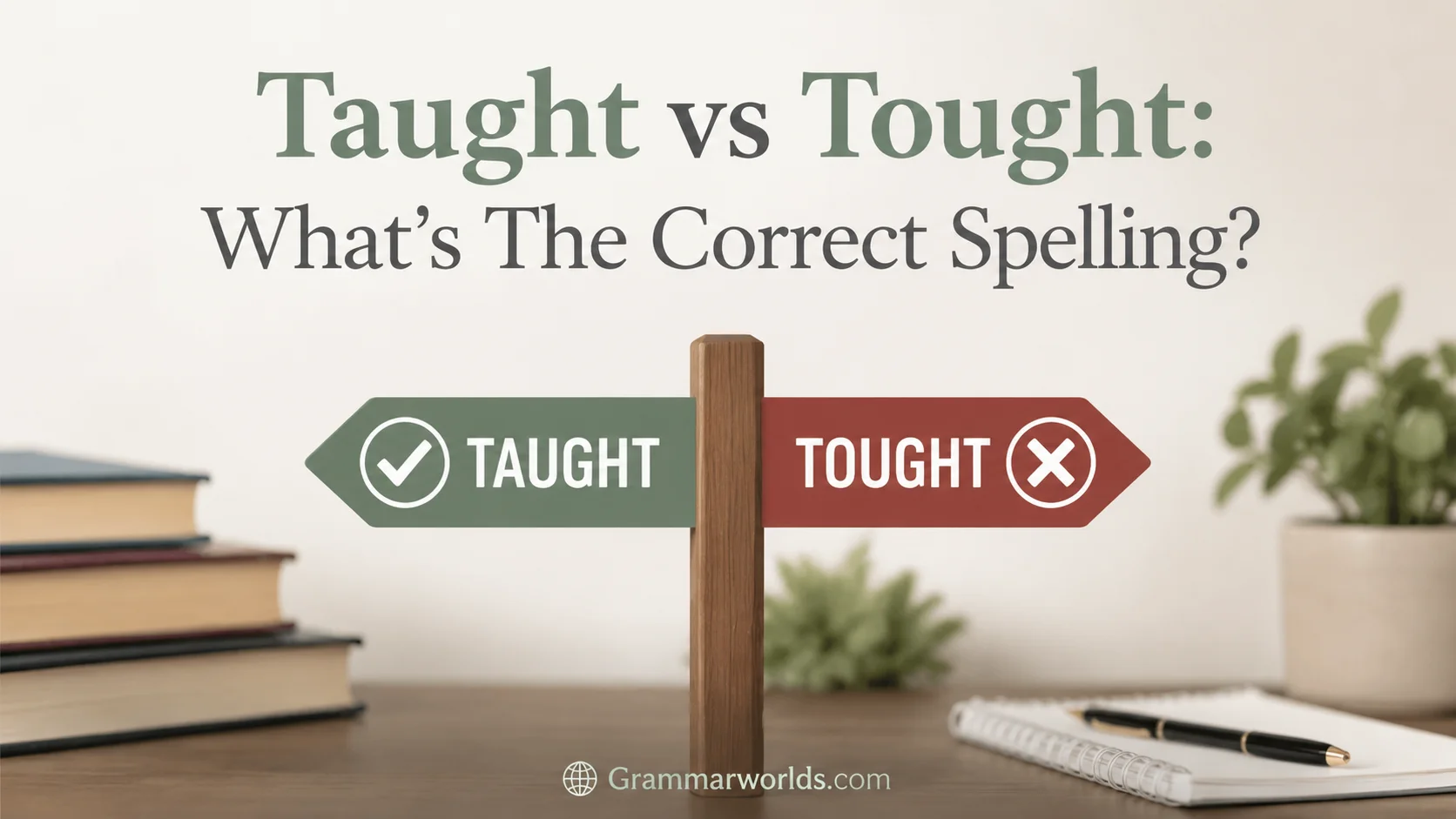
Understanding Taught vs Tought: What’s The Correct Spelling? helps English learners avoid confusion because similar words create writing mistakes. Many English learners become confused when Taught and Tought have a similar look, but only one word has the correct spelling in standard English. At first glance, the incorrect form may seem possible because people often speak quickly during conversation and conversations. This can lead to mistakes in typing, written work, and writing.
Through language learning, understanding grammar, English grammar, vocabulary, word choice, and proper usage can help prevent this common misspelling. Taught is the past tense and verb form of teach, meaning to instruct, explain, or give information through teaching. A teacher may have taught a student a lesson like algebra by showing and explaining knowledge through education and instruction.
The incorrect Tought is a commonly confused word that can be mixed with Thought or Taut. Thought works as a noun for an idea or opinion created in the mind, and it can also connect with the verb form of think when forming ideas.
Taught vs Tought: The Quick Difference
Before exploring the details, here is the simple answer:
| Word | Correct or Incorrect? | Meaning | Example |
| Taught | ✅ Correct | Past tense of “teach” | “She taught me Spanish.” |
| Tought | ❌ Incorrect | Common spelling mistake | “She tought me Spanish.” |
The correct spelling is always:
Teach → Taught
Never:
Teach → Tought
The word tought does not function as a standard English word. If you see it in writing, it usually means the writer intended to write.
What Does Taught Mean?
The word taught comes from the verb teach, which means to help someone gain knowledge, understand an idea, or develop a skill.
When you use taught, you are talking about something that happened in the past.
The basic structure is:
Subject + taught + person + information/skill
Examples:
- “My mother taught me how to cook.”
- “The coach taught the players new strategies.”
- “The training course taught employees valuable skills.”
In each sentence, someone provides knowledge or guidance.
The Three Forms of Teach
English verbs often have different forms depending on the tense. The verb teach is irregular, which means it does not simply add “-ed” to become past tense.
| Tense | Verb Form | Example |
| Present | Teach | “I teach mathematics.” |
| Past | Taught | “I taught mathematics yesterday.” |
| Past participle | Taught | “I have taught mathematics for years.” |
Notice that both the past tense and past participle use the same word: taught.
Why Is Thought Incorrect?
The biggest question people ask is:
“Is tought a word?”
In standard English, the answer is no.
The spelling tought is usually an accidental combination of familiar patterns from other English words.
Many people write it because they know words like:
- Thought
- Bought
- Brought
- Fought
These words contain similar letter patterns, so the brain naturally tries to create a connection.
However, English spelling does not always work through patterns alone.
For example:
- Thought means an idea or opinion.
- Bought means purchased.
- Brought means carried something somewhere.
- Taught means helped someone learn.
They may look similar, but they belong to different verbs.
Incorrect Examples
❌ “My uncle tought me fishing.”
Correct:
✅ “My uncle taught me fishing.”
❌ “The teacher tought us grammar rules.”
Correct:
✅ “The teacher taught us grammar rules.”
❌ “She tought herself how to play guitar.”
Correct:
✅ “She taught herself how to play guitar.”
Why Do People Confuse Taught and Taught?
The mistake happens for several understandable reasons. English has many irregular spelling patterns, and taught is not pronounced exactly as many learners expect.
1. Similar-Looking Words Create Confusion
The English language contains many words with the -ought and -aught patterns.
Examples:
| Word | Meaning |
| Thought | An idea or belief |
| Bought | Purchased something |
| Brought | Took something somewhere |
| Fought | Participated in a battle |
| Taught | Helped someone learn |
Because these words look alike, writers sometimes replace aught with ought.
However, the correct spelling is:
T-A-U-G-H-T
Not:
T-O-U-G-H-T
2. English Has Many Irregular Verbs
One reason English can feel difficult is that many common verbs change completely in the past tense.
Regular verbs:
- Walk → Walked
- Talk → Talked
- Play → Played
Irregular verbs:
- Teach → Taught
- Buy → Bought
- Catch → Caught
- Bring → Brought
A learner might logically think:
“If I add letters to make teach past tense, maybe it becomes teached or tought.”
But English does not always follow logical rules. Sometimes you simply have to remember the correct form.
Taught vs Teached: Another Common Mistake
Many people confuse taught with teached.
The incorrect version:
❌ “She teached me English.”
The correct version:
✅ “She taught me English.”
Why?
Because teach is an irregular verb.
Regular verbs use “-ed”:
- Learn → Learned
- Explain → Explained
- Help → Helped
But irregular verbs change differently:
- Teach → Taught
- Go → Went
- Write → Wrote
- Take → Took
A helpful way to remember this:
A teacher teaches today, but a teacher taught yesterday.
How to Remember the Correct Spelling of Taught
Spelling mistakes become easier to avoid when you create a simple mental connection.
Here are some useful tricks.
Memory Trick 1: Remember “Teacher Taught”
The phrase “teacher taught” appears naturally in English.
Examples:
- “My teacher taught me science.”
- “The teacher taught the class.”
The two words belong together, making the spelling easier to remember.
Memory Trick 2: Connect Teach With Taught
Think of this pattern:
Teach → Taught
The ending changes:
- teach ends with -ch
- taught uses -ght
Similar examples:
- catch → caught
This connection helps you remember that the past tense changes completely.
Memory Trick 3: Focus on “AU”
The correct spelling contains:
TAUGHT
The middle letters are:
AU
Not:
OU
A simple reminder:
You learn with a teacher who taught you, not tought you.
Real-Life Examples of Using Taught Correctly
The word taught appears in many everyday situations.
Education
- “The professor taught the students advanced mathematics.”
- “My English teacher taught me pronunciation.”
Family
- “My grandfather taught me how to repair bicycles.”
- “My parents taught me important life lessons.”
Work
- “The manager taught new employees how to use the software.”
- “The training program taught workers new safety procedures.”
Personal Skills
- “My friend taught me how to play chess.”
- “She taught herself a new language.”
Taught in Different Sentence Structures
The word taught can appear in several types of sentences.
Understanding these structures helps you use it naturally.
Simple Past Tense
The simple past describes something completed in the past.
Structure:
Subject + taught + object
Examples:
- “The coach taught the team new techniques.”
- “She taught her brother how to swim.”
- “I taught my friend how to use the program.”
Present Perfect Tense
The present perfect connects past actions with the present.
Structure:
Subject + has/have + taught + object
Examples:
- “She has taught English for ten years.”
- “They have taught thousands of students.”
- “I have taught several online courses.”
Passive Voice With Taught
Sometimes the focus is on the person receiving knowledge instead of the person teaching.
Examples:
- “I was taught how to read by my parents.”
- “The students were taught important safety rules.”
- “She was taught valuable lessons from experience.”
Although active voice is often clearer, passive voice works well when the teacher is unknown or less important.
Taught Synonyms and Alternative Words
The word taught is common and useful, but English offers several alternatives depending on the situation. These words may seem similar, yet each one carries a slightly different meaning.
Choosing the right word makes your writing more precise.
| Word | Meaning | Example |
| Taught | Helped someone learn knowledge or skills | “My father taught me how to cook.” |
| Educated | Provided broader knowledge, often through formal learning | “The program educated students about climate change.” |
| Trained | Developed a specific ability through practice | “The coach trained the athletes for the competition.” |
| Instructed | Gave directions, explanations, or guidance | “The instructor instructed employees on safety procedures.” |
| Showed | Demonstrated how something works | “She showed me how to use the camera.” |
| Guided | Helped someone by giving advice or direction | “The mentor guided me through my career decisions.” |
Although these words overlap, they are not always interchangeable.
For example:
- “My father taught me how to drive.”
- He helped me learn the skill.
- “My father trained me how to drive.”
- This suggests formal practice or structured instruction.
- “My father showed me how to drive.”
- This suggests he demonstrated the process.
The best word depends on the exact meaning you want to express.
Common Mistakes With Taught vs Tought
The spelling mistake tought is not the only problem people make with this verb. Several other errors appear frequently.
Understanding these mistakes will help you write more accurately.
Mistake 1: Writing Taught Instead of Taught
This is the most common error.
Incorrect:
❌ “My mother tought me how to bake.”
Correct:
✅ “My mother taught me how to bake.”
The solution is simple: remember that teaching changes.
Mistake 2: Using Teached Instead of Taught
Many English learners assume every past-tense verb needs “-ed.”
Incorrect:
❌ “The teacher teached us history.”
Correct:
✅ “The teacher taught us history.”
The verb teach is irregular, so it does not follow the normal pattern.
More examples:
| Incorrect | Correct |
| Teached | Taught |
| Buyed | Bought |
| Goed | Went |
| Catched | Caught |
Mistake 3: Confusing Taught and Thought
Because these words look similar, people often mix them up.
However, they have completely different meanings.
| Word | Meaning | Example |
| Taught | Helped someone learn | “She taught me French.” |
| Thought | Had an idea or opinion | “I thought about the answer.” |
Compare these sentences:
- “My teacher taught me grammar.”
- The teacher gave knowledge.
- “I thought about grammar.”
- I considered the topic.
A teacher can teach something, but a person can think about something.
Mistake 4: Using Taught for Present Actions
Another common issue is using taught when talking about something happening regularly now.
Incorrect:
❌ “I taught English every Monday.”
Correct:
✅ “I teach English every Monday.”
Why?
Because:
- Teach = present or regular action.
- Taught = completed action in the past.
Examples:
Present:
“She teaches math at a local school.”
Past:
“She taught math at a local school last year.”
Also Read This : Shining vs Shining: What’s the Correct Spelling?
The History Behind the Word Taught
The word taught has a long history that explains why its spelling looks unusual.
The English verb teach comes from Old English tǣcan, which meant “to show, point out, or give instruction.”
Over hundreds of years, English changed through influences from:
- Old English
- Old Norse
- French
- Latin
Many common English verbs developed irregular past forms during this period.
Words like:
- Teach → taught
- Bring → brought
- Think → thought
- Buy → bought
kept older spelling patterns instead of changing into simple “-ed” forms.
This is why modern English learners often find these verbs confusing.
The spelling may seem strange today, but it reflects centuries of language development.
Why Learning the Difference Between Taught and Taught Matters
A small spelling mistake can change how professional and reliable your writing appears.
The difference between taught and tought matters in many situations.
Academic Writing
Students often write about lessons, teachers, and learning experiences.
Incorrect:
❌ “My professor tought me valuable research skills.”
Correct:
✅ “My professor taught me valuable research skills.”
A spelling mistake in an essay can distract readers from your ideas.
Professional Communication
Emails, reports, and resumes require accurate language.
Incorrect:
❌ “I was tought leadership skills during my internship.”
Correct:
✅ “I was taught leadership skills during my internship.”
Correct spelling helps create a stronger professional impression.
Everyday Communication
Even casual messages benefit from correct spelling.
Incorrect:
❌ “My grandfather tought me this recipe.”
Correct:
✅ “My grandfather taught me this recipe.”
Small corrections make your writing easier to understand.
Taught vs Taught Examples in Different Contexts
Seeing real examples makes the difference easier to remember.
School Examples
✅ “The teacher taught the students about science.”
✅ “My professor taught me how to analyze data.”
❌ “The teacher tought the students about science.”
Family Examples
✅ “My grandmother taught me traditional recipes.”
✅ “My parents taught me important values.”
❌ “My parents tought me important values.”
Workplace Examples
✅ “The manager taught employees new procedures.”
✅ “The company taught workers how to use the equipment.”
❌ “The company tought workers how to use the equipment.”
Self-Learning Examples
The word taught can also describe learning from yourself.
Examples:
✅ “Experience taught me patience.”
✅ “Failure taught me an important lesson.”
In these sentences, no person directly teaches you. Instead, an event or experience provides knowledge.
A Simple Guide to Using Taught Correctly
When you are unsure whether to use taught or tought, follow these steps.
Step 1: Ask What You Mean
Are you talking about someone giving knowledge?
If yes, you probably need taught.
Example:
“My uncle ___ me how to fish.”
Answer:
“My uncle taught me how to fish.”
Step 2: Check the Verb Form
The original verb is:
Teach
The past form is:
Taught
Not:
- Teached
- Tought
Step 3: Read the Sentence Aloud
Sometimes hearing the sentence helps.
Compare:
❌ “My teacher tought me English.”
The spelling looks wrong.
✅ “My teacher taught me English.”
This sounds natural because it matches the correct verb form.
Taught vs Taught Cheat Sheet
Here is a quick reference you can save:
| Question | Answer |
| Is taught correct? | Yes |
| Is tought correct? | No |
| What is the past tense of teach? | Taught |
| What is the past participle of teach? | Taught |
| Can you say “teached”? | No |
| Can you say “tought”? | No |
| How do you spell it? | T-A-U-G-H-T |
FAQs
Is “tought” a real English word?
No. Thought is not considered a standard English word. It is usually a spelling mistake made when someone means taught.
For example:
❌ “She tought me how to swim.”
✅ “She taught me how to swim.”
Is the past tense of teach?
Yes. Taught is the past tense and past participle form of teach.
The verb forms are:
- Present: teach
- Past: taught
- Past participle: taught
Example:
- “I teach English.”
- “I taught English yesterday.”
- “I have taught English for five years.”
Can I say “I was teached”?
No. The correct phrase is:
✅ “I was taught.”
The verb teach is irregular, so it changes to taught instead of adding “-ed.”
Examples:
Incorrect:
❌ “I was teached by my father.”
Correct:
✅ “I was taught by my father.”
How do you pronounce words?
In American English, taught is usually pronounced like:
“tawt”
It sounds similar to words like:
- bought
- caught
- thought
The pronunciation is different from “toot” or “touched.”
What is the difference between taught and learned?
The difference depends on who is performing the action.
Taught means someone gives knowledge.
Learning means someone receives knowledge.
Example:
“My teacher taught me mathematics, and I learned algebra.”
The teacher provides the information. The student gains the information.
Conclusion
The difference between taught vs tought is simple once you remember one important rule:
The word taught is the past tense of teach. It describes giving knowledge, skills, instructions, or lessons to someone else.
Whether you are writing an essay, sending an email, creating content, or having a conversation, using the correct spelling helps your message look polished and professional.
Once this small spelling difference becomes familiar, you’ll avoid one of the most common English mistakes and write with greater confidence.