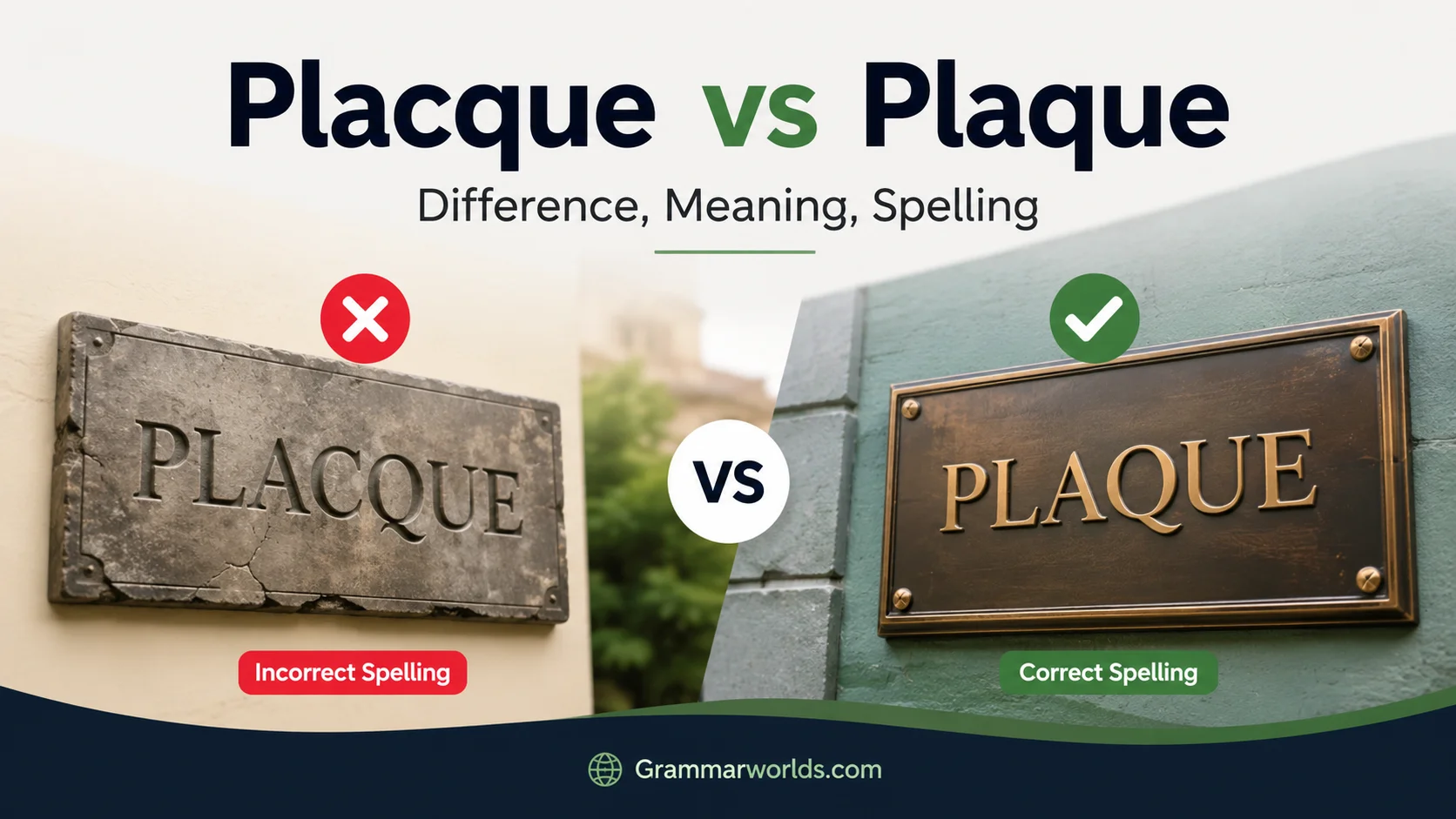
Have you ever stopped while writing and wondered whether the correct spelling is placque or plaque?
You’re not alone. Many English learners, students, writers, and even native speakers occasionally make this mistake. At first glance, both words appear legitimate. After all, English contains countless words with unusual spellings. However, only one of these terms is correct.
The confusion usually arises because plaque has an uncommon letter combination that doesn’t match its pronunciation. As a result, many people instinctively add an extra “c” and write placque, even though that spelling does not exist in standard English.
In this guide, you’ll learn the difference between placque vs plaque, discover the correct spelling, understand the meaning of plaque, see real-world examples, and pick up simple memory tricks that will help you avoid this mistake forever.
Placque vs Plaque: The Quick Difference
If you’re in a hurry, here’s the simple answer.
| Word | Correct Spelling? | Meaning | Usage |
| Placque | ❌ No | Misspelling | Incorrect |
| Plaque | ✅ Yes | A flat sign, dental buildup, or medical deposit | Correct |
Key takeaway: The only correct English spelling is plaque.
Whenever you see placque, treat it as a spelling error.
What Does Plaque Mean?
The word plaque has several meanings depending on the context. Although the spelling stays the same, the definition changes slightly in different fields.
Definition of Plaque
A plaque is generally a flat object, layer, or deposit.
The word originates from French and eventually entered English usage. Today, it appears frequently in healthcare, dentistry, architecture, education, and history.
Common Meanings of Plaque
Let’s explore the three most common uses.
Commemorative Plaque
A commemorative plaque is a flat plate made from metal, stone, wood, or another durable material.
Organizations often install plaques to honor people, events, achievements, or historical locations.
Examples include:
- Memorial plaques
- Historical markers
- Award plaques
- Building dedication plaques
- Recognition plaques
Examples
- The city unveiled a plaque honoring local veterans.
- A bronze plaque marked the birthplace of the famous inventor.
- She received a plaque for twenty years of community service.
Many schools, universities, museums, and government buildings display commemorative plaques.
Think of them as permanent reminders of important moments in history.
Dental Plaque
When dentists mention plaque, they mean something entirely different.
Dental plaque is a sticky film of bacteria that forms on teeth.
After eating, bacteria in the mouth feed on sugars and starches. These bacteria create acids and biofilms that stick to tooth surfaces.
If plaque remains on teeth for long periods, it can cause:
- Cavities
- Tooth decay
- Bad breath
- Gum disease
- Tooth loss
Examples
- Brushing twice daily helps remove plaque.
- Dentists recommend flossing to reduce plaque buildup.
- Excess plaque can irritate the gums.
Interesting Fact
Dental plaque begins forming only a few hours after cleaning your teeth. That’s one reason dentists encourage consistent oral hygiene.
Medical Plaque
In medicine, plaque often refers to fatty deposits that accumulate inside arteries.
Doctors call this condition atherosclerotic plaque.
Over time, these deposits can narrow blood vessels and reduce blood flow.
This process increases the risk of:
- Heart attacks
- Stroke
- Cardiovascular disease
- High blood pressure complications
Examples
- The scan revealed plaque buildup in the patient’s arteries.
- Lifestyle changes may help reduce plaque accumulation.
Although medical plaque and dental plaque share a name, they are entirely different substances.
Is Placque a Real Word?
No.
Placque is not a recognized English word.
You won’t find it in standard dictionaries because it is simply a misspelling of plaque.
Why People Write Placque
Several factors contribute to this mistake.
Unusual Spelling Pattern
The ending “-que” feels unusual to many English speakers.
People often attempt to make the spelling appear more logical by inserting an extra “c.”
Pronunciation Confusion
Since plaque sounds like “plak,” many writers assume an extra letter belongs in the middle.
Typing Errors
Fast typing frequently produces accidental spellings.
Limited Exposure
Many people hear the word more often than they see it written.
As a result, they guess the spelling and end up writing “placque.”
Dictionary Verification
Major English dictionaries recognize plaque but not placque.
Examples include:
- Merriam-Webster
- Cambridge Dictionary
- Oxford English Dictionary
- Collins Dictionary
- Dictionary.com
If a spell checker highlights “placque” as incorrect, it is doing exactly what it should.
Why Plaque Is Difficult to Spell
English contains many words that don’t follow predictable spelling rules.
Plaque is one of them.
Silent Letters Create Confusion
The ending “-que” comes from French influence.
Although the spelling appears complex, the pronunciation remains simple.
Plaque → sounds like “plak.”
The letters “ue” are not pronounced separately.
That mismatch between spelling and sound causes confusion.
Similar Words With -Que Endings
English contains several words with similar patterns.
| Word | Pronunciation |
| Plaque | Plak |
| Antique | An-teek |
| Unique | Yoo-neek |
| Mosque | Mosk |
| Opaque | Oh-payk |
These words show how English often preserves historical spellings even when pronunciation changes.
Memory Trick for Plaque
A simple trick can help.
The Antique Connection
Both words end with -que.
- Antique
- Plaque
If you can spell antique correctly, you can remember plaque.
The Award Plaque Method
Imagine a shiny award plaque hanging on a wall.
The word itself looks elegant because it ends with the sophisticated French-style “-que.”
No extra “c” belongs there.
Visual Memory Trick
Picture this:
Plaque = Plate + Unique
The ending resembles unique.
Therefore:
Plaque = Correct
Placque = Incorrect
Plaque Pronunciation Guide
Many spelling mistakes originate from pronunciation uncertainty.
Fortunately, plaque is easy to pronounce.
Standard Pronunciation
Plaque
Phonetic spelling:
plak
IPA:
/plæk/
Pronunciation Examples
- Plaque on a building
- Dental plaque
- Arterial plaque
In all cases, the pronunciation remains identical.
Also Read This :Cheer vs Chear: What’s the Difference?
Common Pronunciation Mistakes
Some learners incorrectly say:
- Pla-kwee
- Pla-koo
- Pla-kway
These pronunciations are incorrect.
The correct pronunciation contains only one syllable.
Plaque in Sentences
Seeing a word in context helps reinforce proper usage.
Everyday Examples
- The museum displayed a plaque describing the artifact.
- A plaque commemorated the town’s founding.
- The company awarded him a plaque for excellence.
Healthcare Examples
- Plaque buildup can damage tooth enamel.
- Regular brushing helps remove plaque.
- Dentists monitor plaque accumulation carefully.
Medical Examples
- Doctors discovered plaque in the patient’s arteries.
- Healthy habits may slow plaque formation.
- Researchers continue studying arterial plaque development.
Academic Examples
- The historical plaque contained detailed information.
- Students examined the plaque during the field trip.
- The university unveiled a plaque honoring its founder.
Placque vs Plaque: Side-by-Side Comparison
The easiest way to remember the difference is through direct comparison.
| Feature | Placque | Plaque |
| Valid English Word | ❌ | ✅ |
| Dictionary Entry | ❌ | ✅ |
| Accepted in Formal Writing | ❌ | ✅ |
| Used in Healthcare | ❌ | ✅ |
| Used in History | ❌ | ✅ |
| Correct Spelling | ❌ | ✅ |
Whenever you’re unsure, choose plaque.
Common Mistakes People Make
Spelling confusion often follows predictable patterns.
Understanding those patterns helps prevent future mistakes.
Misspelling Plaque as Placque
This remains the most common error.
Incorrect:
❌ The dentist removed placque from my teeth.
Correct:
✅ The dentist removed plaque from my teeth.
Confusing Plaque With Plague
These words differ significantly.
One refers to deposits or markers.
The other refers to disease.
Incorrect usage can completely change a sentence’s meaning.
Trusting Autocorrect Too Much
Spell-check tools are helpful.
However, they occasionally miss context-related errors.
Always review important documents manually.
Words Commonly Confused With Plaque
Several similar-looking words create confusion.
Let’s clear them up.
Plaque vs Plague
This pair causes frequent mistakes.
| Word | Meaning |
| Plaque | Deposit or commemorative marker |
| Plague | Deadly disease or widespread problem |
Examples
- The dentist removed plaque.
- The plague devastated medieval Europe.
One missing letter creates a completely different meaning.
Plaque vs Plate
A plaque can resemble a plate physically.
However, the meanings differ.
| Plaque | Plate |
| Marker or deposit | Dish or flat object |
| Often commemorative | Usually functional |
Example
- A plaque honored the scientist.
- The meal arrived on a plate.
Plaque vs Plaid
These words sound somewhat similar to some learners.
Their meanings are unrelated.
| Word | Meaning |
| Plaque | Marker or deposit |
| Plaid | Patterned fabric design |
Examples
- The plaque hung on the wall.
- He wore a plaid shirt.
How to Remember the Correct Spelling
Memory techniques make spelling easier.
Use Word Associations
Associate plaque with:
- Unique
- Antique
- Opaque
All share similar endings.
Remember Professional Contexts
Think of:
- Award plaques
- Historical plaques
- Dental plaque
You’ll likely encounter the correct spelling repeatedly.
Use the Sentence Method
Repeat:
“The plaque on the wall looked unique.”
The shared ending helps reinforce spelling.
When Should You Use Plaque?
Plaque appears across many fields.
Understanding those situations improves writing accuracy.
Plaque in Healthcare Writing
Healthcare professionals frequently discuss plaque.
Examples include:
- Dental plaque
- Arterial plaque
- Plaque accumulation
- Plaque prevention
Medical journals and patient education materials use this term regularly.
Plaque in Dentistry
Dentists use the word daily.
Common phrases include:
- Plaque control
- Plaque removal
- Plaque buildup
- Plaque prevention
Because oral health affects overall health, understanding this term is useful for everyone.
Plaque in History and Memorials
Historical organizations install plaques to preserve important stories.
Examples include:
- War memorial plaques
- Historic site plaques
- Building dedication plaques
- Cultural heritage plaques
These markers provide valuable information for future generations.
Plaque in Awards and Recognition
Businesses, schools, and organizations frequently award plaques.
Common examples:
- Employee recognition plaques
- Sports achievement plaques
- Leadership awards
- Retirement plaques
A plaque often symbolizes lasting appreciation.
Quick Quiz: Test Your Understanding
Choose the correct word.
Question 1
The dentist removed _____ from my teeth.
A. Placque
B. Plaque
Question 2
The city installed a bronze _____ downtown.
A. Plaque
B. Placque
Question 3
_____ buildup may contribute to cavities.
A. Placque
B. Plaque
Question 4
The museum displayed a historical _____.
A. Plaque
B. Placque
Question 5
The employee received an achievement _____.
A. Placque
B. Plaque
Answer Key
- B — Plaque
- A — Plaque
- B — Plaque
- A — Plaque
- B — Plaque
If you selected plaque every time, you got a perfect score.
FAQs
Is Placque Ever Correct?
Placque is not a standard English word. It is considered a misspelling of plaque.
What Does Plaque Mean in Dentistry?
In dentistry, plaque refers to a sticky bacterial film that forms on teeth and gums. If not removed, it can lead to cavities and gum disease.
What Is a Memorial Plaque?
A memorial plaque is a permanent marker that honors a person, event, or achievement. These plaques often appear in public buildings, parks, schools, and historical sites.
Why Do People Spell Plaque as Placque?
Most people misspell plaque because the word contains an uncommon French-style ending. The pronunciation does not clearly reveal the correct spelling, which leads many writers to add an unnecessary extra “c.”
Is Plaque a Noun or an Adjective?
Plaque is a noun. It refers to a flat commemorative sign, a bacterial film that forms on teeth, or a buildup of substances in the body’s arteries. It does not function as an adjective in standard English usage.
Conclusion
The debate over placque vs plaque has a simple answer: plaque is the only correct spelling in English. Whether you’re referring to a commemorative plaque on a building, dental plaque on teeth, or plaque buildup in arteries, the word is always spelled plaque.The confusion usually happens because plaque has an unusual French-derived spelling that doesn’t match its pronunciation perfectly. As a result, many people mistakenly write placque, even though no major English dictionary recognizes it as a valid word.