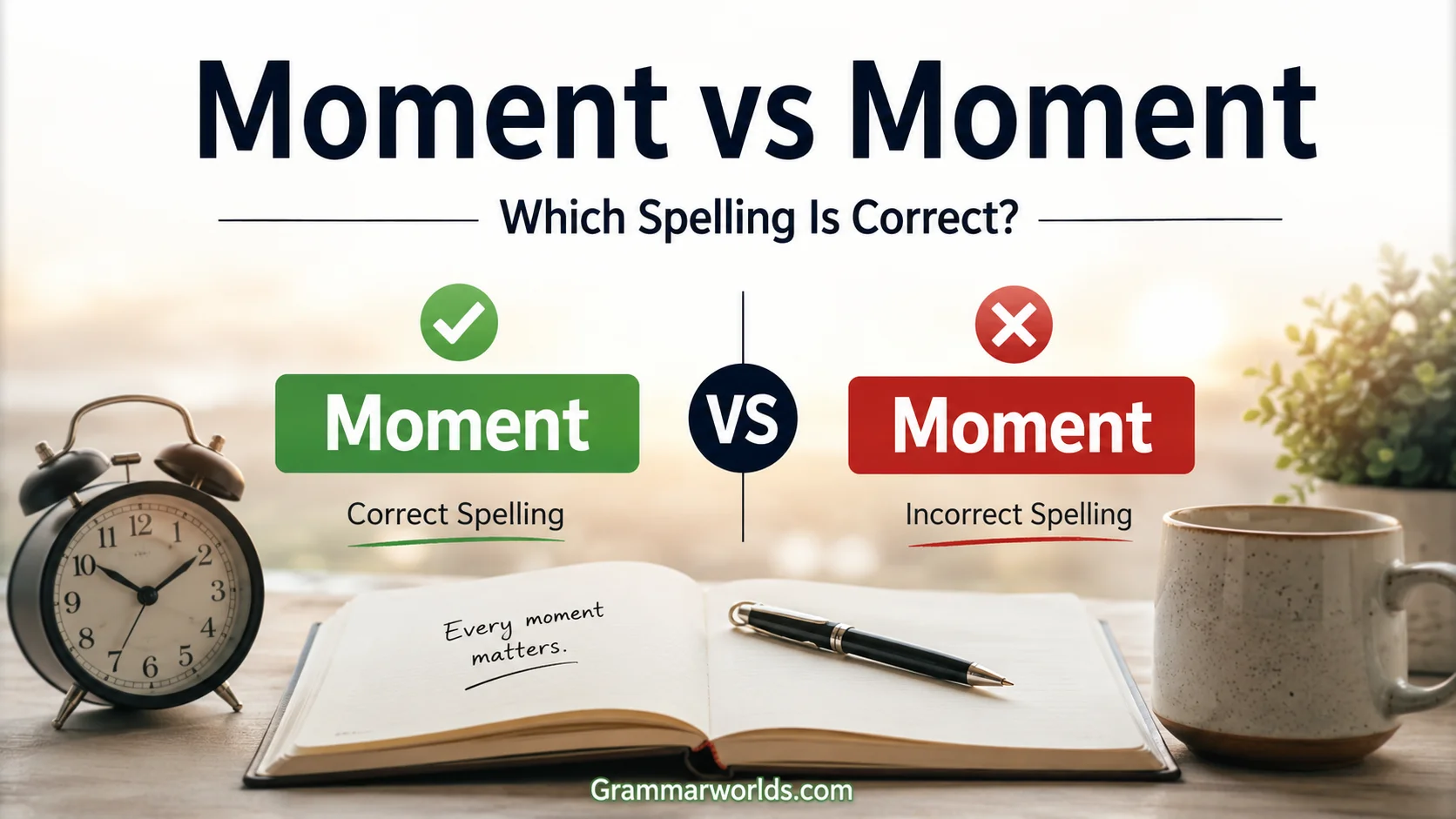
The topic Moment vs Moment Which Spelling Is Correct? explains why moment is correct and momment is a common spelling mistake in English today. Many students, professionals, content writers, learners, and texters have typed momment and wondered if this spelling is acceptable. The correct word is moment, while momment is a misspelling that is not a recognized standard English word.
This common mistake happens because moment is often pronounced quickly, making some people think it has two m letters. A spellcheck tool usually catches the error, but it may not explain the reason behind the wrong form. This guide helps you learn the origin, meaning, and difference between these forms through everyday examples and practical tips to remember the correct form every time.
The mix up between moment and momment can happen when a keyboard goes rogue, fast fingers become betrayed, or a tiny typo creates chaos in communication. This confusing spelling pattern appears because English has many words with double consonants and double letters, including comment, summer, commitment, and accommodation. People sometimes add an extra m to moment, even though it does not belong.
Moment vs. Momment: Quick Answer
Before exploring the details, here is the simple comparison:
| Word | Correct Spelling | Meaning | Usage |
| Moment | ✅ Correct | A short period of time, a specific point in time, or an important occasion | Used in everyday and formal English |
| Momment | ❌ Incorrect | No standard English meaning | Considered a spelling mistake |
The correct word is always:
✅ Moment
Not:
❌ Momment
Examples:
- Correct: Please wait a moment.
- Incorrect: Please wait a momment.
- Correct: It was a memorable moment.
- Incorrect: It was a memorable momment.
What Is the Correct Spelling: Moment or Momment?
The correct spelling is moment.
The word contains:
M + O + M + E + N + T
It has:
- One m at the beginning
- One m before “ent”
- No extra “m”
The spelling pattern is:
mo + ment = moment
Many people mistakenly write momment because they hear the repeated “m” sound and assume the letter should appear twice together. However, English spelling does not always follow pronunciation rules perfectly.
For example:
- Moment → correct
- Comment → correct
- Commitment → correct
The words may sound similar in some parts, but their spellings follow different patterns.
Why Do People Spell Moment as Momment?
The mistake “momment” happens for several practical reasons. It is not because people do not understand the meaning. It usually comes from confusion about English spelling patterns.
Double Letter Confusion
English contains many words with double consonants:
- Common
- Comment
- Immense
- Address
- Occasion
Because writers see many double-letter words, they may automatically assume that moment also requires two “m” letters together.
However, moment does not follow that pattern.
Pronunciation Can Be Misleading
When people say “moment,” the two “m” sounds can feel connected:
“mo-m-ent”
The ear may interpret this as needing a double “m.” However, pronunciation and spelling do not always match perfectly.
English has many examples:
| Spoken Sound | Correct Spelling |
| Necessary | Necessary (not neccessary) |
| Separate | Separate (not seperate) |
| Moment | Moment (not momment) |
Typing Quickly Creates Mistakes
Another reason is simple: speed.
When people type quickly, they often repeat letters accidentally.
Examples:
- momment
- comming instead of coming
- tommorrow instead of tomorrow
These mistakes are common in text messages, comments, and online posts.
Influence From Similar Words
Words such as comment and commitment can influence spelling habits.
For example:
- Comment → has double “m”
- Commitment → has double “m”
- Moment → does not
Your brain naturally looks for patterns. Sometimes it applies the wrong pattern to a new word.
What Does Moment Mean?
The word moment is a noun with several related meanings. The exact meaning depends on the context.
Moment Meaning: A Short Period of Time
The most common meaning of moment is a brief amount of time.
It usually refers to a short period that may last only seconds or minutes.
Examples:
- Wait a moment while I check.
- I’ll be ready in a moment.
- She stopped for a moment to think.
In everyday conversations, people often use “moment” when they mean “a little while.”
Example:
“Can you give me a moment?”
This usually means:
“Please give me a short amount of time.”
Moment Meaning: A Specific Point in Time
A moment can also describe a particular time when something happens.
Examples:
- At that moment, everything changed.
- I knew the answer the moment I saw the question.
- That was the moment I decided to start my business.
Here, “moment” refers to a meaningful point rather than a length of time.
Moment Meaning: An Important Event or Experience
Sometimes a moment represents an experience that people remember.
Examples:
- Winning the championship was an unforgettable moment.
- Graduation was a proud moment for her family.
- Their wedding day was a special moment.
These moments may last only a short time but carry emotional importance.
Moment Meaning in Formal English
In formal writing, moment can also mean importance or significance.
Example:
“The discovery was a momentous achievement.”
The related word momentous means something extremely important.
Another example:
“The decision was of great moment.”
This means the decision had great importance.
Examples of Moment Used Correctly
Understanding examples is one of the easiest ways to remember the correct spelling.
| Sentence | Meaning |
| Give me a moment to finish this task. | A short amount of time |
| This is the happiest moment of my life. | A memorable experience |
| I realized the truth at that moment. | A specific point in time |
| The team created a historic moment. | An important event |
| She enjoyed every moment of her vacation. | Each part of an experience |
Also Read This: Faring vs Fairing : What’s the Difference?
Is Moment Ever a Real Word?
No. “Momment” is not a standard English word.
You will not find it listed as an accepted English word in major dictionaries. It is simply a spelling mistake caused by adding an unnecessary extra “m.”
However, there is one exception.
Sometimes people intentionally create unusual spellings for:
- Brand names
- Usernames
- Online accounts
- Creative projects
For example, a company might choose a name like “Momment” for branding purposes. In that case, it becomes a proper name rather than a normal English word.
The important distinction is:
- Moment = correct English word
- Momment = spelling mistake unless intentionally used as a name
Moment vs. Moment Examples: Correct and Incorrect Usage
| Incorrect Sentence | Correct Sentence |
| Wait one momment please. | Wait one moment please. |
| I will call you in a momment. | I will call you in a moment. |
| It was a beautiful momment. | It was a beautiful moment. |
| She enjoyed every momment of the trip. | She enjoyed every moment of the trip. |
| That momment changed my life. | That moment changed my life. |
A useful habit is to slow down when writing important documents. A one-second spelling check can prevent mistakes from reaching professional communication.
How to Remember the Correct Spelling of Moment
Spelling becomes easier when you create a simple memory connection.
Remember: “Moment Has One Extra Thing Missing”
The word moment does not have a double “m” at the beginning.
Think:
Mo + ment = moment
Not:
Mom + ment = momment
Use Common Phrases as Practice
The word appears in many everyday expressions:
- Just a moment
- At the moment
- In a moment
- One moment please
- Live in the moment
- Moment of truth
When you see and use these phrases regularly, the correct spelling becomes automatic.
Visual Memory Trick
Picture the word:
MOMENT
Notice the shape:
- First M
- O
- Second M
- ENT
There are two “m” letters in the word, but they are separated.
Correct:
MO-MENT
Incorrect:
MOM-MENT
Common Phrases Using Moment
The word “moment” appears in many common expressions.
At the Moment
Meaning: Right now or currently.
Examples:
- I’m busy at the moment.
- The store is closed at the moment.
In a Moment
Meaning: Very soon.
Examples:
- I’ll be there in a moment.
- The meeting will begin in a moment.
Just a Moment
Meaning: Wait briefly.
Examples:
- Just a moment, please.
- Just a moment while I find the file.
Live in the Moment
Meaning: Focus on the present instead of worrying too much about the past or future.
Example:
“Travel teaches people to slow down and live in the moment.”
Moment of Truth
Meaning: A critical point when the outcome becomes clear.
Example:
“The final exam was his moment of truth.”
Synonyms of Moment
Depending on the meaning, different words can replace “moment.”
| Meaning | Synonyms |
| Short time | Instant, second, minute, brief period |
| Important event | Occasion, milestone, experience |
| Point in time | Time, stage, point |
| Importance | Significance, consequence, weight |
Examples:
- “Wait a moment” → “Wait a second”
- “A special moment” → “A special occasion”
However, synonyms do not always fit every situation. “Moment” remains the most natural choice in many everyday sentences.
Common Spelling Mistakes Similar to Momment
People often make spelling mistakes by adding unnecessary letters.
| Incorrect | Correct |
| Momment | Moment |
| Tommorrow | Tomorrow |
| Seperate | Separate |
| Occured | Occurred |
| Neccessary | Necessary |
| Definately | Definitely |
These mistakes happen because English spelling often contains exceptions and confusing patterns.
Why Correct Spelling Matters
A small spelling mistake may seem harmless, but words shape how people view your communication.
Correct spelling helps you:
- Appear professional
- Communicate clearly
- Build credibility
- Avoid misunderstandings
Imagine seeing this sentence in a business email:
“Please give me one momment to review the report.”
The meaning is clear, but the spelling mistake can distract the reader.
A polished version:
“Please give me one moment to review the report.”
The difference is small, but the impression is stronger.
Faqs:
Is “momment” the correct spelling?
No. “Momment” is not the correct spelling. It is a common misspelling of “moment.” In standard English, you should always write moment when referring to a short period of time, a specific point in time, or an important experience.
Example:
✅ I’ll call you in a moment.
❌ I’ll call you in a momment.
Why do people spell moment as momment?
People often write “momment” because they assume the word needs a double “m,” similar to words like comment or commitment. Fast typing, pronunciation confusion, and unfamiliarity with English spelling patterns can also cause this mistake.
The correct spelling is:
Mo + ment = Moment
The two “m” letters appear in the word, but they are not placed together.
What does the word moment mean?
The word moment has several meanings depending on the context. Most commonly, it refers to:
- A short period of time
- A specific point in time
- A memorable or important experience
Examples:
- Please wait a moment.
- That was the happiest moment of my life.
- I knew the answer at that moment.
Can “momment” be used in formal writing?
No. You should avoid using “momment” in formal writing, academic work, business communication, or professional documents. Since it is a spelling mistake, it can make your writing appear less polished.
Always use moment instead.
How can I remember the correct spelling of moment?
A simple trick is to break the word into two parts:
Mo + ment = Moment
You can also remember common phrases that use the correct spelling:
- At the moment
- In a moment
- Just a moment
- Live in the moment
- Moment of truth
Seeing these phrases regularly will help the correct spelling become natural.
Conclusion
The difference between moment vs. momment is straightforward. Moment is the only correct spelling in standard English, while momment is simply a spelling error.
Although the extra “m” may seem like a small mistake, using the correct spelling helps your writing appear clearer, more professional, and easier to trust. English contains many confusing spelling patterns, but remembering a few simple rules can prevent common errors.
Whenever you want to describe a brief period of time, a meaningful experience, or an important point in life, choose: