Have you ever typed a word, looked at it, and suddenly wondered, “Does that spelling actually look right?” The English language has many words that sound almost identical but have very different spelling rules. Comprable vs Comparable is one of those common spelling questions that confuses writers, students, professionals, and even native English speakers.
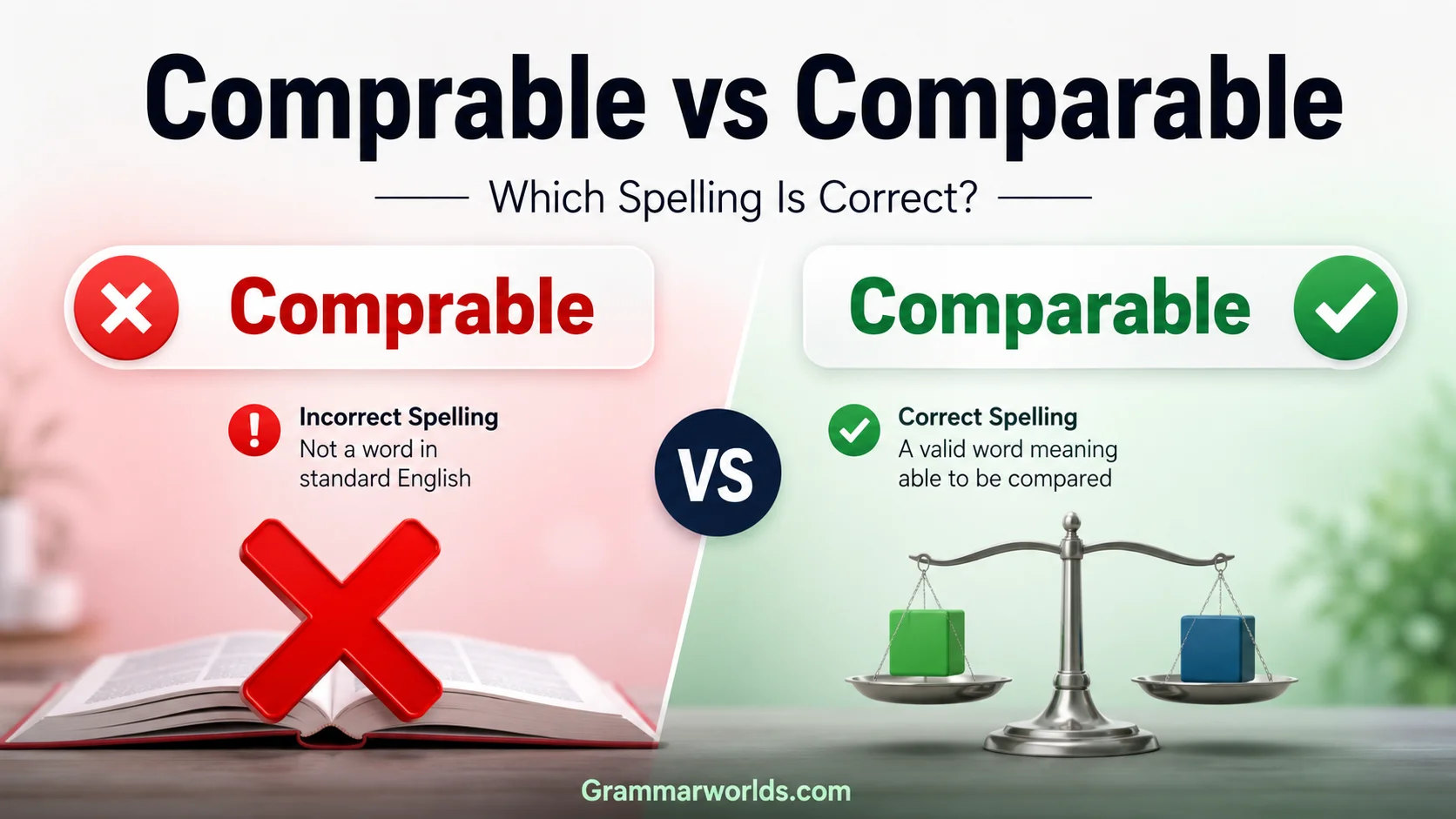
The correct spelling is Comparable.
The word Comprable is a spelling mistake. It does not appear as a standard English word in dictionaries and should not be used in writing.
Although the difference looks small, that missing “a” changes the entire word. These tiny spelling errors can affect how professional your writing appears, especially in academic papers, business reports, emails, and online content.
Quick answer: Use Comparable when you mean something that can be compared. Never use Comprable.
This guide explains the difference between Comprable vs Comparable, why people make this mistake, how to remember the correct spelling, and how to use Comparable properly in everyday writing.
Comprable vs Comparable: Quick Comparison
Before exploring the details, here is the simple difference between these two spellings:
| Word | Correct Spelling | Meaning | Usage |
| Comparable | ✅ Correct | Similar enough to be compared with something else | Used in English writing |
| Comprable | ❌ Incorrect | No recognized meaning | Common spelling mistake |
The answer is straightforward: Comparable is the only correct spelling.
If you write a sentence such as:
❌ This laptop has comprable performance to expensive models.
the correct version is:
✅ This laptop has comparable performance to expensive models.
The second sentence clearly communicates that the laptop performs similarly to other expensive models.
What Does Comparable Mean?
The word Comparable means similar enough to another thing that you can compare them fairly.
It describes two or more things that share important qualities, characteristics, or features.
For example:
- Two smartphones with similar battery life have comparable performance.
- Two houses with similar locations and sizes may have comparable prices.
- Two athletes with similar records may have comparable achievements.
However, comparable does not always mean exactly equal.
That difference matters.
Imagine two restaurants. One offers faster service while the other provides better food quality. Their overall experiences might still be comparable because customers can reasonably evaluate them against each other.
In simple terms:
Comparable = similar enough for a fair comparison.
It does not mean:
Comparable = exactly the same.
The Origin of the Word Comparable
Understanding where a word comes from can make spelling easier.
The word Comparable comes from the verb compare.
The structure looks like this:
Compare + able = Comparable
The word compare means to examine two or more things to identify similarities and differences.
The suffix -able means “capable of” or “able to.”
So:
- Compare = examine similarities and differences
- Comparable = capable of being compared
This connection creates an easy spelling reminder.
If you remember the word compare, you will remember that Comparable contains the extra “a” after “par.”
Correct:
✅ Compare → Comparable
Incorrect:
❌ Compr → Comprable
The missing vowel is the main reason people make this mistake.
Why Do People Spell Comparable as Comprable?
The mistake happens because English pronunciation does not always clearly show every letter.
When people say Comparable, the middle sounds can blend together. In casual speech, some speakers pronounce it quickly, making the word sound closer to:
“comp-rable”
instead of:
“com-par-a-ble”
This creates confusion.
Here are some common reasons people write Comprable:
Pronunciation Confusion
English contains many words where letters are written but not strongly pronounced.
For example:
- Comfortable is often pronounced “comfterble.”
- Vegetable is often pronounced “vejtable.”
- Comparable is sometimes shortened in speech.
When people write based only on sound, they may accidentally remove letters.
Fast Typing
Modern communication happens quickly. People often type messages, emails, or notes without carefully checking every letter.
A missing vowel can easily slip through.
For example:
- Comparable → Comprable
- Separate → Seperate
- Definitely → Definately
These mistakes happen because the brain recognizes familiar patterns and sometimes fills in missing information automatically.
English Spelling Rules Are Not Always Predictable
English developed from several languages, including Latin, French, Germanic languages, and Greek.
Because of this history, spelling does not always follow simple rules.
The word Comparable keeps its connection to compare, which helps maintain its original structure.
How to Pronounce Comparable Correctly
Correct pronunciation can also help you remember the spelling.
In American English, Comparable is commonly pronounced:
KOM-puh-ruh-bul
Phonetic pronunciation:
/ˈkɑːm.pɚ.ə.bəl/
Break the word into parts:
Com • par • a • ble
Say each part slowly:
- Com
- Par
- A
- Ble
When you separate the syllables, the missing a becomes easier to notice.
A helpful practice:
Instead of saying:
“comprable”
say:
“compare-able”
The word itself reminds you of its spelling.
Comparable vs Comprable: Detailed Difference
Although these two spellings look similar, only one works in English.
| Category | Comparable | Comprable |
| Dictionary recognition | Yes | No |
| Standard English word | Yes | No |
| Used in professional writing | Yes | No |
| Correct grammar | Yes | No |
| Related to “compare” | Yes | No |
Using Comprable in formal writing may distract readers because they will recognize it as an error.
For example:
❌ The company offers comprable benefits to larger organizations.
A professional version:
✅ The company offers comparable benefits to larger organizations.
The meaning stays the same, but the correct spelling improves credibility.
How to Use Comparable Correctly in Sentences
The word Comparable usually works as an adjective.
An adjective describes a person, place, thing, or idea.
Here are examples:
Business Examples
- Our company provides comparable services at a lower price.
- The two brands offer comparable quality.
- Their customer support is comparable to industry leaders.
Businesses often use this word when comparing products, services, prices, or performance.
For example, a company might say:
“Our software delivers comparable results without the high subscription cost.”
This means the software performs similarly to more expensive options.
Education Examples
- The students achieved comparable exam scores.
- Both universities provide comparable learning opportunities.
- The research produced comparable results.
Researchers often use comparable when analyzing data from different groups.
Technology Examples
- This phone offers comparable features to premium models.
- The new processor delivers comparable speed.
- These two cameras produce comparable image quality.
Technology reviews frequently use the word because products are constantly compared.
Everyday Examples
- The two apartments have comparable sizes.
- Their cooking skills are comparable.
- The restaurants offer comparable experiences.
The word fits naturally whenever two things share noticeable similarities.
Comparable Examples in Real Life
The word Comparable appears in many areas of life because people constantly evaluate one thing against another. Whether you are shopping for a product, comparing salaries, analyzing businesses, or choosing a service, the idea of comparison plays an important role.
Understanding real-world examples makes the meaning much easier to remember.
Comparable in Business and Marketing
Businesses frequently use Comparable when they analyze competitors, products, prices, and performance.
For example, a company launching a new smartphone may compare its device with other phones in the same price range.
A marketing statement might say:
“This smartphone provides comparable features to premium models at a lower price.”
This does not mean the phone is exactly identical to expensive competitors. It means the phone offers similar features and performance that customers can reasonably compare.
Common business uses include:
- Comparable pricing
- Comparable revenue
- Comparable sales
- Comparable products
- Comparable services
- Comparable customer experience
Business Example
Imagine two online stores:
| Feature | Store A | Store B |
| Product range | 10,000 items | 9,500 items |
| Delivery time | 2 days | 3 days |
| Customer support | 24/7 | 24/7 |
These stores have comparable services because they provide similar benefits, even though they are not exactly the same.
Comparable in Real Estate
The real estate industry uses the term comparable very often.
Real estate professionals analyze similar properties to estimate a home’s value. These similar properties are often called comparables or comps.
For example:
A house in a neighborhood may be compared with other nearby homes that have:
- Similar square footage
- Similar number of bedrooms
- Similar location
- Similar condition
- Similar features
A real estate agent may say:
“The property has a value comparable to recently sold homes in the area.”
This means the home’s estimated price matches similar properties based on available market information.
Also Read This :Crier vs Cryer: The Correct Usage Explained Clearly
Real Estate Example
Suppose three homes recently sold:
| Property | Size | Selling Price |
| House A | 2,000 sq. ft. | $450,000 |
| House B | 2,100 sq. ft. | $465,000 |
| House C | 1,950 sq. ft. | $440,000 |
A new 2,050-square-foot home may have a comparable value because it shares similar characteristics.
Comparable in Technology
Technology companies constantly compare products.
When a reviewer says a device has comparable performance, they mean it performs similarly to another product.
Examples:
- A budget laptop has comparable battery life to a premium laptop.
- A new processor offers comparable speed to an older high-end model.
- A camera produces comparable image quality to competing brands.
However, comparable does not always mean better.
For instance:
“This tablet has comparable performance to expensive models.”
This means the performance is similar. It does not automatically mean the tablet beats those models.
Comparable in Education and Research
Researchers use comparable when studying groups, results, or information that share similar qualities.
For example:
A scientist comparing two groups may need them to have comparable characteristics.
These factors might include:
- Age range
- Background
- Experience level
- Learning environment
- Previous knowledge
If two groups are not comparable, the research results may not be reliable.
Example
A study comparing online students and classroom students should consider whether both groups have comparable access to learning materials.
Without similar conditions, the comparison may not provide accurate results.
Comparable in Finance
Financial analysts use comparable companies when evaluating businesses.
This method is called comparable company analysis or comps analysis.
Analysts compare businesses with similar:
- Industry
- Revenue size
- Growth rate
- Market conditions
- Business model
For example:
A technology startup may be compared with other software companies rather than a completely different industry.
The goal is to create a fair comparison.
Common Phrases Using Comparable
The word Comparable appears in many common expressions. Learning these phrases helps you use the word naturally.
Comparable Quality
Meaning: Similar level of quality.
Example:
“The affordable brand offers comparable quality to more expensive alternatives.”
This phrase often appears in product reviews and purchasing decisions.
Comparable Price
Meaning: A price that is similar to another product or service.
Example:
“Both hotels offer comparable prices during the holiday season.”
The prices do not need to be exactly the same. They simply fall within a similar range.
Comparable Performance
Meaning: Similar ability, results, or output.
Examples:
- Two computers have comparable performance.
- Two athletes achieved comparable results.
- Two companies showed comparable growth.
Comparable Value
Meaning: Similar usefulness or worth.
Example:
“The smaller package provides comparable value at a lower cost.”
Comparable Experience
Meaning: A similar level of satisfaction, service, or quality.
Example:
“The new app offers a comparable experience to the original version.”
Comparable Data
Meaning: Information that can be fairly compared.
Researchers and analysts often need comparable data before making conclusions.
For example:
Comparing sales from two different years requires similar conditions, such as:
- Same market area
- Similar pricing
- Similar customer base
Comparable vs Similar vs Equal: What Is the Difference?
Many people confuse comparable, similar, and equal because these words overlap.
However, they do not mean exactly the same thing.
| Word | Meaning | Example |
| Comparable | Similar enough to compare | These laptops have comparable performance. |
| Similar | Almost alike but not necessarily equal | The two designs look similar. |
| Equal | Exactly the same in value, amount, or status | Both payments are equal. |
Understanding the difference prevents incorrect word choices.
Comparable vs Similar
Comparable focuses on the ability to compare.
Similar focuses on having shared qualities.
Example:
“These two phones are similar.”
This means they look alike or have similar features.
“These two phones have comparable performance.”
This means their performance can be fairly evaluated against each other.
Something can be comparable without being very similar.
For example, two cars may be completely different in design but still have comparable prices and performance.
Comparable vs Equal
The biggest difference is that comparable does not mean identical.
Consider two salaries:
- Employee A earns $70,000.
- Employee B earns $72,000.
Their salaries are comparable.
They are not equal.
Equal means the exact same amount.
Example:
- $50 = $50 → Equal
- $50 and $55 → Comparable
Common Mistakes When Using Comparable
Even after learning the correct spelling, people sometimes misuse the word.
Here are mistakes to avoid.
Mistake: Writing Comprable Instead of Comparable
Incorrect:
❌ The two products have comprable features.
Correct:
✅ The two products have comparable features.
Remember the connection:
Compare → Comparable
Mistake: Using Comparable When Things Are Completely Different
Comparable requires some reasonable connection.
Incorrect:
“A bicycle and a smartphone have comparable features.”
These objects serve completely different purposes.
Better:
“Two electric bicycles have comparable features.”
Mistake: Treating Comparable as Equal
Incorrect:
“These products are comparable, so they are exactly the same.”
Comparable only means they share enough similarities for comparison.
They may still differ in:
- Quality
- Price
- Design
- Performance
- Features
Easy Ways to Remember the Correct Spelling of Comparable
Spelling tricks make difficult words easier.
Remember the Root Word
The easiest method:
Compare + able = Comparable
The word keeps the full form of compare.
Think:
“I can compare it, so it is comparable.”
Break It Into Syllables
Write it like this:
Com – par – a – ble
The middle a is easy to remember when you slow down.
Use a Memory Sentence
Try this:
“If I can compare it, it is comparable.”
This simple sentence connects the meaning and spelling together.
Is Comprable Ever Correct?
No.
Comprable is not a standard English word.
It is simply a misspelling of Comparable.
You may occasionally see it online because people make typing mistakes, but it should not appear in:
- Professional documents
- School assignments
- Articles
- Business emails
- Reports
- Presentations
If you see Comprable, replace it with Comparable.
Key Takeaways
The difference between Comprable vs Comparable is simple once you know the rule.
Remember these important points:
- ✅ Comparable is the correct spelling.
- ❌ Comprable is a spelling mistake.
- Comparable comes from compare + able.
- Comparable means “similar enough to compare.”
- Comparable does not mean exactly equal.
- The word appears frequently in business, technology, education, finance, and everyday conversations.
A single missing letter can change whether a word looks professional or incorrect. By remembering the connection between compare and comparable, you can avoid this common spelling mistake.
FAQs
Is Comprable a word?
No. Comprable is not a recognized English word. It is an incorrect spelling of Comparable.
The correct form always includes the additional “a”:
✅ Comparable
❌ Comprable
Which spelling is correct: Comparable or Comprable?
Comparable is the correct spelling.
It means something is similar enough to another thing that you can compare them fairly.
Why do people misspell Comparable as Comprable?
People usually misspell Comparable because the middle sounds are easy to shorten when speaking quickly.
The pronunciation may make the word sound like it has fewer letters than it actually does.
Is Comparable an adjective?
Yes.
Comparable is an adjective because it describes a noun.
Examples:
- Comparable products
- Comparable results
- Comparable prices
- Comparable services
What is the noun form of Comparable?
The noun form is usually comparison.
Example:
- Adjective: These products are comparable.
- Noun: The comparison shows important differences.
Another related noun is comparability, which means the quality of being suitable for comparison.
Example:
“The comparability of the data affects the accuracy of the study.”
Conclusion
The difference between Comprable vs Comparable is simple: Comparable is the correct spelling, while Comprable is a common spelling mistake that you should avoid.The word Comparable means something is similar enough to another thing that it can be compared fairly. You will often see it used when discussing products, prices, performance, quality, research, business analysis, and everyday situations.