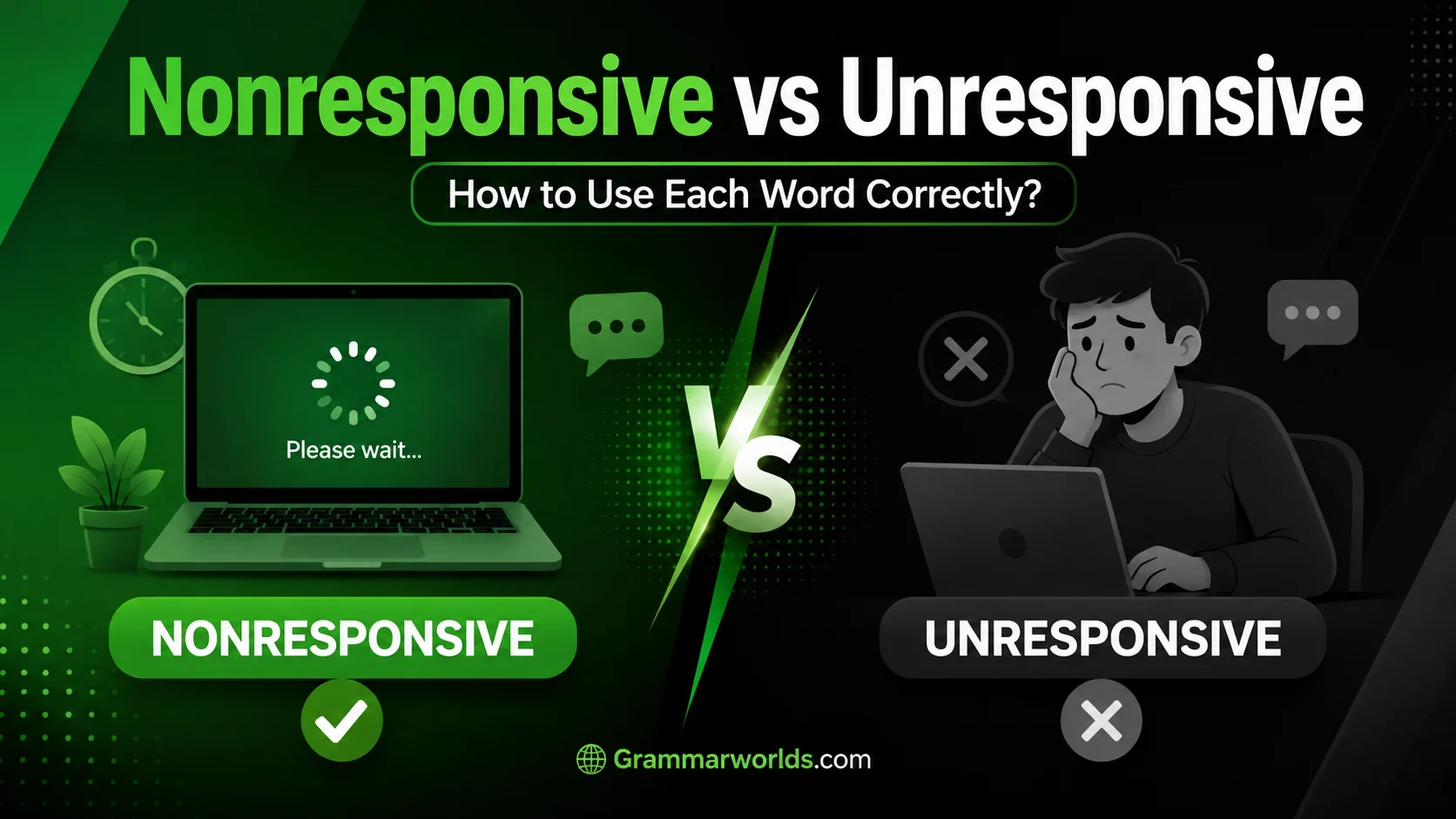
Words can look almost identical yet carry slightly different meanings. Nonresponsive vs unresponsive is a perfect example. Both words describe a lack of response, but they are not always interchangeable.
If your computer freezes, your doctor says a patient is “unresponsive.” If a company ignores your emails, you might call it “nonresponsive.” Both situations involve a missing response, but the type of response matters.
Choosing the right word improves clarity. It helps your reader understand whether something failed to react, reply, function, or participate.
This guide explains the difference between nonresponsive and unresponsive, when to use each term, common mistakes, industry-specific examples, and simple ways to remember the difference.
Nonresponsive vs Unresponsive: The Quick Difference
The easiest way to understand the difference is to focus on what kind of response is missing.
| Word | Main Meaning | Common Situations |
| Unresponsive | Not reacting, functioning, or responding normally | People, machines, software, physical reactions |
| Nonresponsive | Not providing an expected answer, reply, or participation | Emails, surveys, customer service, legal matters |
A simple memory trick:
Unresponsive = no reaction.
Nonresponsive = no answer.
For example:
- “The laptop became unresponsive after installing the update.”
- “The company was nonresponsive to customer complaints.”
The laptop failed to work. The company failed to reply.
What Does Unresponsive Mean?
Unresponsive describes something or someone that does not react, respond, or operate as expected.
The word usually suggests that a response should happen naturally, but it does not.
The prefix “un-” means “not” or “the opposite of.” Therefore, unresponsive means “not responsive.”
However, the word has several uses depending on the situation.
Unresponsive Meaning in Everyday Communication
In normal conversation, people often use unresponsive when someone ignores communication or fails to react.
For example:
“I called him three times, but he was completely unresponsive.”
This could mean:
- He did not answer the phone.
- He did not acknowledge the messages.
- He showed no reaction.
The word often carries an emotional tone. Calling someone unresponsive can suggest frustration because the person should have reacted but did not.
Other examples:
- “The manager was unresponsive when employees asked questions.”
- “She became unresponsive during the conversation.”
- “The child seemed unresponsive to the instructions.”
Unresponsive Meaning in Healthcare
Healthcare is one of the most important areas where the word unresponsive appears.
Medical professionals use it when a patient does not react to:
- Voice
- Touch
- Pain stimulus
- Surrounding activity
A person who is unconscious or unable to communicate may be described as unresponsive.
Example:
“Emergency workers found the patient unresponsive and immediately checked vital signs.”
In medical situations, the term does not simply mean someone is quiet or ignoring others. It often indicates a serious condition requiring attention.
Common medical examples include:
- A person who has fainted
- Someone experiencing a seizure
- A patient after severe trauma
- Someone who has lost consciousness
Unresponsive Meaning in Technology
Technology is another major area where unresponsive is the preferred word.
When software, websites, or devices stop accepting commands, they become unresponsive.
Examples:
- “The application became unresponsive after opening a large file.”
- “My phone screen is frozen and unresponsive.”
- “The website is temporarily unresponsive because of server problems.”
A device can appear active while still being unresponsive.
For example:
Your computer screen may remain visible, but clicking buttons does nothing. The system has stopped reacting to your commands.
What Does Nonresponsive Mean?
Nonresponsive means failing to provide a response when one is expected.
The word focuses more on communication, cooperation, or participation.
The prefix “non-” means “not,” so nonresponsive literally means “not responding.”
However, it often sounds more formal than unresponsive.
Nonresponsive Meaning in Business and Customer Service
Businesses frequently use nonresponsive when describing poor communication.
For example:
“The supplier became nonresponsive after several follow-up emails.”
This means the supplier did not:
- Answer messages
- Provide updates
- Address concerns
- Communicate properly
Common business examples:
- “The vendor was nonresponsive during contract negotiations.”
- “The customer support team was nonresponsive to complaints.”
- “The company received criticism for being nonresponsive to customer feedback.”
In these cases, the issue is not that the company physically cannot react. The issue is that it failed to communicate.
Nonresponsive Meaning in Legal Writing
Legal professionals often use nonresponsive because legal matters involve formal requests and required answers.
Examples:
- A witness gives an answer unrelated to the question.
- A party fails to respond to legal requests.
- A company ignores required documentation.
Examples:
“The witness provided a nonresponsive answer during questioning.”
This means the person answered something different instead of addressing the actual question.
Another example:
“The defendant was considered nonresponsive after failing to provide requested documents.”
The focus is on failure to answer or comply.
Nonresponsive Meaning in Research and Surveys
Researchers also use nonresponsive when participants fail to provide information.
Examples:
- A person does not complete a survey.
- A participant does not answer follow-up questions.
- A study loses data because people stop responding.
Example:
“Researchers removed nonresponsive participants from the final analysis.”
This does not mean participants could not respond. It means they did not provide the required response.
Nonresponsive vs Unresponsive: Key Differences Explained
Although these words overlap, they emphasize different problems.
| Category | Unresponsive | Nonresponsive |
| Focus | Reaction or function | Communication or participation |
| Tone | Common and conversational | More formal and professional |
| Used for | People, devices, systems | Organizations, requests, documents |
| Example | “The computer is unresponsive.” | “The company is nonresponsive.” |
The difference becomes clearer when you ask one question:
Was something supposed to react or was something supposed to answer?
If it should react:
Use unresponsive.
If it should answer:
Use nonresponsive.
Are Nonresponsive and Unresponsive Interchangeable?
Sometimes they are. Often they are not.
English has many words with overlapping meanings. The challenge is not whether a sentence is technically correct. The challenge is whether it sounds natural.
Consider these examples:
Example 1: Technology
Correct:
“My computer is unresponsive.”
Why?
A computer does not communicate like a person. It reacts to commands.
Less natural:
“My computer is nonresponsive.”
This is understandable, but it sounds more technical.
Example 2: Customer Service
Correct:
“The company was nonresponsive to my emails.”
Why?
The company failed to provide answers.
Possible but less precise:
“The company was unresponsive to my emails.”
This is not wrong, but it sounds more like criticism of the company’s overall behavior.
Example 3: Medical Situation
Correct:
“The patient was unresponsive.”
Why?
The patient failed to react physically.
Less common:
“The patient was nonresponsive.”
This may appear in some professional settings, but medical workers usually prefer “unresponsive.”
Also Read This : Across vs Accross: What’s The Correct Spelling?
When to Use Unresponsive
Use unresponsive when describing:
1. A Lack of Physical Reaction
Examples:
- A person does not wake up.
- Someone does not respond to their name.
- A patient does not react.
Example:
“The rescue team found an unresponsive person and began emergency care.”
2. A Device or System Failure
Examples:
- Frozen computer programs
- Mobile applications
- Websites
- Electronic devices
Example:
“The software became unresponsive after processing too much data.”
3. Emotional or Social Lack of Reaction
Sometimes people use unresponsive to describe someone who shows little emotion or engagement.
Examples:
- “He appeared unresponsive during the discussion.”
- “The audience was unresponsive to the presentation.”
Here, the meaning is not physical. It describes a lack of visible reaction.
When to Use Nonresponsive
Use nonresponsive when describing:
1. Failure to Reply
Examples:
- Emails
- Messages
- Requests
- Complaints
Example:
“The company remained nonresponsive despite multiple requests.”
2. Failure to Participate
Examples:
- Surveys
- Applications
- Research studies
Example:
“Nonresponsive applicants were removed from consideration.”
3. Formal or Professional Situations
Nonresponsive often appears in:
- Legal documents
- Business reports
- Research papers
- Official evaluations
Example:
“The contractor was labeled nonresponsive because they failed to meet submission requirements.”
Nonresponsive vs Unresponsive in Different Industries
Different fields prefer different words because they deal with different types of responses.
Healthcare: Unresponsive Is Usually Preferred
Healthcare focuses on physical reactions.
| Situation | Best Word |
| Patient does not wake up | Unresponsive |
| Patient ignores questions | Nonresponsive |
| Patient cannot react physically | Unresponsive |
Example:
“The nurse documented that the patient was unresponsive upon arrival.”
Technology: Unresponsive Is More Common
Technology responds to commands, clicks, and inputs.
Common phrases:
- Unresponsive application
- Unresponsive device
- Unresponsive website
- Unresponsive operating system
Example:
“The browser became unresponsive after opening too many tabs.”
Business: Nonresponsive Often Fits Better
Businesses respond through communication.
Common phrases:
- Nonresponsive vendor
- Nonresponsive customer
- Nonresponsive department
Example:
“The contractor was nonresponsive during the negotiation process.”
Legal Field: Nonresponsive Dominates
Legal language often focuses on answers and obligations.
Common phrases:
- Nonresponsive answer
- Nonresponsive party
- Nonresponsive witness
Example:
“The attorney objected because the witness gave a nonresponsive answer.”
Common Mistakes When Using Nonresponsive and Unresponsive
Using Nonresponsive for Technology
Many people say:
“My phone is nonresponsive.”
This is understandable, but unresponsive sounds more natural.
Better:
“My phone is unresponsive.”
Thinking Unresponsive Only Applies to Medical Situations
Some people believe unresponsive only describes unconscious people.
That is incorrect.
You can describe:
- Computers
- Apps
- Websites
- Employees
- Conversations
Examples:
- “The app became unresponsive.”
- “The employee was unresponsive to feedback.”
Ignoring Context
The biggest mistake is choosing the word based only on the idea of “no response.”
Instead, consider what type of response is missing.
Ask:
Is there no reaction?
Use:
Unresponsive
Is there no reply?
Use:
Nonresponsive
A Simple Way to Remember Nonresponsive vs Unresponsive
Think about a door.
A locked door that will not open when you push it is like an unresponsive computer. It does not react.
A person who refuses to answer when you knock is like a nonresponsive customer service department. They do not reply.
The difference is small but useful:
- Reaction = unresponsive
- Reply = nonresponsive
Examples of Nonresponsive vs Unresponsive in Sentences
| Sentence | Correct Word | Reason |
| “The computer stopped responding to clicks.” | Unresponsive | It failed to react |
| “The company ignored five emails.” | Nonresponsive | It failed to reply |
| “The patient did not react to stimulation.” | Unresponsive | Physical reaction missing |
| “The survey participant never completed the form.” | Nonresponsive | Participation missing |
| “The website froze during checkout.” | Unresponsive | System failure |
Faqs:
Is nonresponsive a real word?
Yes. Nonresponsive is a standard English word. It is commonly used in professional settings such as business, law, research, and customer service.
Is unresponsive more common than nonresponsive?
Yes. Unresponsive is generally more common in everyday English because people frequently use it for technology, physical reactions, and general behavior.
Can someone be both nonresponsive and unresponsive?
Yes, depending on the situation.
For example:
A person who cannot wake up is unresponsive.
A person who ignores emails and refuses to answer questions is nonresponsive.
The words describe different types of missing responses.
Is nonresponsive or unresponsive better for customer service?
Usually, nonresponsive works better.
Example:
“The company was nonresponsive to my refund request.”
The sentence clearly shows a failure to communicate.
Which word should I use in formal writing?
Use the word that matches the situation.
Choose nonresponsive for:
- Requests
- Questions
- Communication problems
- Legal issues
Choose unresponsive for:
- Physical reactions
- Technology problems
- System failures
Conclusion
The difference between nonresponsive vs unresponsive comes down to one simple idea:
A response can mean either a reaction or an answer.
When something fails to react, choose unresponsive.
- An unresponsive patient
- An unresponsive computer
- An unresponsive application
When someone fails to answer, choose nonresponsive.
- A nonresponsive company
- A nonresponsive customer
- A nonresponsive participant
Both words are correct. The key is matching the word to the situation.
When you understand the type of response that is missing, choosing the right word becomes much easier.