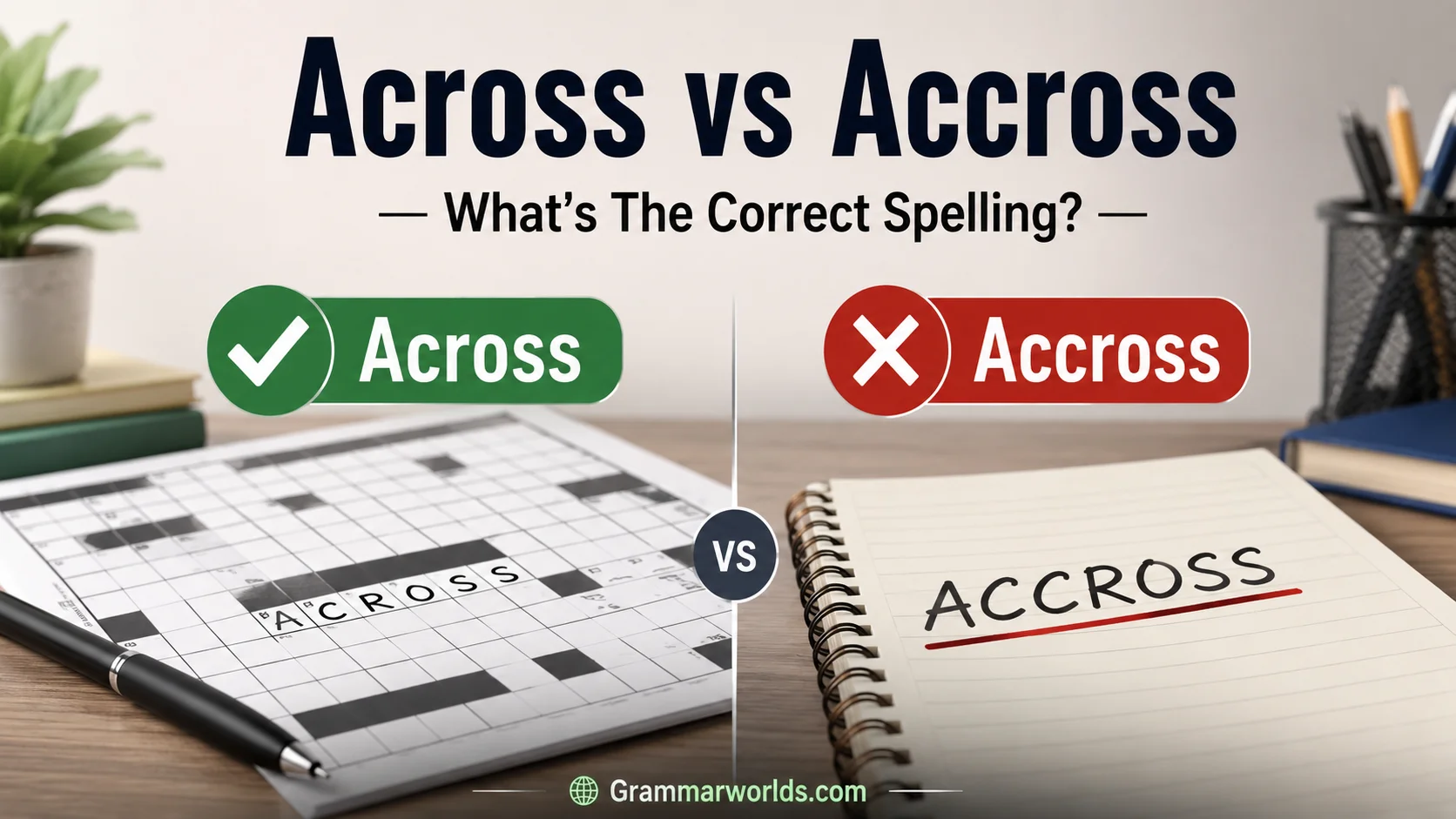
If you have ever typed “accross” and stopped to wonder whether it looked correct, you are not alone. This small spelling mistake appears often in emails, school assignments, blog posts, and everyday messages.
The confusion makes sense. English has many words with double consonants, such as accept, access, and accomplish. Because of this pattern, adding an extra “c” can feel natural. However, “accross” is not the correct spelling.
The correct word is:
✅ Across
The incorrect spelling is:
❌ Accross
The difference is only one letter, but using the wrong form can make your writing look careless. Whether you are writing a professional email, creating online content, or completing an academic assignment, choosing the right spelling matters.
This guide explains the difference between across vs accross, how to use across correctly, why people misspell it, and how you can easily remember the correct spelling forever.
Across vs Accross: The Quick Answer
The answer is simple:
Across is always correct. Accross is always incorrect.
There is no situation where you should use “accross” in standard English writing.
| Word | Correct Spelling | Meaning | Example |
| Across | ✅ Yes | From one side to another, opposite side, or throughout an area | “She walked across the street.” |
| Accross | ❌ No | Misspelling of across | “She walked accross the street.” |
The word across has been part of English for centuries. It describes movement, position, distance, and distribution.
Examples:
- “The child ran across the playground.”
- “My neighbor lives across the street.”
- “The company operates across several countries.”
- “The news spread across social media.”
The spelling never changes. It always has one “c.”
What Does Across Mean?
The word across has several meanings depending on the sentence. It can describe physical movement, location, or even ideas spreading between people and places.
Understanding these different uses helps you avoid mistakes and communicate more clearly.
Across as a Preposition
The most common use of across is as a preposition.
A preposition shows the relationship between different parts of a sentence. In this case, across usually connects an action with a place or direction.
It often means:
- From one side to another
- On the opposite side
- Over a surface or area
Examples of across as a preposition:
- “The runner moved across the finish line.”
- “She walked across the bridge.”
- “The cat jumped across the table.”
- “They drove across the country.”
In each example, something moves from one point to another.
Think of across as a path connecting two sides.
For example:
Side A —————- Side B
→ across →
A person walking from one side of a road to the other walks across the road.
Across as an Adverb
Sometimes across works without directly naming the place or object.
In these situations, the location is already understood.
Examples:
- “She looked across.”
- “The ball rolled across.”
- “He shouted across.”
The reader understands that something happened from one side toward another.
For example:
“I saw him standing across.”
The sentence may feel incomplete without context, but in a conversation where the location is already known, it works.
Across Meaning “Throughout” or “All Over”
One of the most useful meanings of across is showing something that exists in many places.
In this use, it does not always describe physical movement.
Examples:
- “The company has customers across the world.”
- “The message reached people across different communities.”
- “The disease spread across multiple regions.”
- “The brand became popular across generations.”
Here, across means “in many places” or “among many groups.”
A useful comparison:
| Sentence | Meaning |
| “He walked across the room.” | Movement from one side to another |
| “The company expanded across Asia.” | Presence in many locations |
| “The idea spread across society.” | Influence among many people |
Across Meaning “Opposite Side”
Another common meaning of across is identifying something located on the other side.
Examples:
- “The bank is across the street.”
- “The restaurant is across from the hotel.”
- “She lives across the road.”
In these sentences, there is no movement. The word simply describes location.
Imagine standing outside your house and seeing a store directly opposite you. The store is across the street.
Why Is Accross Incorrect?
Many people wonder why accross feels like it should be correct.
The reason comes from English spelling patterns.
English contains many words where double consonants appear naturally:
- access
- accident
- accomplish
- address
- aggressive
Because of these examples, writers sometimes assume that across should follow the same pattern.
But English does not always follow predictable rules.
The correct spelling developed from older forms of English and remained:
Across
not:
Accross
Adding another “c” does not make the word more correct. It simply creates a spelling error.
Also Read This : Scoup vs Scoop: Which Spelling Is Correct?
Why Do People Spell Across as Accross?
There are several common reasons.
Pronunciation Confusion
When people pronounce across, the “k” sound can feel strong:
uh-KROSS
Because the sound feels emphasized, some writers naturally add another “c.”
However, pronunciation does not always reveal spelling.
For example:
- Necessary sounds like it should have two “s” sounds but only has one “c.”
- Recommend has a double “m,” but many similar words do not.
English spelling requires learning the standard form rather than relying only on sound.
Influence From Similar Words
People often compare across with words like:
- access
- accompany
- accept
These words begin with “ac,” so the brain creates a connection.
However:
- Access = two c’s
- Across = one c
The words may look similar, but they follow different spelling patterns.
Across vs Similar Words: Understanding the Differences
Many writing mistakes happen because similar words have slightly different meanings.
Learning these differences improves accuracy.
Across vs Through
Both words can describe movement, but they describe different types of movement.
| Word | Meaning | Example |
| Across | Moving from one side to another | “She walked across the bridge.” |
| Through | Moving inside something or within an area | “She walked through the tunnel.” |
A bridge has two sides, so you move across it.
A tunnel has an inside space, so you move through it.
Compare:
❌ “The train went across the tunnel.”
This suggests the train moved from one side of the tunnel to the other without entering it.
✅ “The train went through the tunnel.”
This means the train entered and passed inside.
Across vs Over
These two words often overlap, but they emphasize different ideas.
Across focuses on crossing from one side to another.
Over focuses on being above something.
Examples:
- “The bird flew over the house.”
- “The child ran across the yard.”
The bird is above the house.
The child moves from one side of the yard to another.
Across vs Cross
This is another common confusion.
The difference is grammatical.
Cross is usually a verb.
Across is usually a preposition or adverb.
Examples:
✅ “I crossed the street.”
Here, crossed is the action.
✅ “I walked across the street.”
Here, across describes where the walking happened.
A simple way to remember:
You cross something to move across it.
Common Mistakes When Using Across
Knowing the correct spelling is only the first step. Many writers also misuse the word in sentences.
Here are the most common problems.
Mistake: Writing Accross Instead of Across
Incorrect:
“The office is located accross the road.”
Correct:
“The office is located across the road.”
The extra “c” has no purpose.
Mistake: Using Across When Through Is Correct
Incorrect:
“The hikers walked across the forest.”
Correct:
“The hikers walked through the forest.”
Why?
A forest is an area you move inside.
You walk through it.
However:
“The hikers walked across the field.”
works because a field has two sides you can cross.
Mistake: Using Across Without an Action
Incorrect:
“He across the street.”
Correct:
“He walked across the street.”
Across usually needs a verb showing movement or position.
Common verbs used with across include:
- walk across
- run across
- drive across
- travel across
- move across
- look across
- reach across
Examples of Across in Everyday Writing
The word across appears everywhere because it describes both physical and abstract connections.
Daily Life Examples
- “My keys are across the room.”
- “The children ran across the playground.”
- “The supermarket is across the road.”
Business Examples
Companies often use across when discussing large-scale operations.
Examples:
- “The company has employees across five continents.”
- “Teams across the organization worked together.”
- “The service is available across multiple platforms.”
Here, across shows broad coverage.
Travel Examples
Travel writing frequently uses across.
Examples:
- “They traveled across Europe for three months.”
- “The train journeyed across the mountains.”
- “She drove across the United States.”
Communication Examples
Modern communication often spreads across digital spaces.
Examples:
- “The video went viral across social media.”
- “The announcement reached users across the platform.”
- “The campaign attracted attention across industries.”
How to Remember the Correct Spelling of Across
The easiest memory trick is simple:
Think: A + Cross = Across
The word contains:
A + Cross
Not:
Ac + Cross
You cross a road.
You walk across a road.
The word “across” connects directly with “cross,” and both keep the single “c” sound.
Another reminder:
“You don’t need an extra C to cross across something.”
Faqs:
Is “accross” a word?
No. Accross is not a standard English word.
It is a common spelling mistake of across. Dictionaries and professional writing standards recognize only across.
Is across a preposition?
Yes. Across is most commonly used as a preposition.
Example:
“She walked across the street.”
It can also function as an adverb.
Example:
“The ball rolled across.”
How do you pronounce across?
The standard pronunciation is:
uh-KROSS
The emphasis usually falls on the second syllable.
The spelling remains the same regardless of pronunciation:
✅ across
❌ accross
What is the opposite of across?
The opposite depends on the meaning.
Possible opposites include:
| Meaning of Across | Possible Opposite |
| From one side to another | Same side |
| Opposite location | Near, beside |
| Throughout many places | Local, limited |
There is no single opposite word that works in every situation.
Can across describe time?
Yes.
Although people often use across for physical spaces, it can also describe periods.
Examples:
- “The pattern continued across several years.”
- “Changes happened across generations.”
- “The company grew across decades.”
Here, across means “throughout” a period.
Conclusion
The difference between across vs accross is easy once you remember one rule:
Across is correct. Accross is incorrect.
The word across helps describe movement, location, distance, and connection. It appears in everyday conversations, professional writing, news articles, and academic work.
When you are unsure, remember this:
You cross something to move across it.
That single “c” is all you need. Use across confidently, and your writing will always stay accurate.