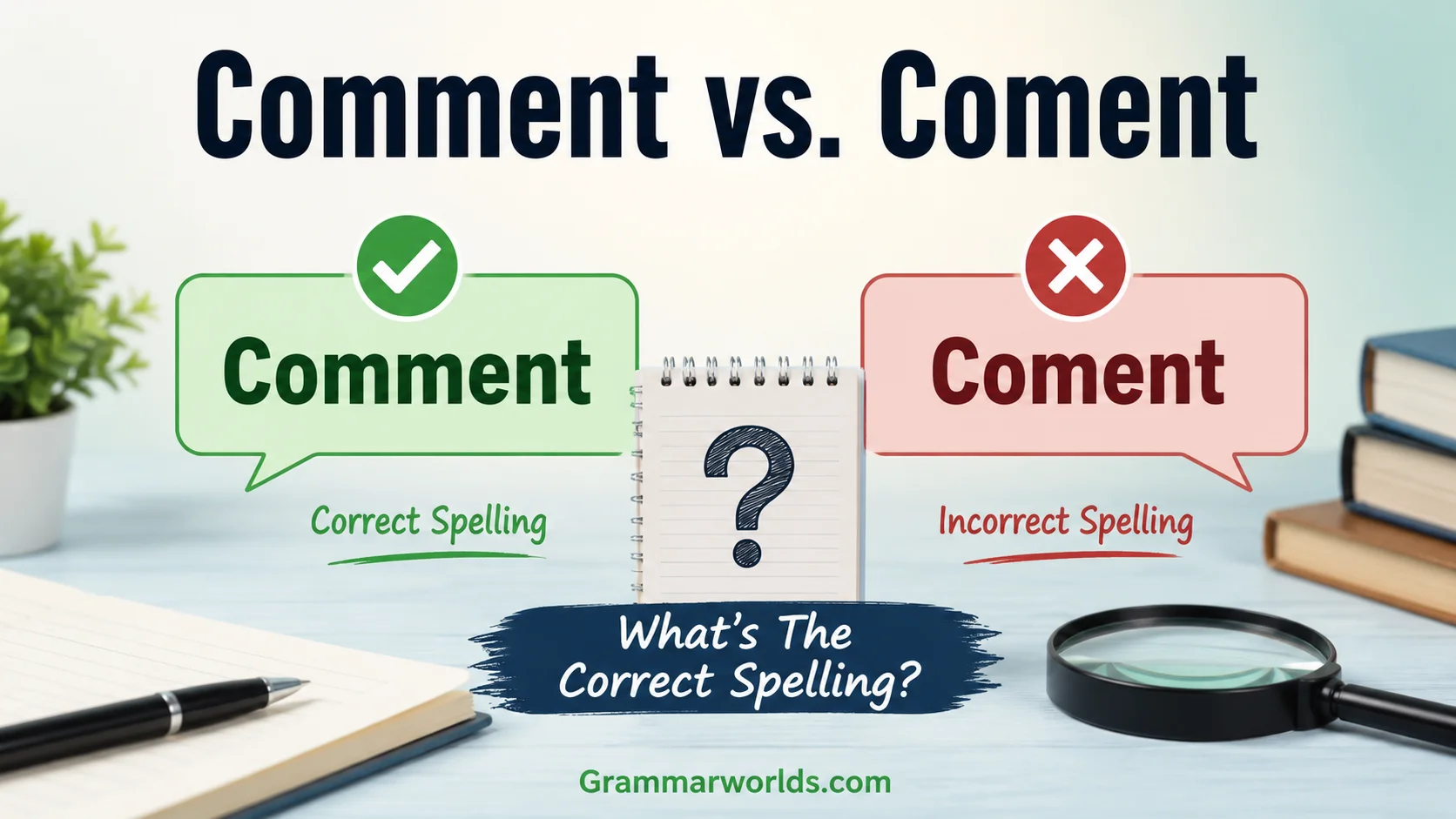
Have you ever typed “coment” while writing a message, blog post, assignment, or social media reply and wondered whether it was actually correct?
You are not alone. The confusion between comment vs. coment happens because the two spellings look almost identical and sound nearly the same when spoken. A single missing letter can make the difference between correct and incorrect English.
The answer is simple:
“Comment” is the correct English spelling.
“Coment” is not a standard English word and is usually a spelling mistake.
The word comment appears everywhere. You see it under social media posts, inside online discussions, in school feedback, business reports, product reviews, and everyday conversations.
This guide explains the difference between comment and coment, why people confuse them, how to use comment correctly, and how to avoid this common spelling mistake.
Comment vs. Coment: Quick Difference
Before exploring the details, here is the simple comparison:
| Word | Correct Spelling? | Meaning | Example |
| Comment | ✅ Yes | A remark, opinion, observation, or response | “She left a helpful comment on the article.” |
| Coment | ❌ No (in standard English) | Usually a spelling mistake | “Please leave a coment below.” |
The extra “m” in comment is what makes the spelling correct.
A simple way to remember it:
A comment has two m’s because it carries more meaning.
Is “Coment” a Word?
The short answer is no, not in standard English.
When people search for “coment meaning” or “is coment correct?”, they are usually checking whether they have made a spelling mistake.
In modern English dictionaries, coment does not appear as an accepted spelling for the word comment.
If you write:
❌ I read your coment yesterday.
Most English readers will recognize what you mean, but they will also notice the spelling error.
The correct version is:
✅ I read your comment yesterday.
Why does “coment” appear so often?
Several reasons explain this mistake:
- People often spell words based on how they sound.
- The second “m” in comment is not strongly pronounced.
- Fast typing causes people to skip repeated letters.
- Autocorrect does not always catch spelling mistakes.
- Some languages use similar-looking words with different spelling rules.
English contains many words where spelling does not perfectly match pronunciation. This creates confusion even for experienced writers.
For example:
| Word | Common Mistake | Correct Form |
| Comment | Coment | Comment |
| Address | Adress | Address |
| Occurred | Occured | Occurred |
| Necessary | Necesary | Necessary |
What Does “Comment” Mean?
The word comment has several related meanings, but they all connect to one main idea:
A comment is something someone says, writes, or expresses about a topic.
It can be a short reaction, a detailed opinion, feedback, or an observation.
The word works as both a noun and a verb.
Comment as a Noun
When comment is used as a noun, it refers to a statement, opinion, or remark.
Examples:
- “The customer left a positive comment about the service.”
- “The teacher wrote a comment on my homework.”
- “His comment changed the direction of the conversation.”
A comment does not have to be long. It can be one sentence or several paragraphs.
For example:
A social media comment:
“Great article. I learned something new today.”
A professional comment:
“The report needs more information about customer behavior.”
A classroom comment:
“Good explanation, but add more examples.”
Comment as a Verb
When comment is used as a verb, it means to express an opinion or make a statement.
Examples:
- “The CEO commented on the company’s future plans.”
- “She commented that the instructions were confusing.”
- “The athlete refused to comment after the match.”
The verb form often appears in news reports and professional writing.
Example:
“The government commented on the recent changes.”
This means the government gave a statement or reaction.
The History Behind the Word “Comment”
Understanding where the word comes from helps explain why it contains two m’s.
The word comment comes from Latin commentum, meaning an interpretation, invention, or explanation. It later moved through Old French before becoming part of English vocabulary.
Over time, English kept the double consonant spelling:
comment → com + ment
The spelling developed historically rather than simply following pronunciation.
This happens often in English.
For example:
- different has a silent-looking structure compared with how many people pronounce it.
- necessary contains repeated letters that are easy to miss.
- committee has multiple repeated consonants.
English spelling often preserves history, not just sound.
Why Do People Confuse Comment and Coment?
The confusion between comment vs. coment is understandable because English pronunciation can hide spelling details.
Here are the main reasons.
The Pronunciation Problem
When people say comment, the word usually sounds like:
com-ent
The second m does not stand out clearly.
Because of this, many writers naturally remove one letter.
The same thing happens with other words:
- accommodation → people write accomodation
- commitment → people write comitment
- address → people write adress
The ear hears the sound, but the eyes need to remember the spelling.
Fast Online Communication
Modern communication has increased spelling shortcuts.
People write thousands of messages every day:
- Text messages
- Social media replies
- Online reviews
- Workplace chats
- Forum discussions
When typing quickly, repeated letters are easy to miss.
For example:
A person may type:
“Thanks for your helpful coment.”
They understand the meaning, but they accidentally remove the second m.
Influence From Other Languages
English borrows words from many languages. Sometimes a spelling pattern that feels normal in one language does not work in English.
For example, some languages may use a single consonant where English uses a double consonant.
However, when writing in English, the correct spelling remains:
✅ comment
How to Use “Comment” Correctly in Different Situations
The word comment appears in many areas of daily life. Knowing how people use it helps you choose the right word naturally.
Comments on Social Media
Social media is probably where most people see the word comment today.
A comment is a response left under someone’s post, video, or photo.
Examples:
- “Thanks for your comment.”
- “The video received thousands of comments.”
- “She replied to every comment on her post.”
Popular platforms use this term because users add written reactions below content.
A comment can be:
- Positive
- Negative
- Informative
- Funny
- Critical
- Supportive
For example:
A simple comment:
“Amazing photo!”
A helpful comment:
“Try adjusting the lighting settings for better results.”
A discussion comment:
“I agree with your point because the research supports this idea.”
Comments in Blogs and Articles
Website owners often use comments to create conversations with readers.
A blog comment allows visitors to:
- Share opinions
- Ask questions
- Add additional information
- Discuss the topic
Example:
A reader writes:
“This explanation helped me understand the difference between comment and coment.”
The website owner may reply:
“Glad it helped! Remember, the correct spelling is comment with two m’s.”
Comments in Education
Teachers frequently use comments to provide feedback.
A comment can explain:
- What a student did well
- What needs improvement
- How to make the work stronger
Example:
Teacher comment:
“Your argument is clear, but include more evidence to support your point.”
This type of comment helps students improve their skills.
Also Read This : Nonresponsive vs Unresponsive:How to Use Each Word Correctly?
Comments in the Workplace
Businesses use comments during:
- Document reviews
- Meetings
- Performance discussions
- Project planning
For example:
A manager may add a comment to a report:
“Please update these figures before the final presentation.”
In professional settings, comments help teams communicate clearly without rewriting entire documents.
Comment vs. Feedback: Are They the Same?
People often confuse comment and feedback, but they are slightly different.
| Word | Meaning | Example |
| Comment | A specific remark or observation | “The introduction needs more details.” |
| Feedback | Information meant to improve something | “Your writing improved, but focus on organization.” |
A comment can be feedback, but not every comment is feedback.
Example:
Comment:
“This design looks modern.”
Feedback:
“This design looks modern, but increasing the font size would improve readability.”
The second example provides guidance.
Common Mistakes Related to Comment
The spelling mistake coment is not the only confusion people have with this word.
Several similar words create problems too.
Comment vs. Compliment
These words look similar but have different meanings.
| Word | Meaning | Example |
| Comment | A statement or remark | “He made a comment about the movie.” |
| Compliment | Praise or admiration | “She complimented his presentation skills.” |
Examples:
❌ Incorrect:
She commented him on his excellent work.
✅ Correct:
She complimented him on his excellent work.
Comment vs. Commentary
These words are related but not identical.
| Word | Meaning | Example |
| Comment | A short remark or opinion | “I left a comment on the post.” |
| Commentary | A longer explanation or analysis | “The sports commentator provided commentary.” |
A comment might be one sentence.
A commentary may cover an entire event, topic, or issue.
How to Remember the Correct Spelling of Comment
Spelling mistakes often happen because our brains focus on sound rather than letters. The best way to avoid writing “coment” is to create a simple memory shortcut.
Here are a few tricks that can help:
Remember the Double “M”
The easiest method is:
Comment has two m’s because a comment contains a message.
Both words begin with “mm”, which makes the spelling easier to connect.
Comment = Co + mm + ent
When you write the word, pause for a second and check:
- Did I include both m’s?
- Does it look like comment?
If yes, your spelling is correct.
Use the Word “Comment” in a Sentence
One of the fastest ways to remember spelling is through repetition.
Instead of memorizing a letter pattern alone, practice the word naturally.
Examples:
- “I received a helpful comment from my reader.”
- “She made an interesting comment during the meeting.”
- “Please leave a comment below.”
- “The teacher added a comment to my assignment.”
The more often you see and write the correct form, the easier it becomes to recognize the mistake.
A Simple Spelling Test
When you are unsure whether to write comment or coment, try this:
Remove the second m mentally.
Compare:
Coment
vs.
Comment
The correct spelling usually looks more familiar because you have seen it many times in books, websites, apps, and conversations.
Your eyes often recognize correct spelling faster than your brain can explain the rule.
Comment vs. Coment in Professional Writing
Correct spelling matters more in professional communication because small mistakes can affect how readers view your attention to detail.
Imagine two emails:
Version One:
Thank you for your coment on the proposal. We will review your suggestions.
Version Two:
Thank you for your comment on the proposal. We will review your suggestions.
The second version looks polished and professional.
Although one missing letter does not change the meaning, spelling mistakes can distract readers from your message.
This matters in:
- Business emails
- Reports
- Resumes
- Academic papers
- Marketing content
- Customer communication
Strong writing is not only about ideas. It is also about presenting those ideas clearly.
Examples of Correct and Incorrect Usage
Seeing real examples makes the difference between comment vs. coment easier to understand.
| Incorrect | Correct |
| Please add your coment below. | Please add your comment below. |
| I appreciate your coment about my article. | I appreciate your comment about my article. |
| The teacher left a positive coment. | The teacher left a positive comment. |
| She refused to coment on the issue. | She refused to comment on the issue. |
| Many people shared their coments online. | Many people shared their comments online. |
Notice that the mistake affects every form of the word.
The correct spelling remains:
- Comment
- Comments
- Commented
- Commenting
Why Correct Spelling Matters Online
The internet has made writing more important than ever.
Every day, people write:
- Social media posts
- Reviews
- Blog articles
- Business messages
- Online discussions
A spelling mistake like coment may seem small, but repeated errors can affect credibility.
For example, a customer reading a company’s website may notice careless spelling mistakes. Even if the information is accurate, poor writing can reduce trust.
Good spelling helps communicate three things:
- Attention to detail
- Professionalism
- Clear thinking
A well-written message feels more reliable.
Faqs:
Is “coment” ever correct in English?
No, “coment” is not considered a correct spelling in standard English.
If you want to refer to an opinion, response, or statement, use comment.
Correct example:
“I left a comment on the website.”
Incorrect example:
“I left a coment on the website.”
How do you spell comment correctly?
The correct spelling is:
C-O-M-M-E-N-T
The important part to remember is the double m in the middle:
✅ Comment
❌ Coment
A quick memory trick is to think:
“A comment has two m’s.”
What is the plural form of comment?
The plural form is:
Comments
You simply add -s at the end.
Examples:
- “The article received many comments.”
- “I read all the comments before replying.”
- “The comments section was full of useful information.”
The spelling keeps the double m:
✅ Comments
❌ Coments
What is the difference between a comment and an opinion?
A comment and an opinion are closely related, but they are not exactly the same.
An opinion is what someone thinks or believes about something.
A comment is a statement someone makes, which may include an opinion.
Example:
Opinion:
“I think electric cars are the future.”
Comment:
“I think electric cars are the future because battery technology is improving.”
A comment can contain facts, reactions, questions, or opinions.
Why does comment have two m’s?
The word comment has two m’s because English spelling developed from its Latin and French origins.
The spelling was preserved as the word entered English.
Many English words contain double letters because of their history rather than pronunciation.
Examples include:
- Address
- Committee
- Necessary
- Accommodation
The double m in comment is part of the correct spelling pattern.
Conclusion
The difference between comment vs. coment is simple:
- ✅ Comment is the correct English spelling.
- ❌ Coment is a spelling mistake in standard English.
- ✅ Use comment when talking about a remark, opinion, response, or observation.
The word comment appears everywhere, from online conversations to professional documents. Learning the correct spelling helps your writing look clearer, more polished, and more trustworthy.
Whenever you are unsure, remember the extra m:
Co + mm + ent = Comment
That small letter makes the difference. Whether you are writing a blog post, replying to a social media discussion, submitting an assignment, or sending a work message, always choose comment.