Have you ever written “grately appreciated” and wondered whether it was correct? You’re not alone.
Thousands of people search for grately vs greatly every month because the two words look similar and sound almost identical when spoken quickly. However, only one of them is correct in standard English.
The confusion often appears in emails, academic papers, business reports, social media posts, and everyday messages. A single spelling mistake may seem minor, yet it can affect credibility and professionalism.
The good news is that the distinction is simple.
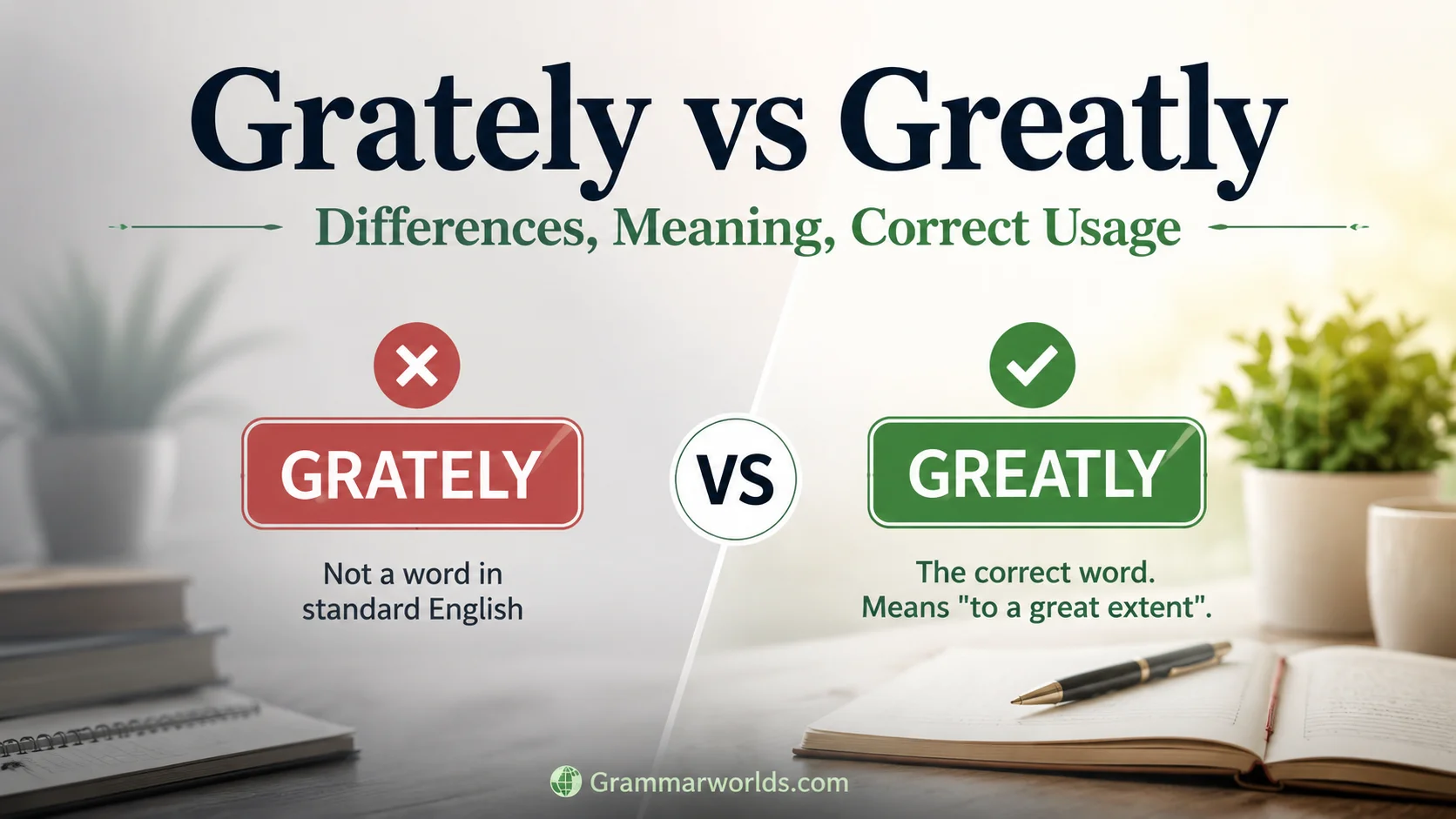
“Greatly” is a correct English word. “Grately” is not.
In this guide, you’ll learn exactly what greatly means, why people mistakenly write grately, how to use greatly correctly in different situations, and practical techniques to avoid this common spelling error forever.
Grately vs Greatly: The Quick Answer
If you’re looking for the fastest possible answer, here it is:
| Word | Correct? | Meaning |
| Grately | ❌ No | Misspelling of greatly |
| Greatly | ✅ Yes | To a large extent or degree |
The word greatly functions as an adverb. It describes the extent, degree, or intensity of an action, feeling, or condition.
Correct Examples
- We greatly appreciate your support.
- The new software greatly improved productivity.
- Her presentation greatly influenced the final decision.
- The company greatly benefited from the partnership.
Incorrect Examples
- We grately appreciate your support.
- The system grately improved performance.
- I am grately honored.
In every case above, grately should be replaced with greatly.
Is “Grately” a Real Word?
No.
Grately is not recognized as a standard English word.
You won’t find it in reputable dictionaries because it is simply a spelling mistake.
Many people assume grately exists because:
- It resembles the word “great.”
- It sounds similar to greatly in casual speech.
- Typing quickly often causes letters to be omitted.
- English spelling rules can sometimes feel inconsistent.
While grately appears online in forums, comments, and social media posts, those occurrences don’t make it a legitimate word.
Important Fact
A word appearing frequently on the internet does not automatically make it correct.
For example:
- Definately → Incorrect
- Seperate → Incorrect
- Recieve → Incorrect
- Grately → Incorrect
These words remain spelling mistakes regardless of how often people use them.
What Does Greatly Mean?
The adverb greatly means:
To a very large extent, degree, or amount.
It emphasizes the strength or significance of something.
Dictionary-Like Definition
Greatly = considerably, substantially, significantly, or to an important degree.
Think of greatly as a word that amplifies meaning.
Instead of saying:
The changes improved efficiency.
You can say:
The changes greatly improved efficiency.
The second sentence carries more impact because it shows the improvement was substantial rather than minor.
Simple Examples
- The weather greatly affected travel plans.
- Your advice greatly helped me.
- Technology has greatly changed communication.
- Exercise can greatly improve health.
In each example, greatly strengthens the statement.
Why Do People Write “Grately” Instead of “Greatly”?
The mistake is surprisingly common.
Let’s examine why.
Typing Errors
Most instances of grately result from simple typing mistakes.
When typing quickly, people often omit letters.
Compare:
- Greatly
- Grately
The missing “e” between “gr” and “ately” is easy to overlook.
Because spell-check software isn’t perfect, the error sometimes slips through unnoticed.
Pronunciation Confusion
Many native and non-native speakers pronounce greatly quickly during conversation.
When spoken fast, the middle vowel sound can become less noticeable.
As a result, some writers spell the word exactly as they hear it.
This phenomenon is common in English.
Consider these examples:
| Correct Word | Common Misspelling |
| Definitely | Definately |
| Separate | Seperate |
| Grateful | Greatful |
| Greatly | Grately |
Each mistake occurs because pronunciation influences spelling.
Autocorrect and Informal Writing
Texting, social media, and instant messaging encourage speed.
People often prioritize quick communication over perfect grammar.
Over time, repeated exposure to incorrect spellings can create the false impression that those spellings are acceptable.
That doesn’t change the fact that professional writing requires the correct form: greatly.
Side-by-Side Comparison: Grately vs Greatly
Sometimes the easiest way to understand a difference is through comparison.
| Feature | Grately | Greatly |
| Standard English word | No | Yes |
| Accepted by dictionaries | No | Yes |
| Part of speech | None | Adverb |
| Appropriate in formal writing | No | Yes |
| Appears in academic writing | No | Yes |
| Indicates degree or extent | No | Yes |
| Correct spelling | No | Yes |
The table makes the distinction crystal clear.
If you’re choosing between grately and greatly, the answer is always greatly.
How Greatly Functions in English Grammar
Understanding grammar makes correct usage much easier.
Greatly is an adverb.
Adverbs modify:
- Verbs
- Adjectives
- Other adverbs
Most commonly, greatly modifies verbs.
Greatly Modifying Verbs
Examples:
- We greatly appreciate your patience.
- The investment greatly increased profits.
- The update greatly reduced loading times.
- Education greatly influences career opportunities.
Here, greatly explains the extent of the action.
Greatly Modifying Adjectives
Examples:
- I am greatly honored.
- She was greatly relieved.
- They were greatly disappointed.
- The audience was greatly impressed.
In these cases, greatly intensifies the adjective.
Greatly Modifying Participles
Examples:
- Greatly respected
- Greatly admired
- Greatly valued
- Greatly appreciated
These combinations appear frequently in professional communication.
How to Use Greatly Correctly
The best way to master a word is through practical examples.
Greatly + Appreciate
One of the most common combinations in English.
Examples:
- We greatly appreciate your assistance.
- I greatly appreciate your understanding.
- Your support is greatly appreciated.
- The team greatly appreciates your feedback.
Greatly + Improve
Examples:
- The software greatly improved efficiency.
- Better training greatly improves performance.
- Exercise greatly improves mental health.
- The redesign greatly improved user experience.
Greatly + Benefit
Examples:
- Students greatly benefited from the workshop.
- The company greatly benefited from automation.
- Communities greatly benefit from investment.
- Patients greatly benefit from early treatment.
Greatly + Affect
Examples:
- Weather greatly affected crop production.
- Economic conditions greatly affect spending habits.
- Technology greatly affects daily life.
- Leadership greatly affects workplace culture.
These combinations appear frequently because they sound natural and professional.
Common Phrases That Use “Greatly”
Certain expressions have become standard in modern English.
You’ll encounter them repeatedly in professional, academic, and personal communication.
Greatly Appreciated
Perhaps the most common phrase.
Examples:
- Your help is greatly appreciated.
- Any feedback would be greatly appreciated.
- Donations are greatly appreciated.
Greatly Respected
Examples:
- She is a greatly respected researcher.
- He became a greatly respected leader.
- The professor remains greatly respected within the field.
Greatly Missed
Examples:
- He will be greatly missed.
- The retiring teacher will be greatly missed.
- Her contributions will be greatly missed.
Greatly Influenced
Examples:
- The author was greatly influenced by history.
- Modern design was greatly influenced by technology.
- Consumer behavior is greatly influenced by social media.
Greatly Reduced
Examples:
- Automation greatly reduced costs.
- The vaccine greatly reduced infection rates.
- New policies greatly reduced waste.
Real-World Examples of Greatly in Different Contexts
Language becomes easier to understand when viewed in real situations.
Business Communication
Professional writing often uses greatly because it conveys appreciation and significance.
Examples:
We greatly appreciate your continued partnership.
Your feedback has greatly assisted our development team.
The new strategy greatly increased customer retention.
Academic Writing
Researchers frequently use greatly when discussing findings.
Examples:
Climate conditions greatly influence crop yields.
The intervention greatly improved learning outcomes.
Early detection greatly reduces treatment complications.
Customer Service
Companies use greatly to sound polite and professional.
Examples:
Your patience is greatly appreciated.
We greatly value your business.
Customer suggestions greatly help us improve.
Personal Communication
Examples:
I greatly enjoyed meeting you.
Your kindness greatly helped me.
We greatly appreciate everything you’ve done.
The word works well in both formal and informal settings.
Also Read This :Atleast or At Least? Which One Is Correct?
Why Using the Correct Spelling Matters
Some people dismiss spelling as unimportant.
In reality, correct spelling affects how others perceive your writing.
Professional Credibility
Imagine receiving two emails.
Email A:
We grately appreciate your business.
Email B:
We greatly appreciate your business.
Which company appears more professional?
Most readers immediately trust the second version more.
Small details create lasting impressions.
Academic Performance
Teachers and professors evaluate writing quality.
Repeated spelling mistakes may:
- Lower grades
- Reduce clarity
- Distract readers
- Weaken arguments
Using greatly correctly helps maintain a polished presentation.
Business Reputation
Companies invest heavily in communication.
Spelling errors can:
- Damage credibility
- Create negative first impressions
- Reduce customer trust
Professional writing requires accuracy.
Common Spelling Mistakes Related to Greatly
People who misspell greatly often make similar errors with other words.
Let’s examine a few.
Greatful vs Grateful
Incorrect:
❌ Greatful
Correct:
✅ Grateful
Remember:
Grateful comes from gratitude, not great.
Example:
I am grateful for your support.
Definately vs Definitely
Incorrect:
❌ Definately
Correct:
✅ Definitely
Example:
I will definitely attend the meeting.
Seperate vs Separate
Incorrect:
❌ Seperate
Correct:
✅ Separate
Example:
Please keep the documents separate.
Recieve vs Receive
Incorrect:
❌ Recieve
Correct:
✅ Receive
Memory trick:
“I before E except after C.”
Example:
I received your message.
Alot vs A Lot
Incorrect:
❌ Alot
Correct:
✅ A lot
Example:
I learned a lot from that experience.
How to Remember the Correct Spelling of Greatly
Fortunately, remembering the correct spelling isn’t difficult.
Use the Base Word Method
Start with the word:
Great
Then add:
-ly
Result:
Great + ly = Greatly
The spelling stays intact.
No letters disappear.
Visual Memory Trick
Picture the word in two pieces:
Great | ly
The complete word becomes easier to recall.
Proofreading Technique
Before sending important documents:
- Read slowly.
- Check commonly misspelled words.
- Use spell-check tools.
- Review key phrases manually.
This habit catches most spelling errors.
Read Backward
Professional editors often review text backward.
Why?
Because it forces attention onto individual words instead of sentence meaning.
The technique quickly exposes spelling mistakes.
Examples of Correct and Incorrect Usage
The following table provides a quick reference guide.
| Incorrect | Correct |
| We grately appreciate your help. | We greatly appreciate your help. |
| Your support is grately appreciated. | Your support is greatly appreciated. |
| The update grately improved performance. | The update greatly improved performance. |
| She was grately influenced by her mentor. | She was greatly influenced by her mentor. |
| We were grately surprised. | We were greatly surprised. |
Notice that every incorrect sentence becomes correct by replacing grately with greatly.
Quick Rule to Remember Forever
If you’re ever unsure, ask yourself:
Does the word come from “great”?
If yes, the adverb form keeps the entire base word:
Great → Greatly
Not:
Great → Grately
English often forms adverbs this way:
| Adjective | Adverb |
| Quick | Quickly |
| Slow | Slowly |
| Serious | Seriously |
| Complete | Completely |
| Great | Greatly |
The pattern remains consistent.
Key Takeaways
Before we finish, let’s summarize the most important points.
- Greatly is the correct spelling.
- Grately is a misspelling.
- Greatly means “to a large extent” or “significantly.”
- Greatly functions as an adverb.
- Common phrases include “greatly appreciated,” “greatly respected,” and “greatly improved.”
- Correct spelling improves professionalism and credibility.
- The easiest memory trick is: Great + ly = Greatly.
Once you remember that simple formula, you’ll never confuse the two words again.
Final Verdict: Grately or Greatly?
The answer is straightforward.
Greatly is the only correct word in standard English.
Grately is simply a spelling mistake.
Whether you’re writing an email, preparing an academic paper, publishing content online, or sending a text message, always choose greatly when you want to express something to a significant degree.
It’s a small correction that can greatly improve your writing.
FAQs
Is grately a real word?
No. Grately is not recognized as a standard English word. It is considered a misspelling of greatly.
Why do people write grately instead of greatly?
Most people write grately because of typing mistakes, pronunciation confusion, or simple spelling errors.
What does greatly mean?
Greatly means to a large extent, significantly, considerably, or substantially.
Is greatly appreciated grammatically correct?
Yes. “Greatly appreciated” is a common and grammatically correct phrase used in both professional and personal communication.
Is greatly formal or informal?
Greatly works in both formal and informal writing. However, it appears most often in professional, academic, and business communication.
Conclusion
The debate between grately vs greatly is actually quite simple once you understand the difference. Greatly is the correct English word and means to a large extent or significantly. In contrast, grately is not a recognized word in standard English and should be avoided in formal, academic, professional, and everyday writing.Although the mistake is common, especially in emails, text messages, and online content, using the correct spelling can make your writing look more polished and credible. Whether you’re writing “greatly appreciated,” “greatly improved,” “greatly influenced,” or “greatly respected,” the rule never changes: greatly is always the correct choice.