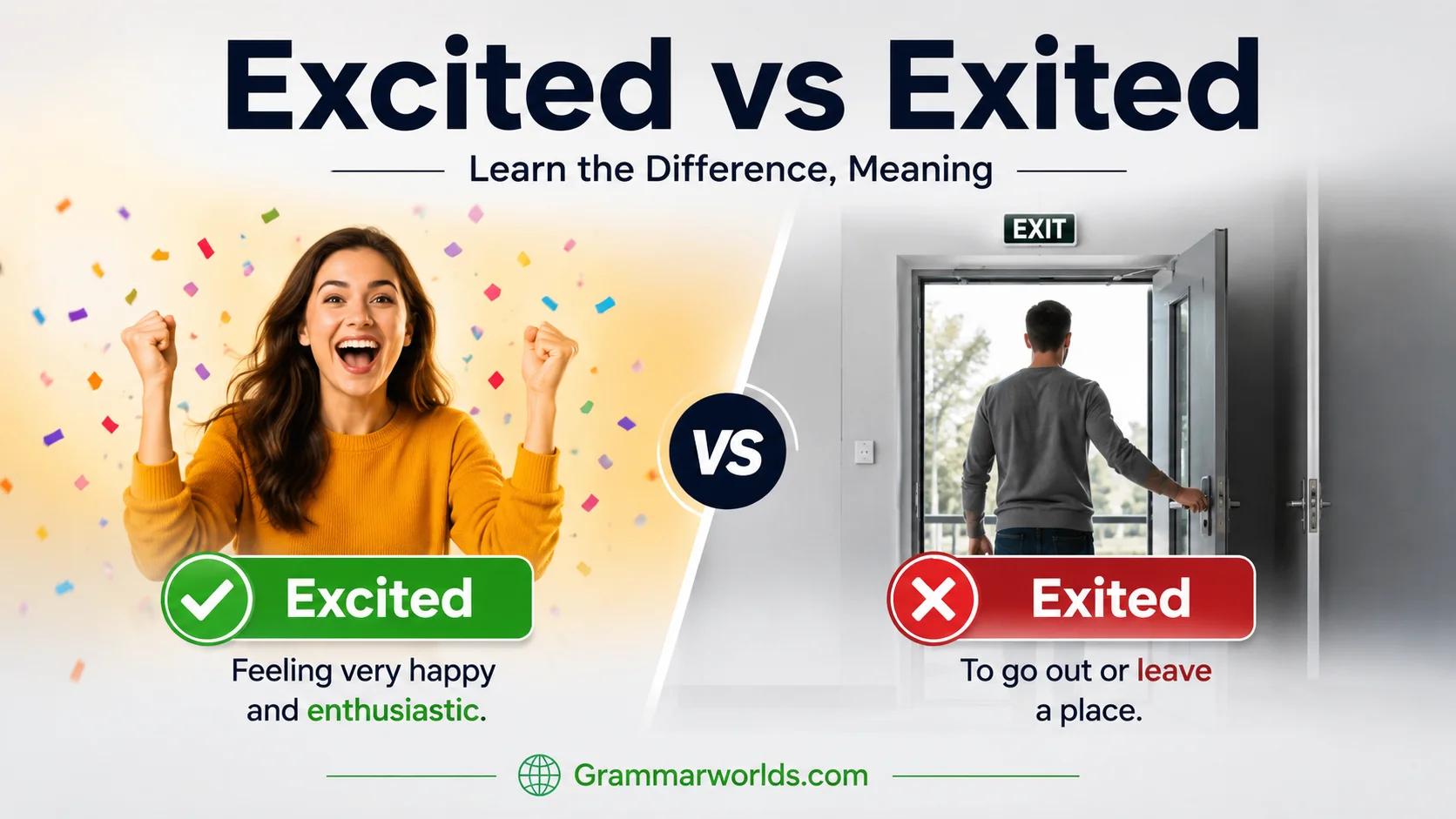
English contains many word pairs that look almost identical but carry completely different meanings. Excited vs exited is one of those confusing pairs that often causes mistakes, especially for English learners and writers.
At first glance, the difference seems tiny. The words have almost the same spelling, and they even sound similar when spoken quickly. However, adding or removing one small letter changes the entire meaning of the word.
If you say “I’m excited about my new job,” you’re talking about happiness, enthusiasm, and anticipation. But if you say “I exited my new job,” you’re saying that you left your workplace. The meaning changes completely.
Understanding the difference between excited and exited helps you communicate more clearly in conversations, emails, essays, and professional writing.
In this guide, you’ll learn:
- The meaning of excited and exited
- The grammar rules behind both words
- The pronunciation differences
- Common mistakes people make
- Real-life examples
- Easy memory tricks
- A comparison table
- A quiz to test your understanding
Let’s clear up the confusion once and for all.
Excited vs Exited: Quick Difference Explained
The simplest way to remember the difference is:
- Excited describes a feeling or emotion.
- Exited describes an action of leaving.
Here is a quick comparison:
| Word | Meaning | Grammar Role | Example |
| Excited | Feeling happy, enthusiastic, or eager | Adjective | “She is excited about her vacation.” |
| Exited | Left a place, activity, or situation | Verb (past tense of exit) | “She exited the building after work.” |
The word excited connects with emotions. It describes how someone feels when something enjoyable, surprising, or important happens.
The word exited connects with movement. It explains that someone or something moved out of a location or situation.
A simple rule:
Excited = Emotion
Exited = Exit action
Although these words look similar, they belong to different parts of speech and serve different purposes in a sentence.
What Does Excited Mean?
Excited Meaning and Definition
The word excited means feeling very happy, enthusiastic, interested, or eager about something that is happening or will happen.
People usually feel excited when they expect something positive. It could be a celebration, a new opportunity, a personal achievement, or an enjoyable experience.
For example:
- “I’m excited about my birthday party.”
- “The students were excited to meet their new teacher.”
- “She felt excited after receiving the acceptance letter.”
In each example, excited describes an emotional reaction.
You cannot physically see excitement, but you can notice it through someone’s behavior. A person who feels excited might smile more, speak faster, or show extra energy.
Think about a child waiting for a surprise gift. They may ask questions, jump around, or keep checking the clock. That feeling of anticipation is excitement.
How to Use Excited in a Sentence
The word excited usually works as an adjective. It describes a person’s emotional state.
Common sentence patterns include:
Excited + About + Noun
Use this structure when you feel enthusiastic about something.
Examples:
- “I’m excited about my upcoming trip.”
- “He is excited about the new project.”
- “They were excited about the concert.”
Here, the word after about explains the reason for the excitement.
Excited + To + Verb
Use this structure when someone looks forward to doing something.
Examples:
- “I’m excited to start my new job.”
- “She’s excited to learn Spanish.”
- “We’re excited to visit the museum.”
This pattern focuses on an upcoming action.
Excited + That + Sentence
Use this structure when explaining a situation that creates excitement.
Examples:
- “I’m excited that you’re joining us.”
- “She was excited that her application was accepted.”
- “They’re excited that the company is growing.
Examples of Excited in Everyday Situations
The word excited appears in many areas of life.
School Examples
- “The students were excited about the science experiment.”
- “She was excited to graduate from college.”
Students often feel excited when they experience something new or achieve an important goal.
Workplace Examples
- “We’re excited to announce our new product.”
- “The team is excited about the upcoming project.”
Companies often use excited in announcements because it creates positive energy.
For example:
“We’re excited to welcome our new employees.”
This sentence shows enthusiasm and creates a friendly tone.
Travel Examples
- “I’m excited about my first international flight.”
- “They were excited to explore a new city.”
Travel often creates excitement because it involves adventure, discovery, and new experiences.
What Does Exited Mean?
Exited Meaning and Definition
The word exited is the past tense and past participle form of the verb exit.
It means that someone or something left a place, activity, organization, or situation.
Examples:
- “The passengers exited the airplane safely.”
- “He exited the room quietly.”
- “The company exited the market.”
Unlike excited, this word does not describe feelings. It describes an action.
When someone exits, they move from inside something to outside something.
A simple way to imagine it:
If a person walks through a door and leaves a building, they exit the building.
If a person feels happy because they are going somewhere exciting, they are excited.
How to Use Exited in a Sentence
Because exited comes from the verb exit, it usually describes an action.
Common sentence patterns include:
Subject + Exited + Place
Examples:
- “She exited the office at 6 PM.”
- “The customers exited the store.”
- “The players exited the field.”
The sentence explains where someone left.
Subject + Exited + Situation
Examples:
- “The company exited the competition.”
- “The investor exited the market.”
- “The team exited the tournament.”
Here, exited means leaving a situation rather than physically leaving a building.
Excited vs Exited: Key Differences
Understanding the main differences makes these words easier to remember.
| Feature | Excited | Exited |
| Meaning | Feeling happy or enthusiastic | Leaving a place or situation |
| Word type | Adjective | Verb |
| Root word | Excite | Exit |
| Describes | Feelings | Actions |
| Related word | Excitement | Exit |
| Example | “I’m excited for the event.” | “I exited the event early.” |
The biggest difference is that one describes an internal feeling, while the other describes an external action.
Why Do People Confuse Excited and Exited?
Many people confuse these words because English spelling and pronunciation can be tricky.
Both words:
- Begin with similar letters
- Have similar sounds
- Contain the same ending letters
- Are often used in everyday conversations
However, their meanings come from completely different roots.
Excited comes from the verb excite, which means to create enthusiasm or strong feelings.
Exited comes from the verb exit, which means to leave.
The confusion usually happens when someone writes quickly and focuses on sound instead of meaning.
For example:
Incorrect:
“I’m exited to see you tomorrow.”
The writer means they feel happy and eager.
Correct:
“I’m excited to see you tomorrow.”
Common Mistakes When Using Excited and Exited
Using Exited to Describe Feelings
Incorrect:
“I’m exited about my new car.”
This means:
“I left my new car.”
That is probably not the intended message.
Correct:
“I’m excited about my new car.”
Using Excited When Someone Leaves
Incorrect:
“He excited the building at noon.”
Correct:
“He exited the building at noon.”
The person did not feel enthusiastic about the building. They left it.
Confusing Similar English Words
English has many word pairs that create confusion.
Examples:
| Incorrect Pair | Correct Difference |
| Affect vs Effect | Affect is usually an action; effect is usually a result |
| Accept vs Except | Accept means receive; except means excluding |
| Advice vs Advise | Advice is a noun; advise is a verb |
| Excited vs Exited | Emotion vs leaving |
Learning these pairs improves both writing and speaking skills.
Also Read This : Meating vs Meeting: Difference, Meaning, and Correct Usage
How to Remember the Difference Between Excited and Exited
Memory tricks make confusing words easier to master.
Memory Trick: Excited Has an Extra “C” for Celebration
The word excited contains the letter C.
Think:
C = Celebration
Celebrations create excitement.
Examples:
- Birthday parties
- Weddings
- Vacations
- Achievements
When something makes you happy, you feel excited.
Memory Trick: Exited Contains Exit
The word exited contains the word:
Exit
If someone leaves, they use an exit.
Examples:
- Exit a building
- Exit a car
- Exit a meeting
- Exit a competition
Simple Reminder
Your heart feels excited. Your feet exit.
This small sentence can help you remember the difference instantly.
Excited vs Exited Examples
Examples Using Excited
- “I’m excited to watch the new movie.”
- “She was excited about her promotion.”
- “The children were excited when they saw the gift.”
- “We’re excited to start this journey.”
- “He feels excited about learning a new skill.”
Examples Using Exited
- “The passengers exited the bus.”
- “She exited the conference before the final speech.”
- “The athlete exited the competition.”
- “The employees exited the building after the alarm.”
- “The company exited the international market.”
Excited vs Exited in Different Contexts
Business Context
Both words appear frequently in professional communication.
Examples:
Excited:
“We’re excited to introduce our latest service.”
This creates enthusiasm.
Exited:
“The company exited the market after several challenges.”
This describes a business decision.
Technology Context
Technology companies often use both words.
Examples:
- “Users are excited about the new software update.”
- “The company exited an outdated technology market.”
The first example describes emotions.
The second describes a strategic decision.
Travel Context
Travel provides easy examples.
Excited:
“She was excited about visiting Japan.”
Exited:
“She exited the airport after collecting her luggage.”
One describes anticipation. The other describes movement.
FAQs
Is excited the same as exited?
No. Excited and exited have completely different meanings.
Excited describes happiness, enthusiasm, or anticipation.
Exited means someone left a place, activity, or situation.
Is exited a correct English word?
Yes. Exited is a correct English word.
It is the past tense of the verb exit.
Example:
“She exited the building.”
How do you use excited in a sentence?
Use excited when describing feelings.
Examples:
- “I’m excited about the trip.”
- “She is excited to start school.”
- “They were excited about the results.”
How do you use exited in a sentence?
Use exited when someone leaves.
Examples:
- “He exited the car.”
- “The audience exited the theater.”
- “The company exited the industry.”
Why do people confuse excited and exited?
People confuse these words because they look and sound similar.
The difference becomes clear when you focus on meaning:
- Excited = emotion
- Exited = leaving
Conclusion
The difference between excited vs exited is simple once you understand the meaning behind each word.
Excited describes a feeling of happiness, enthusiasm, or anticipation. You use it when something makes you feel positive or eager.
Exited describes an action. You use it when someone leaves a place, activity, or situation.
Remember this simple rule:
Your heart gets excited, but your body exits.
By keeping this difference in mind, you’ll avoid one of the most common spelling mistakes in English and communicate with greater confidence.