Have you ever stopped while writing and wondered whether courtesy or curtesy is the correct spelling? You’re not alone. These two words look almost identical, yet they have very different meanings. In fact, one belongs in everyday English while the other survives mainly in historical legal texts.
Many writers accidentally replace courtesy with curtesy because the words sound similar. Spell-checkers don’t always catch the mistake either, especially when curtesy appears as a legitimate historical term. That confusion leads to awkward emails, school assignments, blog posts, and professional documents.
The good news? Once you understand the difference, you’ll never mix them up again.
This complete guide explains the meaning, usage, pronunciation, history, examples, and common mistakes surrounding Courtesy vs Curtesy. By the end, you’ll know exactly which word to use in every situation.
Courtesy vs Curtesy: What’s the Difference?
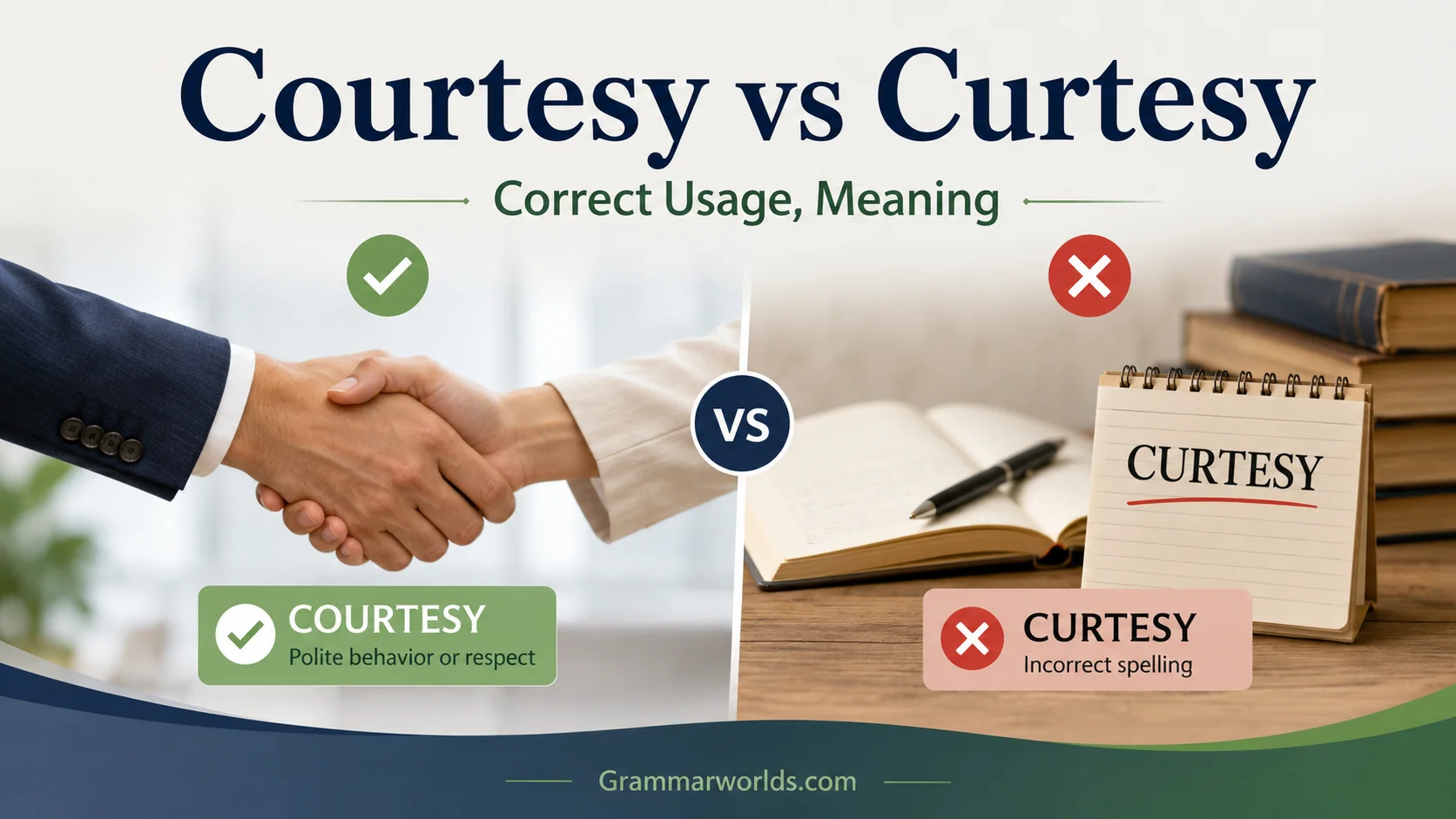
Although courtesy and curtesy differ by just one letter, they represent completely different ideas.
- Courtesy means politeness, respect, good manners, or a thoughtful act toward others.
- Curtesy is an old legal term that refers to a husband’s historical right to inherit property from his deceased wife’s estate under specific legal conditions.
For almost every modern conversation, email, essay, or article, courtesy is the correct choice.
Quick Comparison
| Feature | Courtesy | Curtesy |
| Meaning | Politeness, respect, good manners | Historical legal inheritance right |
| Modern Usage | Very common | Extremely rare |
| Part of Speech | Noun | Noun |
| Everyday English | Yes | No |
| Common Mistake | Often misspelled as “Curtesy” | Mistakenly used instead of “Courtesy” |
Simple rule:
If you’re talking about being polite, respectful, or kind, use Courtesy.
Is “Courtesy” or “Curtesy” Correct?
The answer depends entirely on what you’re trying to say.
If you’re discussing manners, customer service, respect, or polite behavior, the correct spelling is Courtesy.
For example:
✅ Thank you for your courtesy.
✅ She treated everyone with courtesy.
✅ Common courtesy makes workplaces more pleasant.
Now compare those with incorrect examples.
❌ Thank you for your curtesy.
❌ He showed great curtesy during the meeting.
These are spelling mistakes because the writer intended to use courtesy, not the historical legal word curtesy.
The only time curtesy is technically correct is when discussing medieval or historical property law.
What Does “Courtesy” Mean?
The word courtesy refers to behavior that shows kindness, respect, consideration, and good manners.
It often describes actions that make other people feel valued or comfortable.
Dictionary Meaning
Courtesy (noun)
A polite attitude or respectful behavior toward other people.
It can also describe something offered free of charge as a gesture of goodwill.
Examples include:
- Complimentary hotel transportation
- Free tickets
- Free refreshments
- Complimentary upgrades
These are often called courtesy services.
Pronunciation of Courtesy
Courtesy
Pronounced:
/KUR-tuh-see/
The pronunciation remains consistent across American English.
Origin of Courtesy
The word traces back to the Old French word courtoisie, meaning behavior suitable for a royal court.
Eventually, Middle English adopted the word as courtesy, referring to refined manners and respectful conduct.
Its history explains why the word still carries a sense of elegance and respect today.
Courtesy vs Curtesy: Side-by-Side Comparison
| Feature | Courtesy | Curtesy |
| Definition | Politeness and respectful behavior | Husband’s historical inheritance right |
| Common Today | Yes | Rare |
| Used in Conversation | Daily | Almost never |
| Used in Law | Occasionally | Historical property law |
| Appropriate in Business Writing | Yes | No |
| Appropriate in Emails | Yes | No |
| Appropriate in Essays | Yes | Only in legal history |
This comparison highlights why confusing the two words can change the meaning of your writing completely.
When to Use “Courtesy”
You should use courtesy whenever you’re referring to respectful behavior or thoughtful actions.
Here are the most common situations.
Courtesy in Everyday Conversations
Politeness helps build stronger relationships.
Examples:
- Please accept my sincere thanks for your courtesy.
- He always speaks with courtesy.
- A little courtesy goes a long way.
- Everyone deserves basic courtesy.
Courtesy in Professional Communication
Employers value employees who communicate respectfully.
Professional courtesy includes:
- Responding promptly
- Speaking politely
- Respecting deadlines
- Listening carefully
- Thanking coworkers
Example:
Thank you for your professional courtesy throughout the project.
Also Read This : Excited vs Exited: Learn the Difference, Meaning
Courtesy in Customer Service
Excellent customer service depends heavily on courtesy.
Businesses encourage employees to:
- Smile
- Listen patiently
- Speak respectfully
- Solve problems calmly
- Thank customers
Example:
The receptionist handled every visitor with courtesy.
Courtesy in Schools
Teachers often encourage students to practice courtesy.
Examples include:
- Waiting your turn
- Saying “please”
- Saying “thank you”
- Respecting classmates
- Helping others
Courtesy creates a positive learning environment.
Courtesy in Formal Writing
Formal letters often include the word courtesy.
Example:
We appreciate your courtesy and cooperation.
It adds professionalism without sounding overly formal.
When Is “Curtesy” Used?
Most people never need this word.
However, historians and legal scholars still discuss it when studying property law.
For example:
Under the doctrine of curtesy, the husband received a life estate in the land.
Another example:
The legal concept of curtesy influenced inheritance laws for centuries.
Outside legal history, avoid using it.
FAQs
Is “Curtesy” a misspelling of “Courtesy”?
Not always. Curtesy is a real English word, but it has a very specific historical legal meaning. In modern writing, most people who type curtesy actually mean courtesy, which refers to politeness, respect, or good manners. Unless you’re discussing old property laws, courtesy is almost always the correct choice.
Why does the word “Curtesy” appear in legal books?
The word curtesy appears in legal books because it was once an important concept in English common law. It described a husband’s right to use or inherit his deceased wife’s property under certain conditions. Although many modern legal systems have abolished this doctrine, the term still appears in historical legal documents and academic discussions.
Can I use “Curtesy” in modern writing?
In most situations, no. If you’re writing an email, article, report, business document, or school assignment, you should use courtesy when referring to polite behavior or respect. Reserve curtesy only for discussions of historical property law or legal history.
What does “Courtesy of” mean?
The phrase “courtesy of” means something has been provided by a person, company, or organization as a favor, sponsorship, or complimentary service. For example:
- The event refreshments were courtesy of a local bakery.
- Photos courtesy of the city museum.
It is commonly used in advertising, journalism, events, and everyday communication.
How can I remember the correct spelling?
An easy memory trick is to connect courtesy with courtly manners and courteous behavior. Both words begin with cour-, making them easy to associate with politeness and respect. Remember that curtesy belongs to historical law, not everyday English. If you’re talking about kindness or good manners, choose courtesy every time.
Conclusion
Understanding the difference between Courtesy vs Curtesy is easier than it first appears. While the two words look similar, they have entirely different meanings and uses.
Courtesy is the word you’ll use in almost every situation. It refers to politeness, respect, kindness, and thoughtful behavior. Whether you’re writing a professional email, speaking with customers, thanking someone, or discussing good manners, courtesy is the correct spelling.Whenever you’re unsure, ask yourself a simple question: Am I talking about politeness or historical law? If the answer is politeness, the correct word is courtesy.Using the right spelling not only improves your writing but also makes your communication clearer and more professional. By remembering the distinction, you’ll avoid one of the most common spelling mistakes and write with greater confidence every time.