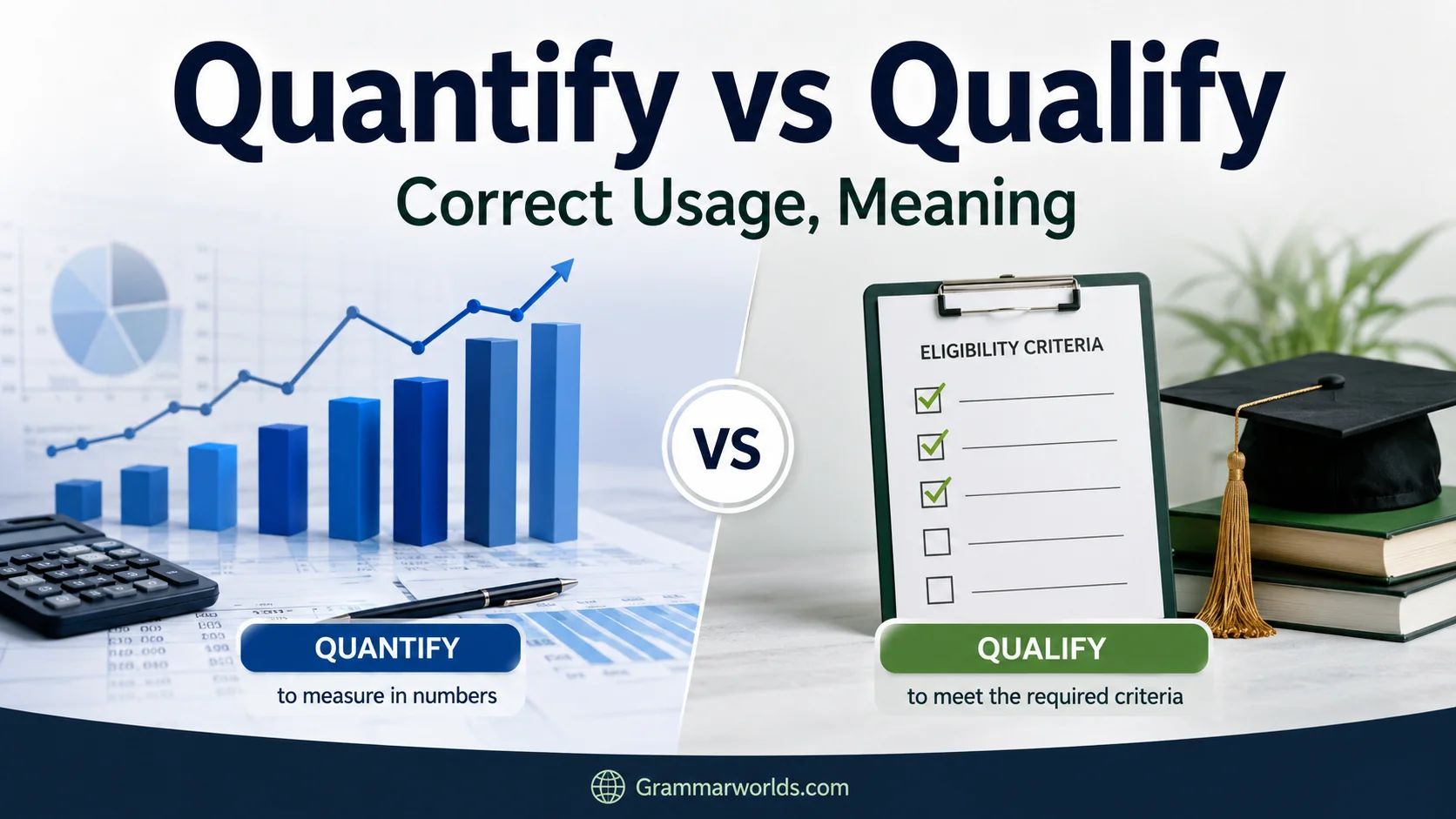
English has many word pairs that look and sound similar but carry completely different meanings. Quantify vs Qualify is one of those confusing pairs. Although both words start with “quali” and appear often in professional, academic, and everyday conversations, they describe two very different ideas.
The easiest way to separate them is simple:
- Quantify means to measure something using numbers or amounts.
- Qualify means to meet requirements, become eligible, or add limits and details to a statement.
For example:
- A scientist might quantify the amount of pollution in a river by measuring chemical levels.
- A student might qualify for a scholarship by meeting specific academic requirements.
One word focuses on measurement. The other focuses on conditions, standards, or descriptions.
Understanding the difference between quantify vs qualify helps you write more clearly, especially in business reports, research papers, applications, and professional communication.
Quantify vs Qualify at a Glance
Before exploring each word in detail, here is a quick comparison:
| Feature | Quantify | Qualify |
| Meaning | To measure or express something as a number | To meet requirements or describe something more accurately |
| Main Idea | Quantity (how much) | Quality, conditions, or eligibility |
| Focus | Numbers and measurements | Standards, limits, or qualifications |
| Common Fields | Science, statistics, business, research | Education, jobs, sports, grammar |
| Example | “Researchers quantified the amount of water waste.” | “She qualified for the final competition.” |
| Related Word | Quantity | Qualification |
A helpful memory trick:
Quantify = Quantity = Numbers
Qualify = Qualifications = Requirements
If you are counting, measuring, or calculating something, you probably need quantify.
If you are talking about eligibility, skills, conditions, or exceptions, you probably need qualify.
What Does “Quantify” Mean?
The word quantify means to measure something and express it as a number, amount, or value.
When you quantify something, you take an idea, object, behavior, or result and turn it into measurable information.
For example:
- “The company quantified its customer growth over five years.”
- “Researchers quantified the level of bacteria in the water sample.”
- “The manager wants to quantify employee productivity.”
In each sentence, something becomes measurable.
You cannot simply say that productivity improved. To quantify it, you might measure:
- Sales numbers
- Completed projects
- Customer satisfaction scores
- Working hours
- Revenue growth
The word comes from quantity, which refers to an amount or number.
When Should You Use Quantify?
You should use quantify when you need to show exact measurements, statistics, or numerical evidence.
Here are common situations where people use this word:
Quantify in Science and Research
Scientists frequently quantify information because research depends on measurable results.
For example:
“The study quantified the effects of exercise on heart health.”
This means researchers measured specific effects, such as:
- Heart rate changes
- Blood pressure levels
- Weight changes
- Fitness improvements
A scientist does not simply say exercise helps people. They collect data and quantify the results.
Quantify in Business and Marketing
Businesses often quantify performance to make better decisions.
A company might quantify:
- Monthly revenue
- Website visitors
- Customer retention rates
- Advertising results
- Product sales
Example:
“The marketing team quantified the campaign’s success by tracking a 35% increase in online sales.”
The percentage provides measurable proof.
Quantify in Everyday Life
Although it sounds like a technical word, people use the idea of quantifying every day.
Examples:
- “Can you quantify how much time you spend on social media?”
- “The coach quantified the team’s improvement using performance statistics.”
- “The survey quantified customer opinions through ratings.”
Whenever you ask “How much?”, you are usually looking for something that can be quantified.
What Does “Qualify” Mean?
The word qualify has several meanings, which makes it more confusing than quantify.
Generally, qualify means to meet a requirement, become eligible, or add more detail to a statement.
The meaning depends on the situation.
Quantify vs Qualify Examples in Sentences
| Sentence | Correct Word | Explanation |
| “The researcher quantified the amount of carbon emissions.” | Quantify | The researcher measured an amount. |
| “She qualified for the scholarship.” | Qualify | She met the requirements. |
| “The company quantified its annual profits.” | Quantify | Profits can be measured numerically. |
| “He is qualified to operate the equipment.” | Qualify | He has the necessary skills. |
| “The report quantified customer satisfaction levels.” | Quantify | Satisfaction was measured using data. |
| “The lawyer qualified her statement with additional details.” | Qualify | She added limitations or clarification. |
When Should You Use “Quantify”?
Use quantify when you need measurable evidence.
Common examples include:
Measuring Results
Instead of saying:
“The project improved productivity.”
You can quantify it:
“The project improved productivity by 20%.”
The second sentence gives measurable information.
Supporting Arguments
Strong arguments often rely on quantified evidence.
Compare:
Weak:
“Many people prefer online shopping.”
Quantified:
“A survey showed that 72% of customers preferred online shopping.”
Numbers make claims stronger.
Analyzing Problems
Businesses and researchers quantify problems before solving them.
For example:
A company notices customers are leaving.
Instead of guessing, it measures:
- Cancellation rates
- Customer complaints
- Response times
After quantifying the problem, leaders can create solutions.
When Should You Use “Qualify”?
Use qualify when discussing standards, eligibility, or explanations.
Jobs and Careers
Employers use qualifications to determine whether someone fits a role.
Example:
“The applicant qualifies for the position because she has five years of experience.”
The focus is not a measurement. It is whether she meets expectations.
Education
Schools often use qualify when students meet academic requirements.
Examples:
- “Students must qualify for admission.”
- “He qualified for the advanced course.”
The student reaches a required level.
Sports
Athletes and teams qualify when they earn a place in a competition.
Examples:
- “The team qualified for the World Cup.”
- “The runner qualified for the finals.”
They met performance standards.
Common Mistakes When Using Quantify and Qualify
Many people confuse these words because they both relate to evaluation. However, they answer different questions.
Mistake: Using Qualify for Numbers
Incorrect:
“The study qualified the amount of rainfall.”
Correct:
“The study quantified the amount of rainfall.”
Why?
Rainfall amount is measurable, so quantify is correct.
Mistake: Using Quantify for Eligibility
Incorrect:
“She quantified for the scholarship.”
Correct:
“She qualified for the scholarship.”
Why?
The scholarship depends on requirements, not numbers.
Mistake: Confusing Qualification With Quantification
These words look similar but describe different processes.
| Word | Process |
| Quantification | Turning information into measurable data |
| Qualification | Meeting standards or requirements |
Example:
A university may qualify students for admission by checking grades.
Researchers may quantify student performance by analyzing test scores.
Easy Trick to Remember Quantify vs Qualify
Here is the simplest way to remember:
Quantify Starts With “Quant”
Think:
Quantity = Amount = Numbers
Examples:
- How many?
- How much?
- What percentage?
Use quantify.
Qualify Starts With “Qual”
Think:
Quality = Qualifications = Standards
Examples:
- Is someone capable?
- Does someone meet requirements?
- Does a statement need clarification?
Use qualify.
Related Words Often Confused With Quantify and Qualify
Measure vs Quantify
Both involve evaluation, but they are slightly different.
Measure means finding the size, amount, or degree of something.
Quantify specifically means expressing something numerically.
Example:
- “The doctor measured my temperature.”
- “The researcher quantified disease patterns using statistics.”
Evaluate vs Qualify
Evaluate means judge the value or performance of something.
Qualify means meet requirements or add conditions.
Example:
- “The manager evaluated employee performance.”
- “The employee qualified for promotion.”
Assess vs Quantify
Assess means examine or judge.
Quantify means measure with numbers.
Example:
- “The teacher assessed student progress.”
- “The teacher quantified progress using test scores.”
Quantify vs Qualify Practice Quiz
Choose the correct word.
Sentence 1:
“The scientist wanted to ___ the amount of chemical waste.”
Answer: Quantify
Sentence 2:
“She worked hard to ___ for the Olympic team.”
Answer: Qualify
Sentence 3:
“The company used statistics to ___ customer satisfaction.”
Answer: Quantify
Sentence 4:
“He is highly ___ for the engineering position.”
Answer: Qualified
Sentence 5:
“The speaker needed to ___ his previous statement.”
Answer: Qualify
FAQs
Is quantify the same as qualify?
No. Quantify means measuring something using numbers, while qualify means meeting requirements, having skills, or adding details to a statement.
Can quantify refer to something that is not numerical?
Usually, quantifying involves numbers. However, some things that seem difficult to measure, such as emotions or opinions, can become quantified through surveys, ratings, or statistical analysis.
For example:
A company can quantify customer happiness using a 1–10 satisfaction scale.
Does qualify always mean becoming eligible?
No. Qualify can also mean adding clarification or limits to a statement.
Example:
“I support the plan, but I qualify my agreement because the budget is limited.”
Which word is more common in research papers?
Quantify appears frequently in research because studies often involve measurements, data collection, and statistical analysis.
How can I remember the difference between quantify and qualify?
Remember:
Quantify = Quantity = Numbers
Qualify = Qualifications = Requirements
Ask yourself:
“Am I measuring something?” → Quantify
“Am I checking requirements or adding details?” → Qualify
Conclusion
The difference between quantify vs qualify becomes easy once you understand their main purposes.
Quantify focuses on measurement. It turns information into numbers, statistics, or amounts.
Qualify focuses on conditions. It explains whether someone meets requirements, has the necessary skills, or needs additional clarification.
A quick reminder:
- Quantify = How much? How many?
- Qualify = Does it meet the standard? What conditions apply?
Whether you are writing a report, preparing an application, or improving your English vocabulary, choosing the right word makes your message clearer and more professional.