Language can be surprisingly tricky. Some words look nearly identical yet carry very different meanings. Emersion and immersion are perfect examples.
At first glance, many people assume these terms are interchangeable. After all, they differ by only one letter. However, using the wrong word can completely change the meaning of a sentence, especially in scientific, academic, and professional writing.
While immersion appears frequently in everyday conversations, education, technology, gaming, and business, emersion remains a specialized term that mostly appears in scientific and technical fields.
Understanding the distinction between these words will help you communicate more accurately and avoid one of the most common vocabulary mistakes related to physical and figurative experiences.
In this guide, you’ll learn the exact difference between emersion vs. immersion, when to use each term, common mistakes to avoid, and practical examples from real-world contexts.
Emersion vs. Immersion: Quick Answer
The simplest way to understand the difference is this:
- Immersion means entering into something, becoming surrounded by it, or becoming deeply involved in it.
- Emersion means emerging from something, especially from water or another surrounding medium.
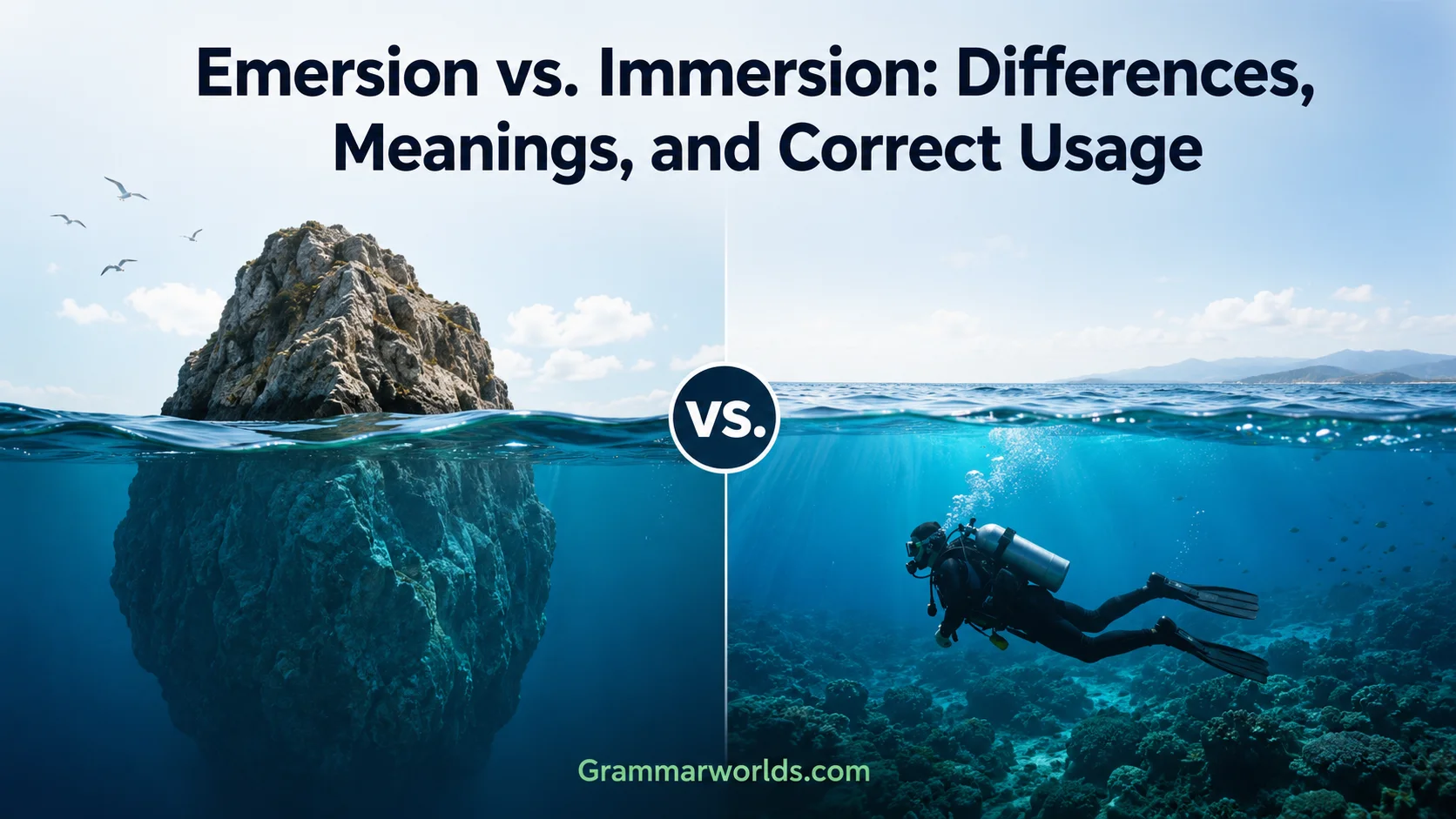
Think about a scuba diver.
When the diver goes underwater, that is immersion.
When the diver comes back to the surface, that is emersion.
Quick Comparison Table
| Feature | Emersion | Immersion |
| Basic Meaning | Emerging from a medium | Entering or being surrounded by a medium |
| Direction | Outward | Inward |
| Everyday Use | Rare | Extremely common |
| Scientific Use | Common | Common |
| Figurative Use | Rare | Very common |
| Public Familiarity | Low | High |
Simple Examples
Immersion:
- The students participated in a language immersion program.
- The diver experienced complete immersion underwater.
- The virtual reality headset increased immersion in the game.
Emersion:
- The diver’s emersion occurred after a 40-minute dive.
- Scientists recorded the emersion of marine plants during low tide.
- The astronaut observed the emersion of the satellite from Earth’s shadow.
What Does Immersion Mean?
The word immersion comes from the Latin word immersio, meaning “to dip into” or “to plunge.”
Today, immersion has both literal and figurative meanings.
Literal Meaning of Immersion
In its physical sense, immersion refers to placing an object or person into a liquid or surrounding substance.
Examples include:
- Swimming underwater
- Scuba diving
- Scientific testing
- Religious baptism
- Industrial cleaning processes
When an object becomes fully submerged, it experiences immersion.
Figurative Meaning of Immersion
Modern English uses immersion more often in a figurative sense.
Instead of entering water, a person enters an experience, culture, activity, or environment.
For example:
- Reading a captivating novel
- Learning a foreign language
- Playing a realistic video game
- Exploring a virtual reality world
In each case, the individual becomes deeply engaged.
Common Types of Immersion
| Type | Description |
| Language Immersion | Learning through constant exposure to a language |
| Cultural Immersion | Experiencing another culture firsthand |
| Educational Immersion | Learning through direct participation |
| Virtual Immersion | Being fully engaged in digital environments |
| Professional Immersion | Intensive workplace training |
| Physical Immersion | Submersion in a liquid or environment |
Why Immersion Is So Powerful
Researchers often highlight immersion because it increases:
- Attention
- Retention
- Emotional engagement
- Learning speed
- Real-world understanding
For example, students who spend months in a language immersion program often develop speaking skills much faster than students who rely solely on textbooks.
The reason is simple.
The brain learns best through repeated exposure and practical use.
What Does Emersion Mean?
Unlike immersion, emersion is not a word most people encounter daily.
The term comes from the Latin word emergere, meaning “to rise out of” or “to come forth.”
Emersion refers to the process of emerging from a liquid, surrounding medium, or obstructing environment.
The Scientific Meaning of Emersion
Scientists use emersion to describe situations where something previously submerged becomes exposed.
Examples include:
- Plants rising above water
- Animals emerging from aquatic habitats
- Geological features becoming visible
- Celestial objects appearing from behind another object
The concept often appears in:
- Marine biology
- Ecology
- Oceanography
- Astronomy
- Environmental science
Everyday Example of Emersion
Imagine a beach during low tide.
At high tide, many rocks remain underwater.
As the tide retreats, those rocks become visible.
That process is called emersion.
Key Characteristics of Emersion
- Involves movement outward
- Often follows immersion
- Usually describes physical emergence
- Frequently used in scientific literature
- Rarely used in casual conversation
Example Sentences
- The emersion of the coral reef exposed delicate ecosystems.
- Researchers measured plant growth during periods of emersion.
- Divers followed standard procedures during emersion.
Emersion vs. Immersion: Side-by-Side Comparison
Because the two words describe opposite actions, comparing them directly makes the distinction easier to understand.
| Category | Emersion | Immersion |
| Direction | Coming out | Going in |
| Primary Context | Scientific | General and scientific |
| Popularity | Rare | Very common |
| Figurative Meaning | Almost none | Extensive |
| Educational Use | Limited | Common |
| Technology Use | Rare | Extremely common |
| Business Use | Rare | Common |
Visual Analogy
Imagine a submarine.
Immersion:
Surface
↓
Submarine dives underwater
Emersion:
Underwater
↑
Submarine rises to the surface
This simple visualization captures the core difference.
Why People Confuse Emersion and Immersion
Many English learners and native speakers mix up these words.
Several factors contribute to the confusion.
Similar Spellings
The words differ by only a single letter.
Compare them:
- Emersion
- Immersion
When reading quickly, the difference is easy to miss.
Similar Pronunciation Patterns
Both terms contain:
- Similar syllables
- Similar stress patterns
- Similar Latin roots
This similarity increases confusion.
Opposite Actions Within the Same Process
Consider a scuba dive.
The diver experiences:
- Immersion while entering the water.
- Emersion while leaving the water.
Because both events belong to the same activity, people often blur the distinction.
Confusion With Emergence
Many people encounter emergence far more often than emersion.
As a result, they mistakenly substitute one for the other.
However, these terms are not identical.
- Emergence = appearance or development
- Emersion = physical emergence from a surrounding medium
The difference may seem subtle, but it matters in technical writing.
Also Read This :Ally vs Allie: What’s the Difference?
Can Emersion and Immersion Be Used Interchangeably?
The short answer is no.
These words describe opposite actions.
Using one in place of the other creates inaccurate statements.
Incorrect Example
“The diver’s immersion occurred when he surfaced.”
This sentence is wrong.
Surfacing is emersion, not immersion.
Correct Example
“The diver’s emersion occurred when he surfaced.”
Now the sentence accurately describes the action.
Another Incorrect Example
“The language emersion program helped students become fluent.”
This sentence sounds strange because language learning programs use immersion, not emersion.
Correct Version
“The language immersion program helped students become fluent.”
Grammar and Usage Rules
Both words function primarily as nouns.
However, they belong to different word families.
Immersion Word Family
| Word | Part of Speech |
| Immerse | Verb |
| Immersed | Adjective |
| Immersive | Adjective |
| Immersion | Noun |
| Immersing | Verb Form |
Emersion Word Family
| Word | Part of Speech |
| Emerge | Verb |
| Emerged | Verb Form |
| Emerging | Adjective |
| Emersed | Adjective |
| Emersion | Noun |
Common Collocations for Immersion
You will frequently encounter phrases such as:
- Language immersion
- Cultural immersion
- Full immersion
- Immersive learning
- Immersive experience
- Immersion therapy
- Immersion technology
- Immersion program
Common Collocations for Emersion
These phrases appear mainly in tchnical literature:
- Tidal emersion
- Emersion period
- Plant emersion
- Reef emersion
- Satellite emersion
- Diver emersion
Real-World Examples of Immersion
Immersion extends far beyond physical submersion.
Its figurative applications have become incredibly important in modern society.
Education
Schools increasingly use immersion programs.
Students learn subjects through direct exposure instead of translation.
For example:
- Spanish immersion schools
- French immersion classrooms
- Mandarin immersion programs
Research consistently shows that prolonged exposure improves language acquisition.
Virtual Reality
Virtual reality depends heavily on immersion.
Developers create environments that feel realistic enough to make users forget their physical surroundings.
Features that improve immersion include:
- Spatial audio
- High-resolution graphics
- Motion tracking
- Interactive environments
Gaming
Gamers often discuss immersion when reviewing titles.
An immersive game creates a sense of presence.
Players feel connected to:
- Characters
- Stories
- Environments
- Missions
The stronger the emotional involvement, the greater the immersion.
Corporate Training
Many organizations now use immersive training programs.
Examples include:
- Flight simulators
- Medical simulations
- Leadership workshops
- Customer service scenarios
Employees learn through experience rather than passive observation.
Real-World Examples of Emersion
Although less common, emersion plays a critical role in several scientific disciplines.
Marine Biology
Marine organisms constantly move between submerged and exposed conditions.
Scientists use emersion to study:
- Survival mechanisms
- Water retention
- Temperature tolerance
- Feeding behavior
For example, mussels experience regular emersion during low tide.
Coastal Ecology
Tidal environments create recurring cycles of immersion and emersion.
These cycles influence:
- Species distribution
- Nutrient availability
- Reproductive patterns
- Ecosystem stability
Environmental Monitoring
Researchers track emersion events to evaluate environmental change.
Monitoring may include:
- Wetland exposure
- Reservoir fluctuations
- River dynamics
- Habitat loss
Astronomy
Astronomers use emersion in a specialized way.
The term describes a celestial body reappearing after being hidden.
For example:
- A star emerging from behind the Moon
- A satellite reappearing from Earth’s shadow
- A planet becoming visible after occultation
In astronomy, emersion marks the moment visibility returns.
Emersion vs. Immersion in Scientific Writing
Scientific writing demands precision.
Choosing the wrong term can alter the meaning of an entire study.
Biology Example
Correct:
“The species experienced prolonged emersion during seasonal low tides.”
Incorrect:
“The species experienced prolonged immersion during seasonal low tides.”
The second sentence completely changes the environmental conditions being described.
Oceanography Example
Researchers often study alternating immersion and emersion cycles.
These cycles influence:
- Oxygen availability
- Salinity exposure
- Thermal stress
- Organism adaptation
A single vocabulary error could misrepresent findings.
Astronomy Example
Astronomers carefully document:
- Immersion times
- Emersion times
These measurements help determine orbital positions and celestial movements.
Accuracy is essential.
Common Mistakes Writers Make
Even experienced writers occasionally misuse these terms.
Mistaking Emersion for a More Formal Version of Immersion
Some writers assume emersion sounds more sophisticated.
It doesn’t.
The words have different meanings.
Using Emersion in Educational Contexts
Incorrect:
- Emersion learning
- Emersion classroom
- Emersion education
Correct:
- Immersion learning
- Immersion classroom
- Immersion education
Confusing Emersion With Emergence
This mistake appears frequently in scientific and academic writing.
Remember:
- Emergence often refers to appearance or development.
- Emersion specifically refers to coming out of a surrounding medium.
Ignoring Audience Familiarity
Most readers understand immersion immediately.
Many readers have never encountered emersion.
When writing for general audiences, provide context if you use the term emersion.
Memory Trick to Remember the Difference
A simple memory technique can eliminate confusion forever.
The Letter Association Method
Immersion = In
Both words begin with the letter I.
Think:
Immersion = In
The Exit Method
Emersion = Exit
Both words begin with the letter E.
Think:
Emersion = Exit
This shortcut works surprisingly well.
Diver Visualization
Picture a diver.
Going down?
Immersion.
Coming up?
Emersion.
The image is easy to remember because it represents both concepts in a single sequence.
FAQs
Is emersion the opposite of immersion?
Yes. In physical terms, emersion generally refers to emerging from a surrounding medium, while immersion refers to entering or being submerged within that medium. They describe opposite directions of movement.
Is emersion a real word?
Absolutely. Emersion is a legitimate English word with a long history. However, it appears primarily in scientific, environmental, biological, and astronomical contexts.
Why is immersion more common?
Immersion developed numerous figurative meanings over time. Today it applies to education, technology, entertainment, business, psychology, and culture. Emersion remains largely technical, which limits its everyday use.
Can emersion be used figuratively?
In theory, yes. In practice, it rarely is. Most writers reserve emersion for physical emergence from water, shadow, or another surrounding medium.
Which word should I use in everyday writing?
In most situations, you should use immersion. The term appears frequently in common English and carries meanings readers immediately understand.
Conclusion
Although emersion and immersion look remarkably similar, they describe two very different actions. Immersion refers to entering, submerging, or becoming deeply involved in an environment, activity, or experience. Emersion, on the other hand, refers to emerging from a surrounding medium, most commonly water, and appears primarily in scientific and technical contexts.The key distinction is simple: immersion is movement inward, while emersion is movement outward. Understanding this difference helps you avoid common vocabulary mistakes and communicate more accurately, whether you’re discussing language learning, virtual reality, marine biology, environmental science, or astronomy.