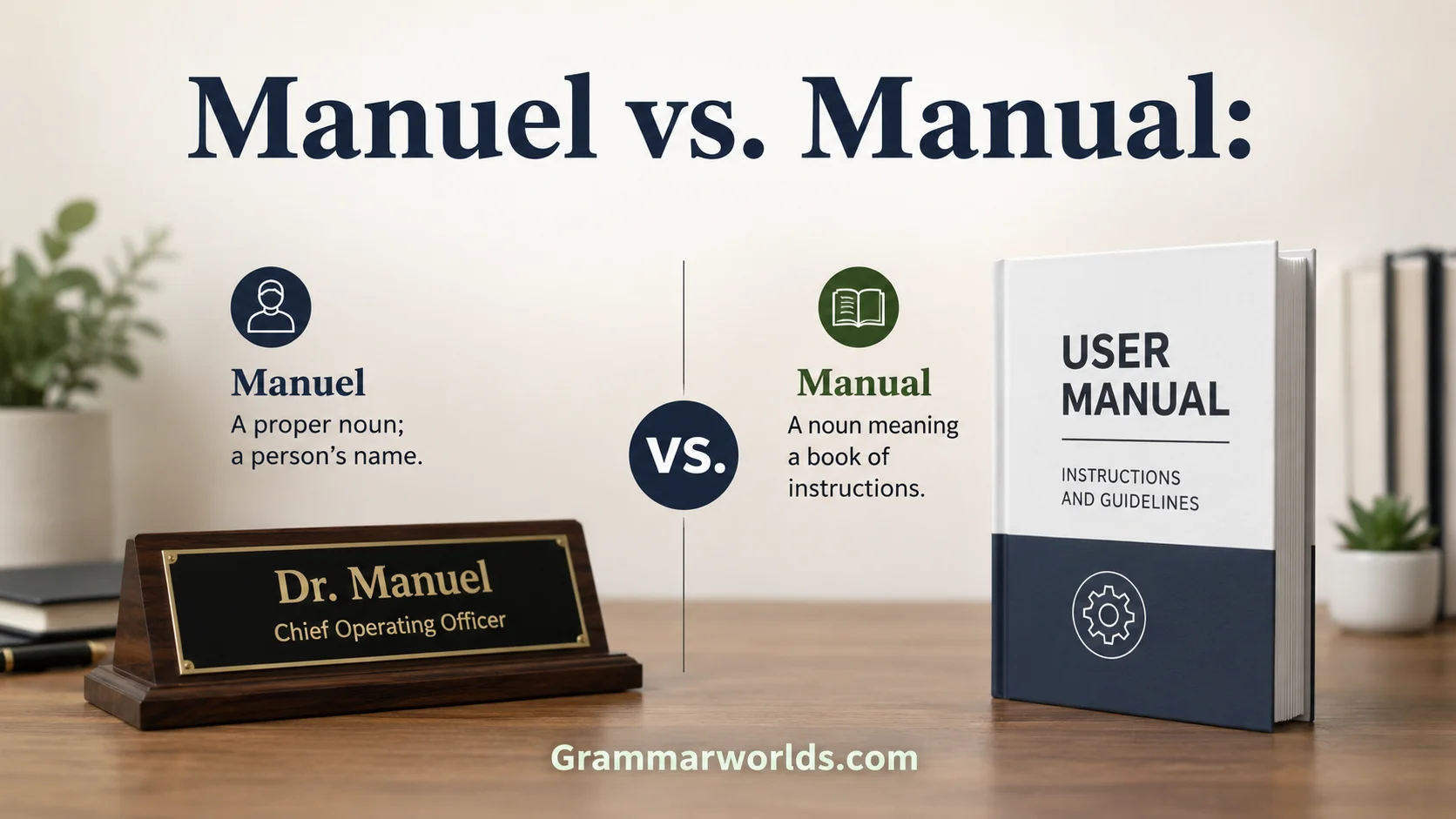
If you’ve ever stopped mid-sentence and wondered whether to write Manuel or manual, you’re not alone.
These two words look remarkably similar. In fact, only one letter separates them. Yet their meanings couldn’t be more different. One is a personal name used by millions of people worldwide. The other is a common English word that refers to instructions, handbooks, or tasks performed by hand.
Because the spelling is so close, many writers accidentally use the wrong word. The mistake often slips past spellcheck because both words are legitimate. As a result, emails, reports, academic papers, blog posts, and social media content can contain embarrassing errors that affect credibility.
The good news is that the distinction is straightforward once you understand how each word functions.
This guide explains the difference between Manuel vs. manual, shows real examples, highlights common mistakes, and provides simple memory tricks that will help you choose the correct word every time.
Manuel vs. Manual: The Quick Difference
The easiest way to understand the difference is to look at both words side by side.
| Word | Part of Speech | Meaning | Example |
| Manuel | Proper noun | A person’s name | Manuel called this morning. |
| Manual | Noun or adjective | Instructions, handbook, or something done by hand | Read the instruction manual carefully. |
The Simple Rule
Remember this:
- Manuel = a person’s name
- Manual = a handbook, guide, or something done by hand
If you’re referring to a human being, use Manuel.
If you’re referring to instructions, documentation, labor, or a process completed without automation, use manual.
That single rule solves almost every case.
What Does Manuel Mean?
The word Manuel is a personal name.
It is commonly used in Spanish-speaking countries, Portuguese-speaking regions, and several European nations. The name has existed for centuries and remains popular throughout the world.
Many people mistakenly assume Manuel is simply a misspelling of manual. In reality, Manuel is a completely separate word with its own history and cultural significance.
Origin of the Name Manuel
The name Manuel comes from the Hebrew name Immanuel, which means:
“God is with us.”
Over time, different languages developed their own versions of the name.
Examples include:
- Emmanuel
- Emanuel
- Manuel
- Manoel
Today, Manuel remains a common first name in countries such as:
- Spain
- Portugal
- Mexico
- Argentina
- Chile
- Colombia
- Peru
- Brazil
Examples of Manuel in Sentences
Here are several examples of correct usage:
- Manuel submitted the proposal before the deadline.
- I spoke with Manuel about the project yesterday.
- Manuel is studying computer engineering.
- The package arrived for Manuel this afternoon.
- Manuel attended the conference in Chicago.
Notice that Manuel always refers to a person.
Why Manuel Is Capitalized
Since Manuel is a proper noun, writers typically capitalize it.
Correct:
- Manuel joined the meeting.
Incorrect:
- manuel joined the meeting.
Like names such as John, Michael, Sarah, or Emma, Manuel requires capitalization when used as a person’s name.
What Does Manual Mean?
Unlike Manuel, the word manual is a common English word.
It functions as both:
- A noun
- An adjective
Understanding both uses will help you avoid confusion.
Manual as a Noun
When used as a noun, a manual refers to a document containing instructions, information, procedures, or guidance.
Think of it as a handbook designed to help users understand something.
Common Types of Manuals
Several types of manuals appear in everyday life.
| Type of Manual | Purpose |
| User Manual | Explains how to use a product |
| Employee Manual | Provides workplace policies |
| Training Manual | Teaches procedures and skills |
| Operations Manual | Explains business operations |
| Owner’s Manual | Gives instructions for equipment or vehicles |
| Safety Manual | Outlines safety procedures |
Examples of Manual as a Noun
- The owner’s manual explains how to maintain the vehicle.
- Please review the training manual before your first shift.
- The instruction manual includes troubleshooting tips.
- The software manual covers every feature in detail.
- Employees receive a manual during orientation.
In each example, manual refers to a document.
Manual as an Adjective
Manual can also describe an action completed by human effort rather than automation.
In this context, it functions as an adjective.
Examples of Manual as an Adjective
- The company uses a manual approval process.
- Workers perform manual inspections every morning.
- The machine requires manual adjustment.
- She completed the data entry through manual methods.
- The warehouse still relies on manual inventory checks.
Here, manual describes how something is done.
Manual vs. Automatic
One of the most common comparisons involves manual and automatic processes.
| Manual | Automatic |
| Requires human effort | Requires little human intervention |
| Usually slower | Usually faster |
| Greater human control | Greater automation |
| Often less expensive initially | Often more efficient long term |
For example:
- A manual transmission requires the driver to change gears.
- An automatic transmission changes gears automatically.
Both systems accomplish the same task. However, they operate differently.
Why People Confuse Manuel and Manual
Despite their different meanings, writers frequently mix them up.
Several factors contribute to the confusion.
Similar Spelling
The biggest reason is obvious.
Compare the words:
- Manuel
- Manual
Only one letter changes.
When typing quickly, many people accidentally substitute one for the other.
Because both words exist in dictionaries, spellcheck often fails to catch the mistake.
Similar Pronunciation
Depending on accent and pronunciation patterns, the words can sound somewhat alike.
For some speakers, especially non-native English speakers, the distinction may seem subtle during conversation.
As a result, people often write the wrong version after hearing it spoken.
Autocorrect and Typing Errors
Technology isn’t always helpful.
Sometimes autocorrect changes Manuel to manual.
In other situations, writers simply overlook the error because their brains recognize the overall shape of the word rather than examining every letter.
This phenomenon is surprisingly common.
Researchers studying reading behavior have found that people often process words as complete units rather than analyzing every character individually.
That’s one reason spelling mistakes frequently go unnoticed during proofreading.
Context Confusion
Context matters.
Consider these examples:
- Manuel reviewed the report.
- Review the manual before installation.
A quick glance reveals how easily the words could be confused.
However, once you identify whether the sentence refers to a person or instructions, the correct choice becomes obvious.
Manuel vs. Manual: Side-by-Side Comparison
The following table summarizes the most important differences.
| Feature | Manuel | Manual |
| Word Type | Proper noun | Noun or adjective |
| Meaning | Person’s name | Handbook or hand-operated activity |
| Capitalization | Usually capitalized | Usually lowercase |
| Refers To | A person | A document, process, or task |
| Example | Manuel arrived early. | Read the manual carefully. |
This comparison provides a quick reference whenever uncertainty arises.
Examples of Manuel and Manual in Real Sentences
Understanding grammar becomes easier when you see words used in context.
Correct Usage of Manuel
- Manuel scheduled the appointment.
- Manuel graduated with honors.
- I met Manuel during a business conference.
- Manuel approved the final design.
- Everyone congratulated Manuel on his promotion.
In every sentence, Manuel identifies a person.
Correct Usage of Manual
- The technician followed the repair manual.
- Read the instruction manual before assembly.
- The company relies on manual quality checks.
- A manual process often takes longer.
- The vehicle comes with a detailed owner’s manual.
In these examples, manual refers either to documentation or a hand-operated process.
Common Mistakes and Corrections
Many writers make predictable errors.
Incorrect Example
- I read the Manuel before installing the software.
Correct Version
- I read the manual before installing the software.
The sentence refers to instructions, not a person.
Incorrect Example
- Manual will join the meeting tomorrow.
Correct Version
- Manuel will join the meeting tomorrow.
The sentence refers to a person.
Incorrect Example
- The employee reviewed Manuel policies.
Correct Version
- The employee reviewed manual policies.
Or better:
- The employee reviewed the policy manual.
Context determines the correct choice.
Manual in Common English Expressions
The word manual appears in many widely used phrases.
Understanding these expressions can strengthen your vocabulary and improve your writing.
Manual Labor
Manual labor refers to physical work performed primarily by human effort.
Examples include:
- Construction work
- Farming
- Landscaping
- Warehousing
- Manufacturing
Example
- The project required extensive manual labor.
Manual Transmission
A manual transmission requires drivers to shift gears themselves.
Many driving enthusiasts prefer manual transmissions because they provide greater control over vehicle performance.
Example
- She learned to drive a car with a manual transmission.
Employee Manual
An employee manual outlines workplace expectations and company policies.
Typical sections include:
- Attendance rules
- Benefits information
- Workplace conduct
- Safety requirements
- Performance standards
Example
- Every new hire receives an employee manual.
User Manual
A user manual explains how customers can operate a product.
You’ll find user manuals accompanying:
- Smartphones
- Computers
- Appliances
- Software
- Industrial equipment
Example
- The user manual explains how to configure the system.
Operations Manual
Businesses often create operations manuals to standardize procedures.
These documents help organizations:
- Improve consistency
- Reduce mistakes
- Train employees
- Scale operations efficiently
Example
- The franchise follows a detailed operations manual.
Real-World Case Study: A Costly Typo
Imagine a company preparing an internal email.
The message reads:
“Please contact Manual regarding the software migration.”
Employees may become confused.
Who is Manual?
Is it a document?
Is it a process?
The writer intended to say:
“Please contact Manuel regarding the software migration.”
A single misplaced letter changed the meaning entirely.
While the mistake seems minor, errors like this can create confusion in business communications, customer support interactions, and official documents.
That is why precision matters.
Also Read This :Nominator vs Nominee: Definitions and Differences
How to Remember the Difference
Fortunately, several simple memory tricks make the distinction easy.
Memory Trick: Manuel Is a Name
Notice the first three letters:
Man
A man can be named Manuel.
This association helps many writers remember the correct spelling.
Memory Trick: Manual Contains “Guide”
When you think of a manual, think of:
- Instructions
- Guides
- Handbooks
- Documentation
A manual tells you how to do something.
Memory Trick: Ask a Simple Question
Before writing the word, ask:
“Am I talking about a person?”
If yes, choose Manuel.
If no, choose manual.
This quick test works nearly every time.
Common Writing Mistakes Involving Manuel and Manual
Certain situations produce errors more frequently than others.
Business Writing
Emails often contain mistakes such as:
- Manuel procedure
- Manuel documentation
- Manuel instructions
The correct word is manual because these phrases refer to documents or processes.
Technical Writing
Technology documentation frequently uses the word manual.
Examples include:
- User manual
- Installation manual
- Service manual
- Maintenance manual
Substituting Manuel creates a noticeable error.
Academic Writing
Students sometimes confuse the terms when discussing research methods.
Correct:
- Manual data collection
Incorrect:
- Manuel data collection
The adjective manual describes a process completed by human effort.
Capitalization Errors
Writers occasionally capitalize manual unnecessarily.
Correct:
- Read the manual.
Incorrect:
- Read the Manual.
Unless manual appears in a title, it generally remains lowercase.
Quick Reference Cheat Sheet
Keep this simple chart handy.
| If You Mean… | Use |
| A person’s name | Manuel |
| Instructions | Manual |
| Handbook | Manual |
| Documentation | Manual |
| Human-operated process | Manual |
| Someone named Manuel | Manuel |
Most situations fit neatly into one of these categories.
Why Correct Word Choice Matters
Some people dismiss spelling distinctions as trivial.
In reality, precise word choice influences:
- Professional credibility
- Reader trust
- Communication clarity
- Search engine optimization
- Academic accuracy
A single letter can change meaning completely.
Consider these examples:
- Manuel repaired the computer.
- The repair manual explains the process.
Both sentences are correct. However, they communicate entirely different ideas.
Strong writing depends on these distinctions.
Final Verdict: Manuel or Manual?
The difference between Manuel vs. manual is simpler than many people realize.
Manuel is a person’s name.
Manual refers to a handbook, instruction guide, or something completed by hand rather than through automation.
Whenever you’re unsure, ask yourself one question:
Am I talking about a person?
If the answer is yes, use Manuel.
If the answer is no and you’re discussing instructions, documentation, procedures, labor, or hand-operated activities, use manual.
That small distinction eliminates nearly every mistake and helps you write with greater confidence and accuracy.
FAQs
Is Manuel a real word?
Yes. Manuel is a widely used male given name, especially in Spanish-speaking and Portuguese-speaking countries. It is not a misspelling of the manual.
Is Manuel a common name?
Yes. Manuel has been a popular name for centuries and remains common throughout Europe and Latin America.
Is manual always a book?
No. While a manual can be a handbook or instruction guide, it can also function as an adjective describing work performed by hand rather than automatically.
Why doesn’t spellcheck always catch the mistake?
Because both Manuel and manual are legitimate words. Spellcheck generally detects misspellings, not incorrect word choices.
Are Manuel and Emmanuel related?
Yes. Manuel evolved from Emmanuel, which ultimately derives from the Hebrew name Immanuel.
Conclusion
Although Manuel and manual differ by only one letter, they have completely different meanings. Manuel is a personal name used by millions of people around the world, while manual refers to a handbook, instruction guide, or a task performed by hand rather than through automation.Because both words are correctly spelled, mistakes often slip through spellcheck and proofreading. That’s why understanding the context is essential. If you’re referring to a person, use Manuel. If you’re talking about instructions, documentation, procedures, or hand-operated work, use manuals.The distinction may seem small, yet accurate word choice improves clarity, professionalism, and reader confidence. Whether you’re writing an email, a business report, an academic paper, or a blog post, choosing the correct term ensures your message communicates exactly what you intend.