If you’ve ever typed “inable” and stared at it for a second, you’re not alone. It looks like it should be a word. It even feels like one. But English has a funny way of tricking you like that.
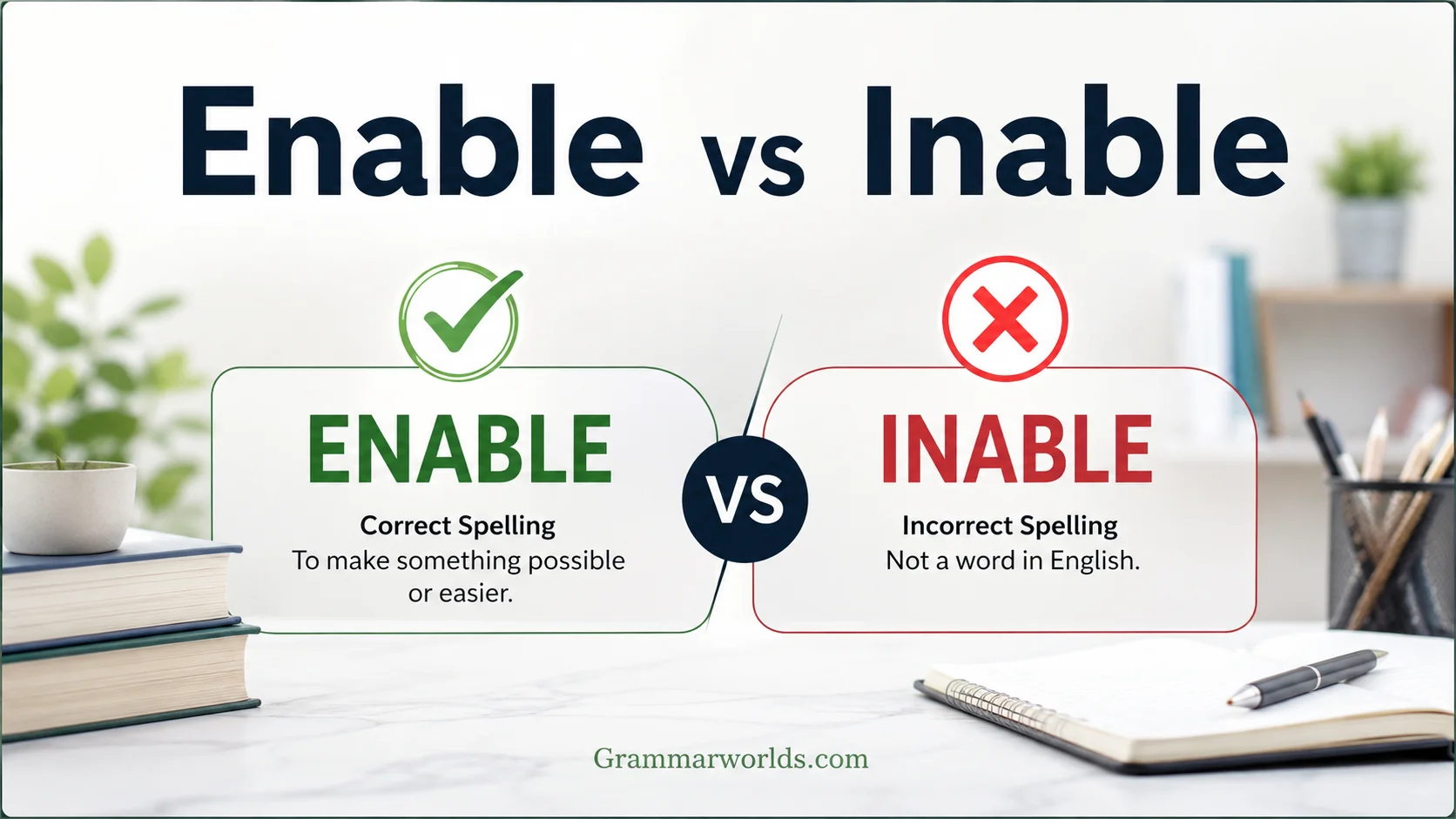
Here’s the truth upfront: “enable” is correct English, while “inable” is not standard English at all.
But that simple answer doesn’t tell the full story. The real confusion runs deeper. It connects to how English builds words, how prefixes work, and how easily our brains mix patterns when we write fast.
Let’s break it all down clearly so you never hesitate again.
Enable vs Inable Difference and Correct Usage: Why This Confusion Happens
English is full of patterns that almost repeat.
You see words like:
- inactive
- incorrect
- incomplete
- invisible
So your brain starts expecting “in-” = “not” in every case.
That’s where the trap forms.
When people try to write “enable,” they sometimes think:
“If ‘enable’ means to make possible, then ‘inable’ must mean not possible.”
It feels logical. But English didn’t build the word that way.
Instead, the correct structure uses a different prefix: “en-”, not “in-”.
So while your brain tries to help, it actually leads you astray.
What Does Enable Mean in English? (Clear Definition and Real Usage)
Let’s strip it down to its core meaning.
Enable means to make something possible or give someone the ability to do something.
It always creates possibility.
Think of it like flipping a switch.
Core meanings of enable:
- To give ability
- To allow action
- To activate a function
- To make something work
Simple real-life examples:
- This tool enables you to edit videos easily.
- The password enables access to your account.
- Exercise enables your body to stay strong.
Notice something important here.
Every sentence moves from “not possible” → “possible.”
That transformation is the heart of the word.
Enable in Everyday English (How People Actually Use It)
You’ll hear “enable” constantly in daily life, especially in technology and instructions.
Common usage patterns:
- Enable Wi-Fi
- Enable notifications
- Enable location services
- Enable dark mode
- Enable permissions
It almost always appears in command-style sentences.
For example:
“Enable Bluetooth before pairing your device.”
Short. Direct. Functional.
That’s why this word is everywhere in tech writing.
It tells your device to do something now.
Where Does the Word “Enable” Come From? (Word Origin Explained Simply)
The word “enable” didn’t appear randomly.
It evolved from older linguistic building blocks.
Breakdown of origin:
- “en-” → to cause or make
- “able” → capable or having ability
Put them together and you get:
en + able = enable → to make able
So instead of “in-” meaning “not,” here “en-” means “to cause or make.”
That small prefix difference completely changes the meaning.
English does this often.
For example:
- enrich = make rich
- enlarge = make large
- empower = give power
Same pattern. Different outcome.
Is “Inable” a Real English Word?
Let’s be direct here.
No. “Inable” is not a standard English word.
You won’t find it in:
- Oxford English Dictionary
- Cambridge Dictionary
- Merriam-Webster
It exists only in two places:
- Typing mistakes
- Misunderstandings of prefixes
Why people think it exists:
There are three main reasons:
- It sounds like a real word
- It follows a familiar “in-” pattern
- It appears in informal or incorrect online writing
But grammar rules don’t support it.
If you ever use “inable” in formal writing, readers will immediately treat it as an error.
Enable vs Unable: The Real Source of Confusion
Here’s where things get interesting.
Most people don’t actually confuse “enable” with “inable.”
They confuse it with “unable.”
And that confusion makes sense.
Let’s break it down simply:
| Word | Meaning | Example |
| Enable | To make possible | Enable Wi-Fi |
| Unable | Not able / incapable | Unable to connect |
Now notice the difference:
- Enable = gives ability
- Unable = removes ability
They sit on opposite ends of meaning.
But because they sound similar, the brain sometimes blends them.
Common Mistakes with Enable vs Inable
Even strong writers slip up here. It usually happens in fast typing or casual writing.
Mistake patterns:
- Writing “inable” instead of “enable”
- Mixing “enable” and “unable” in the same sentence
- Misunderstanding prefix rules
Incorrect vs correct examples:
❌ The update will inable new features
✔ The update will enable new features
❌ I am enable to join the meeting
✔ I am unable to join the meeting
One letter changes everything here.
That’s how sensitive English can be.
Enable vs Inable vs Unable: Side-by-Side Clarity
Let’s make this crystal clear with a simple comparison.
| Word | Correct? | Meaning | Usage Example |
| Enable | Yes | Make possible | Enable settings |
| Inable | No | Not standard English | Not used |
| Unable | Yes | Not capable | Unable to start |
If you remember nothing else, remember this:
Only “enable” and “unable” are real. “Inable” does not belong.
Also Read This :Triple vs Tripple: Which Spelling Is Correct
How to Use “Enable” Correctly in Sentences
Now let’s make sure you actually use it right, not just recognize it.
Basic structure:
Enable + object + to + verb
Examples:
- This software enables users to edit photos.
- The training enables employees to work faster.
- The app enables you to track your expenses.
Tech-focused usage:
- Enable dark mode
- Enable firewall protection
- Enable two-factor authentication
In instructions, “enable” often acts like a command.
It’s short, sharp, and action-driven.
Why “Enable” Matters in Modern English (Especially Tech)
Here’s something interesting.
If you remove the word “enable” from tech language, instructions become unclear.
Imagine this:
- “Turn on Wi-Fi” (simple)
- “Activate Wi-Fi function module” (confusing)
“Enable” sits in the sweet spot between technical and human language.
Where it appears most:
- Software interfaces
- Mobile apps
- Cybersecurity settings
- AI tools
- Cloud platforms
It tells systems to unlock capability.
Without it, modern UI language would fall apart.
Case Study: How a Small Word Mistake Creates Big Confusion
Let’s look at a real-world style scenario.
Scenario: App development team
A developer writes a UI instruction:
❌ “Please inable notifications to receive updates.”
Users get confused. Some think:
- The app is broken
- The instruction is unclear
- The setting might disable something
Support tickets rise.
After correction:
✔ “Please enable notifications to receive updates.”
Everything becomes clear instantly.
Outcome:
- Reduced user confusion
- Fewer support requests
- Improved user trust
One incorrect word created friction. One correct word removed it completely.
That’s the power of precision.
Quick Memory Trick to Never Confuse Enable Again
Here’s a simple mental shortcut.
Enable = En + able = Make able
Break it like this:
- En = make
- Able = capable
So:
Enable = make capable
Now compare:
- Unable = not capable
- Inable = does not exist
If you remember this one pattern, you’re safe forever.
Mini Practice Examples (Try These in Your Head)
Let’s make it stick.
Fill the blank mentally:
- This button will ___ dark mode.
- I am ___ to attend the meeting.
- The tool ___ faster editing.
Answers:
- enable
- unable
- enables
If you got them right, you already understand the system.
FAQ
Is “inable” a real English word?
No. It is not recognized in standard English dictionaries. It is considered a spelling mistake.
What is the correct opposite of enable?
The correct opposite is “unable.”
Why do people write inable instead of enable?
They confuse the “in-” prefix used in other English words and assume it applies here.
Can “enable” be used in formal writing?
Yes. It is widely used in academic, technical, and professional writing.
Is “enable” a verb or adjective?
“Enable” is a verb. It describes an action of making something possible.
Conclusion
Here’s what it all comes down to.
Enable is the correct word. It means to make something possible.
Inable is not a real word in standard English. It appears only as a mistake or misunderstanding.
English often tricks writers with patterns that look familiar but behave differently. This is one of those cases.
But once you understand the structure, it becomes simple:
- “Enable” = make able
- “Unable” = not able
- “Inable” = nothing at all in standard usage
So next time you write it, pause for half a second. That small pause will save you from a big mistake.
And honestly, once this clicks, you won’t forget it.