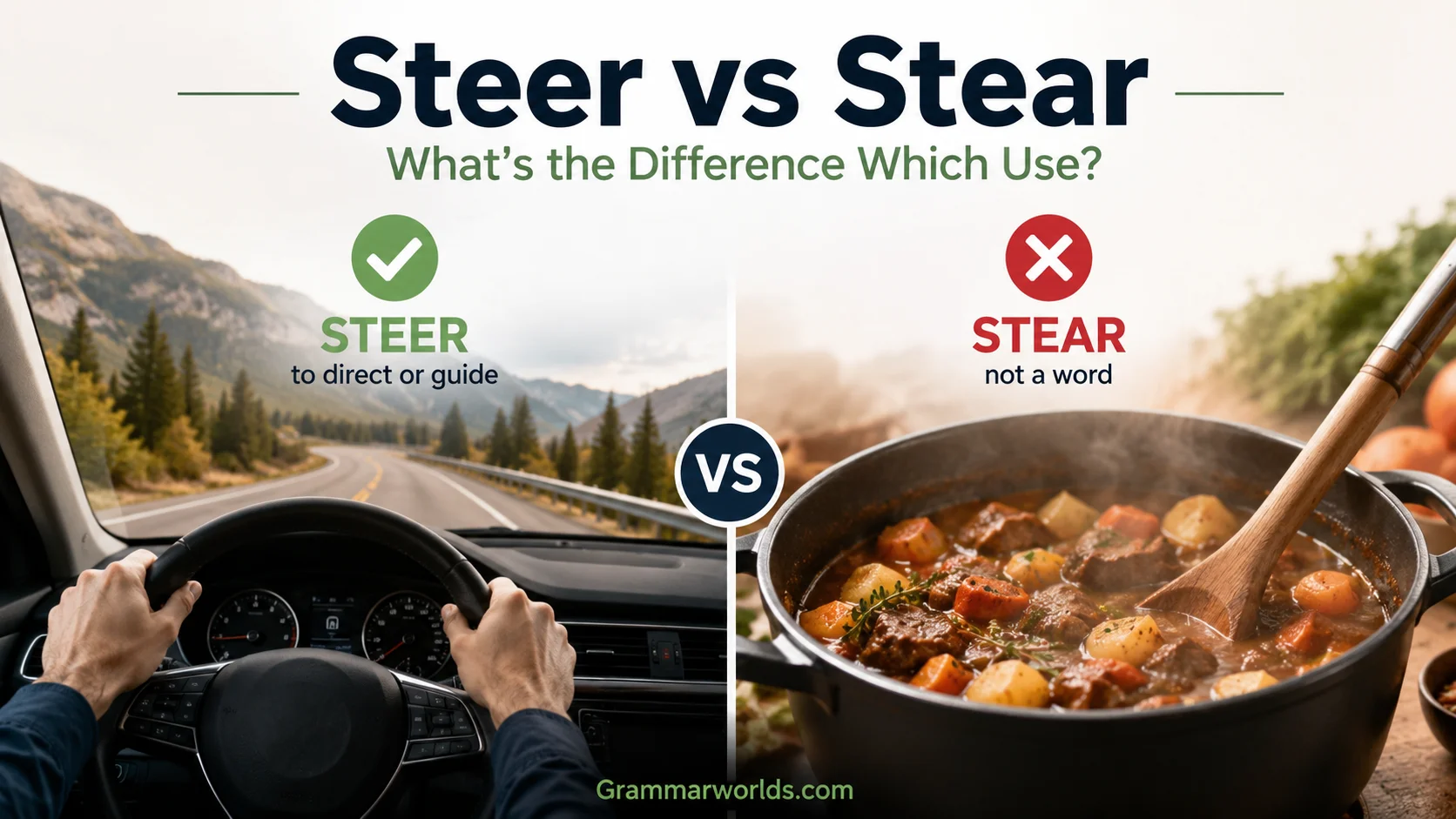
Steer vs Stear What’s the Difference Which Use? explains the difference between correct spelling and real usage with simple English examples. When learning Steer vs Stear, the correct spelling is important because steer is used in standard English, while Stear is not a recognized word for these meanings.
This usage explained guide helps you understand real usage through practical examples. I remember driving late at night with my hands tight on the wheel, thinking about the right word while writing a travel trip note. I had to pause, fix the spelling, and wonder why these words look alike and sound close. Many students, bloggers, and professionals search these terms because the brain creates confusion during daily writing, emails, and posts. The dictionaries show that steering a car means to guide a vehicle, control movement, or influence a decision, project, or direction.
In real life moments, this common mistake often happens while typing quickly when the mind feels tired. A single letter can change meaning and affect credibility in communication, especially in professional communication, academic papers, blog posts, business documents, and formal writing. Good writers focus on ideas, but small details like spelling accuracy, word choice, sentence structure, and language rules improve clarity, readability, and writing skills.
Steer vs. Stear: Quick Answer
The simple answer is:
Steer is the correct spelling. Stear is usually incorrect.
Here is a quick comparison:
| Word | Correct spelling? | Meaning | Example |
| Steer | ✅ Yes | To guide, control, or direct something. It can also mean a male cattle animal. | “She learned how to steer the boat.” |
| Stear | ❌ No (in modern standard English) | Usually a misspelling of “steer.” | “He tried to stear the car.” |
If you are talking about controlling direction, use steer.
If you are referring to cattle, use steer.
If you write stear, most readers will assume you made a spelling mistake.
What Does Steer Mean?
The word steer has more than one meaning. The meaning depends on how you use it in a sentence.
It works as both a verb and a noun, which makes it a flexible word in English.
Steer as a Verb: To Guide or Control Direction
The most common meaning of steer is to guide something in a particular direction.
When you drive a car, you use the steering wheel to control where the vehicle goes. In the same way, you can steer many other things, including conversations, decisions, projects, and even your personal goals.
For example:
- “She steered the car around the fallen tree.”
- “The captain steered the ship through rough waters.”
- “He steered the conversation back to the main topic.”
The core idea stays the same:
Steer means to influence direction or movement.
Examples of Steer in Everyday Situations
The word appears in many different areas of life.
Driving
When you turn a steering wheel, you steer a vehicle.
Example:
“You need to steer carefully when driving on icy roads.”
The driver does not simply move forward. They control the direction.
Conversations
People also use “steer” when talking about discussions.
Example:
“The teacher steered the conversation toward climate change.”
The teacher did not physically move anything. Instead, they guided the discussion toward a specific subject.
Business Decisions
Companies often use the word when discussing strategy.
Example:
“The company is steering toward renewable energy solutions.”
This means the company is moving its focus in that direction.
Personal Choices
People can also steer their own lives.
Examples:
- “She steered her career toward technology.”
- “He decided to steer away from negative influences.”
In these cases, steer means making choices that create a certain path.
Steer as a Noun: A Male Cattle Animal
The second major meaning of steer relates to farming and agriculture.
A steer is a male cattle animal that has usually been castrated.
Farmers commonly raise steers for beef production because they often develop desirable meat qualities.
Here is how common cattle terms compare:
| Term | Meaning |
| Cow | Adult female cattle |
| Bull | Adult male cattle used for breeding |
| Steer | Male cattle that has been castrated, often raised for beef |
| Calf | Young cattle |
Example:
“The farmer moved the steers into a larger pasture.”
In agricultural settings, “steer” has nothing to do with direction or movement. The meaning comes from the animal itself.
Why Is a Steer Different From a Bull?
Many people confuse these cattle terms.
The main difference involves purpose.
A bull is an adult male cattle animal that can breed. Farmers often keep bulls for reproduction.
A steer is typically a male cattle animal that cannot reproduce because it has been castrated. Farmers usually raise steers for meat production.
A simple way to remember:
- Bull = breeding
- Steer = beef production
What Does Stear Mean?
The word stear causes confusion because it looks like it should be correct.
However, in modern standard English, stear is not a commonly accepted word.
In most situations, when someone writes “stear,” they actually mean steer.
Incorrect:
“Can you stear the boat toward the dock?”
Correct:
“Can you steer the boat toward the dock?”
The mistake happens because English pronunciation does not always match spelling.
Why Do People Spell Steer as Stear?
There are several reasons people write stear incorrectly.
The Pronunciation Creates Confusion
When people hear the word “steer,” they may connect the sound with words that contain “ear.”
Examples:
- hear
- near
- clear
- fear
Because these words use “ear” to create a similar sound, some writers naturally assume:
“If I hear this sound, maybe it should be spelled with ‘ear.’”
However, English does not always follow a predictable pattern.
English Has Many Irregular Spellings
English borrowed words from many languages, including Latin, French, German, and Old English.
Because of this history, spelling rules often have exceptions.
For example:
| Sound | Different spellings |
| Long “ee” sound | see, sea, scene, machine, receive |
| Similar “eer” sound | steer, hear, near |
The spelling steer became the accepted form over centuries.
Steer vs. Stear Pronunciation
The pronunciation of steer can vary slightly depending on accent.
In many American accents, steer sounds similar to:
- “stir”
- “steer”
The International Phonetic Alphabet pronunciation is:
/stɪr/
Example:
“I will steer the boat.”
sounds like:
“I will steer the boat.”
Since stear is not a standard English word, it does not have an official pronunciation.
People who misspell “steer” as “stear” usually pronounce it the same way.
Also Read This : Insite vs Insight: Correct The Usage Explained?
How to Use Steer Correctly in a Sentence
Learning common sentence patterns makes it easier to use the word naturally.
Steer + Object
One common structure is:
Subject + steer + object
Examples:
- “The driver steered the truck carefully.”
- “The pilot steered the aircraft safely.”
- “She steered the conversation away from conflict.”
The object is the thing being guided.
Steer Toward Something
This phrase means moving closer to a goal, idea, or direction.
Examples:
- “The company is steering toward international expansion.”
- “He steered the discussion toward practical solutions.”
It does not always describe physical movement.
A person can steer:
- A team
- A project
- A career
- A meeting
- A decision
Steer Away From Something
This phrase means avoiding something.
Examples:
- “She steered away from unnecessary arguments.”
- “Investors are steering away from risky markets.”
Think of it like turning a vehicle away from danger.
Steer Clear Of: A Common Expression
Steer clear of is a popular English idiom.
It means:
Avoid something completely.
Examples:
- “You should steer clear of fake websites.”
- “He steered clear of office gossip.”
- “Drivers should steer clear of flooded roads.”
The phrase creates a mental image of a driver changing direction to avoid an obstacle.
Common Mistakes With Steer
Even native speakers sometimes make mistakes with words that sound similar.
Here are the most common errors.
Mistake 1: Writing Stear Instead of Steer
This is the biggest mistake.
Incorrect:
“The captain tried to stear the ship.”
Correct:
“The captain tried to steer the ship.”
Remember:
You steer with a steering wheel.
The word “steering” contains the correct spelling.
Mistake 2: Confusing Steer With Stare
These words look different but can confuse new English learners.
| Word | Meaning | Example |
| Steer | Guide or control | “She steered the car left.” |
| Stare | Look intensely | “He stared at the painting.” |
A person can steer a car but stare at a car.
The meanings are completely different.
Mistake 3: Confusing Steer With Stir
The pronunciation can sometimes create confusion.
| Word | Meaning | Example |
| Steer | Guide direction | “Steer the boat carefully.” |
| Stir | Mix something | “Stir the coffee.” |
One controls direction. The other mixes things together.
Faqs:
Is “stear” a correct English word?
No, “stear” is not considered a standard English word in modern usage. In most cases, people who write “stear” are making a spelling mistake and mean “steer.”
For example:
❌ “She tried to stear the conversation in another direction.”
✅ “She tried to steer the conversation in another direction.”
The correct spelling is steer when you mean to guide, direct, or control something.
What is the difference between steer and stear?
The main difference is that steer is a correct English word, while stear is usually incorrect.
The word steer has two common meanings:
- As a verb, it means to guide or control direction.
- Example: “He steered the boat toward the shore.”
- As a noun, it refers to a male cattle animal that is usually raised for beef production.
- Example: “The farmer moved the steers into a new field.”
The spelling stear does not have a recognized meaning in everyday English.
How do you remember the correct spelling of steer?
A simple memory trick is to connect the word with a steering wheel.
You steer a car using a steering wheel.
Both words share the same spelling:
- Steer
- Steering
If you remember “steering wheel,” you will likely remember that steer is the correct form.
Another easy reminder:
Steer = correct
Stear = error
Is steer a noun or a verb?
As a verb:
“She steered the vehicle around the obstacle.”
Here, steer means to guide or control movement.
As a noun:
“The rancher raised several steers.”
Here, steer refers to male cattle.
The meaning depends on how the word appears in the sentence.
Can steer be used for things other than vehicles?
Yes. While many people associate steer with driving, the word applies to many situations.
You can steer:
- A car
- A boat
- A conversation
- A meeting
- A project
- A business strategy
- A personal decision
Examples:
- “The manager steered the team toward a better solution.”
- “She steered her career toward healthcare.”
- “The moderator steered the discussion back on track.”
The central idea stays the same: guiding something in a chosen direction.
Conclusion
The difference between steer vs. stear is simple once you understand the spelling.
Steer is the correct word. It can mean guiding or controlling something, and it can also describe a male cattle animal raised for beef production.stear is generally a spelling mistake and should be avoided in standard English writing.
Whenever you are unsure, remember this connection the same spelling appears in both words, making it easier to remember.
Whether you are writing an email, creating content, completing an assignment, or having a conversation, choosing steer will keep your English accurate and polished.
A small spelling choice can make a big difference. In this case, one extra letter changes a correct word into a mistake. Use steer every time.