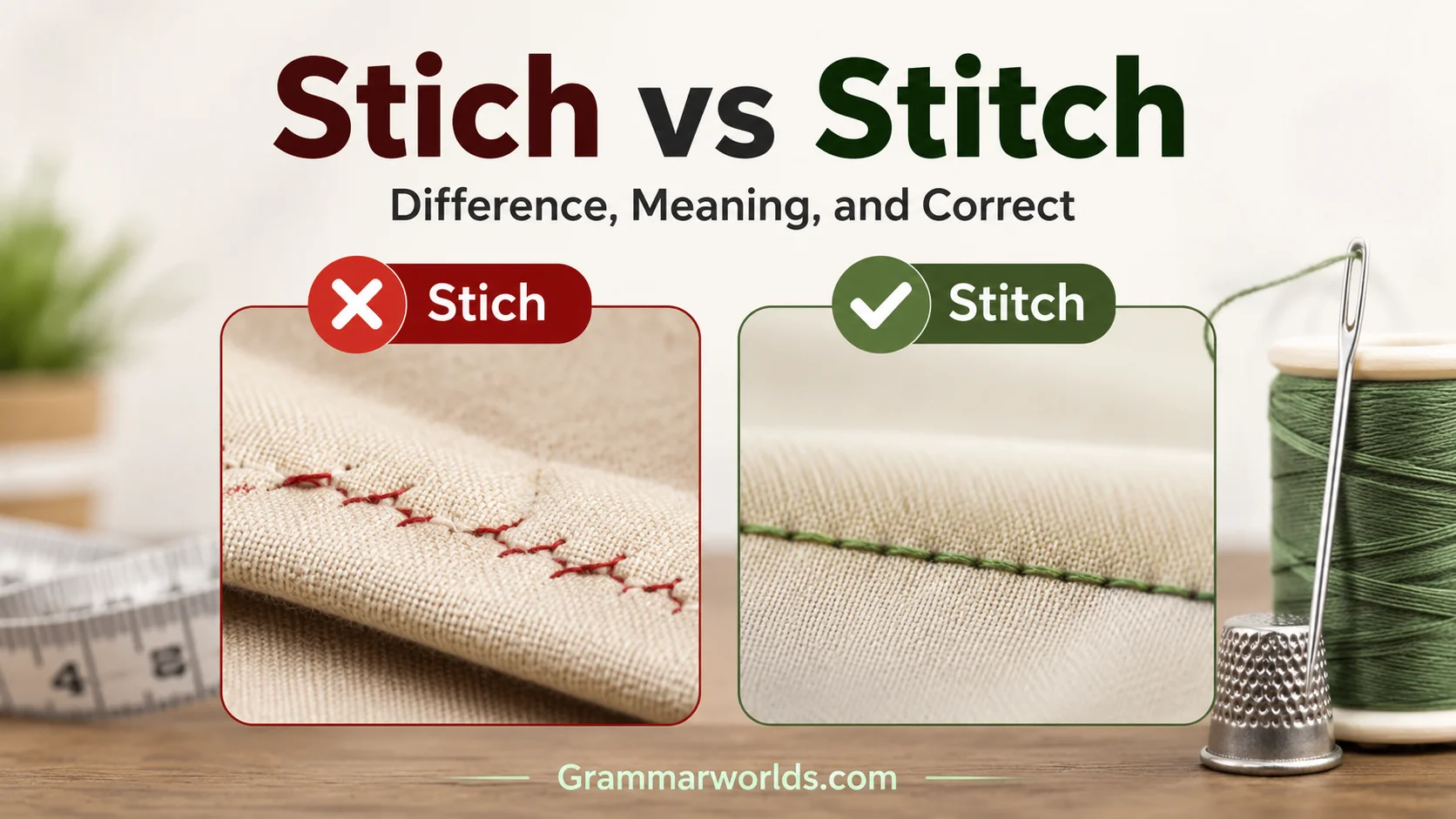
Many English words look almost identical but carry completely different meanings. Stich vs Stitch is one of those confusing word pairs that causes frequent spelling mistakes. The difference comes down to one extra letter, yet that small change completely changes the meaning.
Most people use stitch when they talk about sewing, medical treatment, embroidery, or a sharp pain during exercise. However, stich is also a real word, although it appears much less often. It belongs mainly to literary and historical discussions where it refers to a line of verse or a written line in ancient texts.
So, which spelling should you use?
In everyday writing, stitch is almost always the correct choice. Stich only appears in specific academic or literary contexts.
This guide explains the complete difference between stich and stitch, their meanings, examples, origins, and the situations where you should use each word.
Stich vs Stitch: Quick Difference
The easiest way to understand stich vs stitch is to compare their meanings side by side.
| Word | Meaning | Common Use | Example |
| Stitch | A loop made with thread, a medical repair, a sharp side pain, or the act of joining things | Everyday English | “The tailor added a stitch to repair the shirt.” |
| Stich | A line of verse or a single line in ancient writing | Literary and academic writing | “The researcher examined each stich of the ancient poem.” |
The biggest difference is simple:
- Stitch is a common English word used in daily conversations.
- Stich is a rare technical term used mainly by scholars, poets, and historians.
If you are talking about clothes, injuries, sewing, or exercise pain, choose stitch.
If you are analyzing poetry structure or ancient manuscripts, stich may be correct.
What Does Stitch Mean?
The word stitch has several meanings depending on the context. It can describe sewing, medical treatment, physical discomfort, or the process of connecting things together.
Because of its wide range of meanings, stitch appears frequently in everyday English.
Stitch as a Sewing Term
The most common meaning of stitch relates to sewing.
A stitch is a single loop or movement made when a needle passes through fabric with thread. Multiple stitches create seams, patterns, and designs.
For example:
- A tailor uses stitches to join pieces of fabric.
- A person repairing a torn shirt adds stitches along the damaged area.
- An artist creates decorative designs through embroidery stitches.
Imagine a shirt with a small tear near the sleeve. A person does not repair it by adding one giant thread line. Instead, they create several small connected loops. Each loop is a stitch.
Common sewing-related types include:
| Stitch Type | Description |
| Running stitch | A simple straight stitch used for basic sewing |
| Cross-stitch | Decorative stitches forming an X pattern |
| Backstitch | A strong stitch used for firm seams |
| Blanket stitch | A decorative edge stitch |
| Chain stitch | Connected loops that create a chain-like pattern |
Example sentences:
- “My grandmother taught me how to make a simple stitch.”
- “The designer used colorful stitches to create a unique pattern.”
- “The jacket needs a few stitches before it can be worn again.”
Stitch as a Medical Term
Another common meaning of stitch relates to wound treatment.
When someone gets a deep cut, doctors or nurses may close the wound using stitches. These stitches hold the skin together while the body heals.
The medical process is called suturing, while the individual threads used are commonly called stitches.
For example:
“The doctor gave him five stitches after he cut his hand.”
In medical situations, stitches help:
- Keep wound edges together.
- Reduce bleeding.
- Support proper healing.
- Lower the chance of the wound opening again.
Common phrases include:
- Get stitches
- Remove stitches
- Have stitches
- Need stitches
Examples:
- “She needed stitches after falling from her bicycle.”
- “The nurse removed the stitches after the wound healed.”
Stitch as Exercise-Related Pain
Have you ever gone for a run and suddenly felt a sharp pain under your ribs?
Many people describe this feeling as a stitch.
A stitch in this context means a sudden sharp pain, usually on the side of the abdomen during physical activity.
It commonly happens during:
- Running
- Swimming
- Cycling
- Intense workouts
Example:
- “I had to slow down because I got a stitch while jogging.”
Although scientists still study the exact cause of exercise-related stitches, several factors may contribute, including:
- Rapid movement.
- Eating too close to exercise.
- Increased pressure around the abdominal area.
- Heavy breathing patterns.
The meaning has nothing to do with thread or sewing. The same word simply developed another meaning over time.
Stitch as a Verb Meaning “To Join”
The word stitch can also work as a verb.
When you stitch something, you join parts together using thread or another connecting method.
Examples:
- “She stitched the broken fabric together.”
- “The doctor stitched the wound carefully.”
- “The editor stitched different stories into one article.”
The word can also appear in figurative expressions.
For example:
“The documentary stitches together personal stories from different communities.”
Here, nobody is using a needle. The meaning is about combining separate pieces into one complete thing.
What Does Stich Mean?
Unlike stitch, the word stich rarely appears in normal conversations.
However, it is a legitimate English word.
A stich refers to a line of verse or a single line of written text, especially in poetry and ancient manuscripts.
The word comes from the Greek word stichos, meaning “line” or “row.”
In modern English, it mainly appears in specialized fields such as:
- Classical studies.
- Poetry analysis.
- Religious text research.
- Historical manuscript studies.
Stich in Poetry and Literature
In literary discussions, a stich represents one line of poetry.
For example, when scholars study an ancient poem, they may analyze each individual line. Those lines can be called stichs.
Example:
“The scholar compared each stich of the ancient Greek poem.”
This usage is uncommon among general readers because most people simply say:
- Line
- Verse
- Poetic line
Instead of:
- Stich
A poetry student might encounter the term, but a casual reader probably will not.
Stich in Historical Texts
The term stich also appears when researchers study old manuscripts.
Ancient writings were often organized differently from modern books. Scholars sometimes examine texts by counting lines, sections, or written units.
In these situations, a stich can describe a specific written line.
For example:
- Researchers compare the number of stichs in different manuscripts.
- Historians analyze how ancient texts were arranged.
This meaning has a narrow purpose. It does not apply to everyday writing.
Why Do People Confuse Stich and Stitch?
The confusion between stich vs stitch happens because the two words look and sound almost identical.
A single letter separates them.
Compare:
- Stich
- Stitch
The missing second “t” creates a completely different word.
Several reasons explain this common mistake.
The Words Have Similar Pronunciation
Many English speakers pronounce both words almost the same way.
Because pronunciation does not clearly separate them, people often rely on spelling.
This creates problems when writing quickly.
For example:
Someone might type:
❌ “The doctor gave him three stiches.”
The correct spelling is:
✅ “The doctor gave him three stitches.”
Spell Check Does Not Always Catch the Error
Many people assume spell-check tools will fix every mistake. However, some tools recognize stich as a valid word because it exists in English.
That means a sentence like this might not receive a warning:
“She repaired the dress with a stich.”
The spelling looks acceptable to software, but the meaning is wrong.
Understanding the word yourself remains important.
Also Read This :Common Grammar Mistakes Related to Developed
Everyday Experience Favors Stitch
Most people encounter stitch regularly.
They see it in:
- Clothing labels.
- Medical information.
- Sports discussions.
- Craft tutorials.
Meanwhile, stich usually appears only in academic books or specialized research.
That difference in frequency makes stitch the natural choice for most writing.
Stich vs Stitch Meaning Comparison Table
| Feature | Stich | Stitch |
| Word category | Noun | Noun and verb |
| Frequency | Rare | Very common |
| Origin | Greek literary term | Old English sewing term |
| Main meaning | A line of poetry | Thread loop, repair, pain, joining |
| Used in conversation | Almost never | Very often |
| Common mistake | Used instead of stitch | Rarely confused with stich |
The practical lesson is clear:
Stitch belongs to everyday English. Stich belongs to specialized literary language.
When Should You Use Stitch?
You should use stitch in almost every normal situation.
Choose stitch when talking about:
- Sewing.
- Clothing repair.
- Embroidery.
- Medical wounds.
- Exercise pain.
- Connecting things together.
Examples:
✅ “The seam needs another stitch.”
✅ “The doctor removed the stitches after one week.”
✅ “I felt a stitch while running.”
✅ “She learned a new stitching technique.”
If your sentence involves something being repaired, joined, or connected, stitch is usually the right choice.
When Should You Use Stich?
Use stich only when you are discussing specific literary or historical topics.
Choose stich for:
- A line of poetry.
- Ancient written texts.
- Academic discussions about verse structure.
Examples:
✅ “The professor analyzed every stich in the manuscript.”
✅ “The poem contained hundreds of stichs.”
Avoid using stich when discussing:
❌ Sewing clothes.
❌ Medical wounds.
❌ Sports injuries.
❌ Craft projects.
A simple rule works well:
If you can replace the word with “thread,” “repair,” or “pain,” use stitch.
If you can replace it with “line of poetry,” use stich.
FAQs
Is stich a correct spelling?
Yes, stich is a correct English word, but it is rarely used. It refers to a line of verse or a line of written text, especially in ancient poetry and literary studies. Most people will never need to use this word in everyday writing.
If you are talking about sewing, wounds, or physical pain, stitch is the correct spelling.
What is the difference between stich and stitch?
The main difference between stich and stitch is their meaning and usage.
Stitch is a common word that refers to:
- A loop made with thread.
- A medical repair for a wound.
- A sharp pain felt during exercise.
- The act of joining things together.
Stich is a rare literary term that means:
- A line of poetry.
- A line in an ancient manuscript.
Although the words look almost identical, they belong to completely different contexts.
Should I use stich or stitch for sewing?
You should always use stitch when talking about sewing.
Examples:
✅ “She added a stitch to fix the torn fabric.”
✅ “The tailor used strong stitches to repair the jacket.”
Using stich for sewing is considered a spelling mistake because the word does not have that meaning.
Is stich just a misspelling of stitch?
Usually, yes. In most everyday situations, people who write stich actually mean stitch.
However, stich is not always a mistake because it has its own meaning in literary and historical contexts. A researcher discussing ancient poetry might correctly use the word stich.
The context determines whether the spelling is right or wrong.
How can I remember the difference between stich and stitch?
A simple memory trick can help:
“Stitch has two Ts because sewing uses two pieces that come together.”
Remember:
- Stitch = thread, repair, pain, or joining.
- Stich = line in poetry.
If you are not discussing literature or ancient texts, stitch is almost certainly the word you need.
Conclusion
The difference between stich vs stitch is small in spelling but large in meaning.Stitch is the word you will use most of the time. It describes sewing, embroidery, medical stitches, exercise-related pain, and the process of joining things together. It appears in everyday conversations, books, instructions, and professional writing. On the other hand, stich is a specialized literary term. It refers to a line of poetry or a line in an ancient written text. While it is a real English word, it rarely appears outside academic discussions.