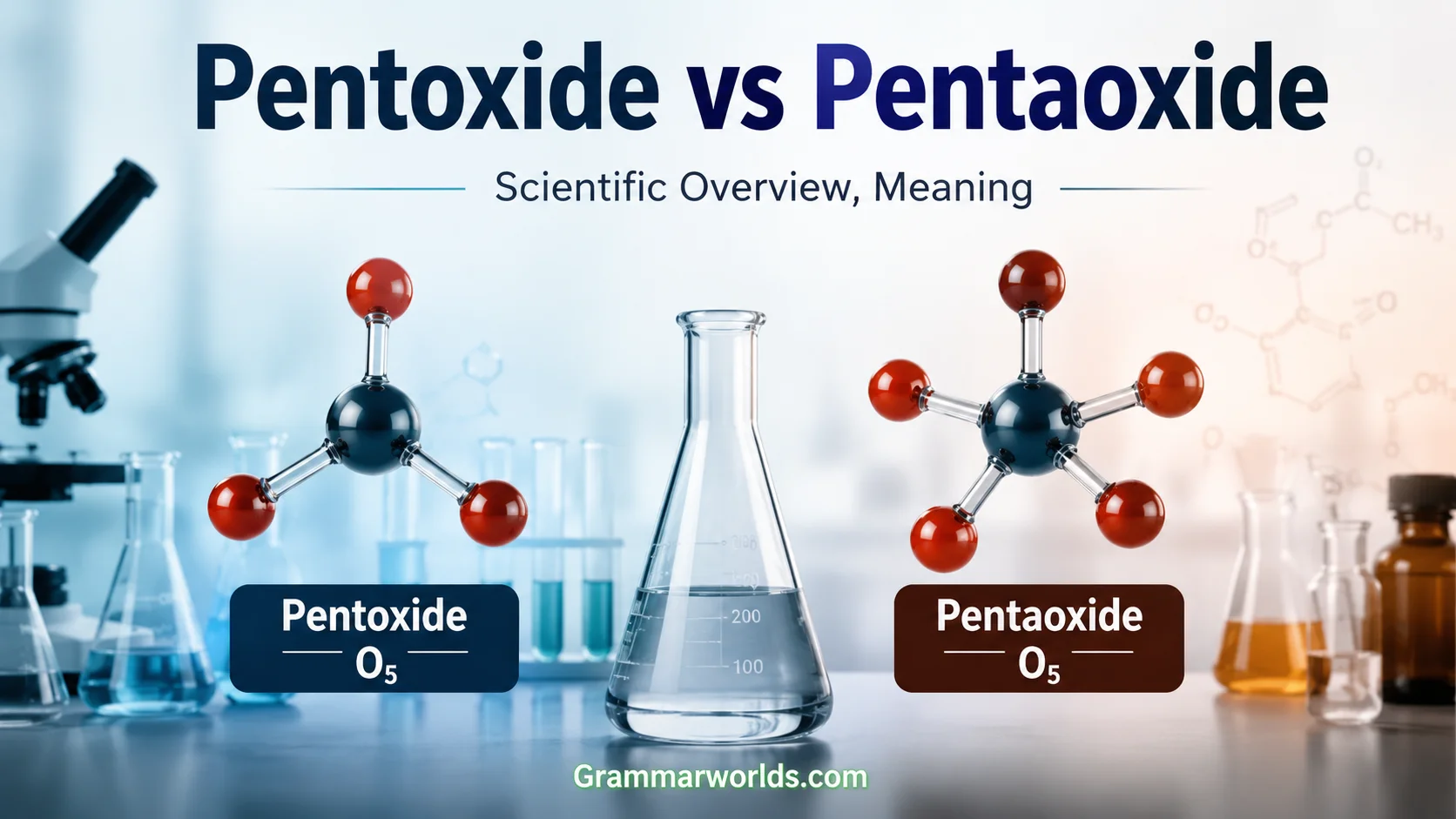
Chemical names often look simple, but a small spelling difference can completely change whether a term is scientifically accepted. One common example appears in the debate between pentoxide vs pentaoxide.
At first glance, both words seem correct. After all, the prefix “penta-” means five, and “oxide” refers to a compound containing oxygen. So why do chemists use pentoxide instead of pentaoxide?
The answer comes down to standardized chemical naming rules. Chemistry does not always follow ordinary English word-building patterns. Instead, it uses internationally recognized naming systems that help scientists communicate clearly across languages and disciplines.
In this guide, you’ll learn the real scientific difference between pentoxide and pentaoxide, why pentoxide is the accepted term, how chemical prefixes work, and where these compounds appear in real-world chemistry.
Whether you’re a student, researcher, writer, or simply curious about scientific terminology, understanding this difference will help you use chemical names accurately.
Pentoxide vs Pentaoxide: Quick Overview
Before exploring the details, let’s look at the basic difference between these two terms.
| Term | Correct Usage | Meaning | Scientific Acceptance |
| Pentoxide | Correct chemical term | An oxide compound containing five oxygen atoms | Accepted and widely used |
| Pentaoxide | Usually incorrect | Intended to mean the same thing | Rarely accepted in formal chemistry |
The main point is simple:
Pentoxide is the correct scientific spelling. Pentaoxide is generally considered an incorrect variation.
The confusion happens because the word appears to come from combining:
- Penta- = five
- Oxide = oxygen-containing compound
However, chemical naming rules modify some prefixes when they combine with element names. This creates smoother and more standardized terms.
What Does Pentoxide Mean in Chemistry?
Pentoxide is a chemical naming term used to describe an oxide compound containing five oxygen atoms.
The word can be separated into two parts:
- Pent- means five.
- Oxide refers to a chemical compound where oxygen combines with another element.
Therefore, a pentoxide is an oxide that contains five oxygen atoms within its chemical formula.
For example:
- Dinitrogen pentoxide (N₂O₅)
- Vanadium pentoxide (V₂O₅)
- Phosphorus pentoxide (P₂O₅)
These compounds contain oxygen in a five-atom ratio and use the accepted “pentoxide” naming pattern.
How Pentoxide Appears in Chemical Names
Chemical names often tell you important information about a compound’s composition.
For covalent compounds, prefixes show the number of atoms present.
Common numerical prefixes include:
| Prefix | Number | Example |
| Mono- | One | Carbon monoxide (CO) |
| Di- | Two | Carbon dioxide (CO₂) |
| Tri- | Three | Sulfur trioxide (SO₃) |
| Tetra- | Four | Carbon tetrachloride (CCl₄) |
| Penta- | Five | Dinitrogen pentoxide (N₂O₅) |
The prefix helps scientists understand the structure of a compound without needing to memorize every formula.
For example, when someone hears dinitrogen pentoxide, they immediately know:
- “di” means two nitrogen atoms.
- “pentoxide” means five oxygen atoms.
The name itself provides chemical information.
What Does Pentaoxide Mean?
The term pentaoxide looks logical because it combines two understandable parts:
- Penta means five.
- Oxide means an oxygen compound.
If someone applies normal English rules, they might think:
“Five oxygen atoms should create pentaoxide because penta means five.”
That reasoning makes sense from a language perspective. However, scientific naming follows different rules.
In chemistry, pentaoxide is not the preferred or standard form.
Why Pentaoxide Is Usually Considered Incorrect
The main issue involves how chemical prefixes combine with element names.
Chemistry often removes certain vowels to avoid awkward pronunciation.
For example:
- penta + oxide becomes pentoxide
- tetra + oxide becomes tetroxide
The extra vowel is removed because it creates a smoother scientific term.
Compare these examples:
| Incorrect or uncommon form | Correct form |
| Pentaoxide | Pentoxide |
| Tetraoxide | Tetroxide |
This pattern appears throughout chemical terminology.
The goal is not just shortening words. The goal is creating consistent names that scientists around the world can recognize.
Pentoxide vs Pentaoxide: Key Differences Explained
The difference between pentoxide and pentaoxide is not about meaning. Both words attempt to describe an oxide containing five oxygen atoms.
The difference is about scientific correctness and accepted usage.
| Feature | Pentoxide | Pentaoxide |
| Chemical naming standard | Follows accepted rules | Does not follow standard naming conventions |
| Frequency of use | Very common | Extremely rare |
| Use in textbooks | Yes | No |
| Use in scientific papers | Yes | Generally avoided |
| Meaning | Five oxygen atoms in an oxide compound | Intended to mean five oxygen atoms |
A chemistry student writing a laboratory report should always choose pentoxide.
Using pentaoxide may confuse readers or suggest unfamiliarity with chemical naming conventions.
Why Chemists Use Pentoxide Instead of Pentaoxide
Chemical Naming Rules Behind Pentoxide
Chemical names follow systems developed to create consistency. Organizations such as the International Union of Pure and Applied Chemistry (IUPAC) establish guidelines that scientists use worldwide.
These rules help avoid confusion.
Imagine if every scientist created their own spelling style for compounds. A researcher in one country might write “pentaoxide” while another writes “pentoxide.”
That small difference could make communication harder.
Standard names solve this problem.
The Rule of Removing Vowels in Chemical Names
One important naming pattern involves removing the final vowel of a numerical prefix when it combines with “oxide.”
Examples:
| Prefix Combination | Final Chemical Term |
| penta + oxide | pentoxide |
| tetra + oxide | tetroxide |
| mono + oxide | monoxide |
This change creates words that are easier to pronounce and recognize.
For example:
Carbon monoxide sounds natural.
Carbon monooxide sounds awkward.
The same idea applies to pentoxide.
Common Examples of Pentoxide Compounds
Several important chemical compounds use the word pentoxide.
These compounds play major roles in industry, research, and manufacturing.
Dinitrogen Pentoxide (N₂O₅)
Dinitrogen pentoxide is one of the best-known pentoxide compounds.
Its formula is:
N₂O₅
This means:
- Two nitrogen atoms.
- Five oxygen atoms.
Dinitrogen pentoxide is an acidic oxide and an important compound in atmospheric and chemical studies.
When it reacts with water, it forms nitric acid:
N₂O₅ + H₂O → 2HNO₃
Nitric acid has many industrial uses, including:
- Fertilizer production.
- Explosive manufacturing.
- Chemical synthesis.
Important Facts About Dinitrogen Pentoxide
| Property | Information |
| Chemical formula | N₂O₅ |
| Main elements | Nitrogen and oxygen |
| Compound type | Acidic oxide |
| Appearance | White crystalline solid |
| Scientific importance | Nitric acid production and atmospheric chemistry |
Also Read This : Preform vs Perform: Confusion, Meaning, Spelling
Vanadium Pentoxide (V₂O₅)
Vanadium pentoxide is another important example.
Its formula is:
V₂O₅
This compound contains:
- Two vanadium atoms.
- Five oxygen atoms.
Vanadium pentoxide has major industrial importance because it works as a catalyst.
A catalyst speeds up a chemical reaction without being consumed.
One of its most important uses is in sulfuric acid production.
The contact process uses vanadium pentoxide to help convert sulfur dioxide into sulfur trioxide.
This process supports industries that produce:
- Fertilizers.
- Chemicals.
- Industrial materials.
Important Facts About Vanadium Pentoxide
| Property | Information |
| Formula | V₂O₅ |
| Chemical category | Metal oxide |
| Color | Yellow-orange solid |
| Major use | Industrial catalyst |
| Industry importance | Sulfuric acid manufacturing |
Phosphorus Pentoxide (P₂O₅ / P₄O₁₀)
Phosphorus pentoxide creates an interesting naming situation.
Although people commonly write its formula as:
P₂O₅
the actual molecular structure is often represented as:
P₄O₁₀
The name remains phosphorus pentoxide because it describes the empirical formula.
This compound strongly absorbs water, making it useful as a drying agent.
Uses of Phosphorus Pentoxide
- Removing moisture from chemical environments.
- Preparing certain acids.
- Supporting laboratory reactions.
Its ability to absorb water makes it extremely valuable in chemistry.
How Chemical Prefixes Work in Compound Names
Chemical prefixes provide clues about the number of atoms in compounds.
They are especially important when naming covalent compounds.
Common Numerical Prefixes
| Prefix | Number | Example |
| Mono | 1 | Carbon monoxide |
| Di | 2 | Carbon dioxide |
| Tri | 3 | Nitrogen trioxide |
| Tetra | 4 | Xenon tetroxide |
| Penta | 5 | Dinitrogen pentoxide |
| Hexa | 6 | Sulfur hexafluoride |
These prefixes act like a chemical counting system.
They allow scientists to describe compounds accurately without needing lengthy explanations.
Why Prefixes Change Their Form
Many people assume prefixes always remain unchanged.
However, scientific language often modifies words for clarity and pronunciation.
For example:
Penta + oxide
would create:
Pentaoxide
But the accepted form removes the extra “a”:
Pentoxide
This happens because chemistry values consistency and readability.
Similar examples appear in everyday language.
For instance:
- “a” becomes “an” before vowel sounds.
- Words often change slightly when combined.
Chemical naming follows a similar idea.
Common Mistakes When Writing Pentoxide and Pentaoxide
Mistake: Assuming Pentaoxide Must Be Correct
Many people think:
“Penta means five, so pentaoxide must mean five oxygen atoms.”
The logic is understandable, but chemical names follow established rules rather than personal word construction.
Mistake: Treating Chemistry Like Regular English
English allows creative word combinations.
Chemistry does not.
Scientific names need to remain consistent because they appear in:
- Research papers.
- Textbooks.
- Safety documents.
- Industrial instructions.
Mistake: Ignoring Standard Chemical Terminology
Using an uncommon variation may not completely prevent understanding, but it can reduce accuracy.
In science, precision matters.
A single naming mistake can create confusion.
Pentoxide vs Pentaoxide in Academic and Professional Writing
Students, researchers, and professionals should always use pentoxide.
Correct terminology shows attention to detail and scientific understanding.
Use pentoxide when writing:
- Chemistry assignments.
- Laboratory reports.
- Research articles.
- Educational materials.
- Technical documents.
Avoid using pentaoxide unless you are discussing the spelling itself.
Easy Ways to Remember the Correct Term
Here are some simple memory tricks:
Remember Common Compounds
Think of familiar examples:
- Nitrogen pentoxide.
- Vanadium pentoxide.
- Phosphorus pentoxide.
The correct spelling appears repeatedly in chemistry.
Remember the Missing “A”
Think:
“Penta loses the ‘a’ before oxide.”
Penta + oxide = pentoxide.
Why Accurate Chemical Naming Matters
Chemical names are more than labels.
They communicate information.
A correct chemical name tells scientists:
- What elements are present.
- How many atoms are involved.
- How a compound should be identified.
- How it relates to other compounds.
Poor naming can create misunderstandings.
In chemistry, communication must be precise because scientists work with substances that may affect:
- Human health.
- Environmental safety.
- Industrial processes.
Case Study: Why Standard Names Matter in Chemistry
Imagine a global research team studying nitrogen compounds.
One scientist writes:
“Dinitrogen pentoxide”
Another writes:
“Dinitrogen pentaoxide”
Although they likely mean the same compound, the difference creates unnecessary uncertainty.
Scientific standards prevent these problems.
By using accepted names, researchers can quickly identify substances and share information without confusion.
This is why terms like pentoxide matter.
They represent a shared scientific language.
Pentoxide vs Pentaoxide: Final Comparison
| Question | Answer |
| Which spelling is correct? | Pentoxide |
| Is pentaoxide accepted? | Generally no |
| Why is the spelling different? | Chemical naming rules remove certain vowels |
| What does pentoxide mean? | An oxide containing five oxygen atoms |
| What are examples? | Dinitrogen pentoxide, vanadium pentoxide, phosphorus pentoxide |
FAQs
Is pentoxide the correct spelling?
Yes. Pentoxide is the accepted spelling used in chemical terminology. It follows standard naming rules used by scientists worldwide.
Is pentaoxide ever used in chemistry?
Pentaoxide may appear occasionally in informal writing or as a spelling mistake. However, it is not the preferred scientific term.
Why is it called pentoxide instead of pentaoxide?
The word changes because chemical naming rules remove the extra vowel when “penta-” combines with “oxide.” This creates the smoother term pentoxide.
What are examples of pentoxide compounds?
Common examples include:
- Dinitrogen pentoxide (N₂O₅)
- Vanadium pentoxide (V₂O₅)
- Phosphorus pentoxide (P₂O₅)
Are pentoxide and pentaoxide the same thing?
They describe the same general idea, but only pentoxide is considered correct in modern scientific writing.
Conclusion
The difference between pentoxide vs pentaoxide comes down to proper chemical naming rules.
Although pentaoxide seems logical because “penta” means five, chemistry uses standardized terminology. The accepted form is pentoxide because it follows scientific naming conventions and provides consistency across the world.
When you write about compounds containing five oxygen atoms, use pentoxide.
Remember the simple rule:
Penta + oxide becomes pentoxide, not pentaoxide.
Using the correct term may seem like a small detail, but accuracy matters in science. Clear language helps students learn, researchers collaborate, and industries communicate safely.