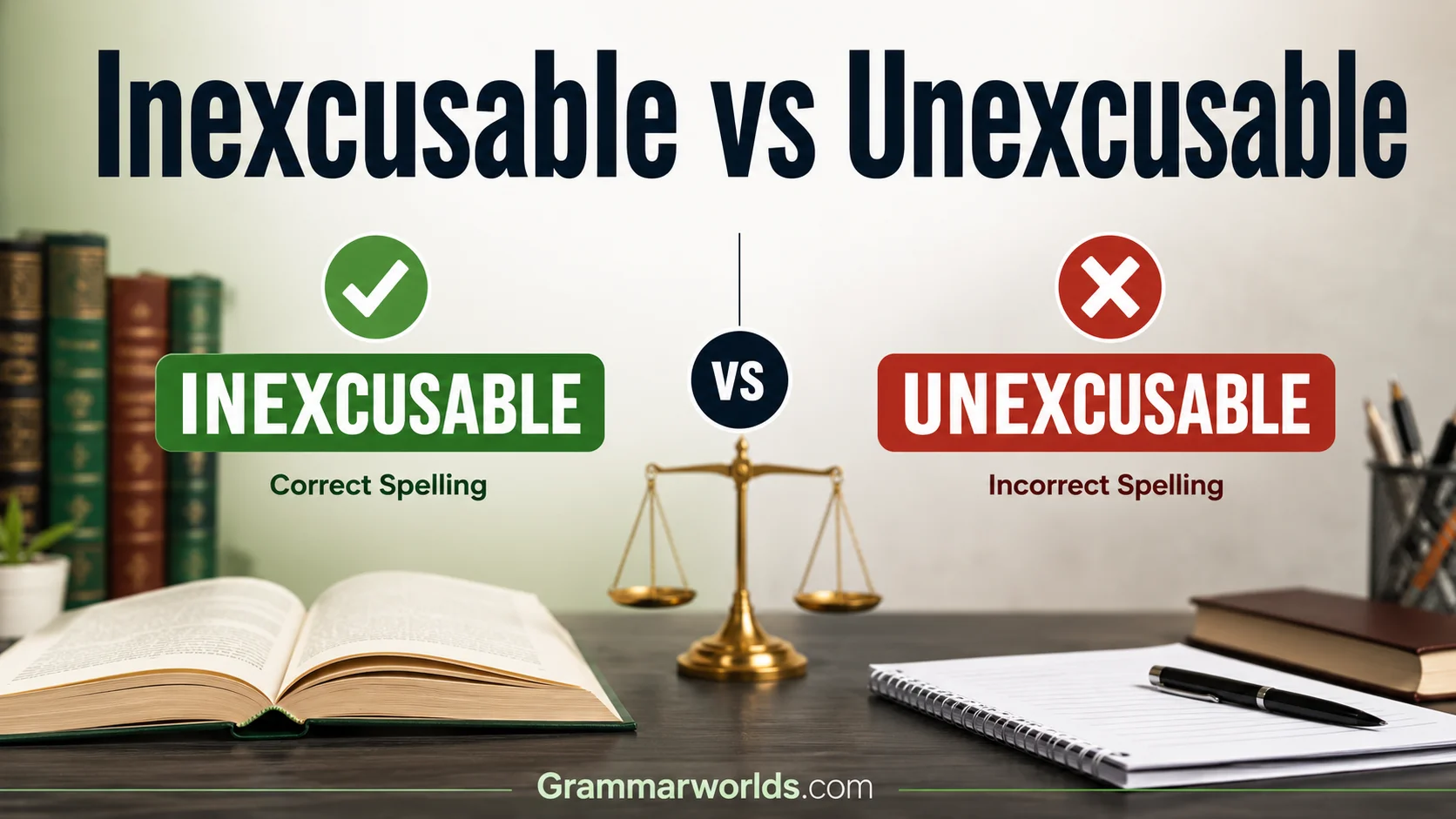
English can be tricky because many words follow patterns that seem logical but do not always follow the rules we expect. One common example is the confusion between “inexcusable” and “unexcusable.”
At first glance, both words look correct. English often uses the prefix “un-” to create opposites, such as unfair, unhappy, and unacceptable. So it feels natural to assume that excusable becomes unexcusable.
However, standard English does not work that way in this case.
The correct word is inexcusable.
The spelling “unexcusable” is generally considered incorrect in modern English. Although you may occasionally see it used online, professional writing, dictionaries, and edited publications use inexcusable.
Understanding why this happens can help you avoid a common mistake and improve your English vocabulary.
Inexcusable vs Unexcusable: The Quick Answer
Here is the simple answer:
| Word | Correct Usage | Meaning | Example |
| Inexcusable | ✅ Correct | Something that cannot be justified, defended, or forgiven | “Ignoring safety warnings was inexcusable.” |
| Unexcusable | ❌ Not standard English | A mistaken form created by confusion with the prefix “un-” | “His behavior was unexcusable.” (Incorrect) |
If you are writing an email, essay, article, report, or professional document, use inexcusable.
Correct sentence:
“The company’s failure to address customer complaints was inexcusable.”
Incorrect sentence:
“The company’s failure to address customer complaints was unexcusable.”
The difference comes down to accepted English usage. The correct spelling has developed over centuries and follows the pattern of similar words that use the prefix in-.
What Does Inexcusable Mean?
The word inexcusable describes something that has no acceptable explanation or justification.
When something is inexcusable, people believe there is no reasonable excuse for it.
The word often appears when discussing:
- Serious mistakes
- Careless behavior
- Ethical failures
- Harmful actions
- Negligence
- Poor decisions
Breaking down the word:
Inexcusable = in + excusable
- In- means “not”
- Excusable means “able to be forgiven or explained”
Together, they create:
Inexcusable = not able to be excused
For example:
“Arriving late once because of unexpected traffic may be excusable.”
But:
“Arriving late repeatedly without warning is inexcusable.”
The second situation suggests that the person had enough control over the circumstances but failed to act responsibly.
What Is the Difference Between Excusable and Inexcusable?
To understand inexcusable, it helps to understand its opposite: excusable.
| Word | Meaning | Example |
| Excusable | Something that can be forgiven or explained | “A small mistake caused by a misunderstanding may be excusable.” |
| Inexcusable | Something that cannot reasonably be forgiven or defended | “Ignoring a serious safety issue is inexcusable.” |
The difference is not only about whether something is good or bad.
It is about whether a reasonable explanation exists.
For example:
Excusable mistake:
A student misses an assignment because they were hospitalized.
Most people would consider this understandable.
Inexcusable mistake:
A student skips every assignment without explanation and blames the teacher.
The issue is not just the missed work. The problem is the lack of responsibility.
Why Is Inexcusable Correct Instead of Unexcusable?
The confusion happens because English uses multiple prefixes to create negative meanings.
Some words use un-:
- unhappy
- uncertain
- unfair
- unnecessary
- unsuccessful
Other words use in-:
- incorrect
- invisible
- impossible
- ineffective
- inaccurate
- inexcusable
A common mistake is assuming English prefixes work like a simple formula:
Positive word + “un-” = negative word
But English does not always follow that pattern.
The language has developed through influences from Latin, French, Germanic languages, and centuries of everyday usage. Many words became established based on historical patterns rather than strict rules.
For example:
Nobody says:
- “unpossible” ❌
They say:
- “impossible” ✅
Nobody says:
- “uncorrect” ❌
They say:
- “incorrect” ✅
The same principle applies to:
- “inexcusable” ✅
- “unexcusable” ❌
The History Behind the Word Inexcusable
The word inexcusable comes from Latin and French language roots.
The prefix in- has Latin origins and means “not.” It appears in many English words that describe the opposite of something.
The word excuse entered English through Old French from Latin roots connected with the idea of freeing someone from blame or responsibility.
Over time:
- Excuse became the idea of forgiveness or justification.
- Excusable meant something that could be forgiven.
- Inexcusable developed as the opposite.
English speakers have used inexcusable for centuries, making it the accepted standard form.
Language is not only about what seems logical. It is also about what communities of speakers consistently use and recognize.
Examples of How to Use Inexcusable Correctly
The word inexcusable is powerful. It usually expresses strong criticism, so it works best for serious situations.
In professional situations
“The repeated failure to protect customer information was inexcusable.”
A business mistake may happen. However, ignoring known risks creates a much more serious issue.
Another example:
“Missing one deadline may happen, but failing to communicate with your team for weeks is inexcusable.”
In everyday conversations
“Forgetting a friend’s birthday is disappointing, but refusing to apologize afterward is inexcusable.”
The word highlights behavior that goes beyond a simple mistake.
In academic writing
“The researcher described the manipulation of results as inexcusable because it damaged public trust.”
Academic and professional environments often use the word when discussing ethics and responsibility.
When Should You Avoid Using Inexcusable?
Because inexcusable carries a strong emotional meaning, you should avoid using it for minor inconveniences.
For example:
Too strong:
“The restaurant forgot to include extra napkins. That is inexcusable.”
This sounds exaggerated.
More appropriate:
“The restaurant forgot to include extra napkins. That was inconvenient.”
However:
“The restaurant knowingly ignored food safety violations.”
Calling that inexcusable makes more sense because it involves serious responsibility.
The word should match the situation.
Also Read This : Symptomatology vs Symptomology: Which Term Is Correct?
Common Mistakes With Inexcusable
Many people make the same mistakes when using this word.
Understanding them will help you write more accurately.
Mistake 1: Writing Unexcusable Instead of Inexcusable
This is the biggest error.
Incorrect:
“The manager’s behavior was unexcusable.”
Correct:
“The manager’s behavior was inexcusable.”
The mistake usually happens because people associate negative meanings with un-.
Remember:
- unfair ✅
- unhappy ✅
- unnecessary ✅
- inexcusable ✅
Mistake 2: Thinking Unexcusable Is an Alternative Spelling
Some writers assume both forms are acceptable, like:
- color / colour
- organize / organise
But inexcusable and unexcusable are not regional spelling differences.
The difference is not American English versus British English.
The standard form in both varieties is:
Inexcusable
Mistake 3: Overusing the Word
Because “inexcusable” sounds strong, using it too often can weaken your writing.
Compare:
Weak:
“Being five minutes late is inexcusable.”
“Forgetting a pen is inexcusable.”
“Not replying immediately is inexcusable.”
The word loses impact.
Stronger:
“A company hiding a dangerous product defect is inexcusable.”
Save powerful words for situations that truly deserve them.
Mistake 4: Confusing Inexcusable With Unacceptable
These words overlap, but they are not identical.
| Word | Meaning | Example |
| Unacceptable | Not satisfactory or allowed | “The quality of the product was unacceptable.” |
| Inexcusable | Impossible to justify or forgive | “The company knowingly lied to customers, which was inexcusable.” |
Something can be unacceptable without being inexcusable.
For example:
A delayed delivery may be unacceptable because customers expected better service.
However, intentionally misleading customers would be inexcusable because it involves dishonesty.
Is Unexcusable Ever Used?
Yes, you may find “unexcusable” in some online writing, but that does not mean it is considered correct standard English.
Language changes over time, and some unusual forms appear because people create words based on patterns they already know.
For example:
Someone may think:
- understandable → un-understandable
- excusable → unexcusable
The logic seems reasonable, but English does not always accept newly formed words.
Professional writers, editors, and dictionaries generally use:
Inexcusable
Instead of:
Unexcusable
When choosing between the two, always choose the established word.
How to Remember the Correct Spelling of Inexcusable
Remembering the right spelling becomes easier with a few simple tricks.
Memory Trick 1: Think “No Excuse”
Break the word into its meaning:
Inexcusable = no excuse
If something has no excuse, it is:
Inexcusable.
Example:
“Ignoring a safety warning after receiving multiple notices is inexcusable.”
Memory Trick 2: Group It With Similar Words
Many common words use in-:
- incorrect
- incomplete
- invisible
- impossible
- inaccurate
- inexcusable
Learning these groups helps you recognize patterns.
Memory Trick 3: Remember the Phrase
A simple phrase can lock it into your memory:
“There is no excuse, so it is inexcusable.”
The spelling matches the meaning.
Real-Life Examples of Inexcusable Behavior
The word often appears in discussions about responsibility.
Workplace example
Imagine an employee accidentally sends an incorrect report.
That may be a mistake.
But if the employee notices false information and intentionally hides it, many people would consider that inexcusable.
Customer service example
A delayed response may frustrate customers.
However, ignoring safety complaints or refusing to fix a known problem can become inexcusable.
Personal relationships example
Everyone makes mistakes.
A forgotten appointment might be understandable.
Repeated dishonesty, betrayal, or refusing to take responsibility may be described as inexcusable.
The word usually appears when a person or organization crosses a line.
Faqs:
Is “inexcusable” a real word?
Yes. Inexcusable is a correct English word. It means something cannot be justified, defended, or forgiven.
Example:
“Ignoring repeated warnings was inexcusable.”
Is “unexcusable” a correct word?
No. Unexcusable is not considered standard English.
Although some people use it, especially online, the accepted spelling is:
Inexcusable
Why do people write “unexcusable”?
People often write “unexcusable” because English frequently uses the prefix un- to create opposites.
Examples:
- unclear
- unfair
- unhappy
However, some words use other prefixes because of their history and established usage.
What is the opposite of inexcusable?
The opposite is:
Excusable
Something excusable can be explained, forgiven, or justified.
Example:
“Being late because of an emergency may be excusable.”
Is inexcusable stronger than unacceptable?
Usually, yes.
Unacceptable means something does not meet expectations.
Inexcusable means there is no reasonable justification.
Example:
- A slow internet connection may be unacceptable.
- A company intentionally stealing customer information would be inexcusable.
Conclusion
The difference between inexcusable vs unexcusable is simple once you know the rule.
✅ Inexcusable is the correct spelling.
❌ Unexcusable is a common mistake.
The word inexcusable means something cannot be defended, justified, or forgiven. It describes serious failures where a reasonable excuse does not exist.
When you are unsure, remember this:
If there is no excuse, the correct word is inexcusable.