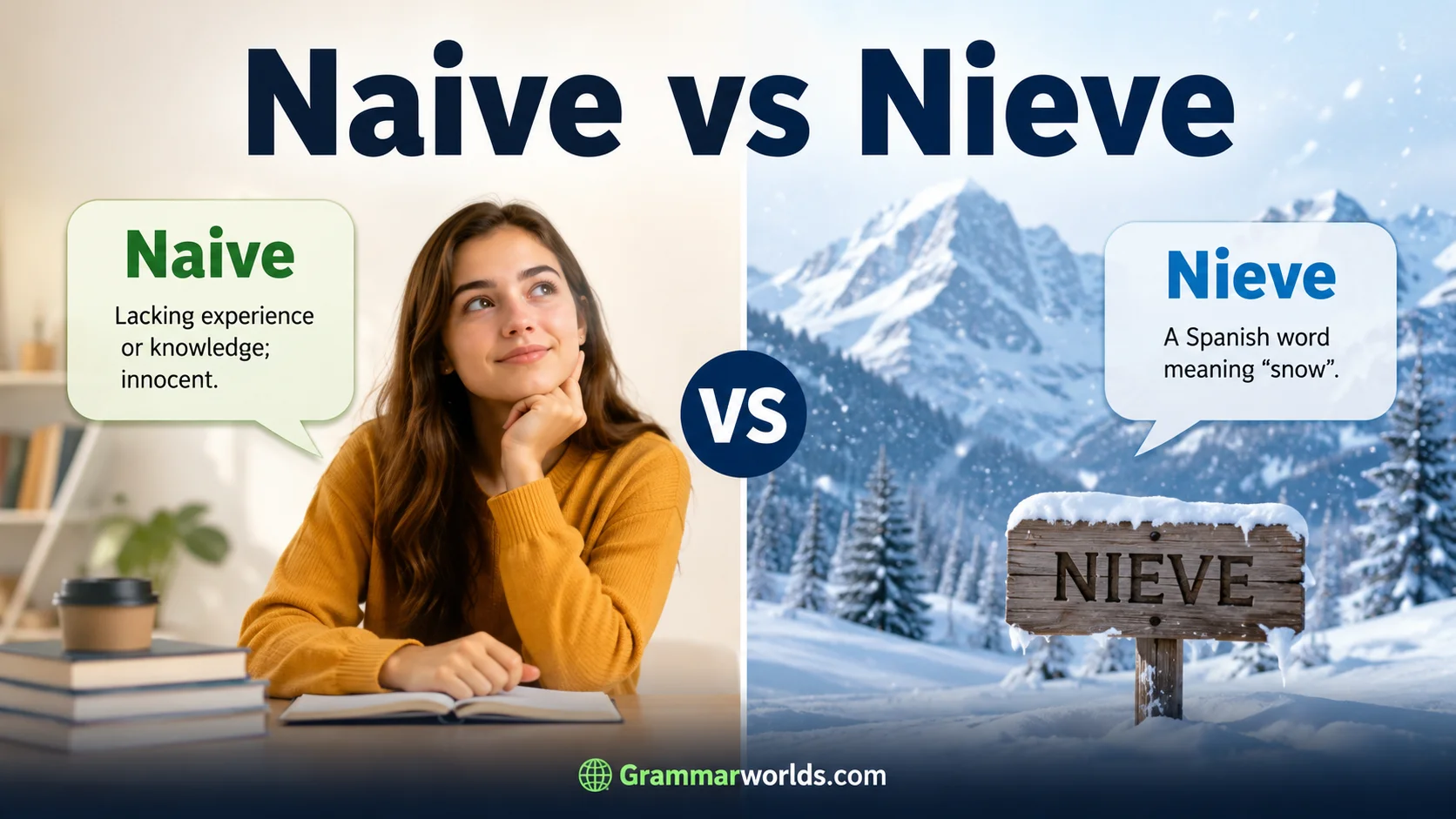
When two words look almost identical, your brain naturally assumes they must be connected. That’s exactly why many people search for “naive vs nieve” and wonder whether these words have similar meanings or simply different spellings.
The truth is much more interesting.
Naive and nieve come from completely different languages and represent completely different ideas. One describes a person’s lack of experience or awareness. The other refers to something you might see falling from the sky during a cold winter day.
In English, naive means someone lacks experience, practical knowledge, or judgment. For example, a person who believes every online offer is trustworthy might be described as naive.
Meanwhile, nieve is a Spanish word that means snow. It has nothing to do with personality, intelligence, or decision-making.
Understanding the difference matters because using the wrong word can completely change your meaning.
Imagine writing:
“She was nieve about online scams.”
A reader might wonder what you mean because nieve is not an English adjective. The correct word is:
“She was naive about online scams.”
This guide explains everything you need to know about naive vs nieve, including their meanings, origins, pronunciation, examples, differences, common mistakes, and practical ways to remember which word to use.
Naive vs Nieve: Quick Difference Between These Two Words
Before exploring the details, here is the simplest explanation:
| Word | Language | Meaning | Word Type | Example |
| Naive | English | Lacking experience, wisdom, or awareness | Adjective | “His naive assumption caused problems.” |
| Nieve | Spanish | Snow | Noun | “La nieve cubrió las montañas.” |
The main difference is simple:
- Naive describes a person, belief, idea, or approach.
- Nieve describes snow in Spanish.
They may look similar on paper, but they belong to different linguistic worlds.
A helpful comparison:
Naive is about understanding. Nieve is about weather.
One happens inside the mind. The other falls from the sky.
What Does Naive Mean?
The word naive describes someone who does not have enough experience, knowledge, or awareness to understand a situation fully.
A naive person often believes things are simpler, safer, or more predictable than they actually are.
For example:
“A naive investor may think every business opportunity will succeed.”
The person is not necessarily unintelligent. They simply lack experience in that specific area.
Someone can be highly educated and still be naive about something unfamiliar.
A doctor might be naive about investing.
A successful business owner might be naive about social media trends.
A teenager might be naive about workplace politics.
Naivety usually comes from a lack of exposure rather than a lack of intelligence.
Common meanings of naive include:
- Inexperienced: Someone who has not encountered many real-world situations.
- Unaware: Someone who does not recognize hidden problems or risks.
- Overly trusting: Someone who believes others too easily.
- Simplistic: Someone who views complicated issues as easier than they really are.
Examples of naive in sentences
Here are different ways people use naive:
| Sentence | Meaning |
| “It was naive to think success would happen overnight.” | The person underestimated reality. |
| “She had a naive understanding of business.” | Her knowledge was limited. |
| “His naive trust made him vulnerable to scams.” | He trusted people too easily. |
| “The idea sounds naive, but it could lead to innovation.” | The idea may seem unrealistic but creative. |
The Difference Between Being Naive and Being Stupid
A common misunderstanding is that naive means stupid.
That is not accurate.
A naive person may simply be inexperienced.
For example:
A child who believes every person is honest is not stupid. The child has not learned about deception yet.
A new employee who thinks every workplace decision happens fairly is not unintelligent. They simply have not experienced office politics.
The difference looks like this:
| Naive | Stupid |
| Lacks experience | Lacks understanding or reasoning ability |
| Can improve through learning | May ignore facts or evidence |
| Often temporary | Not necessarily temporary |
| Comes from innocence | Comes from poor thinking or choices |
A person can stop being naive by gaining knowledge and experience.
Is Being Naive Always a Bad Thing?
The word naive often sounds negative, but it is not always an insult.
Context matters.
Sometimes naivety creates problems. Other times it helps people think differently.
The negative side of being naive
A naive person may:
- Trust unreliable information
- Ignore warning signs
- Make unrealistic plans
- Underestimate challenges
- Believe promises without evidence
Example:
A first-time entrepreneur might think:
“If I build a great product, customers will automatically appear.”
That belief sounds optimistic, but it ignores marketing, competition, pricing, and customer behavior.
The entrepreneur is not foolish. They simply have more to learn.
The positive side of being naive
Interestingly, many successful ideas start with a type of productive naivety.
People with fresh perspectives sometimes question rules that experienced professionals accept.
For example:
- A beginner might ask why a process exists.
- An outsider might notice a problem experts overlook.
- A new creator might try an approach that others dismissed.
Many innovators succeed because they are willing to ask:
“Why can’t this be done differently?”
That curiosity can lead to breakthroughs.
The key difference is this:
Healthy naivety creates curiosity. Harmful naivety ignores reality.
The Origin and History of the Word Naive
The history of naive goes back centuries and reveals how language changes over time.
The English word comes from the French word naïf and naïve, meaning:
- Natural
- Innocent
- Simple
- Unaffected
The French term came from the Latin word nativus, which means:
- Natural
- Born
- Original
Originally, the word carried a more positive meaning.
It described someone who was genuine and natural rather than artificial.
Over time, the meaning shifted.
Today, naive often focuses on a person’s lack of experience or awareness.
The transformation looks like this:
| Period | Meaning |
| Latin origin | Natural or born |
| Old French usage | Innocent and genuine |
| Modern English | Inexperienced or lacking judgment |
This change happens frequently in language. Words often develop new meanings as societies and cultures change.
Also Read This : Transferred vs. Transfered: Which Spelling Is Correct?
How to Pronounce Naive Correctly
Many people hesitate when saying naive because the spelling looks unusual.
The correct pronunciation is:
Naive = nye-EVE
Phonetically:
/naɪˈiːv/
It has two syllables:
- Nye
- Eve
Example:
“She is naive about technology.”
Pronounced:
“She is nye-EVE about technology.”
Common pronunciation mistakes
Some people pronounce it as:
- “Nave”
- “Nay-iv”
- “Nay-vee”
These pronunciations are incorrect in standard English.
The two-syllable pronunciation is the accepted form.
What Does Nieve Mean?
Unlike naive, the word nieve does not belong to English.
Nieve is a Spanish word that means snow.
For Spanish speakers, it is a common everyday word.
Examples:
“La nieve está cayendo.”
Translation:
“The snow is falling.”
Another example:
“Los niños juegan en la nieve.”
Translation:
“The children play in the snow.”
The word appears frequently in Spanish conversations, books, songs, and weather reports.
Why Do People Confuse Naive and Nieve?
The confusion happens because the words look almost identical.
Both begin with:
- N
- A similar vowel sound
- Similar letter patterns
However, their meanings have no connection.
This is called a false friend or false cognate-like confusion.
A false friend occurs when two words look or sound similar but have different meanings.
Examples from other languages include:
| Word | Language | Actual Meaning |
| Nieve | Spanish | Snow |
| Naive | English | Inexperienced |
| Actual | English | Real or current |
| Actual | Spanish | Current |
Language learners encounter these confusing pairs often.
Faqs:
What is the difference between naive and nieve?
The difference between naive and nieve comes down to language and meaning.
Naive is an English adjective that describes someone who lacks experience, knowledge, or awareness. It often refers to a person, belief, idea, or decision.
Example:
“It was naive to believe that every online review was honest.”
Nieve is a Spanish noun that means snow.
Example:
“La nieve cubrió el camino.”
In short:
- Naive = inexperienced or overly trusting
- Nieve = snow in Spanish
Is nieve a correct English word?
No, nieve is not a standard English word.
It appears in English writing when someone is using a Spanish term, translating Spanish content, or referring to a name, place, or brand.
If you are writing in English and want to describe someone who lacks experience, the correct word is naive, not nieve.
Incorrect:
“He was nieve about business.”
Correct:
“He was naive about business.”
Is being naive a bad thing?
Being naive is not always a bad thing. It depends on the situation.
Naivety can create problems when someone ignores risks or trusts information without checking facts.
For example:
“A naive buyer might purchase a product without reading reviews.”
However, being naive can also come with positive qualities. A fresh perspective can help people challenge old ideas and discover creative solutions.
A beginner’s lack of assumptions sometimes leads to innovation because they see possibilities that experienced people overlook.
How do you pronounce naive?
The correct pronunciation of naive is:
nye-EVE
It has two syllables:
- Nye
- Eve
The pronunciation is:
/naɪˈiːv/
Example:
“She was naive about the risks.”
Sounds like:
“She was nye-EVE about the risks.”
The word is not pronounced as “nave” or “nay-iv.”
What is the opposite of naive?
The opposite of naive depends on the context.
Common opposites include:
- Experienced — someone with practical knowledge
- Knowledgeable — someone who understands a subject well
- Realistic — someone who sees situations as they truly are
- Sophisticated — someone with advanced understanding
- Wise — someone who uses experience and good judgment
Example:
Naive:
“He believed every promise he heard.”
Experienced:
“He checked the facts before making a decision.”
Conclusion
Although naive and nieve look almost the same, they describe two completely different things.
Naive is an English word that describes a lack of experience, awareness, or practical knowledge. It often applies to people, ideas, plans, or beliefs. A naive person may trust too easily or misunderstand a situation because they have not gained enough experience yet.
Nieve, on the other hand, is a Spanish word that means snow. It has nothing to do with personality, intelligence, or decision-making.
Remember this simple trick:
- Naive = New to something
- Nieve = Snow in Spanish
Using the correct word helps your writing stay clear and prevents confusion. Whether you are learning English, translating Spanish, or improving your vocabulary, understanding small differences like naive vs nieve makes communication more accurate and effective.